I planted my first banana tree with far more enthusiasm than knowledge. I dug a hole about the size of the pot it came in, dropped it in, and figured a tropical plant would just handle the rest itself. It survived, barely, and it took me another season of actually doing my homework before I got a tree that grew the way it was supposed to and eventually handed me real fruit.
If you’re about to plant your first banana tree, this guide covers everything I wish I had known from the start: picking the right variety, prepping the site properly, the actual planting steps, and the ongoing care that determines whether you get a healthy plant or a sad, stunted one.
Can You Even Grow Bananas Where You Live?
Bananas are a tropical plant at heart, and that matters more than almost anything else in this guide. According to UF/IFAS Extension, bananas only reliably produce fruit in USDA hardiness zones 9B through 11, and even in zone 8b or 9, they will only fruit when winter temperatures stay above freezing.
That does not mean you cannot grow one outside that range. Plenty of gardeners in cooler zones grow bananas as an ornamental that dies back to the ground each winter and regrows from the roots the following spring, they simply will not get fruit unless the plant survives long enough between frosts. If you are outside the warm zones and want actual bananas, plan on growing in a large container you can move indoors for winter.
Choosing the Right Variety for Your Climate
Not all bananas are created equal when it comes to cold tolerance and size. Texas A&M AgriLife Extension notes that ‘Dwarf Cavendish’ stays around 6 feet tall and produces fruit similar to what you’d find in a grocery store, while ‘Orinoco’ is a coarser cooking banana and ‘Lady Finger’ produces smaller, thinner-skinned fruit with noticeably better flavor than supermarket varieties.
If wind is a concern on your property, a dwarf variety is genuinely worth the tradeoff, since shorter plants suffer far less leaf tattering and blow-down damage than the taller types. I went with a dwarf variety specifically for this reason after watching a neighbor’s full-size banana get shredded in one bad storm.
Where to Get Your Banana Plant: Suckers vs. Potted Plants
You have two realistic starting points: a potted plant from a nursery, or a sucker (also called a pup) taken from an established banana planting. Texas A&M’s guidance explains that suckers should be selected when they have a stem diameter of about 2 to 6 inches, and should be dug carefully by cutting the underground base of the sucker away from the mother rhizome with a sharpshooter shovel or spade.
If this is your first banana tree, I would genuinely recommend starting with a potted nursery plant. It removes a lot of guesswork, and you can plant it the same way you would plant any other container-grown shrub. Once you have an established mat of bananas, you will have your own steady supply of suckers for expanding or sharing.
Choosing the Right Spot
Bananas need full sun to really perform. UF/IFAS Extension in Hernando County advises at least 6 hours of direct sunlight a day, noting that a plant in a shadier spot will still grow but will take noticeably longer to produce fruit.
Wind and cold protection matter just as much as sun. Texas A&M recommends choosing a site sheltered from wind and cold, and notes that the warmest spot in most home landscapes is along the south or southeast side of the house, where reflected heat and wind shelter both work in your favor.
Preparing the Soil
Bananas are not especially picky about soil type, but they are picky about drainage. UF/IFAS notes that bananas prefer well-drained, rich soil with a pH between 5.5 and 7.0, and if your native soil is very sandy or drains poorly, working in compost or peat moss before planting makes a real difference.
If your yard tends to stay soggy after rain, consider planting in a raised bed or mound rather than fighting standing water, since bananas genuinely do not tolerate wet feet for long.
How to Actually Plant It, Step by Step
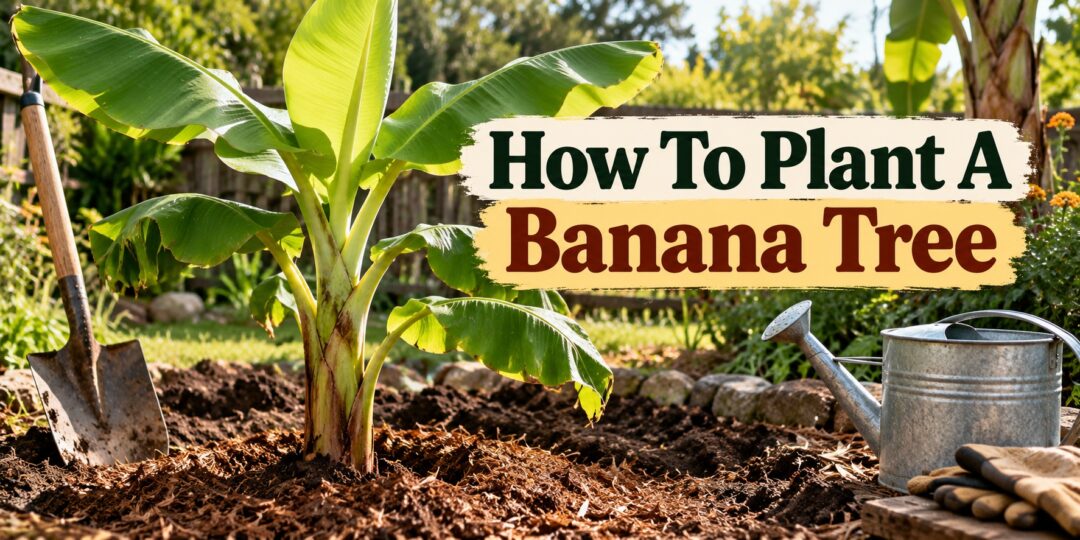
- Dig a hole roughly twice the width of the root ball or sucker base, and only as deep as the plant was growing in its container or at its original location.
- Mix compost into the soil you removed from the hole if your native soil is sandy or heavy clay.
- Set the plant in the hole at the same depth it was growing previously; burying a sucker too deep can encourage rot rather than faster establishment.
- Backfill gently, firming the soil around the base without compacting it heavily.
- Water thoroughly right after planting to settle the soil and eliminate air pockets around the roots.
- Add a 2 to 3 inch layer of mulch around the base, keeping it a few inches clear of the trunk itself.
This is basically the same process as planting any other container-grown plant, and it is a lot less complicated than the tropical mystique around bananas might suggest.
Spacing If You’re Planting More Than One
Spacing depends heavily on whether you want an ornamental planting or serious fruit production. Texas A&M’s fact sheet suggests bananas grown purely for looks can be planted as close as 2 to 3 feet apart, while plants grown for fruit should be spaced about 8 to 10 feet apart so each plant has room to develop a full mat without excessive competition.
I planted mine a little too close together my first year, more out of impatience than planning, and ended up thinning the mat the following season anyway. Give yourself the wider spacing from the start if fruit is the actual goal.
Watering After Planting
Bananas want consistent moisture, not a daily soaking. UF/IFAS recommends watering deeply but infrequently, roughly every 5 to 7 days depending on weather and soil conditions, rather than light, frequent watering that only wets the surface.
A layer of mulch helps enormously here, since it slows evaporation and keeps the root zone from drying out between waterings, especially through the first summer while the plant is still establishing.
Fertilizing Schedule
Bananas are hungry plants, and steady feeding makes a real difference in growth rate. Texas A&M suggests starting new plants with about a quarter cup of ammonium sulfate monthly once regrowth begins, continuing for the first three to four months, then gradually increasing to around two cups per month once the plant starts fruiting.
For an established planting of several bananas growing together, roughly two cups of fertilizer every couple of months is a reasonable ongoing rate. Whatever product you use, look for something balanced in nitrogen, phosphorus, and potassium, and always water it in well after applying.
Protecting Your Banana Tree From Cold
Even in warmer zones, a cold snap can set a banana tree back significantly. UF/IFAS Extension advises covering in-ground plants with a sheet or blanket ahead of a freeze, and bringing container-grown bananas indoors when a hard freeze is expected.
For plants you cannot easily cover, Texas A&M suggests banking soil up around the base of the trunk just before a cold spell, which helps protect the underground buds even if the top growth is killed back, so the plant can regenerate from the roots the following spring.
Managing Suckers (Pups)
Once your banana is established, it will start sending up new suckers around the base. UF/IFAS notes that allowing too many suckers to develop at once reduces any single plant’s ability to produce a good bunch of fruit, so thinning them down to a manageable number keeps your planting productive rather than overcrowded.
For fruit production specifically, Texas A&M recommends limiting a mat to about 5 or 6 plants of varying ages, removing extra suckers while they are still small with a sharpshooter or machete, cutting them off underground from the mother plant.
Common Pests and Diseases to Watch For
Bananas are relatively low-maintenance compared to a lot of fruit trees, but they are not entirely trouble free. UF/IFAS lists scales and nematodes as the two most common pests, along with Sigatoka leaf-spot, Cercospora leaf-spot, and Panama disease as the diseases most likely to show up.
In my own experience, wind damage to the leaves has been a far more common issue than any pest or disease, which is exactly why site selection and a sheltered spot matter as much as they do.
How Long Until You Get Fruit
Patience is part of the deal with bananas. Texas A&M notes that most plants produce their flower bud within 10 to 15 months of a new sucker emerging, with actual production north of the warmest regions typically happening in spring and summer following a mild winter.
Once the flower stalk appears, hands of bananas emerge along it over the following weeks, so from flowering to harvest is a separate, additional stretch of patience on top of the initial growth period.
Harvesting Your Bananas
Bananas do not need to ripen on the plant, and in fact do better if you do not let them. Texas A&M advises cutting the entire stem once individual bananas are plump and rounded, even while still green, then hanging the bunch in a cool, shaded spot to ripen naturally over the following days.
If you’re impatient, enclosing the bunch in a plastic bag with a sliced apple for about a day speeds up ripening. Once the first hand starts turning, the rest of the bunch tends to follow within a couple of days.
Common Mistakes I Made My First Year
Planting too close together was my biggest early mistake, closely followed by underestimating how much water a young banana actually wants during a hot summer. I also let too many suckers grow unchecked, which spread my plant’s energy thin instead of concentrating it into one strong stem heading toward fruit.
The single most useful thing I did differently in year two was simply committing to the fertilizing schedule instead of feeding sporadically whenever I remembered. Consistency mattered more than any single input.
Growing Bananas in Containers if You’re Outside the Warm Zones
If you’re gardening somewhere colder than zone 9, a large container is genuinely your best path to actual fruit rather than just ornamental foliage. Choose a pot with serious drainage holes, use the same well-draining, compost-enriched soil mix you’d use in the ground, and be prepared to size up the container as the plant grows.
The tradeoff is manageability: a potted banana can be wheeled into a garage, greenhouse, or heated space before the first hard frost, giving it a real shot at surviving winter and eventually flowering, something an in-ground plant in a cold climate will rarely manage.
Growing Food Is Only the Beginning of True Independence
Knowing how to plant a banana tree is useful. But imagine knowing how to grow more of your own food, preserve your harvest, cook without modern conveniences, repair what breaks, and keep your household running when the systems you normally depend on are no longer available.
These were once ordinary skills passed naturally from one generation to the next. Today, many of them are disappearing—and we’ve become increasingly dependent on grocery stores, utilities, repairmen, and fragile supply chains as a result.
The Lost Skills of Independence brings that practical knowledge back.
Inside, you’ll discover forgotten methods and time-tested skills for becoming more self-sufficient around your home and property, using knowledge our grandparents and great-grandparents relied on as part of everyday life.
You don’t have to wait for an emergency to become more independent. Start learning these skills now, while you have the time to practice them, rather than wishing you knew them when you truly need them.
Discover The Lost Skills of Independence Here →
Final Thoughts
Planting a banana tree is genuinely simple once you know the handful of things that actually matter: the right variety for your climate, a warm and sheltered spot, well-drained soil, and a consistent watering and feeding schedule. Get those basics right, and the rest of the process, suckers, cold protection, eventual harvest, falls into place with far less guesswork than I started with.
You may also like:
How to Plant Celery: A Step-by-Step Guide for Self-Sufficient Gardeners
A Walgreens Is Opening In Your Backyard (Video)
Why You Should Use Banana Peels In Your Garden
Freeze Dried Strawberries: How to Make, Store, and Use Them at Home
7 Medicinal Seeds You Need to Start Stockpiling
How To Sprout Seeds To Have Fruit Trees
200 Skills You Need to Become 100% Independent