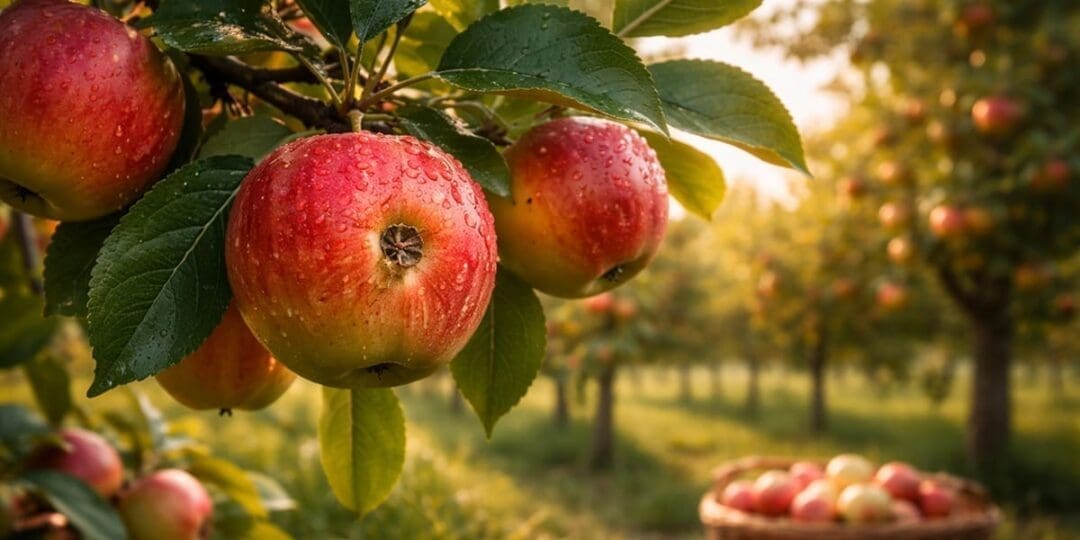
Growing your own apple orchard is one of the most rewarding things a self-sufficient homesteader can do. But anyone who’s tended apple trees for more than a season knows the reality: where apples grow, pests follow. From insects that tunnel through fruit to diseases that strip leaves bare, apple orchard pests can devastate an entire harvest if left unchecked.
The good news is that with the right knowledge — knowing what to look for, when to look for it, and how to respond — you can protect your trees and your harvest without becoming dependent on expensive commercial sprays. This guide covers the most common apple orchard pests, how to identify the damage they cause, and the most effective prevention and treatment strategies for the home orchardist.
Why Pest Management Matters in a Home Orchard
Unlike large commercial operations that spray on a fixed schedule regardless of conditions, home orchardists have the advantage of being hands-on and observant. You can catch problems early, apply targeted treatments, and use integrated pest management (IPM) strategies that protect your trees while minimizing harm to beneficial insects like bees and predatory wasps.
The University of California Statewide IPM Program defines integrated pest management as “an ecosystem-based strategy that focuses on long-term prevention of pests through a combination of techniques.” For the self-sufficient grower, this approach is ideal: it prioritizes cultural practices, biological controls, and targeted treatments over calendar-based chemical spraying.
The Most Common Apple Orchard Pests
 1. Codling Moth (Cydia pomonella)
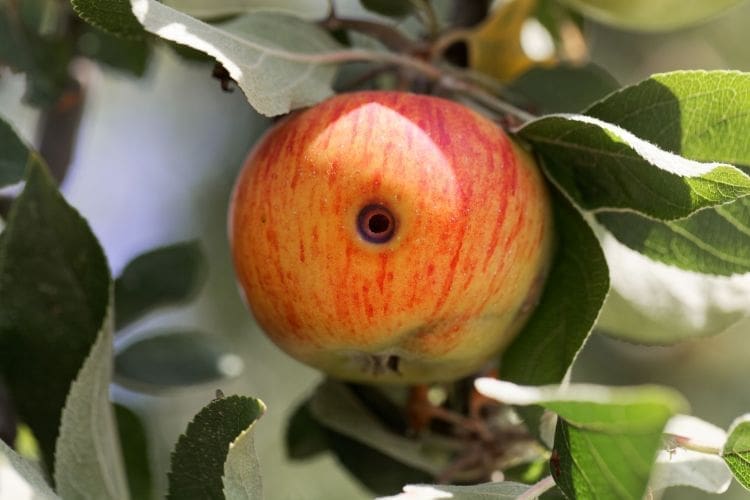
The #1 enemy of apple growers worldwide. The codling moth is responsible for the classic “wormy apple” — and if you’ve ever bitten into an apple only to find a tunnel of brown frass (excrement) leading to a hollowed-out core, you’ve experienced its handiwork firsthand.
Identification: Adult codling moths are small (about ¾ inch wingspan), grayish-brown with coppery wing tips. You’re more likely to identify them by their damage than by spotting the moth itself. Look for a small, circular entry hole on the apple’s skin — often near the stem or calyx end — surrounded by frass. Inside, the larva tunnels directly to the core to feed on seeds.
Life cycle: Codling moths overwinter as pupae under loose bark or in soil debris at the base of the tree. Adults emerge in spring when temperatures consistently exceed 60°F. Females lay eggs on developing fruit and leaves. After hatching, larvae bore directly into the fruit. There can be 2–3 generations per year depending on your climate.
Prevention & Treatment:
- Pheromone traps — Hang traps in trees before bloom to monitor adult populations. This tells you when to act, not just if you have a problem.
- Kaolin clay — A physical barrier that coats fruit and deters egg-laying. Apply every 7–10 days after petal fall and after rain. Approved for organic use.
- Codling moth granulosis virus (CpGV) — A biological pesticide that infects and kills codling moth larvae without harming beneficial insects. Available under brand names like Cyd-X and Madex HP.
- Trunk banding — Wrap corrugated cardboard around the trunk in late spring. Larvae will pupate inside it; remove and destroy the bands every 2–3 weeks.
- Sanitation — Remove and destroy all dropped fruit immediately. Never leave windfalls on the ground.
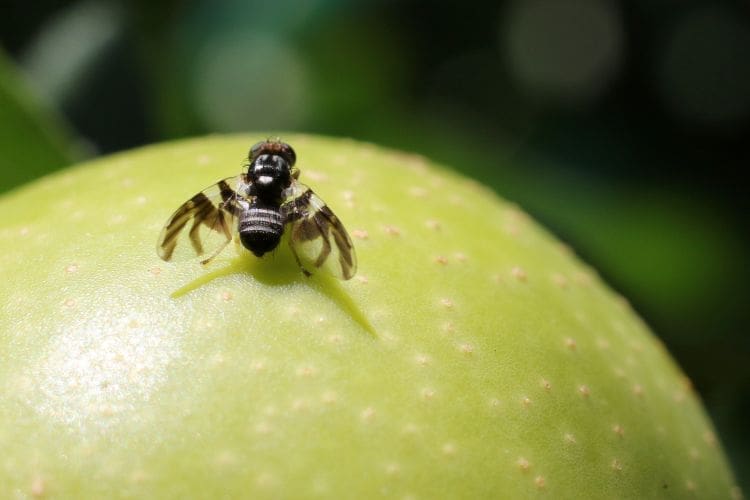 2. Apple Maggot (Rhagoletis pomonella)
Often called the “railroad worm” for the winding brown tunnels it leaves through apple flesh, the apple maggot is a serious pest in the eastern United States and parts of Canada.
Identification: Adult apple maggot flies are slightly smaller than a housefly, with distinctive black, F-shaped markings on their wings. Damage appears as small, dimpled punctures on the fruit surface, with winding brown trails through the flesh beneath. Infested apples typically rot quickly.
Life cycle: Adults emerge from the soil in late June through August. Females puncture the skin of developing apples to lay eggs just beneath the surface. Larvae feed through the fruit for 3–4 weeks before dropping to the soil to overwinter as pupae.
Prevention & Treatment:
- Red sticky sphere traps — Hang 1–2 traps per dwarf tree (or up to 6 per full-size tree) by early July. These mimic the appearance of ripe apples and trap adult flies. Coat with Tanglefoot adhesive.
- Kaolin clay — Effective as a barrier when applied consistently through the summer months.
- Bagged fruit — For small orchards, placing individual paper or plastic bags over developing fruitlets at petal fall physically prevents egg-laying. Labor-intensive but highly effective.
- Soil cultivation — Tilling around the base of trees in fall and again in spring exposes overwintering pupae to predators and freezing temperatures.
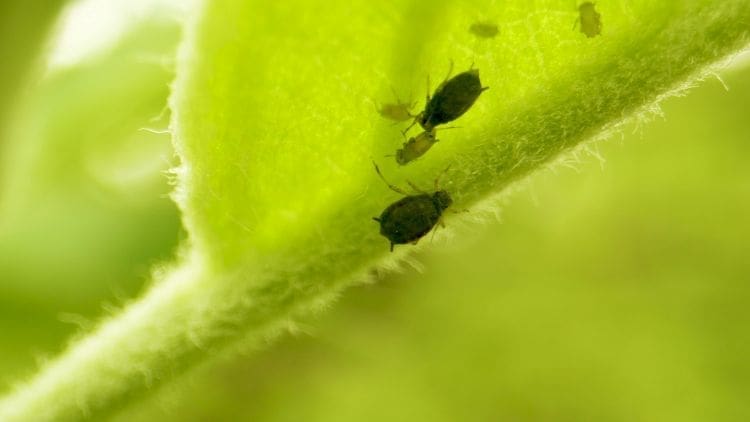 3. Aphids (Various Species)
Several aphid species target apple trees, including the rosy apple aphid (Dysaphis plantaginea), the green apple aphid (Aphis pomi), and the woolly apple aphid (Eriosoma lanigerum). All feed by sucking sap from leaves, shoots, and sometimes roots, weakening trees and distorting new growth.
Identification: Aphids are tiny (1–3mm), soft-bodied insects that cluster on new growth, leaf undersides, and shoot tips. Rosy apple aphids are pinkish-gray and cause severe leaf curl and stunted fruit. Green apple aphids are bright green and found on shoot tips. Woolly apple aphids are covered in white, cottony filaments and typically found on branches or exposed roots.
Prevention & Treatment:
- Encourage beneficial insects — Ladybugs, lacewings, and parasitic wasps are natural aphid predators. Avoid broad-spectrum pesticides that kill them.
- Reflective mulch — Silver reflective mulch around the base of trees confuses and deters winged aphids.
- Strong water spray — A forceful jet of water knocks aphids off shoots and kills many on contact.
- Insecticidal soap or neem oil — Both are effective, low-impact treatments for moderate infestations. Apply directly to affected areas, making sure to coat leaf undersides.
- Dormant oil spray — Applied in late winter before bud break, horticultural oil smothers overwintering aphid eggs. This is one of the most effective preventive measures available.
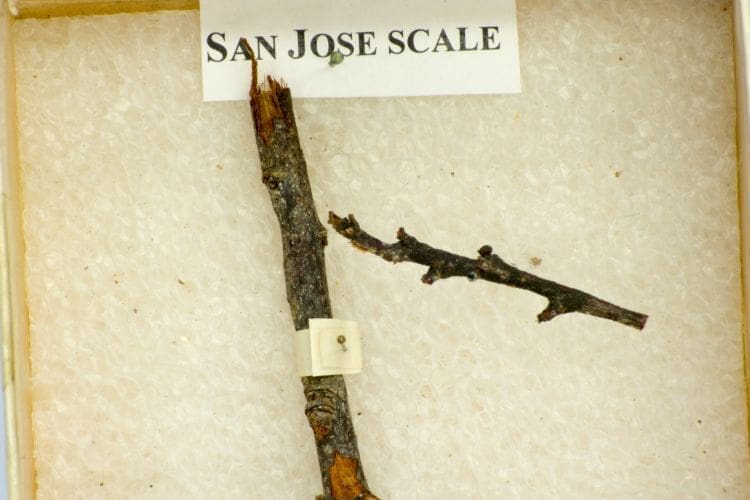
Image from Wikimedia
4. San Jose Scale (Comstockaspis perniciosus)
Scale insects are easy to overlook until the damage becomes severe. San Jose scale is one of the most destructive scale pests of apple trees, capable of killing branches and even entire trees in heavy infestations.
Identification: San Jose scale appears as gray, circular, slightly raised bumps — about 1/16 inch in diameter — encrusting bark, twigs, and sometimes fruit. On fruit, they leave a distinctive red halo around each scale. Heavy infestations give bark a grayish, encrusted appearance.
Prevention & Treatment:
- Dormant oil spray — The single most effective treatment. Apply thoroughly in late winter to smother overwintering scales before they become active.
- Horticultural oil during the growing season — Can be used at lower concentrations during summer, though care must be taken not to apply during hot weather or when trees are stressed.
- Pruning — Remove and burn heavily infested branches to reduce the population before it spreads.
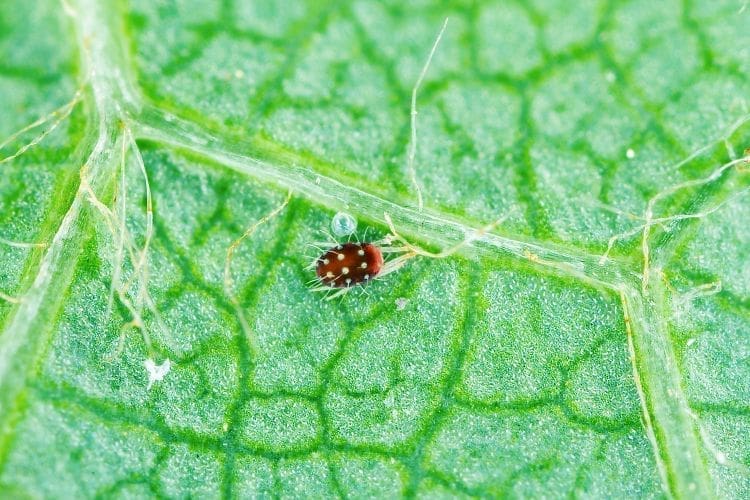 5. European Red Mite (Panonychus ulmi)
Mites are not insects but arachnids — and they can be just as damaging. The European red mite is the most common mite pest of apple orchards in temperate regions.
Identification: Adults are tiny (less than 0.5mm), brick-red colored, and only visible with a hand lens. Damage appears as a bronze or silvery stippling on leaf surfaces — leaves may look dusty or bleached. Severe infestations cause premature leaf drop and weakened trees.
Prevention & Treatment:
- Predatory mites — Species like Typhlodromus pyri are effective biological controls. They thrive in orchards where broad-spectrum pesticides are avoided.
- Dormant oil — Kills overwintering eggs on bark when applied before bud break.
- Avoid pyrethroid insecticides — These kill predatory mites, often making mite problems worse.
- Miticides — If populations explode, approved miticides like bifenazate can be used, but resistance develops quickly with overuse.
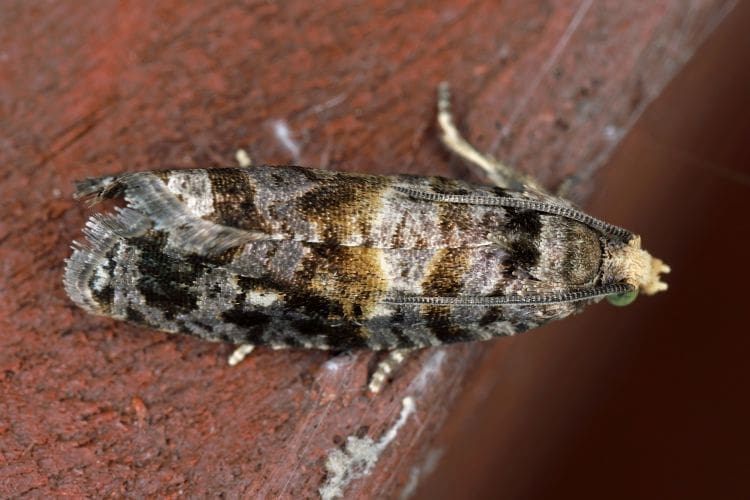 6. Leafrollers (Choristoneura and Archips spp.)
Several species of leafroller moths attack apple trees, including the obliquebanded leafroller and the fruittree leafroller. Their larvae web leaves together into a protective roll, feeding inside while protected from sprays.
Identification: Look for leaves webbed or rolled together, often at shoot tips. Inside you’ll find a pale green or yellowish caterpillar that wriggles backward rapidly when disturbed. Feeding damage on fruit appears as shallow, irregular scarring on the skin surface.
Prevention & Treatment:
- Bacillus thuringiensis (Bt) — A naturally occurring soil bacterium that is highly effective against young leafroller larvae. Must be applied early, before larvae have rolled leaves for protection. Approved for organic use.
- Spinosad — A naturally derived insecticide effective against leafrollers. Apply at egg hatch.
- Parasitic wasps — Many native wasp species parasitize leafroller larvae. Maintaining flowering plants near the orchard supports these beneficials.
Prevention: The Foundation of Orchard Pest Management
Treating pests after they’ve established is always harder than preventing them in the first place. The Cornell University College of Agriculture and Life Sciences recommends a set of cultural practices that form the backbone of any effective orchard pest management program:
- Sanitation is the single most impactful practice. Fallen fruit, pruned wood, and leaf litter are overwintering sites for countless pests. Clean up thoroughly in fall and don’t compost infested material — burn it or bag it for disposal.
- Proper pruning opens the tree canopy to light and airflow, creating conditions that are less hospitable to many pests and diseases. A well-pruned tree is also easier to monitor and treat when needed.
- Choose resistant varieties when planting new trees. Many modern apple varieties have been bred for resistance to common pests and diseases. Consult your local cooperative extension service for variety recommendations suited to your region and pest pressure.
- Monitor consistently. Walk your orchard weekly during the growing season. Use a hand lens to check leaf undersides for mites and aphids. Check fruit for entry holes. Hang pheromone traps to track moth activity. Early detection is everything.
- Support beneficial insects. Plant flowering herbs and wildflowers near your orchard — phacelia, dill, fennel, and yarrow are particularly attractive to predatory and parasitic insects. Avoid any sprays, even organic ones, during bloom when pollinators are active.
The National Sustainable Agriculture Information Service (ATTRA) offers extensive free resources on biological and cultural pest management strategies specifically for home-scale orchardists.
Frequently Asked Questions
Q: When should I start worrying about apple orchard pests? A: Pest management starts before the season begins. Late winter dormant oil sprays address overwintering pests before they become active. As soon as buds begin to swell in spring, begin monitoring. For most pests, the window between petal fall and early summer fruit development is the most critical period.
Q: Can I manage apple orchard pests without using any pesticides? A: For many pests, yes — especially with small orchards where physical interventions like bagging fruit, sticky traps, and hand removal are practical. For heavy infestations of codling moth or scale, some form of spray — even an organic-approved option like kaolin clay, Bt, or horticultural oil — is usually necessary for meaningful control.
Q: Are organic pest control methods as effective as conventional ones? A: They can be, but they typically require more frequent application and more careful timing. Organic options like Bt and CpGV are highly pest-specific and work best when applied at the right life stage. The key is monitoring: organic programs rely on knowing when to act.
Q: How do I know if my apple trees have mites if they’re so small? A: Look for the damage first — bronze or silvery stippling on leaves is the telltale sign. Hold a white sheet of paper under a branch and shake it; mites will fall onto the paper and you’ll see tiny moving specks. A 10x hand lens makes them much easier to see directly on leaves.
Q: What’s the single most important pest management practice for a home apple orchard? A: Sanitation. Removing dropped fruit, fallen leaves, and pruned wood eliminates the overwintering habitat for the majority of apple orchard pests. It’s free, requires no equipment, and makes every other pest management effort more effective.
Q: Should I spray my apple trees every year even if I don’t see pests? A: A dormant oil spray in late winter is worth doing annually as a preventive measure — it’s low-impact and addresses a wide range of overwintering pest eggs and scales. Beyond that, spray only in response to confirmed pest pressure. Calendar-based spraying without monitoring wastes money and harms beneficial insects.
Final Thoughts
Managing apple orchard pests is an ongoing practice, not a one-time fix. The most successful home orchardists are the ones who observe their trees consistently, understand the life cycles of the pests they’re dealing with, and respond with the most targeted, least disruptive intervention available. Over time, a well-managed orchard develops its own ecological balance — with populations of beneficial insects that help keep pest pressure in check naturally.
Start with strong cultural practices, invest in a few basic monitoring tools, and don’t be afraid to get your hands dirty. Your apples — and your self-sufficiency — are worth it.
The Orchard Doesn’t Reward Luck – It Rewards Knowledge
If you’ve spent even one season managing apple trees, you already understand a hard truth of self-sufficiency:
Nature doesn’t care about your plans.
One overlooked pest. One missed warning sign. One poorly timed response — and an entire harvest can disappear.
That’s the difference between hobby gardening and true resilience.
Real homesteaders, real growers, real survivors rely on something far more dependable than guesswork…
Practical, generational knowledge.
This is exactly why the Amish consistently outperform modern households when it comes to food production, preservation, and land management.
They don’t just grow food.
They understand systems.
They understand timing.
They understand prevention.
They understand how to work with nature instead of constantly fighting against it.
The Amish Ways Book is packed with that exact kind of field-tested wisdom:
✔ Low-tech pest control strategies
✔ Natural prevention methods that actually work
✔ Food preservation & long-term storage skills
✔ Orchard & garden efficiency techniques
✔ Soil management & plant health principles
✔ Off-grid solutions that reduce dependency
✔ Crisis-proof homestead practices
These are not trendy hacks or internet gimmicks.
They are time-tested methods from people who have quietly mastered sustainable living for generations.
Because when supply chains break…
When commercial products disappear…
When “just go buy spray” is no longer an option…
Skills become survival insurance.
👉 Get your copy of The Amish Ways Book here while it’s still available
Your orchard doesn’t need more chemicals.
Your homestead doesn’t need more gadgets.
Your future needs more knowledge.
You may also like:
 Homemade Amish Apple Butter Recipe With 12+ Months Shelf Life
An Insanely Effective Way to Build a 5 Year Food Stockpile (Video)
How Long Do Apples Last in the Fridge?
Why Homesteaders are Hanging Empty Jars on Trees