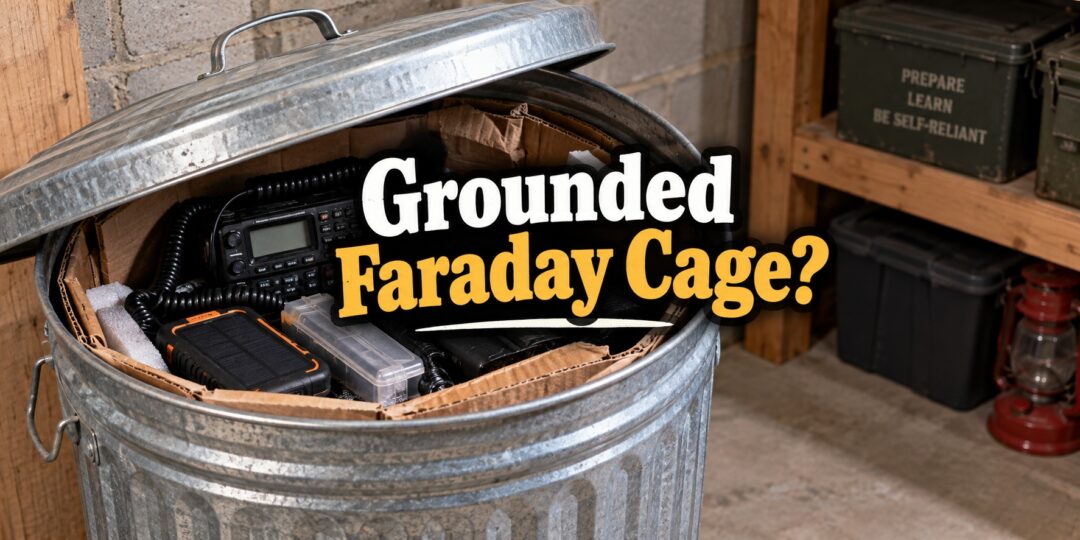
The first time I built a Faraday cage out of an old galvanized trash can, I spent a solid afternoon arguing with myself over whether I needed to run a ground wire out to a copper rod in the yard. I had read three different homesteading forums and gotten three different answers. So I actually went and dug into the physics instead of guessing, and the answer surprised me.
A Faraday cage does not need to be grounded to block the kind of electromagnetic pulse most of us are actually worried about, whether that’s an EMP, a nearby lightning strike, or general RF interference. Grounding matters for a few specific situations, but basic shielding is not one of them. Here is exactly why, and when you actually do want a ground wire.
The Short Answer: No, Not for Basic Shielding
For the job most of us want a Faraday cage to do, protecting radios, spare electronics, or a backup power controller from a damaging pulse, a sealed, continuous conductive enclosure works whether or not it is connected to the earth. Harvard’s physics department demonstrates this directly: a charged object brought near a metal cage produces no response in a detector placed inside, and that result is identical whether the cage is grounded or left floating.
The Physics: Why the Cage Works Without a Ground
A Faraday cage works because it is a conductor, and conductors allow electric charge to move freely within them. When an outside electric field hits the cage, the free charges in the metal shift and redistribute themselves across the surface, creating a counteracting field that cancels out the outside field everywhere inside the enclosure. As Harvard’s demonstration notes, the metal shield is an equipotential surface with or without a ground connection, which is the technical way of saying the redistribution happens on its own.
This is different from the case of shielding something outside from a charge that is actually inside the cage, which does require grounding to work properly. But that is not the situation most preppers and homesteaders are dealing with. We are putting electronics inside the cage to protect them from something outside, and that direction of shielding does not depend on a ground wire.
When Grounding Actually Helps
Grounding is not useless, it just solves a different problem than most people think. In laboratory and industrial settings, a grounded shield gives accumulated static charge somewhere to go, which matters when people are physically touching the enclosure or when sensitive lab instruments need a stable reference point.
Grounding also matters for actual lightning protection systems, where a strike needs a low-resistance path to dissipate a massive amount of current safely away from a structure. That is a genuinely different engineering problem than shielding a sealed box of electronics sitting on a shelf in my pantry.
Why Many EMP Preppers Specifically Avoid Grounding
Here is the part that surprised me most. A fair number of experienced EMP preppers actively recommend against grounding a small Faraday cage, and the reasoning holds up. A grounding wire is a long conductor running from your cage to a rod in the earth, and a long conductor is exactly what an antenna is.
Instead of safely carrying pulse energy away, a poorly designed ground wire can actually collect and funnel that energy toward your cage. For a small, fully enclosed container like a trash can, ammo box, or metal filing cabinet, leaving it ungrounded avoids creating that unintended antenna in the first place.
The Classic Example: Your Car
If you want a real-world example you already trust, think about the advice to shelter in your car during a lightning storm. Purdue’s physics department is explicit that it is not the rubber tires that make a car safe, since the metal body itself acts as a Faraday cage and routes the charge around the outside, not through the interior. Your car is not grounded while you are driving on rubber tires, and it still works as a shield.
What Actually Matters More Than Grounding
If grounding is not the deciding factor, what is? In my experience, and in every solid source I have read, three things matter far more.
- Continuous conductive material: the metal needs to fully surround the contents with no large breaks in the conductive path.
- No gaps larger than the wavelength you’re trying to block: seams, lids, and doors need a tight, overlapping conductive connection all the way around.
- Insulation between the contents and the cage wall: whatever you’re storing shouldn’t touch the metal directly, since contact can let energy jump straight to your device.
A trash can with a loose-fitting lid and a big gap around the rim will underperform a smaller, tightly sealed container every time, regardless of whether either one is grounded.
My Take: What I Do With My Own Faraday Cages
For my own setup, I do not ground my small cages, the ammo cans and galvanized trash cans I use for spare radios and a backup charge controller. I focus my effort instead on a tight seal, overlapping metal-to-metal contact at every seam, and a layer of cardboard or foam so nothing inside touches the walls.
If I were building a dedicated, walk-in Faraday room to protect a whole solar setup or a workshop full of equipment, I would treat that as a different project entirely and bring in someone with real electrical experience, since a structure that size raises genuine safety questions that a small sealed box does not.
Preparedness Is More Than Stockpiling Gear – It’s Knowing How Things Work
A Faraday cage is a perfect example of something every prepper eventually discovers:
Buying equipment is easy. Knowing how to use, repair, improvise, and replace it when modern conveniences disappear is much harder.
That kind of practical knowledge used to be commonplace.
Previous generations knew how to preserve food without a freezer, keep tools and equipment working, improvise solutions from ordinary materials, grow and store their own food, repair things instead of replacing them, and keep a household functioning with far less dependence on stores and modern infrastructure.
Today, many of those skills have nearly disappeared.
The Lost Skills of Independence was created to bring that knowledge back.
It’s packed with practical, old-fashioned self-reliance skills that can help you become less dependent on fragile supply chains, expensive services, and systems you have little control over.
Because during a prolonged blackout, supply shortage, financial crisis, or other emergency, the person with the biggest pile of survival gear isn’t necessarily the person who is best prepared.
The person who knows how to make, repair, preserve, improvise, and adapt has an entirely different kind of security.
You don’t have to abandon modern technology or live completely off-grid to benefit from these skills. You simply need to start rebuilding the knowledge that once allowed ordinary families to take care of far more things themselves.
Final Thoughts
A Faraday cage does not need to be grounded to block an external electromagnetic pulse from reaching what is inside it. What actually determines whether your cage works is a fully enclosed, continuous conductive shell with no significant gaps, and contents that never touch the metal.
Save the grounding wire for genuine lightning protection systems and large permanent installations, not the trash can sitting in your basement with a spare radio inside it.
You may also like:
You Probably Won’t Survive An EMP Without This (Video)
Aluminum Foil for Faraday Cage
Faraday Cage Fabric: A Practical Guide for Everyday Preparedness
EMP Proof Vehicles For Homesteaders