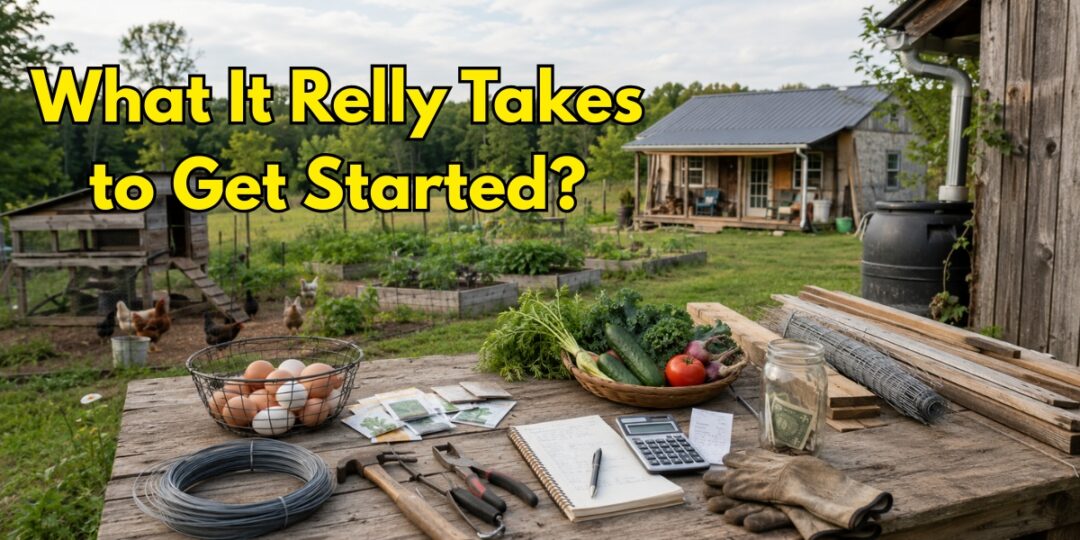
When Mark and I bought our piece of land, I thought the price on the listing was the number I needed to save for. I had it in my head like a finish line. Save that much, buy the land, done.
Then the land showed up with a second bill. And a third. And a fourth.
The land price is the smallest honest number in the whole thing. What costs you is everything it takes to make that land livable, and everything it takes to keep it running after that.
So let’s walk through what a homestead really costs to start. And more importantly, let’s talk about where you can cut that cost without doing something you’ll regret.
There’s no need to make expensive mistakes when you could use that money to build the homestead of your dreams!
The Land Is the Cheapest Part
The price you pay for the land is just a down payment on the real project.
Raw land looks cheap next to a finished house, and that’s exactly the trap. You see a low number and your brain fills in the rest with a dream. But that low number usually means the land has nothing on it yet. No water you can drink. No way to handle waste. No power. Sometimes no road worth the name.
Land prices swing wildly depending on where you are. In 2026, all farmland in this country averaged about $4,500 an acre, and pasture land averaged around $2,000 an acre. But the real price is all over the map. Pasture runs a few hundred dollars an acre in parts of New Mexico and Wyoming, and many times that in the Northeast or California.
So the land itself might be the easy part of your budget. Buy five acres of pasture in the right state and you’ve spent less than you would have had on a decent truck.
Then the work begins. And the work is where the money goes.
A young couple named Alyssa and Jesse did exactly this out in Idaho, and they wrote their real numbers down for Mother Earth News.
They paid $45,000 for five acres. But in their first five months, before they’d even finished a house, they spent over $30,000 on everything else. The septic ran about $3,500, plus another $860 for the permit.
The rest went to a used travel trailer to live in, a truck, a generator, and a pile of tools.
And here’s the part I want you to catch. They knocked a huge chunk off that bill by tracking down $20,000 worth of building materials for a few thousand dollars, just by being resourceful about where they looked. Keep that in your back pocket. We’ll come back to it.
Getting Raw Land Ready to Live On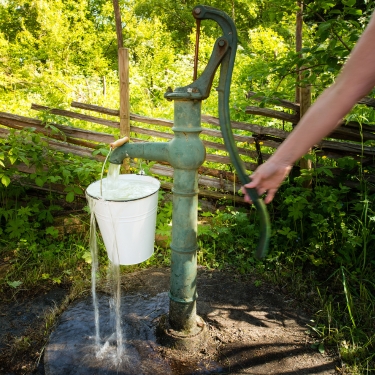
This is the part nobody warns you about, so I’m here for you.
If you’re buying raw land with nothing on it, bringing in the basics usually runs somewhere between $9,000 and $35,000. It lands on the low end if you’re close to existing lines. It climbs fast if you’re way out. Here’s where that money goes.
Water – No city hookup means you need a well. Drilling runs about $25 to $65 per foot, and most wells land somewhere between 100 and 300 feet deep. You don’t know how deep until they start drilling, and every extra foot costs you. A finished well, with the pump and the pressure tank and all of it, commonly runs $6,000 to $20,000.
If you want to build the well yourself and save some money, you can try the Amish method. They’ve been using this technique for hundreds of years and as you can see, their farms are still some of the most prosperous ones in the country.
You can find more about how the Amish build wells and also more on how to install a well pump here.
Waste – No sewer means a septic system. A basic gravity system runs about $3,000 to $12,000. But your soil decides what you’re allowed to install. Before anyone quotes you, you need a perc test, which checks how fast water drains through your ground.
That test costs $450 to $1,400, and it’s the fork in the road for the whole project. Slow or rocky soil forces a fancier system, and that can push you past $20,000 fast. Put the well and the septic together and you’re often looking at $12,000 to $35,000 before you’ve touched anything else.
Power – Running a grid line to your build costs roughly $5 to $25 per foot. If the nearest pole is close, you’re fine. If it’s far, the number gets scary. We heard of folks quoted close to $100,000 to bring power to a remote spot.
That’s the whole reason so many people go solar instead. A solar setup with panels and batteries is a real investment too, usually $20,000 to $60,000 installed. But against a grid bill like that one, it can come in a lot lower, and you own it free and clear.
Also, if you want more affordable electricity, check this out.
Getting in and getting ready – A land survey to mark your real boundaries runs $400 to $1,800. Clearing trees and brush runs $1,200 to $8,000. Grading the ground so water drains away from your house instead of into it runs $1,000 to $5,000.
All of these show you that the price of the empty land is nothing. But don’t be discouraged! Once you have everything in place, the money will start to come back.
I had the same fears as you before I started homesteading and in the end everything turned out ok. It was a slower process than I was expecting, but here I am, loving what I do.
The Costs That Come Back Every Year
Now here’s the mistake I see over and over. People budget the high one-time costs and forget the costs that never stop.
One-time money buys you a well or a coop. You pay it once. But every homestead also has a second kind of cost, the kind that comes back every single year, whether you planned for it or not.
Feed is the big one. A laying hen eats about a quarter to a third of a pound of feed a day, and she eats more in winter when she’s cold. Multiply that across a flock and across twelve months and you’ve got a bill that shows up like clockwork.
Then come the rest. Garden seeds. Compost and other things to feed your soil so it keeps producing. Fuel for the mower and the tractor. Repairs, because something always breaks. Vet care when an animal gets sick. And on top of all of it, property taxes and insurance that arrive on the same land you already paid for.
A backyard setup with a few hens and a garden runs about $400 to $1,200 a year to keep going. Scale up to livestock and pasture and that yearly number climbs right along with it.
So when you plan, plan for both piles. And do yourself a favor. Whatever you think your yearly costs will be, add 10 to 20% on top. You always need to be ready for unexpected events.
Where New Homesteaders Lose Money
Trying to do everything at once is the worst thing you can do when starting a homestead. This approach makes money disappear.
I know that feeling well. You finally have your land, and you want the garden and the chickens and the goats and the orchard and the barn, and you want them now. So you buy it all in the first season.
That’s how you burn through good money. Here’s where it usually slips away.
Doing everything in year one – You spread yourself thin, half-finish six projects, and burn out before winter. You spend money everywhere and have nothing finished to show for it.
Buying tools you can’t use yet – That shiny tool sits in the shed while you figure out the thing you actually needed first. Borrow or rent before you buy. Buy only the tools you’ve already used and know you need.
Livestock before the setup is ready – Animals show up before the fence and the shelter are done, and now you’re scrambling and paying rush prices to fix it. I did this with our first birds. Never again.
Cheap fencing – This one hurts. Fencing is the single place where going cheap costs you more later. A weak fence lets predators in and livestock out, and you end up buying it twice. Buy it right the first time.
Building permanent things too early – You pour a foundation or put up a barn in the wrong spot, before you’ve watched how the sun moves and where the water pools. Then you’re stuck with it. Live on your land through a full year before you build anything you can’t move.
One smart approach is to first finish the things that feed you: a garden and a flock of chickens. Many times those who build these two things in the beginning might actually end up with surplus. You can sell it and make a profit. Later, use that profit to buy new stuff and make improvements on your homestead. If you ask me, this is the winning approach and also the one I used.
And if you want to be the best seller on the market, I know exactly what could help you. Some secret Amish knowledge.
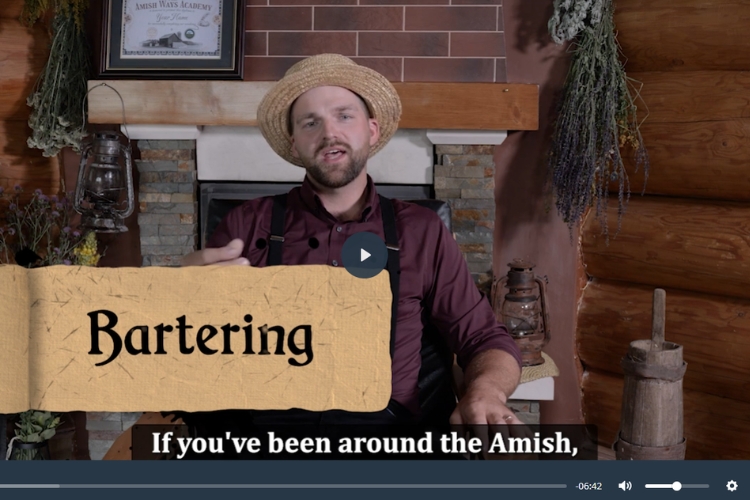
The Amish make their living by selling what they grow on their farms at farmers’ markets all around the country. They always have the best products and people love them.
But this is not the only thing that makes them successful. They’re also great businessmen. The Amish know the art of bartering like no other and they know how to make their customers come back every time.
If you want to do the same and have their success, you can find out more about their secret techniques in this video Academy where an actual ex-Amish will teach you everything you need to know.
Click here and see how to make a business like the Amish →
How to Cut the Cost Without Doing Something Dumb
Alright. This is the part you came for. Here’s how to bring the costs down without cutting corners.
Spend in the right order – Water, waste, and shelter come first. A garden and a few hens come next. The tractor and the big barn come later, once you know you’ll actually use them. When you spend in order, you stop paying for things you weren’t ready for.
If you need a quick source of water for a head start, watch this video and see how this AWG (atmospheric water generator) works.
Live there before you build – I’ll say it again because it’s the biggest money-saver on this whole list. Spend a full year on your land before you put up anything permanent. You’ll learn where the wind hits, where the ground floods, where the sun sits in July. That knowledge saves you from the most expensive mistake there is, which is building the right thing in the wrong place.
Buy used, borrow, and rent – Remember that Idaho couple who got $20,000 in building materials for a few thousand? They didn’t get lucky. They just knew where to look. Auctions, estate sales, farm swaps, and the local Facebook group are full of good tools and materials at a fraction of new prices. For the job you’ll do once a year, rent the equipment. Don’t buy a $2,000 machine to use it twice.
Start with what feeds you fastest – A garden and a small flock of hens give you food fast for very little money. A backyard start runs about $1,500 to $8,000, and it teaches you what your land and your schedule can really handle before you bet big.
Do the safe work yourself, hire the rest – Build your own raised beds, your own coop, your own simple fencing. That work you put in yourself is real money saved. But the well, the septic, and the electrical are not the place to save a few dollars. Those are regulated, and dangerous, and expensive to fix when they’re done wrong. Pay the pro and get it right once.
And know the difference between smart cutting and dumb cutting. Smart cutting is buying a used tiller. Dumb cutting is skimping on your water source, your septic, or your fencing. Those three carry your whole homestead. Cheap out there and you’ll pay for it twice, sometimes three times.
The Skills Worth Learning First
Starting a homestead means learning a bunch of new skills at once. Water, food, power, repairs.
You could learn them the slow and expensive way.
Or you can simply skip the trial and error.
How? With a single book.
This book is called The Lost Skills of Independence, and it puts the whole homestead in one place.
200 skills. Every main pillar covered:
Water – Pull water straight from the ground, set up a 3-barrel rain-harvesting system, store a year’s worth for the family, or filter dirty water clean with nothing but a pot.
Food you grow – A vertical pallet garden, a square-foot bed, a straw bale garden, dwarf fruit trees for a tiny yard, even a fence that doubles as a food garden.
Food you store – Cure your own bacon and sausage, can a burger in a jar, keep butter and eggs for months with no fridge, and store hard cheese in wax.
Off-grid home – A fridge that runs with no power, a solar water heater from plastic bottles, a root cellar from a barrel, a rocket stove, and a way to cool the house without AC.
Animals and repairs – Build an easy-clean chicken coop, a barrel smokehouse, fix a leaking faucet, patch a garden hose, and repair a broken shovel instead of buying a new one.
Every skill comes with step-by-step color pictures and a full list of what you need before you start.
It’s spiral-bound, so it stays open on the workbench while your hands work. Hardcover, built to last, and it ships from the USA.
Three bonus guides come with it. One shows you how to go self-sufficient on a quarter acre. That’s the start-small plan, laid out for you.
The risk is zero. A 60-day money-back guarantee backs it.
Want a head start on everything above?
👉 Get The Lost Skills of Independence here
Order today and you’ll have a special early bird discount!
Pick one skill. Start today.
Figuring Out Your Own Number
Every homestead breaks into five main parts. Land and home. The setup, like water, waste, and power. Garden and orchard. Livestock. Tools and equipment.
Here’s what you do. Take each part and find out what it costs where you live, not some number from a stranger online. Call a well driller in your county. Ask the extension office about perc tests near you. Numbers change hard from state to state, so your numbers are the only ones that matter.
Then split every cost into two columns, one-time on the left and comes-back-every-year on the right. Total up both. The right-hand column is the one that decides whether you can actually keep this going.
Add your 10 to 20% cushion. Then look at the total.
If the number scares you, don’t quit. Shrink instead. A quarter-acre with a garden and six hens is a real homestead, and it might run you a few thousand dollars all in. Twenty acres with a barn and a herd will run into six figures before you’re anywhere near self-sufficient. Start where your budget actually is, and grow from there.
Start Small and Grow
You don’t have to buy the whole dream in one year. Honestly, you shouldn’t. The people who last aren’t the ones who spent the most up front. They’re the ones who started small, learned their land, and added one thing at a time as the money allowed.
So price it out. Be honest with yourself. Then start with the piece you can afford today.
You may also like: 
The Worst Mistakes You Can Make When Buying Land
Never Buy Batteries Again (This Trick Saves $500/Year) (Video)
12 Ways To Mouse-Proof Your Homestead
You’re Not a Real Homesteader if You Don’t Grow This…
11 Scam Items Homesteaders Fall For