
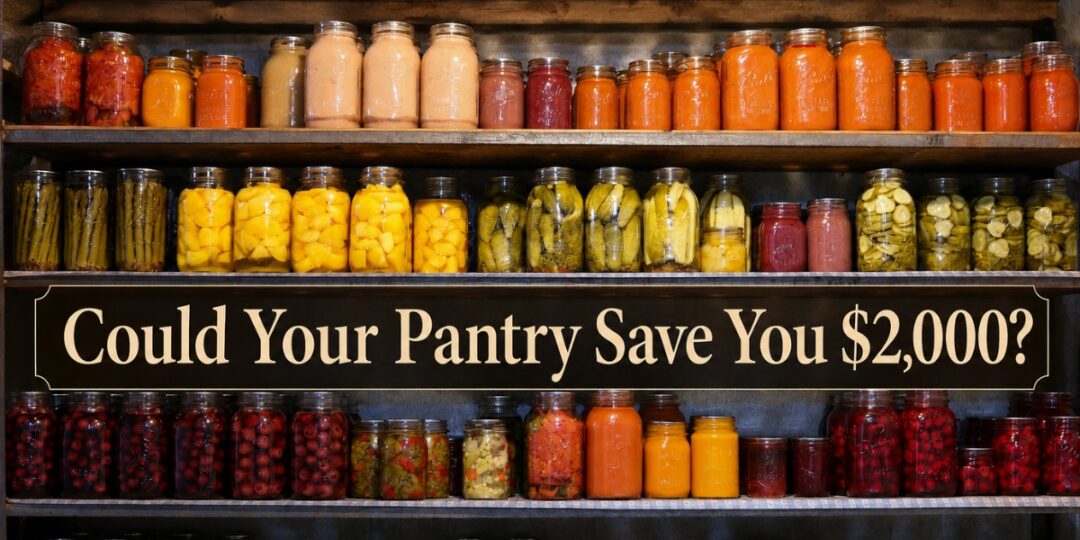
Let’s Run a Little Experiment!
Saving $2,000 a year just by filling jars in your own kitchen sounds almost too good to be true.
For a family of four, that’s a serious chunk of the grocery budget. But before you start thinking about how you’ll arrange all the mason jars, there’s an obvious question:
How much would you actually have to can to save that kind of money?
Because filling 500 jars doesn’t automatically mean you’re saving money. What you put in those jars matters just as much as how many you make.
So I wanted to run the numbers and see what a realistic canning year might look like for a family trying to cut about $2,000 from the grocery bill.
Some Jars Save a Lot More Money Than Others 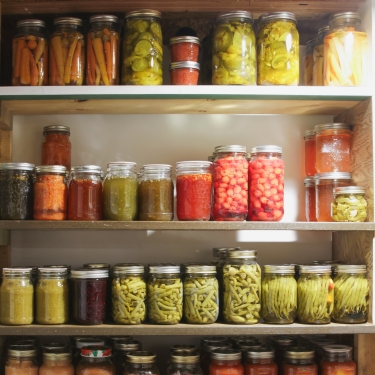
One thing I’ve learned about canning is that a full pantry isn’t necessarily a cheap pantry. You could spend all summer preserving food and still wonder where the savings went. The jars that really pay off usually have two things in common.
First, you’re replacing something that’s relatively expensive at the grocery store. Take marinara sauce. A good jar can easily cost $5 or $6. If you’re making your own with tomatoes from the garden, that’s a pretty good trade. But if you’re comparing your homemade sauce to the cheapest $1.99 jar on the shelf, the savings aren’t nearly as impressive once you count lids, seasonings, fuel, and everything else that went into making it.
The second part is the cost of your ingredients. Garden tomatoes that are coming in faster than you can eat them? Perfect. Tomatoes bought at full price in January? Probably not.
That’s really the whole trick:
Can foods that are expensive to buy but cheap for you to produce.
That’s where most of the savings are. If you want to be able to keep up with your canning goals and produce cheap, high-quality food, how you set up your garden is the most important part. Many people think that once they have 2 garden beds, they are covered and that food will feed them the whole year. But a real homesteader knows that things simply do not work like that.
So, how do you really set up a garden able to feed you for a whole year?
The secret is to take advantage of the whole space you have available and also simple but highly rewarding optimization projects. For example, you migh think that not owning land or having a small backyard will stop you from producing food. But this is not true.
For example, you can build a simple DIY vertical pallet garden, which lets you use vertical space and even doubles your planting area. Or you can make a hydroponic tower and grow salad all year long without even needing to dig a hole. Or you can start a square foot regenerative garden that knows how to take care of itself.
There are many, many projects like these and you can find them all here. You’ll see how to build a self-sustaining garden and this is the perfect start of your canning journey.
Stop spending money on produce and start growing your own food →
So How Many Jars Would It Take?
Let’s use a simple average.
Suppose the food you’re replacing costs about $5 a jar at the store, while your homemade version costs roughly $1 when you’re using homegrown produce, scraps, or ingredients bought on sale.
That’s about $4 saved per jar.
At that rate:
$2,000 ÷ $4 = 500 jars
Five hundred jars sounds ridiculous when you picture them all at once.
But nobody is standing in the kitchen canning 500 jars on a Saturday.
This is work for the entire year.
You might do strawberries in June, cucumbers in July, tomatoes in August and September, apples in October, then meat or broth whenever you find a good sale. A typical canner can process around seven quart jars at a time. On a big canning day, forty or fifty jars isn’t impossible.
And you don’t need to reach 500 jars for canning to be worthwhile.
If your family puts up 150 jars of foods that genuinely save $3 to $5 each, you could still be keeping roughly $500 to $800 in your pocket. That’s nothing to shrug at. Some people are getting close to the $2,000 mark, too.
Christen McCoy, a mom in Maryland, told Fox News that growing and preserving her family’s food saves her close to $1,800 a year. She estimated that her tomatoes alone saved nearly $900.
Another homesteader in Canada actually weighed and recorded everything she canned for an entire year. Depending on whether she compared her food with conventional or organic grocery-store prices, the value of what she preserved worked out to roughly $1,300 to $2,500 in U.S. dollars.
So no, $2,000 isn’t guaranteed. But it isn’t a fantasy either.

What Is Actually Worth Canning?
If saving money is the goal, I wouldn’t automatically can everything that comes out of the garden. I’d save my jars for foods where they make the biggest difference in terms of money.
Tomato Sauce and Salsa
These are some of the easiest wins, especially if you grow tomatoes. Also, if you are passionate about growing tomatoes and you want to get the best harvest, you might be interested in Amish heirloom tomato varieties.
A family eating pasta once a week could easily go through twenty-six quarts of sauce in a year. Add pizza sauce, chili, soups, and salsa, and tomatoes can take up a pretty big section of the pantry. They’re also one of those crops that can suddenly produce far more than you can eat fresh.
That’s exactly the kind of food I want to preserve.
Jam and Jelly
A small jar of decent jam can easily cost $4 or $5. If you grow berries, pick them wild, visit a pick-your-own farm, or buy them when they’re heavily discounted in summer.
Pickles and Relish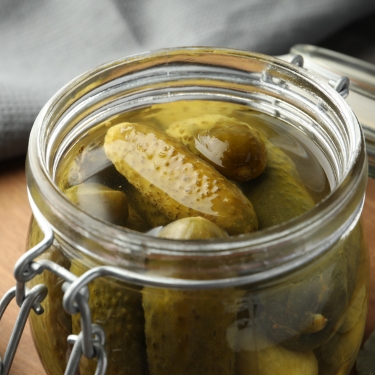
Anyone who has grown cucumbers knows how quickly they can get out of hand. One week you’re waiting for the first cucumber. The next you’re wondering why you planted so many.
Pickles and relish turn that summer glut into something you’ll actually use months later, while replacing jars that might cost $3 or $4 at the store.
Here, you can find one unique recipe that I love, the old-fashioned Amish ice-box pickles recipe.
Chicken and Beef
This is where watching the sales matters. If chicken thighs drop to $2 a pound or you find a good deal on a roast, pressure canning some of that meat gives you shelf-stable meals ready to go. And compared with commercially canned meat, the savings can be substantial.
If you want to make your canned meat last longer and its taste never fade, you should check out this video series. You’ll find out all the secrets!
Broth and Bone Broth
This may be one of the best-value things you can put in a jar. Chicken carcasses, beef bones, vegetable trimmings, and other scraps often cost you almost nothing because they were leftovers from food you already bought.
Meanwhile, a quart of decent broth at the store can run $4 to $8. You’re basically turning scraps into another grocery item you don’t have to buy.
But besides the amazing taste, bone broth brings so much more to the table. Some doctors even call it “nature’s liquid gold.” It’s one of the most nutritious foods you can have in your pantry and it’s also the main ingredient of a joint-friendly diet. How? All the amino acids that make up collagen are found in bone broth.
Keep your joints healthy with this Bone Broth Protocol →
Applesauce and Pie Filling
Fall apples are another good candidate, especially if you can buy seconds or drops from a local orchard. They might be ugly, bruised, or oddly shaped, but none of that matters once they’re peeled and cooked. A few bushels can give you applesauce and pie filling for months.
What I Wouldn’t Waste Jars On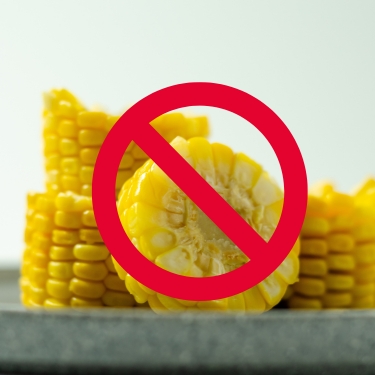
Not everything needs to be canned.
Potatoes, onions, winter squash, carrots, beets, and apples can often be stored for months under the right cool conditions.
If something will sit happily in a root cellar without using a lid, fuel, and an hour in the canner, I’d rather store it that way.
Sweet corn is another one I’d usually freeze. I simply think the flavor holds up better.
Jars aren’t free, and neither is your time, so be wise about both.
How to Fill Your Jars Without Spending a Fortune
Growing your own food is obviously one of the cheapest ways to do this. Even a row of tomato plants can produce a surprising amount of sauce once they’re all ripening at the same time.
But you absolutely do not need a huge garden. You just need to get a little better at spotting cheap food.
Pick-your-own farms can be great for berries, peaches, and other fruit. Roadside stands and orchards often have “seconds,” meaning produce that’s bruised, oddly shaped, too small, or otherwise not pretty enough for the regular display.
For canning, that usually doesn’t matter.
Farmers markets can be worth visiting near closing time, too. A grower may be much more willing to make a deal on a box of ripe produce when the alternative is loading it back onto the truck.
Then there are the jars themselves. Buying every jar brand-new gets expensive fast, so I always keep an eye out at yard sales, estate sales, thrift stores, and church rummage sales. You’ll sometimes find whole boxes for a dollar or two.
If you’re near an Amish or Mennonite community, check the local dry-goods stores as well. Many sell plain jars and lids in bulk at very reasonable prices.
A little hunting around beforehand can make your actual canning season much cheaper.
There’s a Lot We Can Learn From the Amish
If you ever get a chance to see a traditional Amish pantry or cellar during canning season, you’ll understand why I find their approach so interesting. They’re not putting up twelve jars because it makes a pretty pantry shelf. They’re preserving food because that’s how the household is going to eat through winter. A large family may have hundreds of jars lining the shelves.
But what I like most isn’t necessarily the number of jars. It’s how the work gets done. Canning isn’t treated like one person’s giant weekend project. Kids can snap beans. Someone else can wash produce. Another person handles jars. Family members and neighbors may work together when there’s a big harvest to get through. The workload gets spread around.
They’re practical about storage, too.
Not every carrot, apple, potato, or beet needs to go into a jar. Foods that will keep perfectly well in a cool cellar are stored there, leaving the jars for foods that actually need preserving. Some Amish canners also use steam canners for suitable high-acid foods, which can reduce the amount of water that needs to be heated compared with a traditional boiling-water canner.
That practicality is probably the lesson worth borrowing. And you don’t even need to copy the Amish lifestyle.
Grow what makes sense for your family. Preserve the surplus. Store foods in the simplest safe way you can. And when there’s a mountain of tomatoes staring at you from the kitchen table, don’t be afraid to recruit some help.
If you want to start canning like the Amish and maybe live your life a little bit more like them, then you need to hear about this.
The Amish Ways Academy is a collection of videos that do exactly this: help you get access to the Amish wisdom and show you how to apply it in your life.
All the videos are made by Eddie Swartzentruber. Eddie is a father and a husband, and he’s been working for years to preserve the skills that may one day save us. He grew up in Minnesota’s largest Amish settlement and now he wants to share everything he knows with you.
Why?
Because Eddie fears that in the next major crisis, many people won’t have the knowledge or resources needed to survive. The very skills that allowed him to build a life from nothing are fading from memory as society becomes more reliant on technology and convenience.
The Amish Ways Academy is the only COMPLETE resource for self-sufficiency. It lays the strongest foundation for someone new to independent living and gently guides you deeper and deeper into the fine details and secrets that even some of the most advanced survivalists don’t know.
Enroll today and get an 83% discount + 4 FREE books →
For a preview, watch the video below.

You Don’t Have to Sacrifice Your Whole Summer
The number 500 sounds exhausting.
So forget about 500.
Think about strawberries.
Then cucumbers.
Then tomatoes.
Then apples.
Canning is much easier when you follow the harvest instead of trying to hit some giant annual goal.
When strawberries are everywhere, preserve strawberries. When the tomato plants suddenly decide to give you forty pounds in the same week, make sauce. When apples are cheap in October, that’s when you deal with apples. A few focused sessions throughout the year are much more manageable than trying to turn your kitchen into a food-preservation factory every weekend.
I’d also keep a simple notebook. Write down what you can and, more importantly, what your family actually eats. If you put up thirty jars of something and twenty-four are still sitting there next summer, you probably don’t need thirty more. On the other hand, if the salsa disappears by Christmas, there’s your answer. Make more salsa next year.
Your pantry will eventually tell you what your family needs better than any generic canning chart can.
Related: 15 Vegetables You Can Actually Pickle Overnight
One Place I Would Never Cut Corners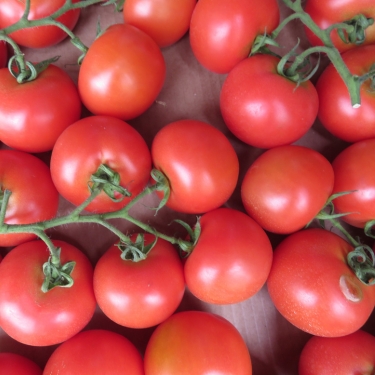
Saving money is great. Saving a few minutes by ignoring safe canning practices isn’t.
High-acid foods such as many fruits, jams, and properly acidified pickles can be processed using an appropriate boiling-water method.
Low-acid foods such as meat and many vegetables require pressure canning when you’re preserving them in this way.
Tomatoes require particular attention because their acidity can vary. Tested tomato recipes may call for bottled lemon juice or citric acid, so follow the recipe exactly rather than deciding that your tomatoes “taste acidic enough.”
For processing times, acidification amounts, jar sizes, and pressure requirements, use a tested recipe from a reliable source such as the National Center for Home Food Preservation.
This isn’t the part of canning where improvising is worth it.
And once those jars are on the shelf, date them.
It takes about two seconds and saves you from finding a mystery jar three years from now and wondering whether it came from last summer or the one before.
So, Can You Really Save $2,000?
Possibly. But I wouldn’t make $2,000 the only reason to start canning. Maybe your family reaches 500 jars and saves that much. Maybe you make 200 jars and save $700. Maybe you only preserve tomatoes, broth, jam, and a few batches of meat because those are the foods that make financial sense in your house.
That’s fine.
The real goal is to replace groceries you’re already buying with food that costs you less to put on the shelf yourself. Choose the expensive foods. Get the ingredients cheap. Preserve them when they’re in season. And keep track of what your family actually uses.
You may also like: 
DIY Cleansing Nettle Soup (Video)
How To Keep Butter Fresh For 5+ Years
The Secret Trick That Cuts Fruit Canning Time in Half
This 200-Year-Old Trick Keeps Meat Fresh Without Salt, Smoke, or Refrigeration


















Actually I get new canning jars pretty cheap when they are on sale. A dozen jars on sale is less than a dollar a jar (without tax).
Great article, I never put a price on the savings I was making in a year but on the knowledge of eating healthy. We all need to get back to growing our own food.