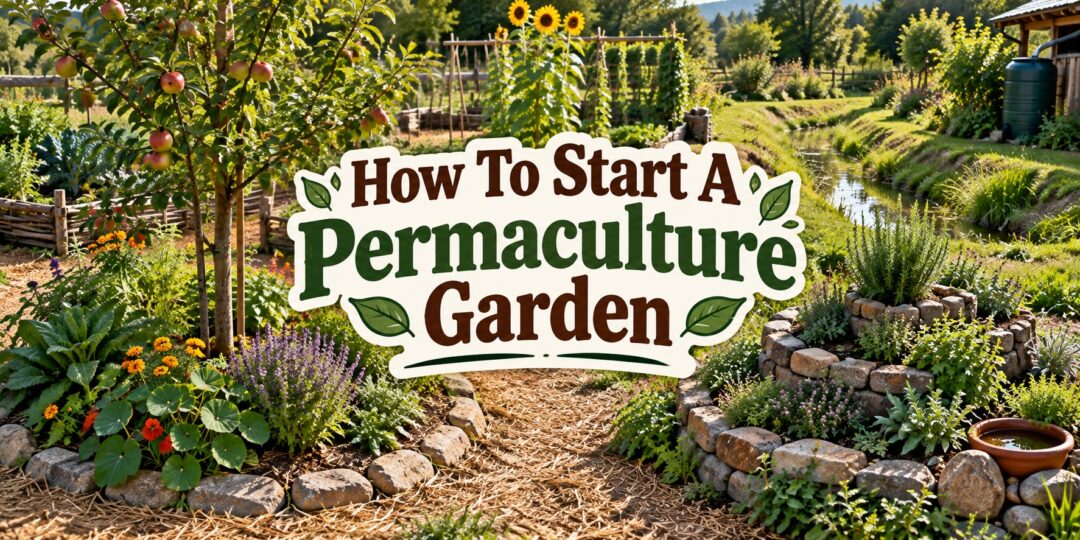
My first vegetable garden was a straight line of raised beds, tilled every spring, weeded every week, and thirsty every single day of a hot July. It produced food, but it also produced a lot of my time and a lot of my frustration. Permaculture is the reason my garden today does most of that work without me.
This isn’t a philosophy piece. It’s the practical version of permaculture I wish someone had handed me a decade ago, covering the actual techniques, the design thinking behind them, and the mistakes I made putting it all into practice on my own patch of dirt.
What Permaculture Actually Means
Permaculture was coined in the 1970s by Bill Mollison and David Holmgren, blending “permanent” and “agriculture” into landscapes designed to mimic natural ecosystems rather than fight them. According to NC State Extension’s guide to permaculture design, the whole discipline rests on three ethics: care for the earth, care for people, and share the surplus once your own needs are met.
In practice, that means less tilling, less watering, less chemical input, and a garden built around relationships between plants rather than rows of a single crop standing alone. It sounds abstract until you actually start applying it, at which point it becomes some of the most practical gardening advice I’ve ever used.
What sold me on it wasn’t the philosophy, it was watching my water bill and my weekend workload both shrink over a couple of seasons as the techniques below actually took hold. That’s the part I want to walk through here, not the theory, but what changed in my own garden once I started applying it bed by bed.
Start With Observation, Not a Shovel
Every permaculture book I’ve read opens with the same unglamorous first step: watch your land before you touch it. Where does water pool after a heavy rain? Which corner gets baked by afternoon sun in July and which stays shaded until ten in the morning?
I spent a full season just taking notes before I put a single plant in the ground at my current place, and it saved me from repeating mistakes I’d already made at my old house. A garden bed placed where water naturally collects needs a fraction of the irrigation one placed on a dry slope will need.
Design Your Garden in Zones
Permaculture zones organize your whole property by how often you actually need to visit each part of it. NC State Extension’s zone breakdown places kitchen herbs and daily-harvest vegetables in Zone 1 right outside the door, an orchard or perennial shrubs in Zone 3 that you’ll visit weekly, and leaves Zone 5 completely unmanaged as a place to just observe wildlife and natural patterns.
This sounds obvious once you hear it, but most new gardeners, myself included, plant everything with equal spacing and equal distance from the house regardless of how often it needs attention. My kitchen herbs are now four steps from my back door, and my fruit trees, which need almost nothing from me between spring and harvest, sit at the far edge of the property where I don’t have to think about them daily.
Build Soil the Lazy Way: Sheet Mulching
Sheet mulching is how I converted a patch of thick lawn into a productive bed without ever picking up a tiller. Oregon State University Extension’s guide to sheet mulching lays out the method clearly: a barrier of overlapping cardboard smothers the grass and weeds beneath it, and alternating layers of nitrogen-rich “greens” and carbon-rich “browns” on top slowly compost in place, building rich soil right where you want to plant.
The catch, and it’s a real one, is patience. That same OSU guidance notes a lasagna bed can take six months or longer to fully break down before you’re planting directly into it, so fall is the ideal time to start one for spring planting. I’ve built three beds this way now, and every single one out-produced the tilled beds next to it once it finally got going.
Design a Plant Guild Around a Fruit Tree
A plant guild is where permaculture starts to feel less like gardening and more like assembling a small ecosystem. The idea is to surround a central plant, usually a fruit or nut tree, with companions chosen for specific jobs: nitrogen fixers to feed the soil, pollinator attractors to bring in bees, bulbs to crowd out grass, and a groundcover to hold moisture and suppress weeds.
My own apple tree guild leans on clover for nitrogen, garlic planted in a ring to discourage grass and some pests, borage for the bees, and comfrey chopped and dropped as mulch a few times a season. Once it was established, that whole bed needed almost no outside fertilizer, which is the entire point of building a guild instead of just planting a tree in a lawn.
Catch and Store Water With Swales
A swale is essentially a shallow ditch dug on contour that catches rainwater and lets it soak into the ground slowly instead of running off. USU Extension’s permaculture guide describes garden basins built this way as infiltrating all the water they catch within about twenty minutes, turning what would be runoff into a slow-release reservoir for nearby plant roots.
I dug my first swale by hand along the downhill side of my orchard after watching where water pooled during a storm, and it was maybe four hours of digging for a bed that now barely needs supplemental watering even in a dry August. That same USU guide includes a simple formula for figuring out how much rainwater your roof or landscape could realistically capture, which is worth running the numbers on before you decide how ambitious to get.
Stack Functions With Companion Planting
Stacking functions just means choosing plants that do more than one job at once, and the clearest example is the traditional Three Sisters planting of corn, beans, and squash. The corn gives the beans something to climb, the beans fix nitrogen the corn and squash both use, and the squash’s broad leaves shade out weeds and hold soil moisture for all three.
I planted my first Three Sisters bed mostly out of curiosity and ended up with a genuinely higher combined harvest from that one bed than I’d gotten planting the same square footage of corn alone the year before. It’s a good reminder that permaculture isn’t always about exotic new techniques, sometimes it’s just borrowing what worked for people who were doing this long before any of us.
Use Edges and Grow a Herb Spiral
One of the stranger-sounding permaculture principles is that the richest, most productive spots in any landscape tend to be edges, the place where a forest meets a field or a pond meets dry land. A herb spiral is a small, practical way to build that edge effect into a tiny footprint.
Stack rocks or bricks into a rising spiral, put the highest point at the center, and you’ve created a dozen different microclimates in the space of a few square feet: dry and sunny near the top, cool and moist toward the bottom. Mine holds rosemary and thyme near the peak, basil and parsley partway down, and mint at the shaded base where it can spread without taking over anything else.
Embrace Diversity Over Monoculture
A single crop planted in a straight row is an open invitation to whatever pest or disease specializes in eating it. My worst pest year happened before I understood this, when a bed of nothing but brassicas got hammered by cabbage moths with nowhere else to go and nothing to confuse their path.
Mixing in flowers, herbs, and unrelated vegetables throughout the same bed breaks up that clear sight line and scent trail for pests, while also bringing in more pollinators and beneficial predator insects. It looks messier than a tidy row garden, and it’s genuinely more resilient because of it.
I’ve also found that diverse plantings spread out my harvest windows instead of dumping everything on me at once. A monoculture bed of one variety of tomato ripens in one frantic week, while a mixed bed staggers naturally, which matters a lot when you’re the one doing the preserving afterward.
Let the Garden Take Care of Itself
The permaculture principle I lean on most these days is simply this: don’t fight the system, design it so it doesn’t need fighting. Fallen leaves become mulch instead of yard waste, kitchen scraps go straight to the compost bin, and pruned branches from the fruit trees get woven into low garden fencing instead of hauled to the curb.
None of that is complicated. It’s just a habit of asking, before something leaves my property, whether it actually has another job to do first.
My Own Permaculture Mistakes
I planted mint directly in a guild bed my first year, and it swallowed half the bed within two seasons because I didn’t respect how aggressively it spreads. I also dug my first swale slightly off contour, which meant water pooled unevenly and drowned a row of seedlings instead of soaking in gradually.
Neither mistake was expensive to fix, but both taught me the same lesson the small and slow solutions principle is built around: test a technique on a small scale before you commit your whole garden to it. A five-foot swale you got wrong is an afternoon of regrading. A hundred-foot one is a much bigger project to undo.
Frequently Asked Questions
Do I need a lot of land to start a permaculture garden?
No. Herb spirals, small guild beds, and sheet-mulched patches all work on a suburban lot or even a large container garden. Zone thinking and stacking functions matter more than acreage.
How long before a permaculture garden actually needs less work?
Expect the first one to two years to be the most labor-intensive, since you’re building soil, establishing perennials, and setting up water systems. Most of my beds hit their low-maintenance stride around year three, once the guilds and perennials are established.
Can I mix permaculture techniques into an existing traditional garden?
Absolutely, and that’s how most people actually start. Sheet mulch one new bed, build one small guild around an existing fruit tree, or dig one test swale rather than redesigning the whole property at once.
What’s the single easiest permaculture technique to try first?
Sheet mulching a small bed is usually the lowest-risk starting point. It costs almost nothing, uses materials you likely already have on hand, and teaches you the patience permaculture rewards before you invest in anything bigger.
Your Garden Can Become More Independent. So Can the Rest of Your Life.
Permaculture teaches a powerful lesson: the less you depend on constant outside inputs, the stronger your system becomes.
Instead of buying fertilizer, you build your own soil. Instead of letting rainwater disappear, you capture and use it. Instead of throwing useful materials away, you find another purpose for them. And instead of depending entirely on the grocery store, you learn how to produce more of your own food.
But why stop at the garden?
The Lost Skills of Independence brings together practical, old-fashioned skills that helped previous generations provide more for themselves with what they already had around them.
It’s about rediscovering the knowledge that made a household capable, resourceful, and far less dependent on stores, utilities, and modern conveniences.
Inside, you’ll explore practical skills connected to growing and preserving food, making useful things yourself, storing what you produce, solving everyday problems, using resources more efficiently, and becoming increasingly self-reliant.
You don’t have to change your entire lifestyle tomorrow.
Start the same way you would start a permaculture garden: one small project, one useful skill, and one step toward greater independence at a time.
Because every skill you recover is something nobody can take away from you when prices rise, supplies disappear, the power goes out, or the systems you’ve always depended on suddenly aren’t there.
Rediscover the Skills That Made Our Grandparents Truly Independent
Your garden can produce more with less.
Your household can learn to do the same.
Get The Lost Skills of Independence and start rebuilding the practical knowledge that modern life has almost forgotten.
CLICK HERE TO DISCOVER THE LOST SKILLS OF INDEPENDENCE →
The Bottom Line
Permaculture isn’t a single technique, it’s a way of looking at your land and asking what it already wants to do before you decide what you want it to do instead. Start small: one sheet-mulched bed, one guild, one swale dug by hand, and let the results teach you whether to expand.
My garden today waters itself far more than it used to, feeds itself more than it used to, and honestly asks less of me every single year it matures. That’s the whole promise of permaculture, and it’s one I’ve actually watched pay off in my own backyard.
You may also like:
Join Our Official Facebook Group For More Homesteading Tips And Tricks
The Silent Stockpile Killer. Do You Have It In Your Pantry? (Video)
Why “Weird” Crops Make Your Garden Better
Compost for Raised Bed Garden: Everything I’ve Learned Building Healthy Soil
25 Ways to Save the Garden Glut Before It Rots
Why You Should Bury Your Cotton Underwear in the Garden
The Only Way to Save Your Garden and Produce Water When It Doesn’t Rain