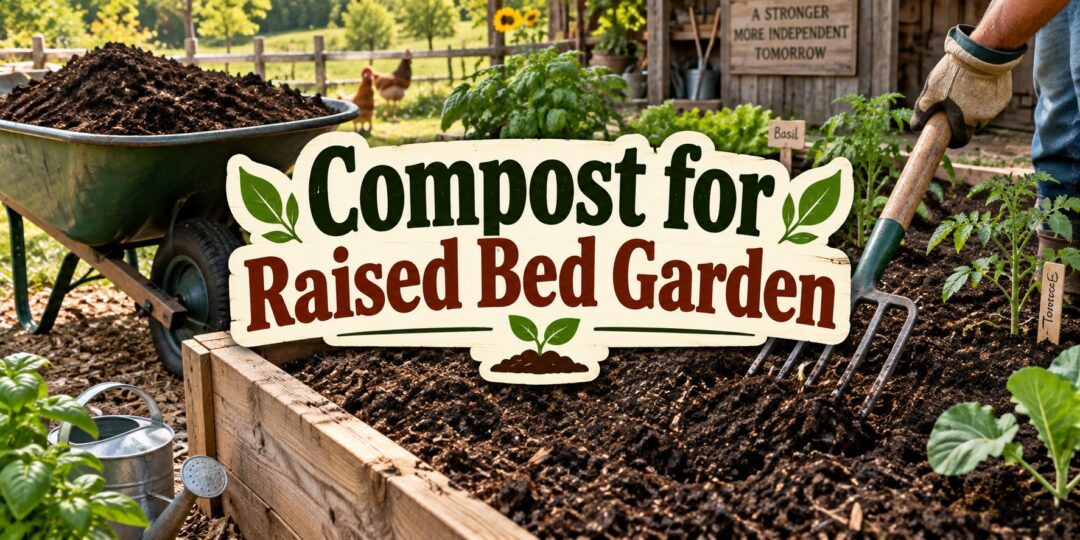
When I built my first raised bed years ago, I made the rookie mistake of shoveling in dirt from the yard and calling it a day. My tomatoes sat there sulking all summer, and it took me a full season to figure out why. The soil had compacted into something close to concrete, and there wasn’t nearly enough organic matter in it to feed anything.
Compost fixed that problem for me, and it’s been the backbone of every raised bed I’ve built since. This guide covers everything I’ve learned about using compost in a raised bed, how much to use, where to get it, how to build your own, and the mistakes that cost me a growing season before I got it right.
Why Raised Beds Need Compost, Not Just Dirt
A raised bed behaves more like a big container than an in-ground garden bed. Once you box soil in and raise it above grade, it drains faster, warms up faster, and loses nutrients faster than the ground around it. Plain native soil compacts under those conditions and stops draining or breathing the way roots need it to.
Compost is what keeps that from happening. It loosens the structure, holds moisture without waterlogging, and feeds the biology in the soil that actually makes nutrients available to your plants. I think of it less as a fertilizer and more as the engine that runs the whole bed.
There’s also a practical reason I lean on compost so heavily: it’s essentially free once you’re making your own, and it puts kitchen scraps, yard trimmings, and coop bedding to work instead of hauling them off to the curb. On a homestead, that kind of closed loop matters as much as the plant science does.
How Much Compost Should You Actually Use?
This is the question I get asked most, and honestly, the guidance varies more than you’d expect. University of Maryland Extension recommends raised beds contain 25 to 50 percent organic matter by volume, and suggests filling a bed with compost and topsoil in a 1:1 or 1:2 ratio depending on your existing soil.
On the lighter end, South Dakota State University Extension notes that most gardeners land somewhere between 10 and 50 percent compost by volume, with 25 percent being the most common choice. Iowa State University Extension offers a similar range: equal parts topsoil, organic matter, and coarse sand, or roughly 70 percent topsoil to 30 percent compost.
In my own beds I land around 30 percent compost mixed with quality topsoil, and I’ve never had a reason to push much higher. Straight compost, or anything close to it, tends to crust over, pack down too tightly, and drain unevenly, which is exactly what more than one extension office warns against.
Building Your Own Compost for the Bed
I make most of my own compost, and once you understand the basic ratio, it’s hard to mess up. Composting microbes need a mix of carbon, the “browns” like dry leaves, straw, and shredded paper, and nitrogen, the “greens” like kitchen scraps, grass clippings, and manure. A carbon-to-nitrogen ratio around 30 parts carbon to 1 part nitrogen keeps the pile working efficiently, and a finished pile settles closer to a 20 to 25 to 1 ratio.
Hot composting, where the pile heats up to 130 to 170 degrees Fahrenheit, gives you usable compost in six to eight weeks and kills off most weed seeds and pathogens along the way. Cool or passive composting is far less work, but you’re looking at closer to a year before it’s ready. I run both at the same time on my place, a hot pile for the beds I need to fill soon, and a slow, cool pile out back for everything else.
Whichever method you use, turn the pile regularly, keep it about as damp as a wrung-out sponge, and don’t add meat, dairy, fats, or pet waste. Those items attract pests and can carry pathogens that a home compost pile isn’t reliably hot enough to kill.
How to Tell Your Compost Is Actually Finished
Adding unfinished compost to a raised bed is one of the fastest ways to hurt your plants, since actively decomposing material can rob nitrogen from the soil and generate heat that scorches roots. UMD Extension lists three signs that compost is genuinely ready: it’s uniform in color and texture with an earthy smell and no “off” odors, the pile has cooled to outdoor temperature, and a handful sealed in a plastic bag won’t produce condensation.
If your compost still looks like recognizable food scraps or eggshells, or if it still smells sour or like ammonia, give it more time. I’ve rushed this step before out of impatience, and the plants let me know about it within a week.
Different Types of Compost Worth Using
- Yard waste compost: made from leaves, grass clippings, and garden trimmings. Usually mild and safe to use generously.
- Food scrap compost: rich in nitrogen and nutrients, great for heavy feeders like tomatoes and squash.
- Aged or composted manure: high in nutrients but variable in salt content, so use it in moderation and never in its raw form.
- Mushroom compost: a byproduct of commercial mushroom growing, generally mild but can carry higher salt levels depending on the source.
- Worm castings (vermicompost): concentrated and gentle, excellent worked into the top few inches around transplants.
I like blending two or three of these together rather than relying on just one. A mixed source gives you a broader range of nutrients and microbial life than any single compost can offer on its own.
Should You Ever Use Raw Manure Directly?
Raw manure can carry pathogens like E. coli and Salmonella, so I never put it straight into a bed I’m about to plant. USDA’s National Organic Program standards require raw manure to be incorporated into the soil at least 120 days before harvest for crops that touch the soil, like lettuce and root vegetables, and at least 90 days for crops that don’t, like tomatoes and peppers.
For my own beds, I just skip the waiting game entirely and compost manure fully before it goes anywhere near food crops. A properly hot compost pile, holding 131 to 170 degrees Fahrenheit for several days, handles the pathogen risk far more reliably than counting down a calendar.
Filling a New Raised Bed: How I Do It
If the ground underneath is covered in turf or weeds, I lay down cardboard or several layers of newspaper first, then cover it with 2 to 4 inches of compost. That smothers what’s below over six to eight weeks while feeding the soil at the same time, and I don’t have to fight a season of weeds coming up through disturbed dirt.
From there, I fill the bed with my compost and topsoil blend, mixing as I go rather than dropping it in as distinct layers. Layered soil creates barriers that water and roots both struggle to cross, so a good fork-and-mix as you fill makes a real difference down the road.
For a bed sitting directly on a hard surface like a patio or driveway, I lean more heavily on compost and a soilless growing mix rather than heavy topsoil, since weight and drainage both become bigger concerns without soil contact underneath.
Topping Off an Established Bed Every Season
Established beds need a refresh every year, not a full rebuild. I add 2 to 4 inches of finished compost to the surface each spring or fall and work it into the top 4 to 6 inches with a garden fork, without turning the whole bed over and disturbing everything below.
This keeps the organic matter level up without the labor of rebuilding, and it replaces the nitrogen and structure that a season of heavy-feeding vegetables pulls out of the soil.
Buying Compost If You Don’t Make Your Own
Not everyone has the space, time, or patience for a compost pile, and there’s no shame in buying it. Bagged compost from a garden center works fine for a single small bed, but it gets expensive fast once you’re filling more than one or two.
For anything larger, I buy compost in bulk from a local landscaping supplier or municipal composting facility. It’s usually a fraction of the bagged price per cubic yard, and most municipal programs process yard waste at scale, which tends to produce a consistent, well-finished product.
Whatever the source, ask before you buy. Find out what went into it, whether it includes manure, and how long it composted. A reputable supplier will know these answers off the top of their head, and if they don’t, I’d look elsewhere.
Frequently Asked Questions
Can I use compost alone with no topsoil at all? You can, but most gardeners who try it run into the same problems: crusting, uneven drainage, and compost that turns hydrophobic if it ever dries out completely. Blending it with topsoil or a soilless mix gives you better structure over the long run.
How often should I add fresh compost to an established bed? Once or twice a year is plenty for most vegetable beds, timed for spring before planting or fall after your last harvest.
Does compost replace fertilizer entirely? Not usually. Compost releases nutrients slowly as microbes break it down, which is great for steady feeding but not always fast enough for heavy feeders early in the season. I still supplement with a quick-release organic fertilizer at planting time in beds growing tomatoes, squash, or corn.
Is it safe to compost diseased plants from my garden? Only if your pile reliably reaches hot-composting temperatures. A cool, passive pile usually won’t get hot enough to kill off plant pathogens, so I burn or bag diseased material instead of risking it in the compost I plan to use on food crops.
Mistakes I’ve Made With Compost in Raised Beds
- Using compost that wasn’t fully finished, which cooked my seedlings before I figured out what was happening.
- Filling a bed with too much compost and not enough coarser material, leaving me with soil that crusted over and shed water instead of absorbing it.
- Letting a bed of mostly compost dry out completely one summer, which made it hydrophobic. Water pooled on top while the soil underneath stayed bone dry.
- Relying too heavily on manure-based compost year after year, which built up phosphorus to the point that it started blocking other nutrients, something I only caught after a soil test.
- Skipping a soil test altogether for the first few years, which meant I was guessing at what my beds actually needed instead of knowing.
Your Garden Can Produce More Than Food – It Can Produce Independence
Making your own compost is a small skill with a surprisingly big payoff.
Instead of buying another bag from the store, you learn how to take kitchen scraps, fallen leaves, grass clippings, manure, and other materials you already have and turn them into something your garden needs.
That is what real self-reliance looks like.
And composting is only one of the practical skills our grandparents and great-grandparents once considered ordinary.
They knew how to grow and preserve food, make useful things from basic materials, repair instead of replace, reuse resources others would throw away, and keep a household functioning with far less dependence on stores and modern conveniences.
Much of that knowledge has disappeared, but you can learn it again.
The Lost Skills of Independence brings together practical, old-fashioned skills designed to help you become more capable and self-reliant at home.
Whether you’re building a productive garden, stocking your pantry, improving your homestead, or simply looking for ways to depend less on expensive modern systems, every skill you master puts a little more control back into your own hands.
Don’t stop at learning how to build better soil. Learn how to build a more independent life.
Final Thoughts
Compost is the difference between a raised bed that struggles and one that produces. Get the ratio roughly right, make sure whatever you’re adding is actually finished, and top the bed off every season instead of ignoring it until things go wrong.
None of this needs to be exact. My own beds are a little different from each other because I’ve built them at different times with whatever compost I had on hand, and they all still grow good food. Start with a reasonable ratio, pay attention to how your plants respond, and adjust from there.
You may also like:
 This Is How Your Compost Could Kill You
Cheap and Easy to Build Root Cellar in Your Own Back Yard (Video)
Vermicomposting: A Simple Way to Turn Scraps Into Black Gold
You Won’t Have To Make Compost Again
Boost Your Soil Quality With This Compost