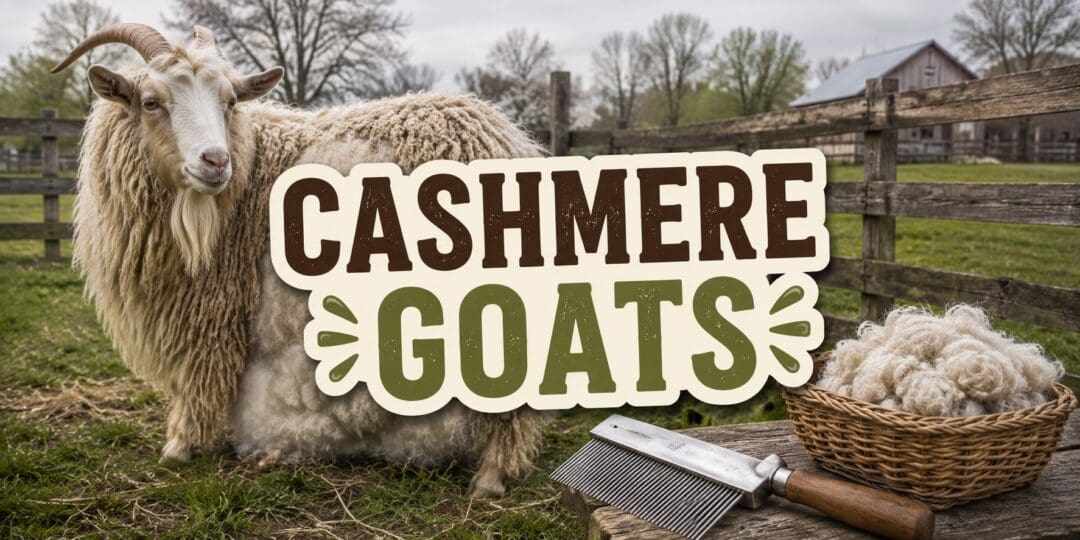
The first time I ran a metal comb through a goat’s winter coat and pulled out a handful of fiber softer than anything I owned in my closet, I understood exactly why cashmere carries the price tag it does. It felt almost unfair that something this luxurious comes off an animal that also happily eats blackberry brambles and shrugs off a hard freeze without complaint.
Cashmere goats are not actually a single formal breed the way a Nubian or a Boer is. Any goat that grows a soft, fine undercoat suitable for spinning into cashmere qualifies, which means this world is a little looser and more forgiving to enter than most specialty livestock ventures. Here is what I have learned about choosing, keeping, and harvesting from cashmere goats on a homestead scale.
What Exactly Is a Cashmere Goat?
Cashmere is not a breed name, it is a fiber classification. Per Werner Creek Farm’s account of raising them, goats naturally grow two types of hair: coarse outer guard hairs and a soft, downy undercoat, and any goat producing a fine enough undercoat can be marketed as a cashmere producer regardless of its formal breed. That is why you will see cashmere coming off Spanish goats, ferals, and various meat-breed crosses, not just goats labeled specifically as Cashmere.
Purpose-bred cashmere lines do exist, developed specifically for consistent, high-quality down. According to industry standards, true cashmere fiber should measure less than 19 microns in diameter and at least 1 and 1/4 inches in length to qualify as premium grade. Globally, breeds like the Chinese Hexi, Mongolian, and Changthangi of the Himalayas are famous for producing some of the world’s finest cashmere, with the Changthangi behind the legendary pashmina shawls.
Why Homesteaders Are Drawn to Them
- Dual-purpose potential: many North American cashmere lines carry meat goat ancestry, so the same animal can produce fiber income and be marketed for chevon
- Hardy, low-input animals: cashmere goats are excellent browsers that thrive on rough forage most other livestock would turn their nose up at
- Cold tolerance: their whole reason for growing a downy undercoat in the first place is surviving harsh winters, which makes them well suited to northern homesteads
- A genuinely valuable product: raw cashmere has sold in the range of $120 to $140 per pound depending on supply, which is a meaningful return from an animal that costs relatively little to feed
- Personality: goats in general are curious, food-motivated, and entertaining, and cashmere producers are no exception
The tradeoff is scale. A single goat produces a genuinely small amount of usable cashmere per year, so this is a slow-building fiber enterprise rather than a fast homestead income stream.
What to Look For in a Cashmere Producer
Registries such as the Cashmere Goat Association judge breeding stock roughly 50% on coat quality and 50% on body conformation. Per MorningChores’ breed guide, the two words that matter most for coat evaluation are cover and consistency. Cover means the neck, shoulders, sides, and hips, the main harvest sites, are completely covered in soft down rather than patchy. Consistency means the fiber holds the same crimp and quality across all of those sites rather than being fine in one spot and coarse in another.
- Adult does typically stand 20 to 25 inches at the withers and weigh 70 to 110 pounds
- Bucks run notably larger, often 100 to 150 pounds
- Most lines are horned, and cashmere goats are typically not dehorned since disbudding can affect skull development tied to coat growth in some lines
- Look for a dense, even undercoat felt close to the skin in winter, distinct from the longer, coarser guard hairs sitting over top of it
Housing and Feeding
Cashmere goats are not fussy compared to most fiber livestock, but a few things genuinely matter for both their health and their fleece quality.
- Shelter: a simple three-sided shelter is usually enough, but goats hate getting wet more than they hate cold, so keep bedding dry and drafts blocked
- Fencing: goats are notorious escape artists and browsers rather than grazers, so sturdy fencing matters more than pasture acreage
- Forage: cashmere goats are excellent browsers and do well clearing brush, brambles, and weeds that other livestock ignore, which makes them useful for land management alongside fiber production
- Supplemental feed: research on pregnant cashmere does found that proper supplemental feeding during gestation measurably improved cashmere length, cashmere yield, and kid birth weight, so does carrying kids benefit from more attention to nutrition, not less
- Minerals: a goat-specific loose mineral supplement supports both fiber growth and general health, since goats have different copper needs than sheep and cannot share a mineral mix
- Fresh water and basic hoof care round out the standard goat care routine that applies regardless of purpose
Breeding and Kidding
- Sexual maturity typically arrives around 6 months, though most breeders wait until closer to 12 to 18 months for does to breed to allow full body growth first
- Gestation runs approximately 150 days, about five months
- Breeding season generally begins in fall, with kids arriving in spring, timing that also lines up conveniently with the spring fiber harvest
- Singles and twins are both common
- Select breeding stock for consistent, fine, well-covered fleeces alongside sound body conformation, since fiber quality is a genetic trait you are actively selecting for generation over generation
If your goal is steadily improving your herd’s fiber quality rather than just maintaining it, keep records on which does and bucks consistently throw kids with the finest, most even coats, and breed toward that.
Harvesting the Fiber: Combing vs. Shearing
This is the part that actually makes a cashmere goat a cashmere goat, and timing matters more than almost anything else in the process. Cashmere goats naturally molt their undercoat in spring, and that molt window is your harvest window. Per Hobby Farms’ fiber goat guide, keepers can harvest cashmere either by shearing or by combing, and fleeces that are shorn tend to contain noticeably more coarse guard hair mixed in than fleeces gathered by combing.
Combing
Combing uses a special metal cashmere comb to gently pull the loosened undercoat away from the skin while leaving the guard hairs and skin undisturbed. It is slower and more labor-intensive than shearing, but it produces a noticeably cleaner fleece with far less guard hair to remove later, and it leaves the goat with some protective coat still in place against unpredictable spring weather.
Shearing
Shearing removes the entire coat, guard hairs and undercoat together, in one faster pass, similar to shearing a sheep. It is more efficient for larger herds but leaves goats more exposed to cold snaps right after harvest and requires more dehairing work afterward to separate the coarse and fine fibers.
- Time it right: comb or shear too early and the down has not loosened yet, causing pain and a fighting goat, too late and you risk losing loose fiber to rubbing, bedding, and brush
- Expect roughly 3 to 4 ounces of usable cashmere from an adult goat in a season, with some well-bred producers reaching up toward 8 ounces
- Provide shelter from wind and cold immediately after harvesting, since you have just removed a meaningful part of the goat’s insulation
- Handle goats calmly during the process, since a rough or rushed combing session makes goats head-shy and uncooperative in future years
Processing Raw Cashmere Into Usable Fiber
Raw cashmere straight off the goat is not ready to spin. It needs to be sorted, cleaned, and separated from the coarser guard hair before it becomes the soft fiber people associate with cashmere sweaters.
- Sort by hand to pull out obvious debris, hay chaff, and heavily matted sections
- Dehair the fleece to separate the fine down from the coarser guard hairs, either by hand for small batches or through a mill for larger quantities
- Wash gently in cool to lukewarm water with a mild wool-safe detergent, avoiding agitation that could felt the delicate fiber
- Dry flat away from direct sun and let it air dry completely before storage or spinning
- Grade the cleaned fiber by fineness and length if you plan to sell it, since buyers pay a premium for consistent, fine, well-sorted cashmere over a mixed bag
If hand-dehairing an entire fleece sounds like more than you want to take on, several fiber mills accept raw cashmere and will wash, dehair, and card or spin it for a fee, which is a reasonable option while you are still building up herd size and experience.
Health Considerations Specific to Fiber Goats
Keep an Eye On:
External parasites like lice, keds, and mites can cause rubbing, broken fibers, dandruff, and bare patches, directly reducing fiber quality alongside general goat health.
Internal parasites reduce coat quality and cashmere yield even when a goat otherwise looks healthy, so a regular fecal testing and deworming program matters as much for fiber goats as for dairy or meat animals.
Foot rot and scald limit movement and browsing, which indirectly affects body condition and fiber growth, so routine hoof trimming and dry bedding are worth the effort.
Post-harvest chill risk is real. A freshly combed or sheared goat has lost a real layer of insulation, and a cold snap or unexpected rain right after harvest can put real stress on the animal, so check weather forecasts before you schedule harvest day.
Turning Fiber Into Income
- Sell raw, sorted cashmere directly to hand spinners and fiber artists, who often pay well for small-batch, ethically raised fiber with known provenance
- Have fiber processed into roving, batts, or yarn through a small mill to sell a higher-value finished product
- Market breeding stock and kids alongside fiber, especially if your line has meat goat ancestry that supports dual-purpose sales
- Build a following through local fiber fairs, farmers markets, and online fiber-community marketplaces, where buyers specifically value knowing which farm and which goat their fiber came from
It takes roughly four goats’ worth of cashmere to produce a single sweater, so realistic expectations matter here. This is a slow-building, relationship-driven fiber business more than a fast-turnaround commodity operation, and most successful small producers treat it that way.
Take a Page from the Amish: Build a More Self-Reliant Homestead
Raising cashmere goats is about more than producing a luxury fiber—it’s about making the most of every animal on your homestead. The same mindset of using what you have wisely, minimizing waste, and creating long-term value has helped Amish families thrive for generations. As this guide shows, success comes from careful animal selection, consistent husbandry, and turning simple resources into lasting rewards.
If you’re looking to become more capable, resourceful, and less dependent on modern conveniences, Amish Ways is the perfect companion to your homesteading journey.
Inside, you’ll discover time-tested knowledge passed down through generations of practical living—from raising livestock and preserving food to building useful skills that help you save money, reduce waste, and become more self-sufficient.
Inside Amish Ways, You’ll Discover:
- 🐐 Traditional livestock-raising practices that prioritize health and productivity
- 🌱 Practical homesteading techniques that require more know-how than expensive equipment
- 🥫 Proven food preservation methods that help your harvest last all year
- 🔨 Simple DIY projects and household solutions that reduce everyday costs
- 🏡 Timeless Amish principles for building a resilient, productive, and sustainable homestead
Whether you’re raising goats, chickens, rabbits, or simply taking your first steps toward a more self-reliant lifestyle, Amish Ways is filled with practical wisdom you can put to work immediately.
Is a Cashmere Goat Right for Your Homestead?
If you already like keeping goats, or you want a browsing animal that can help clear brush while quietly producing one of the most valuable natural fibers in the world, cashmere goats are worth serious consideration. They ask for the same basic care as any other goat, plus about ten focused minutes a year, per goat, spent combing out a fleece most people will never get to touch in person. That is a fair trade in my book, and it is one of the more satisfying small-scale fiber projects a homestead can take on.
Livestock needs and regulations vary by region and climate. Check with your local agricultural extension office or an experienced cashmere breeder in your area before building out a herd.
You may also like:
Join The Self-Sufficient Projects Facebook Group For The Best Homesteading Advice
How to Get 295 Pounds of Extra Food for Just $5 a Week (Video)
Goat Hooves: Everything You Need to Know About Structure, Trimming, and Common Problems
Goat Milk: The Complete Homesteader’s Guide to Raising, Milking, and Using It
Goat Breeds: A Practical Guide to Choosing the Right Goat for Your Homestead