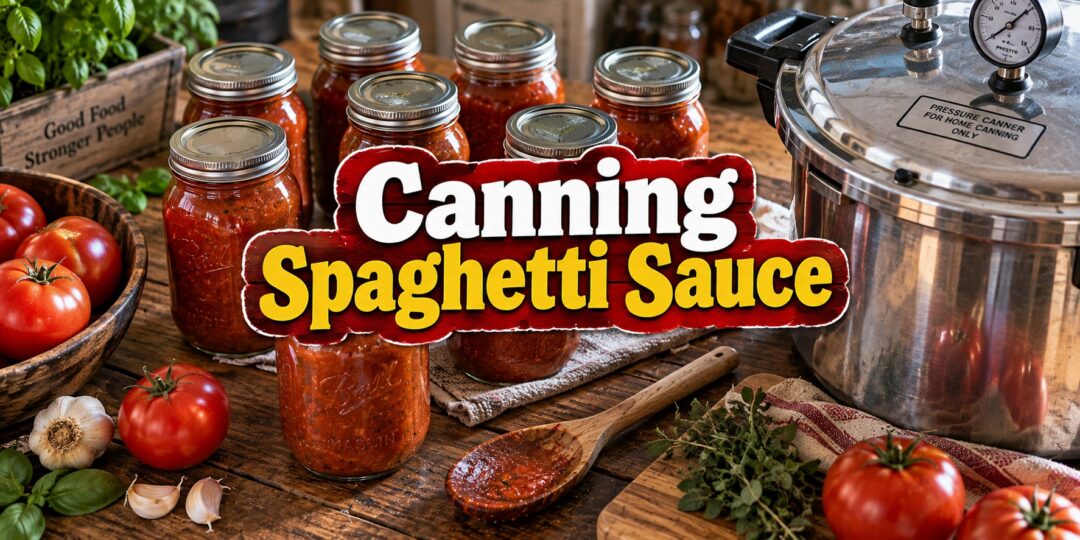
Every August my counter disappears under a mountain of tomatoes, and every August I make the same batch of spaghetti sauce to can for winter. It took me a couple of seasons to actually understand why the tested recipe looks the way it does, though, and once I did, I stopped improvising with it entirely.
This guide walks through the whole process: why spaghetti sauce is genuinely different from canning plain tomatoes, the tested recipes with and without meat, and the specific changes you can and cannot safely make. If you’ve ever wondered why some tomato recipes go in a water bath canner and others don’t, this is exactly that explanation.
Why Spaghetti Sauce Isn’t as Simple as Tomatoes
Tomatoes sit right on the edge between high-acid and low-acid foods, which is why plain canned tomatoes and plain tomato sauce need a small amount of added acid, usually bottled lemon juice or citric acid, to be safely water bath canned. That acidification pushes the pH low enough to keep Clostridium botulinum, the bacteria behind botulism, from growing.
Spaghetti sauce is a different animal entirely, because it’s not just tomatoes. Onions, garlic, celery or peppers, and mushrooms are all low-acid ingredients, and once you add them to the pot in any real quantity, the whole batch stops behaving like a high-acid food. The CDC’s guidance on home-canned foods is direct about this: low-acid foods, which include basically every fresh vegetable, are the most common source of home-canning botulism outbreaks in the country, and pressure canning is the only method that reliably protects against it.
This is exactly why I don’t add extra acid to my spaghetti sauce and skip the pressure canner. Once onions, peppers, and mushrooms are in the mix, acidification alone doesn’t cut it, and the tested recipe accounts for that by requiring a pressure canner regardless of whether meat is in the pot.
Water Bath vs. Pressure Canning: The Line That Actually Matters
It helps to see the contrast directly. The National Center for Home Food Preservation’s Standard Tomato Sauce recipe, which is just tomatoes with bottled lemon juice or citric acid and no vegetables added, can be safely processed in a boiling water canner, 35 to 40 minutes depending on jar size at low elevation.
Their Spaghetti Sauce Without Meat recipe, which adds onions, garlic, celery or peppers, and optional mushrooms, requires a pressure canner instead, even though it contains no meat whatsoever. That’s the line. It’s not about meat specifically, it’s about whether enough low-acid vegetable content is in the pot to change the food’s overall acidity.
The Tested Recipe: Spaghetti Sauce Without Meat
This recipe comes straight from the National Center for Home Food Preservation and yields about 9 pints. Start with 30 pounds of tomatoes, 1 cup chopped onions, 5 cloves minced garlic, 1 cup chopped celery or green pepper, 1 pound sliced fresh mushrooms if you want them, 4 and a half teaspoons salt, 2 tablespoons oregano, 4 tablespoons minced parsley, 2 teaspoons black pepper, a quarter cup brown sugar, and a quarter cup vegetable oil.
Wash the tomatoes and dip them in boiling water for 30 to 60 seconds until the skins split, then plunge them into cold water and slip the skins off. Core and quarter them, then boil uncovered for 20 minutes in a large pot before running everything through a food mill or sieve.
Sauté the onions, garlic, celery or peppers, and mushrooms in the vegetable oil until tender, then combine them with the tomato pulp along with the spices, salt, and sugar. Bring to a boil and simmer uncovered until the sauce is thick enough to serve, which usually means the volume has reduced by close to half. Fill jars leaving 1 inch of headspace.
At 0 to 1,000 feet elevation, process pints for 20 minutes at 10 pounds pressure in a weighted-gauge canner, or 11 pounds in a dial-gauge canner. Quarts need 25 minutes at those same pressures. Above 1,000 feet with a weighted gauge, bump up to 15 pounds; with a dial gauge, follow the elevation chart, since dial-gauge pressure climbs gradually with altitude rather than jumping straight to a single higher number.
Getting the Tomatoes Ready Before You Even Start the Recipe
Thirty pounds of tomatoes sounds like a lot until you’re actually standing over the sink peeling them, so I usually spread the blanching step across a couple of pots going at once to keep things moving. Score a small X on the bottom of each tomato before it goes into the boiling water, which makes the skins slip off far more easily once they’ve cooled in the ice water bath.
Don’t skip draining the seeds and excess water out when you run the tomatoes through the food mill, since a watery pulp just means a longer simmer later to reduce it back down. I keep a large bowl under the mill specifically to catch the pulp and let it sit a few minutes before transferring it to the pot, which lets some of the thinnest liquid separate out on its own.
Adding Meat Safely: Spaghetti Sauce With Meat
The meat version follows the same basic structure with a few key changes. You’ll need the same 30 pounds of tomatoes, but swap in 2 and a half pounds of ground meat, whether that’s beef, sausage, venison, or turkey, and skip the vegetable oil entirely since you’ll brown the meat instead.
Prepare the tomatoes exactly as above: skin, core, quarter, boil 20 minutes, then run through a food mill. Brown the ground meat thoroughly in a skillet, then add the garlic, onion, celery or green pepper, and mushrooms if using, and cook until the vegetables are tender. Combine with the tomato pulp, add the same spice blend as the meatless version, bring to a boil, and simmer uncovered until reduced by roughly half.
Fill jars with 1 inch headspace. Processing times run longer than the meatless version because of the added density and food safety margin for meat: 60 minutes for pints and 70 minutes for quarts, at the same pressures listed above for the meatless recipe.
What You Cannot Safely Change About This Recipe
This is the section that trips people up most, because home cooking instincts and safe canning rules pull in opposite directions here. You cannot increase the proportion of onions, peppers, or mushrooms beyond what the recipe calls for, since that shifts the acid balance the tested processing time was built around.
You cannot add flour, cornstarch, or any other starch thickener before canning. Thickeners interfere with how heat moves through the jar during processing, which can leave the center of the jar underprocessed even though the outer portion reached a safe temperature. If you want a thicker finished sauce, simmer it down further before filling jars, or thicken it in the pan after opening a jar to actually cook with.
Cheese, cream, and other dairy additions are also off the table before canning, for the same heat-penetration reason plus their own spoilage risks. Add those when you reheat a jar to serve, never before it goes into the canner. You can reduce the sugar to taste and swap the meat type freely, but the tomato, onion, pepper, and mushroom quantities are load-bearing parts of the safety math, not flavor preferences.
Adjusting for Altitude
Pressure needs to increase as elevation climbs, since water boils at a lower temperature the higher up you go, and the pressure canner has to compensate to reach the same safe internal temperature. If you’re using a dial-gauge canner, the pressure rises in smaller steps as elevation increases; a weighted-gauge canner instead has just two settings, one for anywhere below 1,000 feet and a single higher setting for everything above that.
Know your actual elevation before you can anything, not just a rough guess. A local extension office or a quick online elevation lookup for your address will get you the number, and it’s worth writing it on the inside of a cabinet door so you’re not hunting for it every canning season.
Storage, Shelf Life, and the One Extra Step Before Eating
Properly processed jars stored in a cool, dark spot between 50 and 70 degrees Fahrenheit will hold good quality for about a year, sometimes longer, though flavor and texture do slowly decline over time. Always check the seal before storing, and label each jar with the canning date so you’re rotating older jars to the front.
The CDC recommends one more safety step that’s easy to skip once a jar has been sitting on the shelf a while: boil home-canned tomato-based foods for 10 minutes at elevations below 1,000 feet, adding a minute per additional 1,000 feet, before tasting or eating them. This isn’t about doubting your own canning process, it’s a cheap, simple backstop that destroys botulinum toxin if it’s ever present, and the CDC is explicit that this applies to home-canned tomatoes and anything made with them, not just vegetables canned on their own.
Mistakes I’ve Actually Made
My first year canning spaghetti sauce, I decided extra mushrooms sounded like a good idea and roughly doubled the amount the recipe called for. It wasn’t until I went back and reread the source recipe afterward that I realized I’d quietly changed the food safety math, not just the flavor, and I ended up reprocessing that batch as a precaution rather than risk it.
I’ve also tried to rush the reduction step more than once, pulling the sauce off the heat before it had actually reduced by close to half. A thinner sauce isn’t a safety problem by itself, but it does mean more liquid separation in the jar and a less satisfying sauce once you open it, so now I just budget more time for that simmer than I think I’ll need.
Frequently Asked Questions
Can I water bath can spaghetti sauce if I add enough lemon juice?
No. The tested recipe’s safety comes from pressure canning at the specified time and pressure, not from acidification, and there’s no tested amount of added acid that makes a vegetable-heavy spaghetti sauce safe for a water bath canner. If you want a water-bath-safe option, make plain acidified tomato sauce instead and add your onions, garlic, and herbs when you actually cook with it.
Can I use a different meat than what’s listed?
Yes, beef, sausage, venison, and turkey are all specifically listed as options in the tested recipe, and other ground meats browned the same way should behave similarly. Just brown it fully before adding it to the pot, the same as any of the listed options.
What if I don’t own a pressure canner yet?
Freeze your spaghetti sauce in freezer-safe containers instead. It’s a genuinely safe, simple option that skips the acid and pressure questions entirely, and it’s a reasonable way to preserve a harvest while you’re saving up for a pressure canner.
Why does the meat version process so much longer than the meatless one?
Denser, protein-heavy contents take longer for heat to penetrate all the way to the center of the jar, and meat specifically carries its own food safety considerations independent of the tomato and vegetable content. The longer processing time is built into the tested recipe specifically to account for that slower heat penetration.
Canning Is Just One of the Skills Our Grandparents Knew
A pantry filled with jars of homemade spaghetti sauce represents more than a successful tomato harvest. It represents something many families have gradually lost: the ability to produce, preserve, and manage more of what they need for themselves.
For previous generations, skills like canning food, growing vegetables, repairing things instead of replacing them, and making household necessities weren’t hobbies. They were simply part of being independent.
Today, many of those practical skills are disappearing.
The Lost Skills of Independence was created to help bring that knowledge back.
It explores the old-fashioned, practical skills that allowed people to depend less on supermarkets, expensive services, and fragile modern supply chains, and do far more with their own hands.
If you’re already learning how to pressure-can spaghetti sauce from your garden, you’re taking an important step in that direction. But food preservation is only one piece of a much larger self-sufficient lifestyle.
Imagine having a collection of practical knowledge you can turn to when you need to grow, preserve, build, repair, reuse, improvise, and provide more for your household yourself.
These aren’t skills you want to start searching for after prices spike, shelves empty, or something you depend on suddenly becomes unavailable.
They’re skills worth learning while you still have the time to practice them.
Your grandparents didn’t call it preparedness. They called it knowing how to live.
Final Thoughts
Spaghetti sauce sits in a category that trips up a lot of home canners precisely because it looks like a tomato recipe but behaves like a mixed vegetable one. Once you understand why, the actual canning process is honestly pretty forgiving, as long as you respect the tomato-to-vegetable ratios and don’t skip the pressure canner.
Follow the tested recipe as written, season it however you like within the ingredients it allows, and you’ll end up with a pantry shelf of sauce that tastes like your own garden all winter long. That’s the whole reason I keep doing this every August in the first place.
You may also like: 
Canning Carrots – The Complete Guide
The Herb You Can Add To Your Coffee Or Tea To Empty Your Bowels Effortlessly Each Morning (Video)
The Secret Trick That Cuts Fruit Canning Time in Half
Canning Potatoes: A Self-Reliant Staple for Your Pantry
10 Amish Canning Recipes You Should Know About