I bought an electric cattle prod my first year running cattle because every old-timer’s advice seemed to assume I already had one. I used it maybe a dozen times total before I understood what actual low-stress handling looks like, and now it sits in a drawer as a genuine last resort rather than the tool I reach for first.
This guide covers what a cattle prod actually is, the safety specs that matter if you own one, and why the people who handle cattle for a living use them far less than you’d think. If you’re a new homesteader wondering whether you need one, the honest answer is probably not as often as you assume.
What a Cattle Prod Actually Is
The term covers two genuinely different tools that get lumped together. A traditional stock prod, sometimes just called a sorting stick, is a simple rigid pole used to physically touch or gently push an animal to encourage movement, no electricity involved.
An electric cattle prod, often called a hot shot, is the version most people picture: a battery-powered or transformer-wired stick with two metal contacts at the end that deliver a brief, painful electric shock when touched to an animal. It’s designed purely to move a stubborn animal through pain, not to physically push or guide it the way a stick or flag does.
Most consumer models fold down to somewhere between one and three feet for storage and extend out for use, and nearly all modern versions run on standard 9-volt or similar small batteries rather than the old wired-in designs still occasionally seen on older equipment. That shift to battery power isn’t just about convenience, it genuinely produces a more controlled, predictable shock than a wired system does.
The Voltage and Safety Specs That Actually Matter
If you own or are buying an electric prod, there are hard limits worth knowing. According to Temple Grandin’s Recommended Animal Handling Guidelines, federal regulations require electric prods to carry a maximum of 50 volts, and a prod must never be wired directly into house current. If a prod plugs into a wall-style power source at all, it has to run through a proper transformer, not a raw electrical connection.
Battery-operated prods are actually the preferred option from a handling standpoint, not just a convenience one, since they deliver a more localized, controlled shock between two prongs rather than a less predictable current. If a prod is powerful enough to knock an animal down or cause visible paralysis, it’s outside acceptable limits entirely and shouldn’t be used at all.
Where You Should Never Touch an Animal With a Prod
This is non-negotiable territory, not a judgment call. The same Grandin guidelines state plainly that electric prods must never be applied to an animal’s eyes, ears, mouth, nose, or anus, and in practical terms shouldn’t be used anywhere on the head at all. If an animal bellows or squeals in direct response to being touched, that’s a stress signal telling you the power is too high or the placement is wrong, not a sign the prod is working correctly.
Stick to the hip and rear areas, briefly, and never repeatedly zap the same spot on an animal that’s already moving. A prod is meant to be a single brief persuasion, not a sustained punishment.
Why the Best Handlers Barely Use Them at All
Here’s the detail that actually changed how I handle my own cattle. Temple Grandin’s guidance on driving aids states an electric prod should never be a person’s primary driving tool and should only be picked up for a genuinely stubborn animal, then put right back down. A reasonable target in professional settings is using a prod on just 1 to 5 percent of cattle passing through a chute, and 0 percent when animals are moved as a group.
That number surprised me the first time I read it, since I’d assumed professional operations relied on prods constantly. The opposite is true. Well-run facilities have largely engineered the need for prods out of the process through better facility design and handler technique, which is really the whole point of this guide.
Understanding Flight Zone and Point of Balance
Before you ever reach for a prod, it’s worth learning two concepts that do most of the actual work. NC Cooperative Extension’s guide to low-stress cattle handling explains a cow’s flight zone as the invisible bubble of personal space around it. Step inside that bubble and the animal moves away from you; stay right at its edge and you can steer that movement in a specific direction.
The point of balance sits at the animal’s shoulder. Stand behind it and the animal tends to move forward; step in front of it and the animal backs up or turns. Combining these two ideas, walking a shallow zigzag just behind the shoulder line of a group, moves cattle calmly in almost every situation where I used to instinctively reach for a prod instead.
Cattle also have roughly 330 degrees of vision, with their only real blind spot directly behind them. Working from that blind spot makes animals nervous and unpredictable, which is often the actual reason an animal balks in the first place, not stubbornness.
Better Tools Than an Electric Prod
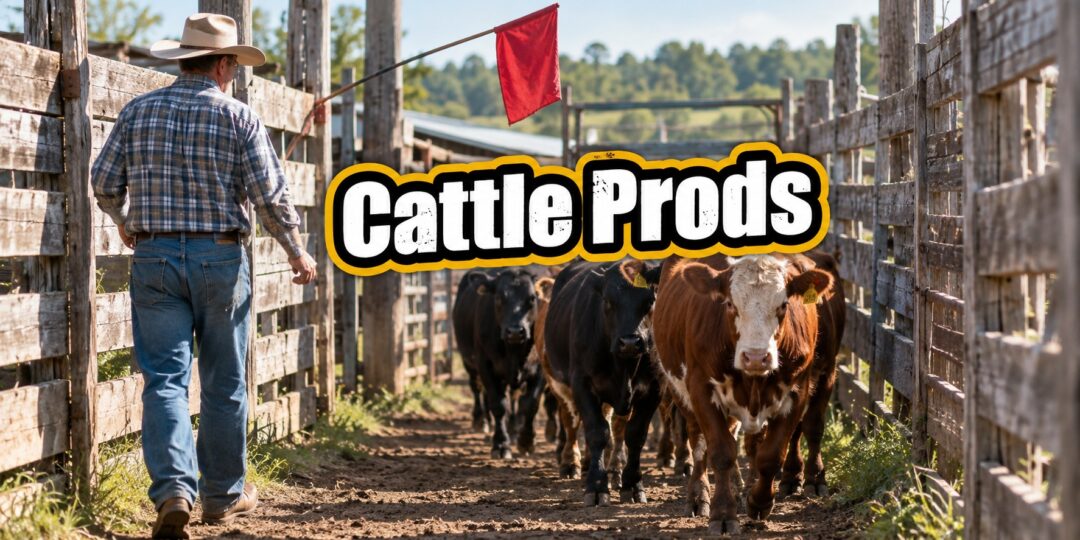
A flag on a light stick, a plastic paddle, or even a length of PVC pipe with plastic ribbons tied to the end does most of what a prod does without the pain. Small, deliberate movements near an animal’s head turn it left or right just as effectively as a shock, and a calm animal responds to these tools far more predictably than an agitated one responds to anything.
I keep a simple flag stick hanging by my corral gate now, and it’s what I reach for automatically. The prod stays in the barn, reserved for the rare animal that’s genuinely planted its feet and won’t move for anything gentler.
Building a Facility That Reduces the Need for One
Good facility design does more to eliminate prod use than any tool or technique. NC Cooperative Extension’s handling guide recommends keeping working alleys around 26 to 28 inches wide for most cattle, since a too-wide alley lets animals turn around and balk, and an alley height around 60 inches to prevent jumping or getting hung up.
A curved chute design also helps enormously, since cattle can’t see the far end while standing in the crowding pen and are more willing to move forward as a result. Straight alleys that dead-end into a visible gate tend to make animals balk exactly where you need them moving most.
When a Cattle Prod Actually Makes Sense on a Homestead
There’s a real, narrow use case here, not just a theoretical one. A genuinely planted animal at the entrance to a squeeze chute, blocking every other animal behind it and creating a real safety hazard, is a legitimate moment to use a properly rated prod briefly on the hip and move on.
What isn’t a good use case is a prod as your everyday moving tool, used on animals that are already walking, or used out of impatience because gentler methods would just take a few more minutes. If you find yourself reaching for it regularly, that’s a signal to look at your facility design or handling technique rather than your prod’s battery level.
My Own Mistakes With This Tool
My first year, I used the prod on cattle that were already moving, just to speed them along a little faster than they wanted to go. All that actually accomplished was making the whole group more agitated and harder to load, which took longer overall than if I’d just been patient in the first place.
I also learned the hard way that a stressed, agitated animal remembers rough handling and gets harder to work with every subsequent time, not easier. Cattle have long memories for bad experiences at a chute, and a few overly aggressive handling sessions early on cost me months of extra difficulty getting the same animals through the same equipment later.
Buying Considerations
If you decide you genuinely need one, stick to a reputable battery-operated model rated within the legal voltage range rather than anything marketed as extra powerful. More voltage isn’t more effective, it’s just more likely to cause an injury or a genuinely traumatized animal.
Length matters more than people expect. A longer prod, in the two to four foot range, keeps you further from an animal’s hind legs during the moment you’re most likely to need it, which is a real safety consideration for the handler, not just the animal.
Check the battery type before you buy, since some models use proprietary rechargeable packs that are expensive and slow to replace, while others run on standard replaceable batteries you can grab from any hardware store. For a tool you’ll use rarely, standard batteries that won’t die quietly in a drawer over the winter are worth the small trade-off in charge time.
Frequently Asked Questions
Are cattle prods legal to own for a small homestead?
Yes, they’re legal to own and use, though federal handling regulations around proper voltage and application apply to commercial and processing settings specifically. Following those same limits on a small homestead is simply good practice, not a legal requirement most backyard operations will be audited on.
Do prods hurt cattle badly, or is it a minor annoyance?
A properly rated prod delivers genuine pain, which is the entire mechanism by which it works, not a mild tickle. That’s exactly why professional guidelines treat it as a last-resort tool rather than a casual first option.
What should I use instead for a single stubborn cow?
Start with a flag or paddle and check whether the animal is balking at something specific, a shadow, a noisy gate, standing water, before assuming it’s simple stubbornness. Removing the actual distraction usually solves the problem faster than any tool, prod included.
Can I use a cattle prod on other livestock like goats or pigs?
Electric prods are specifically discouraged on smaller or younger animals, and international welfare standards recommend against using them on sheep entirely since wool insulates against the shock. For goats, pigs, and other smaller livestock, a paddle or panel is both more humane and more effective.
Real Self-Reliance Starts With Skills, Not More Equipment
Knowing when not to use a tool can be just as important as knowing how to use one.
As you’ve seen with cattle handling, experience, observation, and the right technique can often accomplish more than brute force or another piece of equipment. Learning concepts like flight zones, animal behavior, and better livestock-handling methods is exactly the kind of practical knowledge that makes a homestead safer and more independent.
But livestock handling is only one of the old-fashioned skills worth knowing.
The Lost Skills of Independence brings together practical knowledge that generations before us relied on to run their homes, raise food, preserve what they produced, repair what broke, and become less dependent on modern systems.
Inside, you’ll discover forgotten and disappearing skills that can help you become more capable around your property—from traditional homesteading and food-production techniques to preservation, practical DIY solutions, and other methods of self-sufficient living.
These aren’t skills you learn because you expect the world to end tomorrow. They’re skills worth having because the more you know how to do yourself, the less you have to depend on someone else to do for you.
Whether you’re already running a homestead or simply want to become more prepared and self-reliant, this is the kind of knowledge that’s worth keeping on your bookshelf.
Rediscover the practical skills our grandparents took for granted.
Final Thoughts
A cattle prod is a real tool with a real, narrow purpose, not the default solution its reputation suggests. The handlers who move cattle most efficiently, with the least stress to the animals and the least risk to themselves, are the ones who’ve learned to barely need one.
Learn your cattle’s flight zone and point of balance first, invest in a flag or paddle before an electric prod, and if you do own one, respect the voltage limits and the areas that are always off-limits. The goal on any homestead should be a quiet corral, not a loud one.
None of this is about being precious over cattle handling. It’s that calm animals are genuinely easier, safer, and faster to work with than stressed ones, every single time, and a drawer where the prod mostly sits unused is usually a sign you’re doing something right rather than something you’re missing.
You may also like:
 Join Our Humble Facebook Homesteading Group
Do You Know Why You Should Never Put A Tall Fence Around Your House? (Video)
Holstein Cow – What Every Homesteader Should Know Before Getting One
Do Cows Have to Be Pregnant to Produce Milk? The Straight Answer
Cattle vs Cows: What Is the Actual Difference?
Dexter Cows: The Small Cattle With a Big Role in Self-Sufficiency
Long-Lasting Foods From the Great Western Cattle Trail