A fence does a lot on a homestead. It keeps animals from wandering off, keeps predators away, and hopefully stops deer from eating your garden.
It also marks your property and separates one working area from another.
The only problem is that fencing gets pretty expensive.
Building a small fence around your flower beds is one thing, but fencing your whole property gets complicated. Just think about all the materials you need, from wire to gates, do the math, and you’ll notice that your wallet is not ready for that.
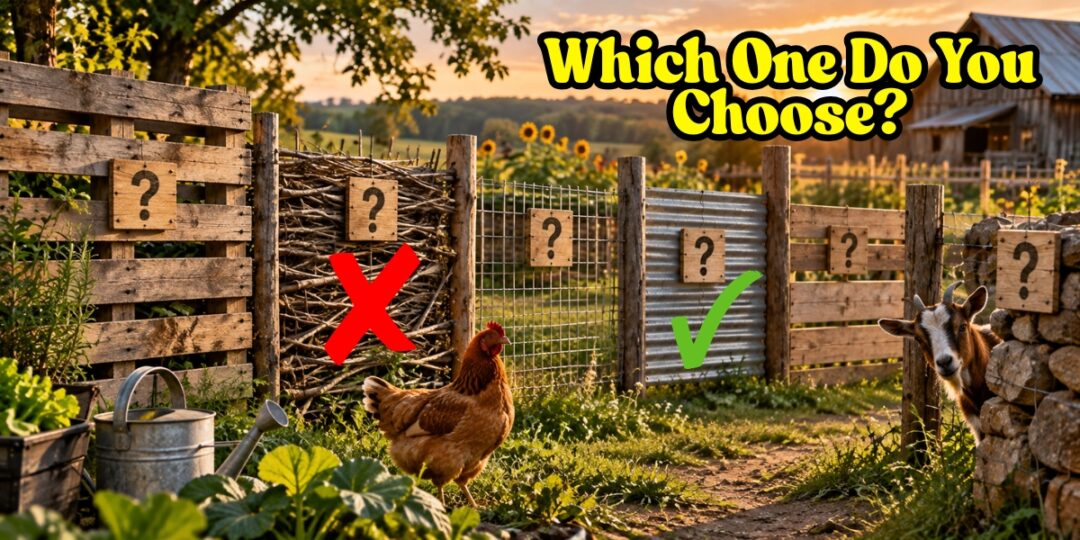
But there are quite a lot of low-cost fence options out there that every resourceful homesteader should know about. Here are seven options I considered for my homestead, along with where I would and wouldn’t trust them.
A Pallet Fence That Barely Costs a Thing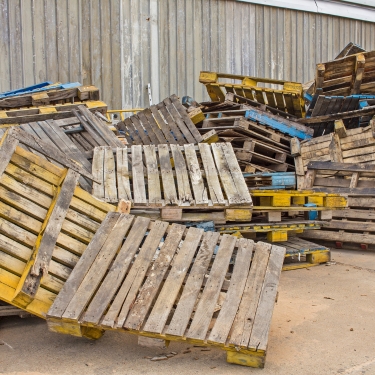
If you can find decent pallets for free, you already have most of a fence. Look on Facebook groups and Craigslist for them. These are the best places to get stuff for free.
The usual setup is simple: drive steel T-posts into the ground and secure whole pallets between them. The pallets become the panels, so you aren’t buying lumber board by board.
People have used pallet fences around gardens, chicken runs, and pig areas. I actually have a homesteader friend from Michigan who used pallets around their pigs and found that they held up, but they also ran electric wire along the inside. That kept the pigs from rubbing on the pallets, pushing them loose, or trying to dig underneath.
Now I don’t know if I would ever use pallets to build a fence for pigs, but for a garden, poultry run, or temporary pen, I’d happily use pallets.
Also, what type of pallets you choose is a big thing. Check the stamp. HT means heat-treated, which is the one you want. MB means the pallet was fumigated with methyl bromide, so leave that one where you found it.
But using a pallet for building a DIY fence is just one idea. Pallets are one of the most flexible building materials out there and there are hundreds of projects you can use them for, just like one of this community’s favorites, cinder blocks.
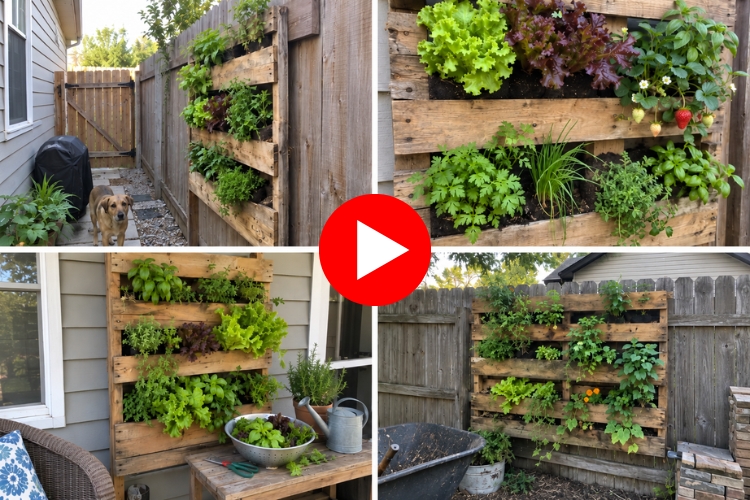
I’ve tried numerous pallet projects myself, but the most useful one is by far the vertical pallet garden.
Most of us grew up with the same idea of what a “real” garden should look like: a big patch of ground, long rows of vegetables, plenty of sun, and enough space to spread everything out.
And if you don’t have that kind of yard?
Well, you’re basically told to settle for a few pots of herbs and call it a day.
The strange thing is, nobody really teaches you to look up.
We spend so much time worrying about square footage that we completely ignore all the empty space above it. Fences, walls, porch railings, and the sides of sheds can all become growing space, yet most of it sits unused year after year.
That’s what makes a vertical pallet garden so useful.
Instead of needing a huge garden bed, you’re stacking your growing space upward. One small patch of ground can suddenly hold several levels of herbs, lettuce, strawberries, and other compact crops.
It’s almost like finding extra land you didn’t know you had!
And once you start looking at your yard this way, you realize just how much growing space we’ve been wasting simply because nobody taught us to use it.
Want to see exactly how this vertical pallet garden works, plus more pallet projects that can make a small homestead a lot more useful?
Click here to see the full project along with other skills they refuse to teach us anymore →
Turn Your Brush Pile Into a Fence
If you prune trees, clear brush, or cut back shrubs every year, you probably already have fence material sitting in a pile somewhere.
You can use them to build a dead hedge. This is an amazing free alternative to regular fencing, and the basic design is really simple.
Drive two parallel rows of sturdy stakes into the ground, leaving a gap between them. Then fill that gap with branches, sticks, and woody prunings. Pack them in as you go.
The branches catch on each other and settle down over time. When the lower material starts breaking down, throw more brush on top.
Now, it won’t look like a new board fence. Depending on how you build it, it can look pretty rough. But if that bothers you, choose the woven wattle-style. This makes it look more welcoming.
This is the kind of fence I’d put along the edge of a garden, orchard, or wooded area. I wouldn’t use it where the whole point is making absolutely sure an animal cannot get through.
This Fishing Line Fence Trick Can Stop Deer 
So apparently, fishing line around your garden has been proven to keep deer away. Penn State Master Gardeners in Westmoreland County tried it in their daylily demonstration garden.
They had deer eating the plants, so they placed 5-foot T-posts around the garden and ran heavy fishing line between them at three different heights. The highest line was around 4 feet off the ground. They didn’t pair it with repellent. The main maintenance was walking the fence about once a week and checking for broken lines.
The daylilies came back and bloomed during both the 2023 and 2024 seasons. What I like the most about this trick is that it barely changes the look of a small garden from a distance.
The likely reason is that deer have trouble seeing the thin line well enough to judge it. They bump into something they didn’t expect, can’t quite tell what is in front of them, and tend to back away instead of confidently pushing through.
If you want to be 100% sure deer will stay away, you can also try to add a natural barrier. This means adding plants that deer hate to your garden, such as yarrow, lamb’s ear, garlic, or onion.
If you want to make things easier, you can get this NON-GMO seed pack. All of the seeds are packed here in the U.S. and the herbs you get are exactly the ones deer hate.
These are the seeds I buy all of the time and I always get beautiful results.
Another advantage is that all of these plants are medicinal herbs, so besides keeping deer away, you can use them around your homestead to make teas and remedies.
Get your own seed pack here and make all deer avoid your property once and for all.
A Fence You Can Take Apart and Move
It’s true that cattle panels cost more than free pallets or fishing line, but they have one advantage I really like: you can use them forever.
If you’re not sure what I’m talking about, these are the rigid welded-steel panels sometimes sold as cattle panels or hog panels. They hold their own shape, which means you don’t need a heavy framework around them. You can easily attach them to wood posts, pipe posts, or ordinary steel T-posts, and they can be cut down when needed.
For me, the best part is that the panels aren’t married to one spot. I find this so important on a homestead.
Why?
Because let’s say you choose a spot for your garden. After one year with a poor harvest, you decide to move it a little bit more to the left to get more sun. Or you want to make more space for your livestock. Imagine doing all of this with a regular fence. That would be terrible.
With cattle panels and T-posts, you can pull the posts, carry the panels somewhere else, and start over without throwing away the fence you already paid for.
They’re not the cheapest thing on this list, but they are really good and will pay for themselves in the long run.
The Fence You Move Right Along With Your Animals
For temporary livestock fencing, polywire is hard to beat.
Polywire is lightweight plastic cord with small conductive wires woven through it. It runs between step-in posts that you can push into the ground by hand. Connect it to an energizer and you have a portable electric fence.
When you want the animals somewhere else, wind the wire onto a reel, pull the posts, and move the whole setup.
This is one of the fastest and cheapest ways to contain livestock.
Since the wire is light, it doesn’t need the same heavy posts and bracing you’d use for a permanent fence. This is especially useful for rotational grazing.
Grow Your Fence Instead of Buying One
Long before farm stores were stacked with rolls of wire, people were growing fences.
Osage orange, often just called hedge in parts of the Midwest, was planted in thick rows across the prairie before barbed wire became common. The U.S. Forest Service describes its thorny, low, spreading growth as useful for fencing when the hedge is properly maintained.
Osage orange became a big part of fencing history on the plains.
The downside is obvious: this one takes time.
You can’t plant a row this spring and expect it to hold livestock next month. It has to establish, and you’ll need to train and prune it. It also won’t suit every climate or property.
Still, as a long-term project, I can see why people used it.
Wooden fences rot. Wire sags. Posts loosen. A living hedge, if it suits the site and you keep it maintained, gets thicker as it grows instead of slowly falling apart.
NRCS still recognizes dense hedgerow planting that creates a living barrier as a conservation practice, so this old idea hasn’t disappeared.
I’d look at it as a long-term boundary, windbreak, or extra barrier behind another livestock fence. It’s something you plant because you know you’ll still need a fence there years from now.
A Fence Designed for Home Security
Most people are taught to think of a fence as a property line. Something to keep the dog in, mark the edge of the yard, and maybe give you a little privacy.
That’s a pretty low bar.
If you’re homesteading, your fence can be part of something much bigger: a layered security system that makes your property harder to approach without being noticed. A sturdy fence, controlled gates, good lighting, cameras or alarms, and reinforced doors and windows all buy you something valuable – time and warning.
That’s really what “bugging in” is about.
It isn’t hiding in a bunker waiting for the world to end. It’s making the place you already live more self-reliant, more prepared, and harder to disrupt.
And once you start looking at your homestead through that lens, you’ll realize how many weak spots most homeowners never even think about.
Want to see how to turn an ordinary property into a much harder target? Click here to see the full bug-in security setup →
The Good Old Electric Fence
A permanent electric fence can save money too, just in a different way.
Instead of building a solid wall of woven wire, high-tensile electric fencing uses fewer strong, tightly stretched wires. Those wires are placed at the right heights for the animals you’re keeping, and the shock teaches them to stop testing the fence.
That means you can often get away with fewer posts and less fencing material.
Electric fencing is more cost-effective and easier to put up and repair than barbed wire, with fewer posts.
But your corner braces need to be solid. The grounding has to be right. Weeds touching the wire can drain power, and the animals need to learn what touching it means.
You also can’t copy one fence design and expect it to work for every animal.
Wire spacing and the number of wires should change depending on what you’re trying to contain. A setup that works fine for cattle may mean absolutely nothing to a goat that has decided to go somewhere.
Built right, though, high-tensile electric fencing can give you a permanent livestock fence without paying for heavy mesh all the way around.
Final Thoughts
One thing I’ve learned is that the cheapest fence isn’t always the one with the lowest price tag in the store.
Sometimes you can make it from materials you already have. Sometimes it’s something you’ll pay more for in the beginning, but in the end you’ll have it standing on your homestead for decades.
The main thing is matching the fence to what you’re actually trying to do.
So before you start building a fence, think about what you’re intending to use it for. There’s no reason to throw money away on an expensive fence meant to contain livestock when you just want to keep your garden safe.
You may also like: 
How to Keep Deer Out of Your Property Without Building a Fence
See How This Portable Backpack Water Generator Can Give You 10 Gallons Per Day (Video)
200 Skills You Need to Become 100% Independent
Why My Grandfather Buried a Coffee Can Under Every Fence Post
This DIY ‘Ghost Fence’ Works Better Than Electric Fencing