If you’ve never heard of a ghost fence, that’s no surprise. Most fences are defined by barbed wire, chain links, or are electrified. They’re all relatively expensive and require varying degrees of maintenance.
In the case of electrified fences, they’re not only expensive to operate but also dangerous and often unreliable. Heavy snow shorts out the fence and, in some areas, can even result in an increase in insurance premiums.
Barbed wire fences can actually harm animals, especially pets and even people. And then there’s the ghost fence.
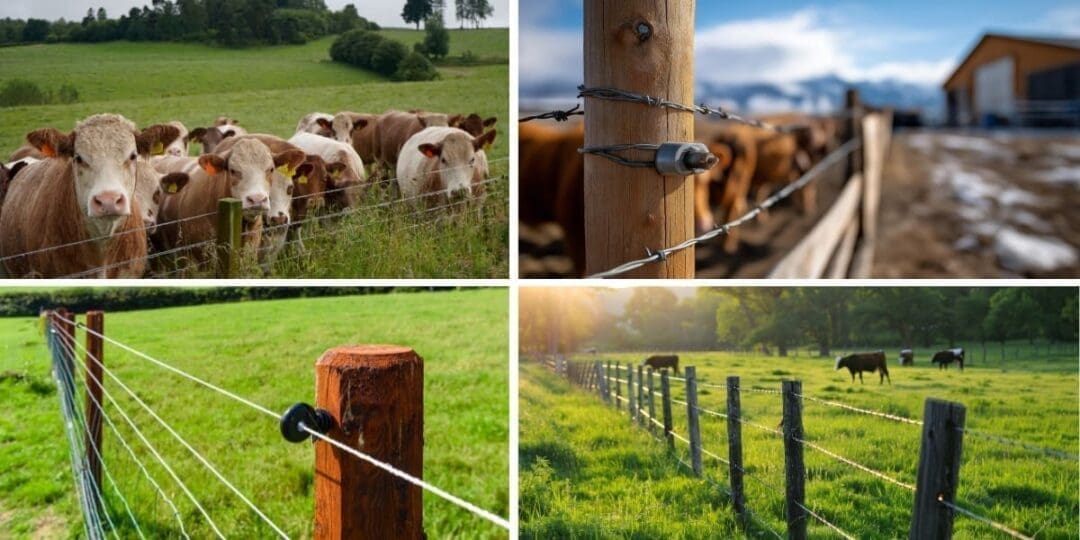
A ghost fence is not as visible as most fences and never electrified. It’s usually defined by thin wire, poly ropes, or other cordage. The wires or ropes are often white so the animals can see the barrier, but the thinness of the wire or cordage makes it difficult for an animal to judge how to jump or get through the fence. And to be clear, a ghost fence doesn’t work for all animals. We’ll cover the animals that are best contained in a ghost fence and those that aren’t.
The fence posts are usually 4 feet tall, and the wires are spaced down the posts every 10 to 12 inches. Sometimes small strips of fabric or reflective tape are attached to the wires to make them more visible. That’s optional depending on how your animals respond to the fence.
The small flags of fabric or tape could also be temporary until the animals learn that the wire’s defined a boundary.
In fact, it makes sense to train your animals to recognize and respect the fence. You can do that by walking them along the fenceline for a week or two. The same applies to pets, although smaller dogs will find their way through. An extra line of wire towards the bottom of the posts can help solve that problem.
The ghost fence is just one example of how we can use simple materials to solve real problems without power, expenses, or constant upkeep.
Such projects quietly solve problems most people accept as unavoidable. If you want to see more of them, click here.
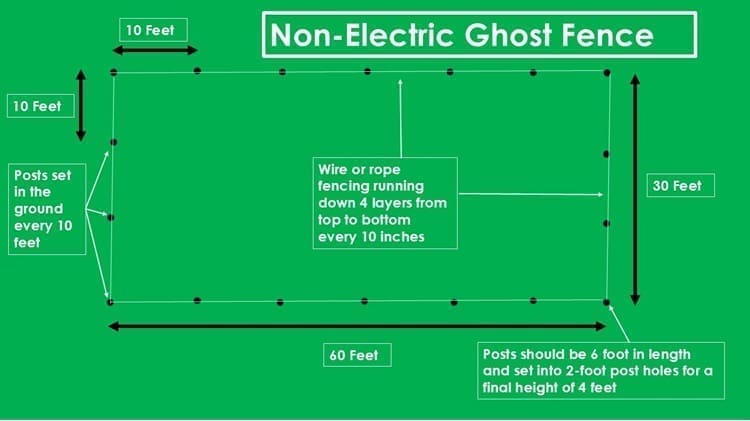
Installing a Ghost Fence
The infographic above shows the basic design and layout of a ghost fence.
- The fence posts are 6 feet long and dropped into post holes 2 feet deep resulting in a 4 foot height for each post.
- The posts are spaced 10 feet apart.
- The strongest posts should be at the corners allowing you to use lighter posts along the lengths if you want.
- You also have an option when it comes to wiring the fence. You can run the wire parallel on both sides of the post essentially creating a double wire. This can confuse the depth perception of certain animals like deer.
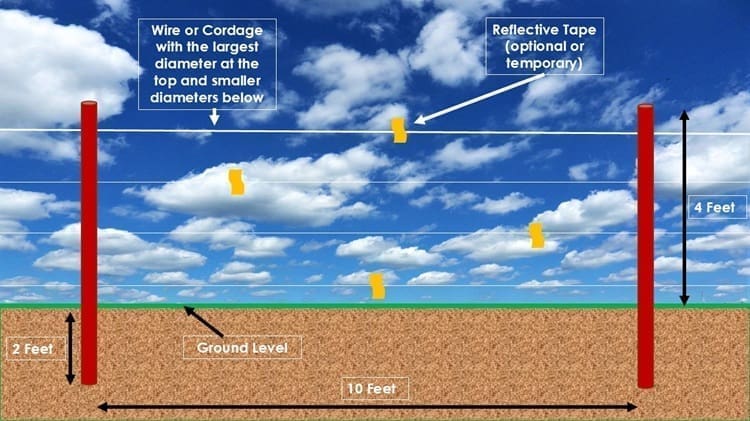
Here’s a ground level view of a ghost fence.
- Start with the top wire or cordage. It should have the most thickness or width.
- Repeat the wiring 10 to 12 inches down on the posts. The next levels of wire below should be a smaller diameter.
- Add your reflective tape or small flags to the wires to ensure the animals see it. Here again, this is optional and could also be temporary.
- Finally, consider mesh. It’s not quite ghostlike but it works.
When a Ghost Fence Won’t Work
Animals vary and some can either slip through a ghost fence or just barge right through it. Here are the exceptions to consider.
Small Animals
Rabbits, squirrels, raccoons, possums, skunks and other small animals can easily squeeze through the gaps in a ghost fence. If they’re a problem, you probably need a more robust fencing material resulting in a finer mesh they can’t squeeze through.
Aggressive, Large Animals
Think in terms of bulls, bears and boars. They’ll barge right through without hesitation. If you have a problem with larger animals like that, an electrified fence might be the only solution or a reinforced metal fence. Better yet, a brick or stone fence but unless you have fields of stone that’s going to get very expensive.

Jumpers
Deer, antelope, even moose and elk are not shy about jumping. Hopefully the flags or reflective tape deter them, and the double parallel wires can also work. If you have a problem with jumpers, consider raising the height of the posts to 6 feet about ground and adding another couple of lines of wire. You also may need to keep those flags attached to the wires because you never know when a new jumper will come to town.
We want to keep our livestock safe, but the biggest mistake we make is thinking that barriers such as a fence are enough. As I mentioned above, small predators can easily get past your defense no matter how hard you try to keep them away.
Weasels and mink are some of the smallest but most destructive pests out there and can pass through holes barely wider than a thumb, often killing multiple birds in a single night!
Without a secure, well-built shelter, chickens remain vulnerable no matter how strong the perimeter looks. In this case protecting them means understanding the necessity of a well-built coop.
If you want to learn how to build a sturdy, resourceful DIY Amish chicken coop that protects your chickens when fences can’t, click here.
The Electrification Myth
There are some who have reported that the reason a ghost fence works is because it looks like an electrified fence and the animals can recognize the risk. That’s fundamentally absurd. Animals learn to respect the perimeter defined by an electrified fence after getting shocked, sometimes repeatedly. It’s highly unlikely that a cow, goat or pig is going to look at a ghost fence for the first time and assume it’s something they may have never experienced.
👉 Learn how to secure clean water for your home here!
A Ghost Fence is Highly Cost-Effective
Compared to other fences, a ghost fence can be very inexpensive. The posts can be harvested from your property, or you can purchase metal fence supports you pound into the ground.
The wire, cordage or rope is also relatively inexpensive and roll of reflective tape or even a roll of red construction ribbon is on a few dollars or less. What’s critical is that you consider the types of animals you want to contain or keep out. Here’s a chart of who respects a ghost fence and who does not.
| ANIMAL TYPE | WORK WITH GHOST FENCE? | WHY? |
| Dogs | YES | Respect barriers |
| Sheep | YES | Not strong jumpers |
| Goats | YES | Respect barriers |
| Alpacas/llamas | YES | Calm, timid |
| poultry | YES (needs small mesh) | Not real smart |
| Cattle/Bulls | No | Too strong |
| Horses | No | Only respect highly visible fencing |
| Pigs | No | Dig and lift |
| Deer | No | High jumpers |
| Coyotes/Foxes | No | Climb and dig |
To Ghost of Not to Ghost
It really all depends on the types of animals you’re dealing with. A ghost fence is inexpensive, easy to install and safe. It’s worth a try if you’re debating what kind of fence you need and you always have that mesh option.
You may also like:
Dexter Cows: The Small Cattle With a Big Role in Self-Sufficiency
How to Get 295 Pounds of Extra Food for Just $5 a Week (Video)
RM43 Weed Killer – What It Does And Why Many Homesteads Are Choosing Another Path
How to Harvest 1000+ Gallons of Water from Your Roof