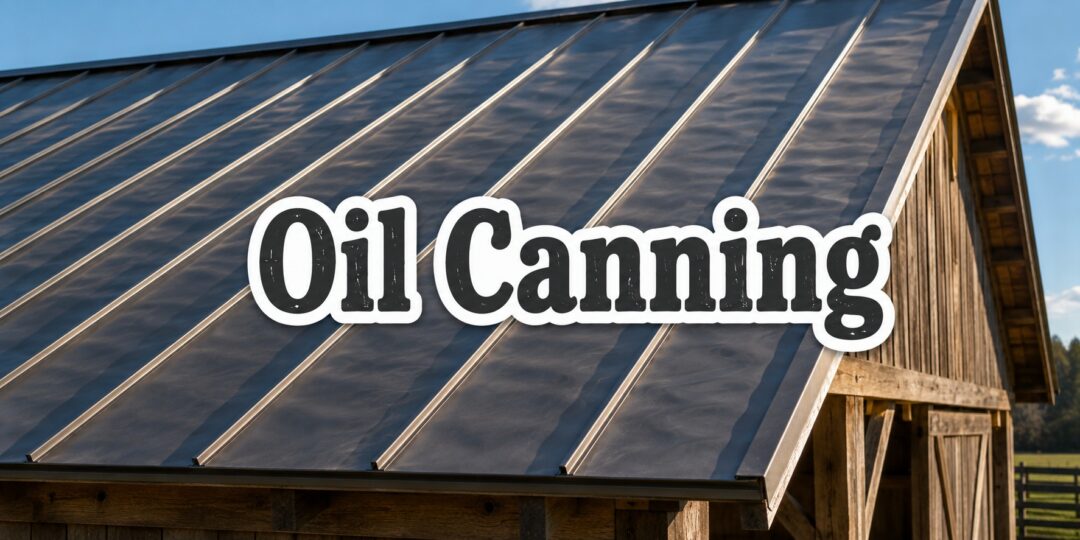
The first time I noticed waviness rippling across my barn roof in the afternoon sun, I was convinced something had gone seriously wrong with the install. A neighbor who’d put up three times as much metal roofing as I ever will just shrugged and called it oil canning, then told me not to worry about it. He was mostly right, but there was more to the story than a shrug.
This guide covers exactly what oil canning is, why it shows up on metal roofs and siding, whether it’s actually worth worrying about, and what you can do at the ordering and installation stage to keep it to a minimum. If you’re putting a metal roof on a barn, shed, cabin, or the house itself, this is worth understanding before the panels ever arrive.
A Quick Note on Terminology
If you’re researching this term online, know that the phrase has nothing to do with food preservation, despite the word canning. It’s strictly a metal fabrication and roofing term, borrowed from the visual similarity to the dents that appear on the bottom of a thin metal can when pressed.
This can cause some confusing search results if you’re used to canning meaning food storage on a homestead site. Once you know the term is unrelated, the rest of the topic is straightforward.
What Oil Canning Actually Is
Oil canning is the visible waviness or rippling that shows up in the flat areas of metal roofing and wall panels. According to the Metal Construction Association, this waviness is technically known as elastic buckling, or stress wrinkling, and it can occur in steel, aluminum, zinc, or copper panels alike. The name comes from the resemblance to the dents that appear on the flat bottom of an old oil can when you press on it.
It shows up most on the broad, flat sections of a panel rather than the ribs or seams, since flat metal has nothing to interrupt or stiffen it against the internal stresses that cause the waviness. Standing seam panels, which rely on wide, uninterrupted flat pans between the seams, are more prone to it than heavily ribbed panels.
Is Oil Canning a Real Problem or Just Cosmetic
This is the question that matters most, and the honest answer is that oil canning is a cosmetic issue, not a structural one. It doesn’t weaken the panel, doesn’t create a leak path on its own, and doesn’t reduce how long the roof will last.
That said, cosmetic doesn’t mean invisible or unimportant, especially if the roof is on a house or a highly visible building. Most manufacturers explicitly exclude oil canning from their warranties, since it’s considered an inherent characteristic of light-gauge, cold-formed metal rather than a manufacturing defect.
What Actually Causes It
Pinpointing a single cause on any given roof is nearly impossible, since oil canning results from a combination of factors stacking up rather than one clear culprit. Metal panels expand and contract with temperature swings, and if that natural movement is restricted, internal stress builds up and shows as waviness.
- Thermal expansion and contraction, especially where one part of a roof sits in full sun while another stays shaded
- Over-tightened or over-driven fasteners that don’t allow the panel any room to move
- An uneven roof deck or substrate that telegraphs its irregularities into the finished panel
- Wider panels and thinner gauge metal, both of which reduce a panel’s natural stiffness
- Manufacturing stress introduced during rolling, forming, or coil slitting, before the panel ever reaches the job site
- Glossy finishes, which make any waviness far more visible by reflecting light unevenly
Panel Type Matters: Standing Seam vs Exposed Fastener
Not every metal roof is equally prone to this. The U.S. Department of Energy’s Building America Solution Center explains that exposed fastener panels are typically ribbed for stiffness and screwed directly through the face into the deck or purlins, while standing seam panels use concealed fasteners and clips that let the panel float and move independently of the fasteners themselves. That freedom of movement is great for handling thermal expansion overall, but the wide, unbroken flat pans on standing seam panels are exactly where oil canning shows up most.
If you’re building a working barn, equipment shed, or any structure where appearance is secondary to function, a ribbed exposed fastener panel is both cheaper and naturally more resistant to visible waviness. If you’re set on the clean, seamless look of standing seam for a house or a highly visible building, you’re accepting a higher chance of oil canning as part of that tradeoff.
How to Minimize Oil Canning Before You Order Panels
- Choose a heavier gauge metal; thicker material resists the buckling that causes waviness
- Order narrower panel widths rather than the widest option available for your profile
- Pick a profile with more ribs, flutes, or striations, since these interrupt the flat area and add stiffness
- Choose a low-gloss or matte finish over a high-gloss one, which hides minor waviness far better
- Go with a darker color if appearance is a top priority, since dark, matte finishes minimize visible reflection
None of these choices guarantee a perfectly flat panel, since no manufacturer can promise total prevention. They do meaningfully shift the odds in your favor, and they’re far easier decisions to make before an order is placed than after a roof is already up.
Installation Practices That Prevent Oil Canning
Good material choices only go so far if the installation itself introduces stress into the panels. Over-driving or angling fasteners is one of the most common installation mistakes, since it can pin a panel too rigidly and leave no room for the metal’s natural thermal movement.
A flat, properly prepared roof deck matters just as much. Any irregularity in the substrate underneath, whether from uneven purlins, warped decking, or debris left under the panel, will telegraph straight through into the finished surface and show up as waviness.
Fasteners should be driven straight and snug, not cranked down hard enough to compress the rubber washer flat. On standing seam systems specifically, clips need to be spaced and installed exactly as the manufacturer specifies, since improperly spaced clips restrict the panel’s ability to expand and contract the way the system was designed to handle.
Choosing the Right Roof Deck and Substrate
Exposed fastener panels are commonly installed directly over open purlins on barns and outbuildings, which works well as long as the purlins themselves are straight, level, and properly spaced. Standing seam systems, by contrast, typically need a solid deck of plywood or OSB sheathing underneath, since the panels and clips need a consistent, flat surface to attach to.
If you’re re-roofing an older structure, check the existing deck carefully before panels go on. A deck with soft spots, rot, or long-term sag will not only cause oil canning, it can lead to far more serious structural problems down the road.
Living With Oil Canning If It’s Already There
If your roof already shows waviness and a full re-install isn’t in the cards, there are still ways to reduce how noticeable it is day to day. Waviness is most visible in direct, low-angle sunlight, particularly in early morning or late afternoon, so how a roof faces the sun plays a real role in how often you actually notice it.
Adding gutters, snow guards, or other visual breaks across a large flat run can also help disrupt the sightline that makes waviness so noticeable from certain angles. Beyond that, time and temperature cycling sometimes soften the appearance slightly, though it rarely disappears entirely once it’s established.
Oil Canning on a Homestead: Does It Actually Matter
For a barn, chicken coop, equipment shed, or any working structure where function outranks appearance, oil canning is genuinely a non-issue. The roof still sheds water, still blocks wind and hail, and still lasts just as long whether the flat panels are perfectly smooth or show some waviness in the afternoon sun.
Save the extra cost of heavier gauge panels, narrower widths, and premium matte finishes for the structures where appearance genuinely matters to you, like the main house or a highly visible workshop. On outbuildings built for durability and function, that budget is almost always better spent on thicker gauge for strength and impact resistance than on cosmetic upgrades aimed purely at minimizing waviness.
Metal Roofing Materials and Oil Canning Risk
Steel, aluminum, zinc, and copper all show some tendency toward oil canning, but they aren’t equally prone to it. Aluminum, being softer and more flexible than steel, tends to show waviness more readily, while heavier gauge steel generally resists it better for a comparable panel width.
Copper and zinc develop their own natural surface texture and patina over time, which can actually help disguise minor waviness compared to a smooth, painted steel or aluminum finish. If minimizing visible oil canning is a top priority and budget allows, that’s worth factoring into a material decision alongside cost and durability.
Related: Aluminum Foil for Faraday Cage
How Roof Pitch and Panel Orientation Play a Role
Steeper roof pitches tend to show oil canning less than low-slope applications, partly because the viewing angle from the ground makes flat-on glare less likely and partly because steep roofs shed water and reduce ponding that can accentuate surface irregularities. Panel orientation matters too, since a panel run parallel to the strongest sun exposure will often show more visible waviness than one oriented differently.
None of this means you should redesign a roof’s pitch purely around oil canning avoidance. It’s simply useful context if you’re already deciding between a couple of roof designs and want one more small factor in favor of the option that happens to minimize visibility.
Common Mistakes That Make Oil Canning Worse
- Ordering the widest panel profile available to save on installation time and material cost
- Over-tightening fasteners in an attempt to make the roof feel extra secure
- Skipping deck prep and installing directly over an uneven or warped substrate
- Choosing a high-gloss finish for a highly visible roof without understanding how it affects visibility of waviness
- Assuming a warranty will cover oil canning, when most manufacturers explicitly exclude it as a cosmetic characteristic
A Self-Reliant Homestead Needs More Than Food and Water – It Needs Skills
Knowing how to grow vegetables and preserve food is important.
But real independence also means understanding the barn over your animals, the shed protecting your tools, the roof over your supplies, and the structures your family depends on every day.
Oil canning is a perfect example.
Someone who doesn’t understand metal roofing might see those ripples and immediately assume the roof is failing, or spend money trying to fix something that’s largely cosmetic.
Someone with the right knowledge knows what matters, what doesn’t, and what should have been done differently before the first panel ever went up.
That’s the difference practical knowledge makes.
Rediscover the Skills People Once Learned as Part of Everyday Life
The Lost Skills of Independence is about bringing back the practical abilities that made previous generations far less dependent on someone else to solve every problem.
It’s for people who want to know how to build, repair, grow, preserve, improvise, maintain, and make better use of what they already have.
Because on a truly self-reliant property, there’s always something that needs attention.
A structure needs repairing.
A tool needs maintaining.
Food needs preserving.
Something needs building.
A problem needs solving without waiting for somebody else to arrive.
The more of those problems you can handle yourself, the less fragile your independence becomes.
Your Most Valuable Tool Isn’t Hanging in the Workshop
You can buy better tools.
You can stockpile spare materials.
You can build a stronger barn.
But none of those things replace knowing what to do when something goes wrong.
And unlike supplies, knowledge doesn’t disappear when the shelves are empty.
The Lost Skills of Independence brings together practical, old-fashioned know-how that can help you become more capable around your home or homestead, not someday after an emergency, but starting now.
Learn the skills while materials are available, mistakes are still affordable, and you have time to practice.
Because when you genuinely need to depend on yourself, that’s a terrible time to start learning how.
👉 DISCOVER THE LOST SKILLS OF INDEPENDENCE HERE!
Frequently Asked Questions
Can oil canning be fixed once it happens?
Not reliably. Once the stress has set into the panel, there’s no practical way to press or heat it back to perfectly flat without risking further damage; prevention at the ordering and installation stage is far more effective than any after-the-fact fix.
Does oil canning mean my roof will leak?
No. Oil canning is a cosmetic surface characteristic and has no direct connection to a panel’s ability to shed water or hold a seal.
Is oil canning more common in certain climates?
Yes, areas with wide daily temperature swings, especially where one section of roof sits in shade while another bakes in full sun, tend to show more oil canning than climates with more stable temperatures.
Should I avoid metal roofing because of oil canning risk?
No. For the vast majority of structures, especially barns, sheds, and outbuildings, oil canning is a minor cosmetic quirk that doesn’t come close to outweighing the durability, fire resistance, and longevity metal roofing offers over asphalt shingles.
Final Thoughts
Oil canning is an inherent, mostly cosmetic quirk of flat metal panels, not a sign of a bad roof or a bad install. Understanding what causes it lets you make smarter choices on gauge, panel width, profile, and finish before you order, and good installation practices around fastening and deck prep keep the odds in your favor once the panels go up.
You may also like:
Our Private Facebook Group Is Accepting New Members Now!
Why You Should Always Store Water Next To A Fence (Video)
12 Ways To Mouse-Proof Your Homestead
EMP Proof Vehicles For Homesteaders
How to Looter Proof Your Stockpile
How To Turn Your Home Into A Bomb-Proof Shelter