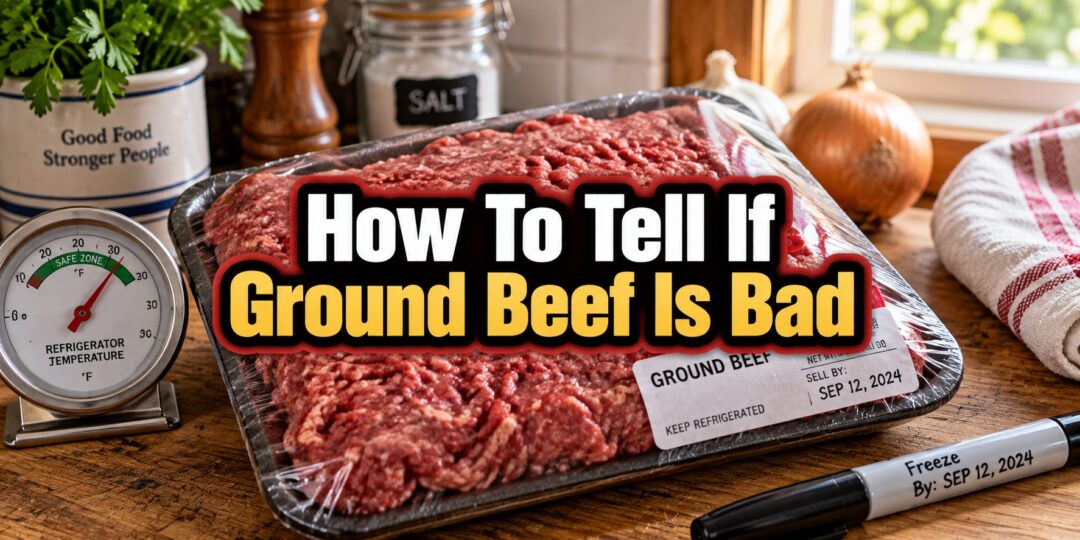
Why Ground Beef Spoils Faster Than a Steak
I learned this the hard way years ago, keeping ground beef in the fridge the same length of time I kept a roast, and ending up with a package that smelled off a full day before I expected it to. Ground beef spoils faster than whole cuts for a simple structural reason: grinding exposes far more of the meat’s surface to air and bacteria than a solid piece ever would.
The USDA’s Food Safety and Inspection Service explains this plainly, noting that when meat is ground, more of the meat surface is exposed to bacteria, and grinding also mixes any bacteria present on the surface throughout the whole batch. That is exactly why I now treat ground beef with a shorter clock than any other cut in my freezer or fridge, and it is the first thing I explain to anyone new to handling meat on the homestead.
The Smell Test Comes First
Before I even look at a package, I smell it. Fresh ground beef has a mild, faintly metallic scent, almost nothing at all if it is truly fresh, and that neutral smell is your baseline for comparison every time after this.
A sour, tangy, or distinctly unpleasant odor is the clearest single sign that spoilage bacteria have taken hold, and in my experience it is usually the very first sign to show up, often before the color or texture has changed at all. I open the package, take one honest sniff, and trust that first reaction rather than talking myself into a second, more hopeful smell.
What Color Actually Tells You, and What It Doesn’t
Color confuses more people than any other spoilage sign, mostly because ground beef changes color naturally even when it is perfectly fine to eat. The bright red you see on the surface of a fresh package comes from oxymyoglobin, a pigment that forms when the meat’s natural myoglobin reacts with oxygen in the air.
The interior of the same package is often a duller grayish brown simply because it hasn’t been exposed to that oxygen, and that alone does not mean anything is wrong. What does matter is the meat turning brown or gray uniformly, all the way through, which signals it is starting to break down rather than just reacting normally to air exposure.
The Touch Test: Slime Is the Real Red Flag
Fresh ground beef should feel cool, moist, and loosely cohesive, breaking apart cleanly when you press into it rather than clinging together in a sticky mass. This is the test I trust most after smell, because a slimy or tacky film on the surface is an almost unmistakable sign that spoilage bacteria have built up a biofilm.
If I press a finger against the meat and it feels the least bit slick or sticky, that package is going straight into the trash, no second-guessing involved. Texture changes like this rarely reverse or improve, so there is no reasonable version of cooking your way around it.
Reading the Package Itself
The “sell-by” date printed on most ground beef packaging is not a safety deadline, it is a retailer’s inventory tool, meant to tell the store how long to display the product rather than to tell you when it becomes unsafe. I still use it as a rough guideline, but I never treat a date a day or two past as an automatic reason to toss otherwise good meat, nor do I treat a date still in range as a guarantee of freshness if the smell or texture says otherwise.
I also check the package itself before I ever get to the meat inside. A torn wrapper, excessive pooled liquid, or a package that feels warm rather than properly cold are all reasons to set a package aside at the store before it ever comes home with me.
How Long Ground Beef Actually Lasts
Raw ground beef holds up in the refrigerator for a much shorter window than most people expect. The federal Cold Food Storage Chart lists ground beef and ground poultry as good for just one to two days in the refrigerator, compared to three to five days for whole steaks, chops, and roasts from the same animal.
In the freezer, that same chart gives ground beef three to four months for best quality, considerably shorter than the four to twelve months you get from whole steaks and roasts stored the same way. I write the date directly on every package the day I freeze it, since relying on memory alone has burned me more than once over the years.
Freezer Burn Versus Actual Spoilage
Freezer burn is not the same thing as spoilage, and conflating the two has cost me good meat in the past out of unnecessary caution. Freezer burn shows up as grayish-brown, dry, leathery patches where air has reached the meat’s surface inside the packaging, and while it looks unappetizing, it is a quality issue rather than a safety one.
Genuine spoilage, on the other hand, typically announces itself with a sour or rancid smell once the meat thaws, sometimes alongside a slimy texture that freezer burn alone never produces. USDA guidance on freezing notes that foods kept continuously frozen at 0 degrees Fahrenheit or below remain safe indefinitely from a purely bacterial standpoint, even though quality declines steadily the longer they sit.
Why I Never Taste-Test Suspect Meat
I know people who will taste a tiny bit of questionable meat to “check,” and I understand the impulse, but it is genuinely not worth the risk. The bacteria responsible for making ground beef dangerous, rather than just unpleasant, cannot be detected by taste, smell, or appearance in every case, which means a small taste test tells you nothing reliable about the presence of pathogens.
If a package fails the smell test, the touch test, or shows uniform discoloration, it goes in the trash without a taste-test detour. This is one of the very few food safety rules I follow without exception, regardless of how wasteful throwing out a pound of ground beef feels in the moment.
Mold on Cooked Ground Beef Leftovers
Everything above applies mainly to raw ground beef, but cooked leftovers made from it deserve their own quick check before reheating. Fuzzy spots in blue, gray, green, or white are unmistakable signs of mold growth, and unlike some other foods, ground beef dishes should be discarded entirely rather than having the moldy portion simply cut away.
Mold on a dense, moist food like cooked ground beef often extends invisible threads well beyond what you can actually see on the surface, which is exactly why partial trimming does not reliably remove the risk. If a container of leftover chili or meatloaf shows any mold at all, the whole batch goes in the trash rather than just the visibly affected portion.
The Bacteria You Genuinely Can’t See
Spoilage bacteria make ground beef smell and feel wrong, but pathogenic bacteria like E. coli and Salmonella are a separate, more dangerous problem, and they give you no reliable warning at all. The CDC notes that most people infected with E. coli experience diarrhea that can be bloody or watery along with severe stomach cramps, sometimes alongside vomiting or a low fever, symptoms that typically begin several days after the contaminated meat was actually eaten.
This delay, and the total absence of any sensory warning sign, is exactly why proper cooking temperature matters so much more than any smell or color check. You cannot smell your way out of E. coli contamination, but thorough cooking reliably destroys it.
Why I Buy From a Butcher or Grind My Own
On my own place, I either buy ground beef from a USDA-inspected source or grind it myself from cuts I trust, and there is a real safety reason behind that preference beyond just flavor. Trimmed beef destined for grinding at an inspected plant is tested for E. coli before it ever reaches the grinder, something that whole steaks and roasts typically are not, since the grinding process is what actually concentrates any risk present on the surface.
Home grinding skips that testing step entirely, which is fine as long as you are sourcing from an animal and cuts you genuinely trust and handling everything with clean, well-sanitized equipment. I still grind my own from time to time, but I am deliberate about hygiene in a way I wasn’t before I understood why that testing step existed in commercial plants.
Safe Handling From Store to Table
Cross-contamination is just as real a risk as spoilage itself, and it is entirely preventable with a few consistent habits. I bag raw ground beef separately from everything else at checkout, make it one of the last things loaded into the cart, and get it into the refrigerator or freezer as soon as I am home rather than letting it sit in a hot car while I run other errands.
Every surface, utensil, and cutting board that touches raw ground beef gets washed in hot soapy water immediately afterward, and I never set cooked patties back on the same plate that held the raw meat unless that plate has been washed in between. Cooking to an internal temperature of 160 degrees Fahrenheit, checked with an actual food thermometer rather than a guess based on color, is the step that finally neutralizes whatever risk made it through every earlier precaution.
Refreezing Ground Beef Safely
I used to be nervous about refreezing thawed ground beef entirely, worried it was an automatic safety violation, until I looked into what actually determines whether it is safe. Ground beef thawed properly in the refrigerator can be safely refrozen within one to two days, even without cooking it first, as long as it never left that safe refrigerator temperature range during thawing.
Meat thawed using the cold water or microwave method is a different story, since those faster methods can bring parts of the meat into the temperature danger zone. If I use either of those quicker thawing methods, I cook the meat immediately rather than considering refreezing it raw afterward.
What I Do When I’m Genuinely Unsure
Even with all of these checks, there are still packages that leave me uncertain, usually a faint smell that isn’t clearly bad but isn’t clearly fine either. In those cases, I don’t try to talk myself into using it.
The cost of one wasted pound of ground beef is nothing compared to a week of foodborne illness for my family, and that math has never once made me regret throwing something out that turned out to be borderline. When in doubt, it genuinely does go in the trash, no exceptions, no second chances for a package that has already raised a real question in my mind.
Thawing Ground Beef the Right Way
How you thaw ground beef matters almost as much as how you store it, since improper thawing gives bacteria exactly the warm, wet conditions they need to multiply quickly. I plan ahead and thaw in the refrigerator whenever possible, which keeps the meat at a safe temperature the entire time even though it takes the better part of a day.
When I genuinely need it faster, I submerge the sealed package in cold water, changing that water every thirty minutes until it is thawed, then cook it right away rather than letting it sit. Counter-thawing is the one method I avoid entirely, since the outer layer of the meat sits in the bacterial danger zone for far too long before the center ever fully thaws.
A Quick Reference I Keep in My Kitchen
I keep a short list taped inside a cabinet door as a fast reference during busy cooking sessions: sour or off smell, discard; slimy or sticky texture, discard; uniform gray or brown color throughout, discard; any mold on cooked leftovers, discard the whole batch. Anything short of those clear signs, paired with proper storage time, generally gets a pass.
Having this list somewhere visible removes the guesswork on a rushed weeknight, when it is easiest to talk yourself into using something you would otherwise toss without a second thought.
Your Freezer Is Useful – Until the Power Goes Out
Knowing whether ground beef has spoiled can save you from a miserable case of food poisoning. But for anyone serious about self-reliance, there’s an even bigger question worth asking:
What would happen to all the food in your refrigerator and freezer if the power disappeared for days, or weeks?
Generations before us couldn’t depend on a chest freezer, supermarket, or 24-hour electrical grid to keep food on the table. They learned how to preserve what they raised, make harvests last through winter, waste as little as possible, and keep a household functioning with the resources they already had.
Much of that practical knowledge has disappeared from everyday life.
Lost Skills of Independence was created to bring it back.
Inside, you’ll discover old-fashioned skills and practical methods that can help you become more self-sufficient—from preserving and storing food to growing what you need, cooking without modern conveniences, making useful things yourself, and solving everyday problems without immediately depending on a store or outside service.
These aren’t skills that matter only after some enormous disaster. They can help during a blackout, supply shortage, financial emergency, bad winter, or simply when you decide you’d rather produce and preserve more of your own food instead of constantly buying it.
Because a freezer full of meat is only security as long as the freezer keeps running.
The knowledge to preserve food, improvise, repair, grow, cook, and provide for yourself is something no power outage can switch off.
Final Thoughts
Smell, texture, and uniform color change are the three checks that actually matter, and once you know what fresh ground beef is supposed to look, feel, and smell like, spotting a problem becomes fast and almost automatic. Dates on packaging are a helpful guideline, never a substitute for your own senses, and proper storage times give you a real framework to plan around rather than guess at.
None of this needs to be complicated or anxiety-inducing once it becomes habit. A quick smell, an honest look, and a light touch before it ever hits the pan is enough to keep a homestead kitchen running safely, year after year, without giving spoiled meat a single chance to become a bigger problem than it needed to be.
You may also like:
 Join Our Homesteading Facebook Group For Valuable Advice You Won’t Find Anywhere Else!
What Happens When You Pour Honey Over Jalapenos? (Video)
How Long Does Ground Beef Last in the Fridge?
Food Storage Bags – The Complete Guide for Every Job on the Homestead
What Is a Homestead? The Complete Guide to Starting and Living the Homesteading Life