I collect eggs from my own hens almost every day, and I still test a batch before I bake with it. Not because I think my girls are laying bad eggs, but because “fresh” is a sliding scale, not a yes-or-no answer, and knowing exactly where an egg sits on that scale changes how I cook with it.
This isn’t a guide about spotting a rotten egg. I’ve already covered that ground in detail in my article on how to spot spoiled eggs without breaking a shell. What I want to dig into here is the actual science behind egg freshness testing: why the float test works the way it does, how to candle an egg like a poultry judge, what a cracked-open egg is really telling you, and how to use an egg’s age to your advantage in the kitchen instead of just tolerating it.
Why Freshness Testing Matters More When You Keep Your Own Hens
Store eggs come with a pack date stamped right on the carton, so freshness is mostly a math problem. Backyard eggs don’t come with a label, and if you’ve got a broody hen who likes to hide her nest, or a coop with multiple layers using the same boxes, you can easily end up with eggs of very different ages sitting in the same basket.
That’s the real reason I test. It’s not about food safety so much as it is about sorting my eggs by age so I know which ones to grab for a delicate poached egg breakfast and which ones are destined for deviled eggs, where an easy-peel shell actually works in my favor.
What’s Actually Happening Inside an Aging Egg
An eggshell looks solid, but it’s covered in thousands of microscopic pores, and those pores are constantly letting moisture and carbon dioxide escape, even in a refrigerator. As the egg loses that moisture and gas, the air pocket at the wide end, called the air cell, grows larger to fill the space.
That growing air cell is the mechanism behind almost every freshness test in this guide. It’s why an egg floats higher in water as it ages, why the air pocket you see when candling gets deeper over time, and why an older egg’s white spreads out thinner when you crack it into a pan.
According to Penn State Extension’s guide to proper egg handling, eggs stored properly at 40 to 45 degrees Fahrenheit can hold Grade A quality for at least six weeks. That’s a good reminder that freshness is a matter of storage temperature just as much as time since the egg was laid.
The Float Test, Done Right
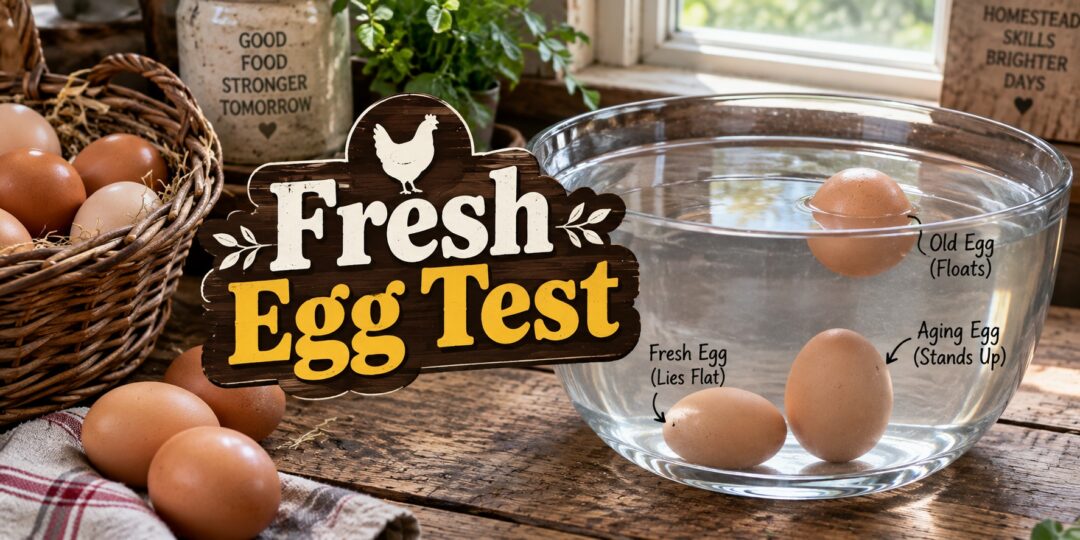
Everyone knows some version of the float test, but most people skip the details that make it actually useful. Fill a bowl or tall glass with cold water, deep enough that the egg can be fully submerged with a couple of inches to spare, and lower the egg in gently rather than dropping it.
A very fresh egg, laid within the past week or so, will sink straight to the bottom and lie flat on its side. That’s because the air cell is still tiny, so the egg is dense relative to its size and has nowhere to catch buoyancy.
As the air cell grows over the following one to three weeks, the egg will start to tilt and eventually stand on its end while still staying submerged. That upright-but-sunk position isn’t a warning sign. In fact, those eggs are often easier to peel after hard boiling, which is worth remembering the next time you’re planning a batch of deviled eggs.
Once the air cell has grown large enough, the whole egg becomes buoyant enough to float to the surface. A floating egg is simply an old egg, not automatically a spoiled one, and the only way to know for sure is to crack it open and use your nose and eyes, which is exactly the territory my spoiled-egg article covers in depth.
One caveat worth knowing: don’t use the float test on eggs you’re incubating under a broody hen or in an incubator. Submerging a developing egg in water risks introducing bacteria through the shell and can chill or damage the embryo, so save this test strictly for eggs headed to the kitchen.
Candling: The Test the Real Egg Graders Use
Candling is the method actual USDA egg graders rely on, and it’s simpler to do at home than most people expect. According to the University of Kentucky’s 4-H poultry judging guide to candling, all you need is a darkened room and a bright, narrow beam of light, which these days can just be your phone’s flashlight held tight against the shell.
Hold the egg by its small end and tilt the large end toward the light. You’re looking for two things: the size of the air cell, which sits at the wide end, and the shadow of the yolk floating in the middle.
A very fresh egg shows a small, shallow air cell and a yolk shadow that barely moves when you twirl the egg between your fingers, because it’s still held tight in the center by thick, dense albumen. As the egg ages and that albumen thins, the yolk swings more freely toward the shell and its outline becomes easier to see.
The USDA’s official grading standards give this some hard numbers. An air cell depth of one-eighth of an inch or less earns a Grade AA rating, a depth between one-eighth and three-sixteenths of an inch drops it to Grade A, and anything deeper than that is Grade B. If you don’t have an egg gauge handy, comparing the visible air cell to a dime, then a nickel, then a quarter gets you a rough estimate that’s good enough for home use.
The Crack Test: Reading a Cracked Egg Like a Pro
Cracking an egg into a shallow bowl or plate tells you almost everything the candling test does, just after the fact rather than before. A fresh egg holds together in a tight, defined mound: the yolk sits high and round, and the thick white clings closely around it rather than spreading thin across the plate.
As the egg ages, that thick albumen breaks down and thins out, so the white spreads wider and flatter, and the yolk sits lower and flattens along with it. This is exactly the same albumen breakdown that makes the yolk swing more freely during candling, just viewed from the outside of the shell instead of through it.
Here’s the detail most people get backward: a cloudy or slightly milky-looking white is actually a sign of freshness, not staleness. That cloudiness comes from dissolved carbon dioxide still trapped in the albumen, and it clears up as the egg ages and gradually loses that gas through the shell.
The Shake Test
This one is quick, low-tech, and worth knowing even though it’s more of a rough sorting tool than a precise measurement. Hold the egg up to your ear and give it a gentle shake. A very fresh egg will feel solid and produce little to no sound, because the contents are dense and tightly packed with almost no room to move.
An older egg, with its larger air cell and thinner, looser albumen, will produce a faint sloshing sound as the contents shift inside the shell. It’s not a substitute for the float test or candling, but it’s a fast way to flag an egg for closer inspection before you crack it into a bowl.
Decoding the Carton: Julian Dates and Sell-By Labels
If you buy eggs at the store to supplement your own flock, or you’re helping a friend or neighbor figure out what’s in their fridge, the carton itself is a freshness test in print. Look for a three-digit number on the short end of the carton, which is the Julian date, or pack date.
According to the USDA Food Safety and Inspection Service, this three-digit code represents the consecutive day of the year the eggs were washed, graded, and packed, starting with January 1 as 001 and running through December 31 as 365. A carton stamped 032, for example, was packed on February 1st.
On any carton bearing the USDA grade shield, a sell-by date can’t be more than 30 days past that pack date, and a best-by or use-by date can’t exceed 45 days past it. The University of Nebraska-Lincoln’s food safety extension program notes that eggs generally stay good for three to five weeks beyond the sell-by date as long as they’ve been refrigerated the whole time, so that date is far more about store inventory than kitchen safety.
Tracking Freshness on Your Own Homestead
The simplest freshness test of all is one you set up before the egg ever needs testing. I keep a pencil by the coop door and write the date directly on each egg’s shell the moment I collect it, which sidesteps the whole guessing game later.
If pencil on the shell isn’t your style, a basket system works just as well: collect into a clean container each day, date the outside, and always pull from your oldest dated basket first before moving to a newer one. This kind of first-in, first-out rotation is standard practice on commercial layer operations for a good reason, and it scales down perfectly to a backyard coop.
I also keep my nest boxes cleaned out and collect at least once, ideally twice, a day. Eggs that sit in a nest for hours pick up warmth and moisture that speeds up the aging process before you’ve even brought them inside, so a fast collection routine is really a freshness strategy in disguise.
Match the Egg’s Age to the Job
Once you know how to read an egg’s age, you can actually put that information to work instead of just watching the clock. The freshest eggs, the ones that sink flat and hold a tight mound when cracked, are exactly what you want for poaching and frying, where a thick white keeps its shape instead of spreading into wisps across the pan.
Eggs in that one-to-three-week window, the ones that stand upright in the float test, are my go-to for hard boiling. As the egg ages, its pH rises slightly and the inner membrane separates a bit more easily from the shell, which is the main reason older eggs peel so much cleaner than fresh ones.
Eggs on the older end that still pass a smell and appearance check are actually prized for meringues and whipped egg whites. Thinner albumen whips up faster and holds more air, so bakers who separate eggs for meringue often reach for eggs that are a couple of weeks old rather than the freshest ones in the carton.
Frequently Asked Questions
Can I test a whole dozen eggs at once?
Yes, and it’s actually a great way to sort a mixed basket. Fill a large bowl or stockpot with enough water to submerge several eggs at once, and you’ll be able to see at a glance which ones sink flat, which stand up, and which float, letting you sort your whole collection by age in one pass.
Does water temperature affect the float test?
It can. Warm water causes the air inside the egg to expand slightly, which can make a moderately fresh egg tilt or stand up a bit sooner than it would in cold water. Stick with cold tap water for the most consistent, repeatable results.
Why does my very fresh backyard egg sometimes float anyway?
Shell thickness and porosity vary by hen, breed, and even diet, so air cell size doesn’t always track perfectly with calendar age across different birds. If an egg floats but shows no off odor or unusual color when cracked, it’s almost certainly still fine to eat, just older or more porous than average.
Is candling only useful for hatching eggs?
Not at all. Candling for freshness is a completely separate use from candling to check embryo development in a fertile egg. Commercial graders candle every egg destined for your grocery store’s carton purely to check air cell size, yolk position, and interior clarity, with no incubation involved.
How Many Other Everyday Skills Have We Forgotten?
Knowing how to test the freshness of an egg without relying on a date stamped on a carton might seem like a small skill.
But that’s exactly the kind of practical knowledge our grandparents took for granted.
They knew how to raise and preserve food, make the most of what they produced, repair instead of replace, build useful things with their own hands, and keep a household running with far less dependence on stores, utilities, and modern conveniences.
Today, much of that knowledge has nearly disappeared.
The Lost Skills of Independence was created to bring it back.
Inside, you’ll discover practical, old-fashioned skills designed to help you become more capable and self-reliant—from producing and preserving food to handling everyday problems with resources you may already have around your home or homestead.
Because true self-sufficiency isn’t about owning more stuff.
It’s about knowing how to do more for yourself.
If keeping your own hens, testing your own eggs, and making better use of the food you produce appeals to you, don’t stop there. Rediscover the practical knowledge that helped generations before us live more independently.
👉 Discover The Lost Skills of Independence and start bringing forgotten self-reliance skills back into your home.
Rediscover the Skills That Made Our Grandparents Self-Reliant →
Final Thoughts
A fresh egg test isn’t really one test, it’s a toolkit, and each method tells you something slightly different. The float test gives you a fast age estimate, candling gets you closer to what a professional grader sees, the crack test confirms it all visually, and the carton’s Julian date does the math for you on store-bought eggs.
Once you’re reading these signs comfortably, egg freshness stops being a worry and starts being a sorting tool. Use the freshest eggs for the dishes that need them, let the middle-aged ones peel clean for your deviled eggs, and save your oldest good eggs for the meringue that’s been on your list. If cracking one open ever gives you pause about safety rather than just age, my guide on spotting spoiled eggs without breaking a shell walks through exactly what to look and smell for.
You may also like: 
Join Our Homesteading Facebook Group For Tips To Help You!
The Amish do this to every chicken coop in the spring. Why? (Video)
How Many Eggs Does a Chicken Lay a Day?
How Long Do Chicken Eggs Take to Hatch? A Complete Incubation Guide