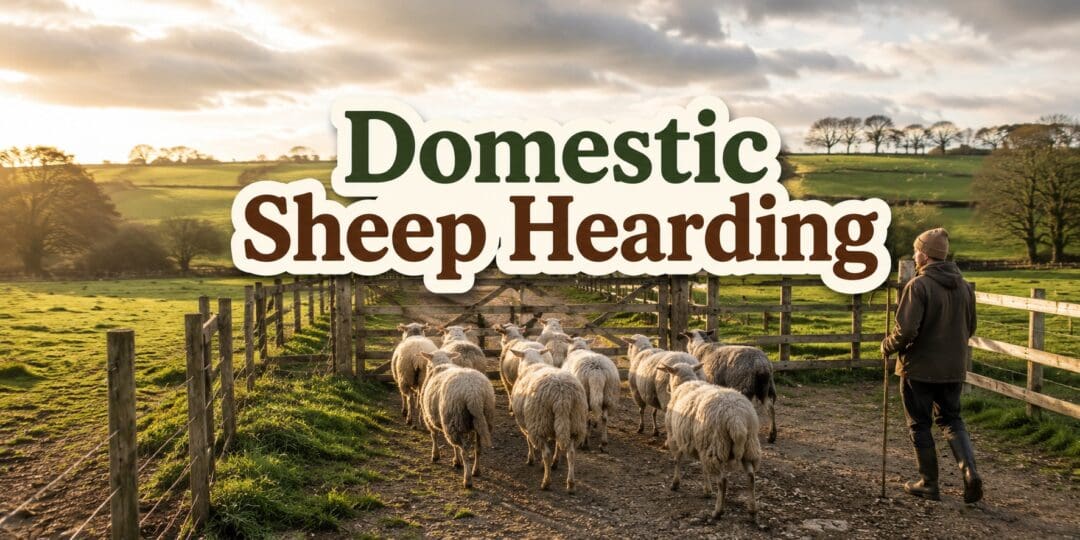
Sheep are one of the most forgiving livestock choices for a homestead. They ask for less than cattle, produce more than chickens, and reward patient management with wool, meat, and milk depending on which direction you take the flock. But sheep are also flock animals with strong instincts, and domestic sheep herding requires that you understand those instincts before you try to work against them. Get the fundamentals right and moving a flock of twenty becomes almost effortless. Get them wrong and you will spend a lot of frustrated hours chasing animals that scatter the moment you enter the paddock.
This guide covers everything a small-scale homesteader needs to know about herding domestic sheep: how sheep behave naturally, how to read and use that behavior, the tools and dogs that help, and how to build a management system that makes daily handling smooth and low-stress for both you and your animals.
Understanding Sheep Behavior Before You Try to Herd Them
Sheep are prey animals with a well-developed flight response and an equally strong flocking instinct. These two traits are not problems to overcome. They are the foundation of everything that makes herding possible. When a sheep perceives a threat, it moves away. When one sheep moves, the others follow. As a herder, your job is to position yourself so that the flock’s natural tendency to move away from pressure takes them exactly where you want them to go.
The concept that makes this work is called the flight zone. Every sheep has a bubble of personal space that, when entered, triggers movement. The size of that bubble depends on how tame or wild the individual animal is. Sheep that have been handled regularly from birth may have a flight zone of just a few feet. Sheep that have had limited human contact may bolt the moment you enter the paddock. Understanding where the edge of the flight zone is for your flock tells you how close to approach before you create movement and how to apply just enough pressure to keep animals walking without panicking them into a run.
The point of balance is the second key concept. For most sheep, the point of balance sits at the shoulder. If you position yourself behind the point of balance, the animal moves forward. If you move in front of it, the animal slows or stops. Skilled herders and well-trained dogs instinctively work relative to this point, applying and releasing pressure in a way that keeps the flock moving in a controlled, calm flow. The American Sheep Industry Association offers extensive resources on sheep behavior and low-stress handling that build directly on these principles.
Setting Up Your Property for Effective Herding
No amount of skill makes herding easy on a poorly designed property. Before you think about technique, look at how your land is laid out and whether it works with or against natural sheep movement.
Fencing and Paddock Design
Sheep follow the path of least resistance. Curved lanes and rounded corners work far better than sharp angles because sheep naturally bend away from tight corners, which is where bunching, pushing, and injuries happen. If you are designing paddocks from scratch, build corners with a gentle curve rather than a 90-degree angle. This keeps the flock moving through gates and into handling facilities without piling up.
Gates should be wide enough that several sheep can pass side by side. A gate that forces sheep to single-file creates a bottleneck that the flock hesitates to enter, especially under pressure. Aim for a minimum of six feet for working gates and wider for main paddock entries. Consider where gates lead: sheep move more willingly toward other sheep, toward feed, toward shade, and toward familiar areas. Gates that open toward the barn or water trough will be easier to push a flock through than gates that lead to isolation.
The Value of a Working Yard
A small working yard or handling pen attached to your main paddock is one of the most practical investments a sheep herder can make. This is a confined space, typically 20 to 30 feet across, where you can sort animals, catch individuals, or hold sheep before moving them to a different paddock. The working yard takes most of the effort out of catching and treating individual sheep because instead of chasing one animal around a large paddock, you reduce the space until you can simply step in and take hold.
A simple race or chute extending from the working yard allows you to direct sheep single-file for weighing, vaccinating, footbathing, or loading into a trailer. None of this requires expensive commercial equipment. A well-built wooden yard and race, properly positioned relative to your paddocks, does everything a homestead flock needs.
Herding Domestic Sheep Without a Dog
Many small homesteads manage flocks of ten to thirty sheep without a herding dog, and with good technique this is entirely workable. The key is understanding that you are using the same principles a dog uses, just with less speed and range.
Move slowly and deliberately. Fast movement, sudden gestures, and loud noise trigger the panic response in sheep, which scatters the flock rather than directing it. Walk steadily, keep your body upright, and use your arms or a long stock whip to extend your effective width. A crook or a long stick held out to the side makes you appear wider, which helps you cover more ground when guiding the flanks of the flock.
Work in a zigzag pattern behind the flock rather than pushing straight from the rear. A direct push from the center rear creates pressure that splits the flock around you. Moving back and forth across the rear in a wide arc keeps even pressure across the full width of the group and discourages animals from breaking out to the sides. If the flock is moving too fast, step to the side or slightly forward to ease pressure. If they slow or stop, step back toward center and slightly closer.
Use the flock’s preference to move toward other sheep. If you are moving animals from one paddock to another, leave a small number of trusted, calm ewes already in the destination paddock. The moving flock will hear or see them and pull toward the opening rather than away from it. The University of Wisconsin Extension livestock handling resources describe this technique as using the flock’s social instinct as a low-stress movement tool, and it genuinely cuts the effort of paddock moves in half.
Working With a Herding Dog: What to Know Before You Start
A well-trained herding dog transforms what is difficult into what is easy. A poorly trained or badly handled dog transforms a calm flock into a panicking one and can set back months of trust-building with your sheep in a single bad session. The decision to add a herding dog to a homestead flock is worth taking seriously.
Breed Selection
The breeds most commonly used for domestic sheep herding are Border Collies, Australian Kelpies, and Australian Shepherds. Border Collies are widely considered the most naturally gifted sheep dogs, with an instinctive tendency to gather, a controlled approach to the flock, and strong responsiveness to handler direction. Kelpies are more independent, better suited to large open country, and extremely energetic. Australian Shepherds are versatile, slightly more amenable to dual roles as working dogs and companions, and good for homesteaders who want one dog that does multiple jobs.
What matters far more than breed is the individual dog’s instinct, temperament, and training. A well-bred, well-trained dog of any herding breed is more valuable than a well-bred dog with poor training or a weak working instinct.
Basic Training Principles
A herding dog learns through the relationship between pressure and release. The dog applies pressure to the flock by approaching or moving. When sheep respond by moving in the desired direction, the handler signals the dog to ease off, which is the release that the dog learns to work toward. Over time the dog learns to read both the sheep and the handler, adjusting pressure constantly to keep the flock moving in a controlled, even flow.
For homesteaders starting with an untrained dog, working with a professional trainer for the foundation skills is the most efficient path. The basic commands, come-bye (flank left), away (flank right), lie down (stop), and walk on (advance straight), form the working vocabulary between handler and dog. Getting these reliably installed by someone who knows the process prevents a great deal of frustration and confusion for both dog and handler.
The American Herding Breed Association maintains a directory of herding trials and working dog resources, including contacts for trainers who specialize in working dogs for small farm and homestead use.
Handling Sheep for Health and Routine Maintenance
Herding is not only about moving animals between paddocks. A significant part of working with sheep involves catching and restraining individual animals for health checks, hoof trimming, vaccinations, and shearing. How you approach and catch sheep affects how trusting they become over time.
Catching Individual Sheep
The most reliable way to catch an individual sheep without a working yard is to work with the flock’s instinct rather than against it. Move the whole flock into a smaller space first, then work the individual toward a corner or fence. Approach from the side, not head-on. Reach under the chin or over the back of the neck, never grab for a leg, and use steady pressure to pull the animal against your body before moving to a full hold.
A sheep that has been caught roughly or repeatedly chased will become harder to catch over time. A sheep that has been caught calmly, handled briefly, and released without drama becomes progressively easier to approach. Every handling interaction is either building trust or eroding it.
Crutching, Hoof Trimming, and Shearing
Once caught, most maintenance tasks are performed with the sheep in a sitting position, tipped back onto its rump with its weight balanced on your body. This position, called rumping or tipping, renders most sheep calm and cooperative. It takes a little practice to tip a sheep smoothly, but once learned it allows one person to trim hooves, inspect fleece, or perform basic treatments without a second pair of hands.
Hoof trimming should be done at least twice per year in most climates, more often in wet conditions where hoof overgrowth and foot rot become a concern. Shearing timing depends on your climate and breed, but most wool breeds in temperate climates are shorn once per year in late spring before the heat of summer. If you are not shearing yourself, establish a relationship with a shearer early in the season since schedules fill quickly in areas with significant sheep populations.
Seasonal Herding and Management Considerations
Sheep herding is not a single set of skills applied the same way year-round. Each season brings different handling priorities and different challenges.
Spring is lambing season for most breeds, and handling during this period requires particular care. Ewes with newborn lambs are protective and can be aggressive in ways that sheep rarely are at other times. Newly bonded ewes and lambs should be moved as a unit rather than separated, since separation causes extreme stress for both animals and can disrupt bonding in the first critical days of life. Sorting and moving ewes with young lambs is best done quietly and in small groups.
Summer management centers on pasture rotation and parasite control. Sheep on continuously grazed pasture develop heavy worm burdens that reduce condition and require treatment. Rotational grazing, where the flock moves between paddocks on a planned schedule, breaks the parasite lifecycle by allowing pastures to rest and reduces the need for chemical intervention. Herding skill makes rotational grazing practical on a small homestead since moving the flock efficiently between paddocks requires far less time and effort than it initially appears.
Autumn is the breeding season for most temperate breeds, and rams need to be managed carefully during this period. A ram in full rut is unpredictable and should be treated with respect. Herding rams requires more caution than herding ewes, and it is worth having solid working infrastructure in place before attempting to move or handle breeding rams alone. The USDA National Agricultural Library’s Animal Husbandry resources include detailed guidance on ram management and seasonal breeding protocols that are practical for small flock owners.
Building a Flock That Is Easy to Handle
The single most valuable thing you can do for your herding practice is build genuine trust with your flock over time. Sheep that are regularly and calmly handled from a young age become progressively easier to work with. They tolerate a smaller flight zone, respond to familiar routines, and follow a trusted handler without the need for pressure at all.
Spend time in the paddock doing nothing. Walk among the sheep without trying to move or catch them. Feed small amounts by hand to build positive associations with your presence. Call the flock with a consistent sound before feeding so they learn to associate that cue with something good. Over time most flocks develop a follow response that makes paddock moves as simple as walking to the gate and calling.
This level of trust does not happen in weeks. It builds over months and years of consistent, low-stress interaction. But it compounds. A flock you have worked with for three or four seasons will be managed in a fraction of the time it takes to work a nervous, poorly handled group of the same size. The investment in calm, patient handling pays back every single day.
Domestic sheep herding is a skill that improves steadily with practice and patience. Start with the fundamentals of flight zone and point of balance, build infrastructure that works with natural sheep movement, and handle your animals consistently and calmly from the beginning. Whether you work alone, with a dog, or with both, the goal is always the same: a flock that moves where you need it to go, without drama, without injury, and with as little stress on the animals as possible. That outcome is within reach for any homesteader willing to learn how sheep think.
You may also like:
An Ingenious Eggshell Remedy and 25 Others Made from Things People Usually Throw Away (Video)
Valais Blacknose Sheep: The Complete Ownership Guide for Homesteaders
Katahdin Sheep: The Homesteader’s Guide to This No-Shear Meat Breed
Freeze Dried Cheese: The Complete Guide to Storing Cheese for 25+ Years