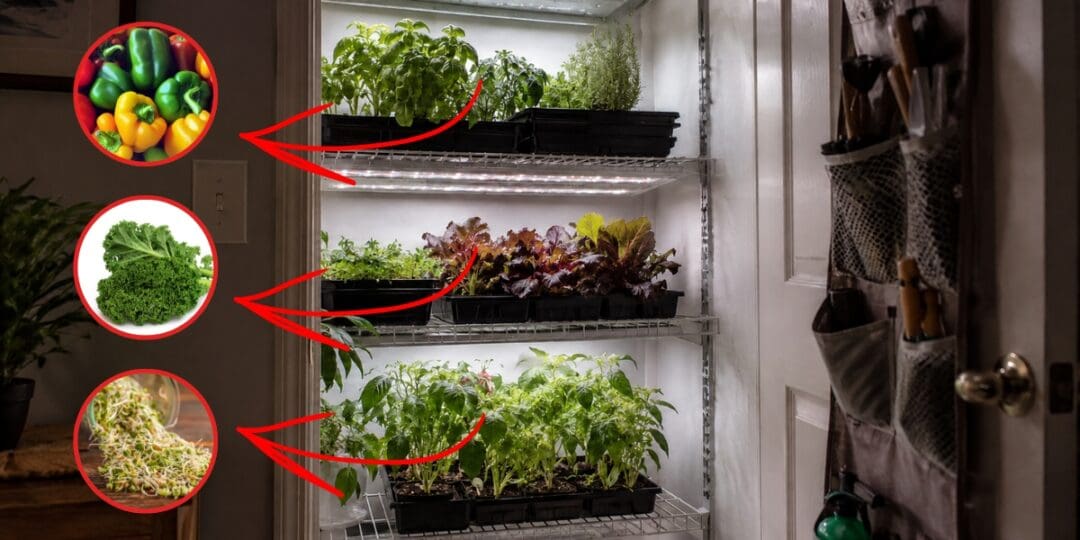
It may seem unusual, but a closet is an excellent location for an interior garden. Many people who try to create garden spaces indoors, especially during the winter, often have to sacrifice space appearances and put up with the mess of dirt on the floor and the unsightly glare of grow lights filling the room.
A closet keeps all of that out of the way and creates an environment that’s perfect for plants throughout the year. Better yet, you can vary the crops to suit your needs and the time of year. Think of it as a living refrigerator providing you with fresh vegetables, fruits, herbs, sprouts and even seedlings for Spring planting.
Better yet, it’s relatively inexpensive. All you need are some soil trays, LED grow lights, soil, and seeds. We’re going to cover the basics step by step of how to put together your closet garden and what closet farming is.
Who Needs a Closet Farm?
The obvious answer is people who can’t have an outside garden. People who live in urban apartments, townhouses, condos, or rent properties where the owner frowns upon a garden. However, anyone can benefit from a closet farm for a wide range of reasons. The biggest reason is that it lets you grow so many things all year round. That means fresh, homegrown strawberries in January, tomatoes in April, fresh herbs for a holiday feast, and leafy greens every day. There are more benefits that we’ll cover as we go. In the meantime, let’s build a closet farm.
Step 1: The Closet
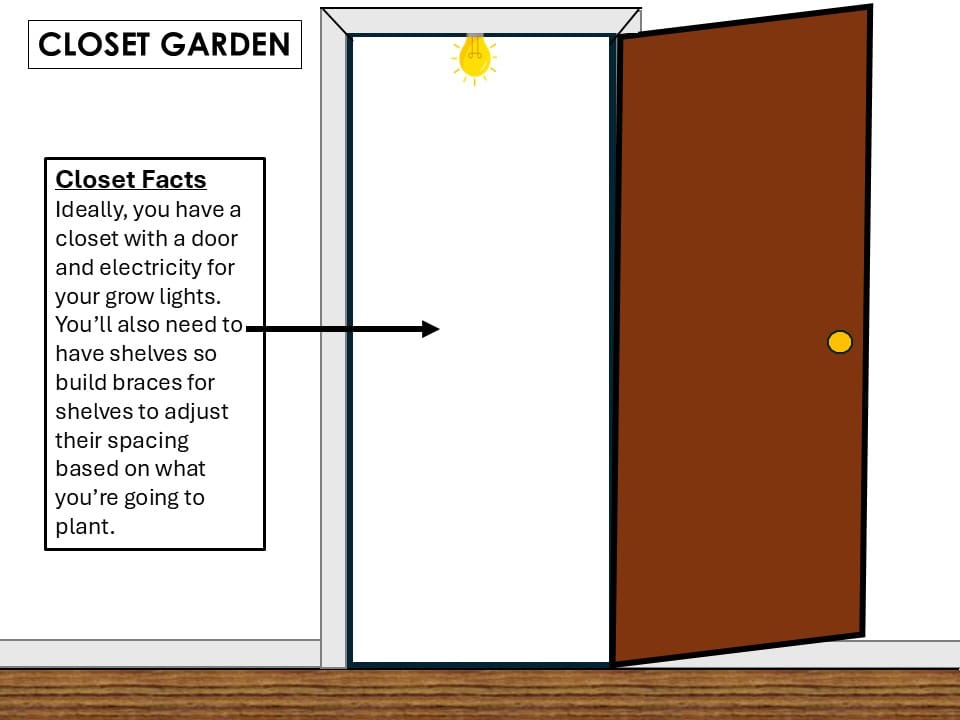
This is fairly simple. Find an extra closet or pantry in the house and dedicated to closet farming. You may think you can’t spare a closet, but after you learn about the benefits, you might think again.
What’s important is that the closet has a door and electricity for the LED grow lights. If it has shelves, that’s great, but you can adjust the shelf spacing with a slat of wood on opposing sides if you want to raise or lower a shelf.
The shelf spacing is designed to accommodate the mature height of plants you are growing. Even then, you should consider dwarf varieties of some vegetables like tomatoes. A closet is not the best place for the long vines of a Beefsteak tomato. A watermelon is probably out of the question.
If you don’t want to start building shelves, you can try to get some that are already built.
For example, you can use something like this to make your life easier.
What Can You Grow in a Closet?
Here’s a starting list for vegetables and fruits you can grow in a closet. Most of them are fairly compact plants in terms of height, but root vegetables like radishes, beets, horseradish, turnips, rutabagas and even carrots can thrive in a closet garden. Just make sure you think about how deep the roots go down (especially for carrots) and make sure your soil container is deep enough. If that’s a problem, stick with the bulbing tubers like radishes, beets, and turnips.
Root vegetables 🥕
like radishes
Vining vegetables 🍅
like dwarf tomatoes
Leafy greens 🥬
like spinach
Fruits 🍓
the few that handle indoor life
Compact herbs 🌿
like oregano
Sprouts 🌱
like lentil sprouts
And you can start seedlings for every fruit, vegetable, and flower right here too.
There’s more, but this list gives you an idea. What you plant and how much depends on the number of shelves you have and the size of your closet. There are also times of the year that are best suited for different vegetables, but let’s build our closet farm first.
How to Choose Your Seeds Wisely
So, before you start planting, I want to make you aware of one thing: where you get your seeds from matters a lot. Everything you grow starts from here, and cheap, old, or low-quality seeds give you weak sprouts that will never turn into the plants you are dreaming of.
I always look for non-GMO, open-pollinated, or heirloom seeds. Heirloom varieties let you save seeds from your best plants and replant them next season, so you’re not buying new ones every year.
Buy from a trusted seed company with good reviews, or a local source that knows your area. Good seeds cost a little bit more upfront, but over time they will pay back with every harvest.
Now, one thing I didn’t mention is that a closet farm is ideal for medicinal herbs. Yes, you can grow parsley or chives, but you can also plant echinacea or calendula. Having medicinal herbs on a homestead is essential because many of these plants have incredible benefits.
• Yarrow – Stops bleeding in minutes and keeps wounds clean
• California Poppy – Sleep like a kid again, no pills needed
• Lavender – Calms anxiety almost like prescription meds
• Echinacea – The best plant out there for immunity
• Calendula – Heals wounds and makes scars disappear
I am a big fan of medicinal plants. I have them in my garden and I also have them inside my home. This is why I get a lot of questions about where I source my medicinal herb seeds, so let me save you the trouble I went through.
For years I hunted for one kit that had all the healing plants I actually wanted to grow, and most of what I found was either low quality or scattered across a dozen different sellers.
Then I found the Medicinal Garden Kit from Dr. Nicole Apelian. Ten medicinal plants, every seed handpicked, non-GMO, all in one package, and it comes with a guide that walks you through turning each plant into the remedy you need.
👉 See the 10 plants inside the Medicinal Garden Kit here
Step 2: Shelf Spacing
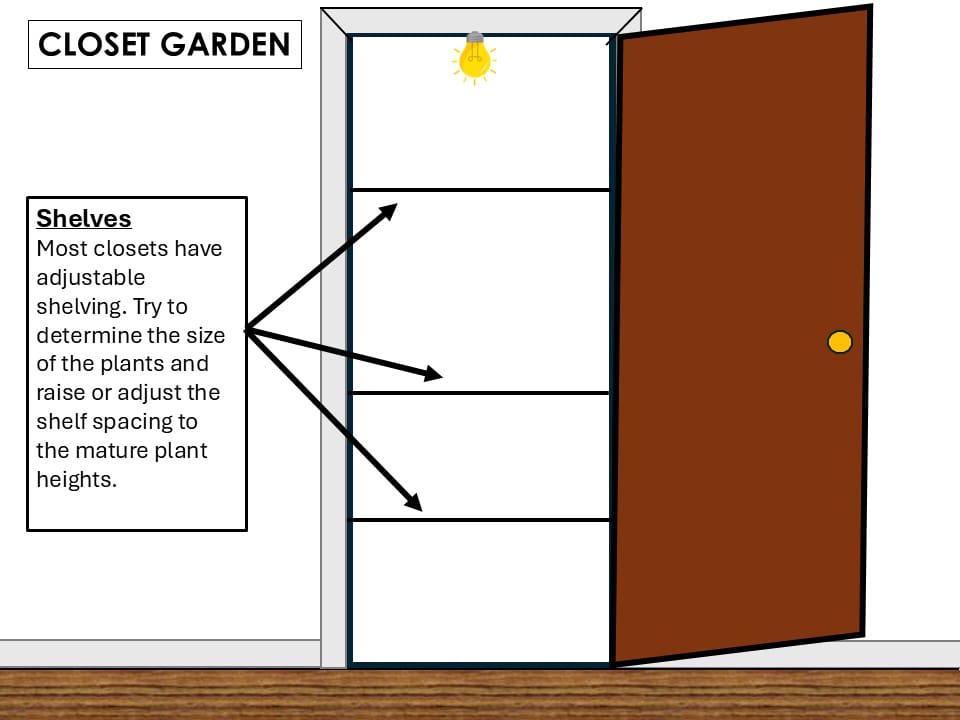
Think about what you might plant over a year. Dedicate the space in at least one shelf for larger vegetables. Even dwarf tomatoes and pepper plants will grow up to 2 feet tall. We’re going to start with 3 shelves and the floor to hold 4 soil containers. The soil containers SHOULD NOT have holes in the bottom. You don’t want the water to drain into your closet. Add Vermiculite to your soil mix to absorb excess water and water carefully. Because you will be using LED grow lights rather than sunlight, you won’t have as many challenges with soil dehydration that the sun can cause outdoors.
Vary the height of the other shelves to suit the other types of vegetables or strawberries you choose to plant. We only mention strawberries because most fruits either grow on trees or long vines and tall bushes. Those won’t work in a closet farm.
Step 3: Install Your Grow-Lights
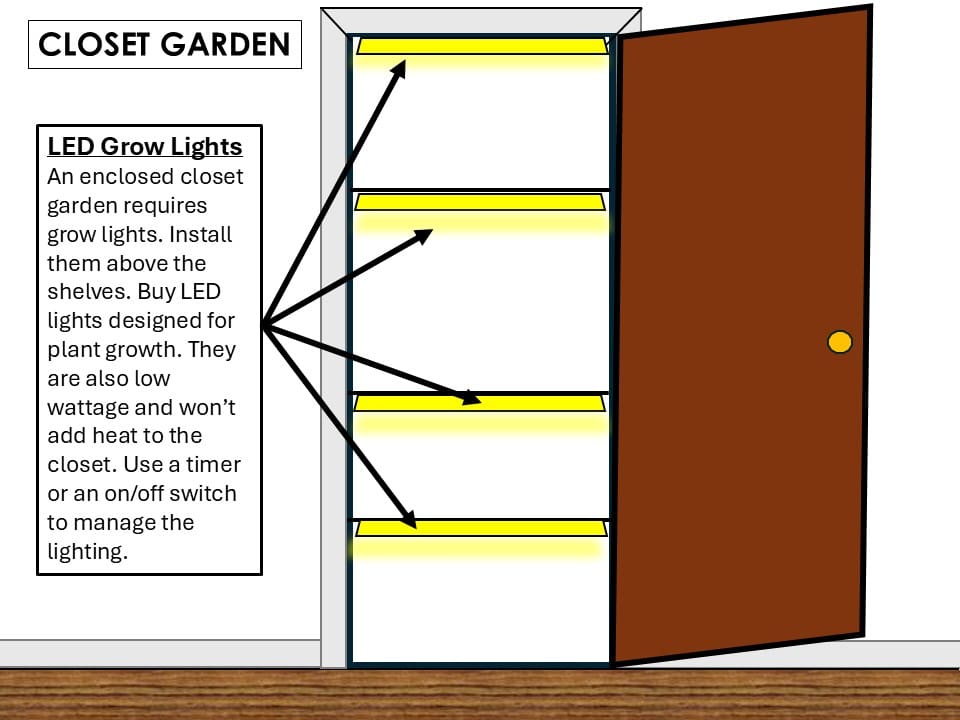
You can buy your grow lights online or at a farm supply store or home center. Buy the LED lights made for sustaining plants. The LED lights will keep your plants healthy and encourage photosynthesis but will not add heat to the space, causing the water to dehydrate or the plants to wilt.
You can use the closet on/off switch to control your grow lights or add a timer to automatically turn them on and off. Plants actually like a period of darkness, which has evolved into their DNA over millions of years of day and night cycles of sunlight and darkness.
If you need some easy-to-install LED lights for plants, you can get them from here.
Step 4: Install Your Soil Trays
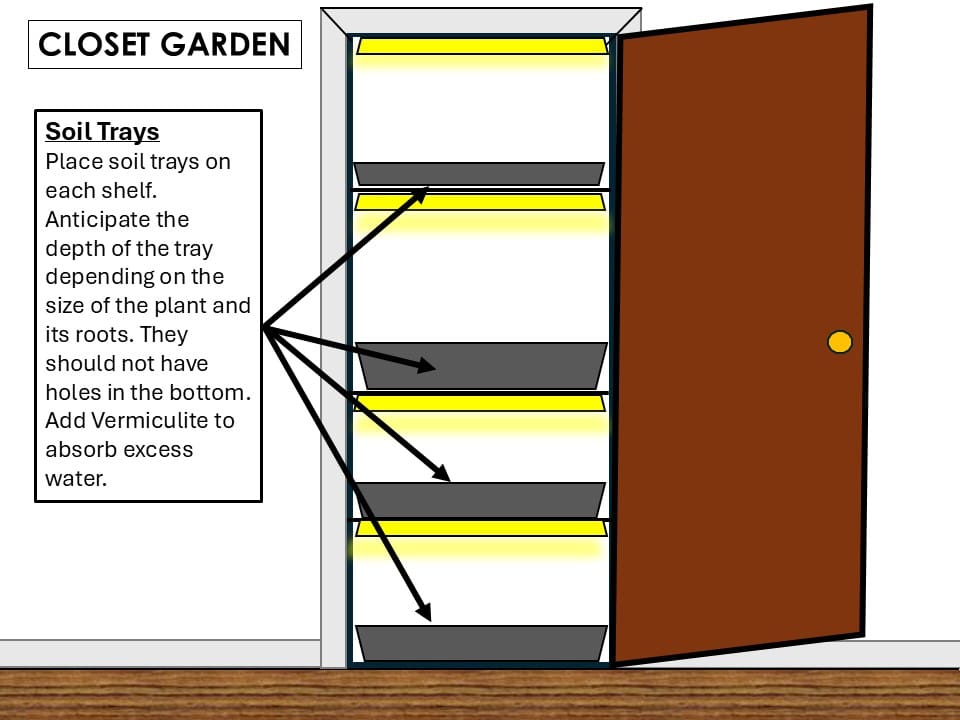
Choose soil containers to suit your planting plans. Think deep for root vegetables but don’t assume shallow works for smaller plants. Try to maintain at least 3 inches of soil or more in your containers.
Well-composted soil is best, but make sure it is well composted. We don’t notice the odors that emerge from an outdoor compost heap, but if your compost is still decomposing, you will notice it quickly in a small space like a closet. Buying a soil mix from the garden center might be your best bet if you’re not sure.
You might also consider installing a vent on your closet door. A closet will contain the humidity from watering your soil, but you could also leave the door open a crack and get adequate ventilation. If you really want to air it out, just leave the door open for a while until you have company coming over. Then again, you might want to show off your closet farm, so maybe leave it open.
Step 5: Planting Time
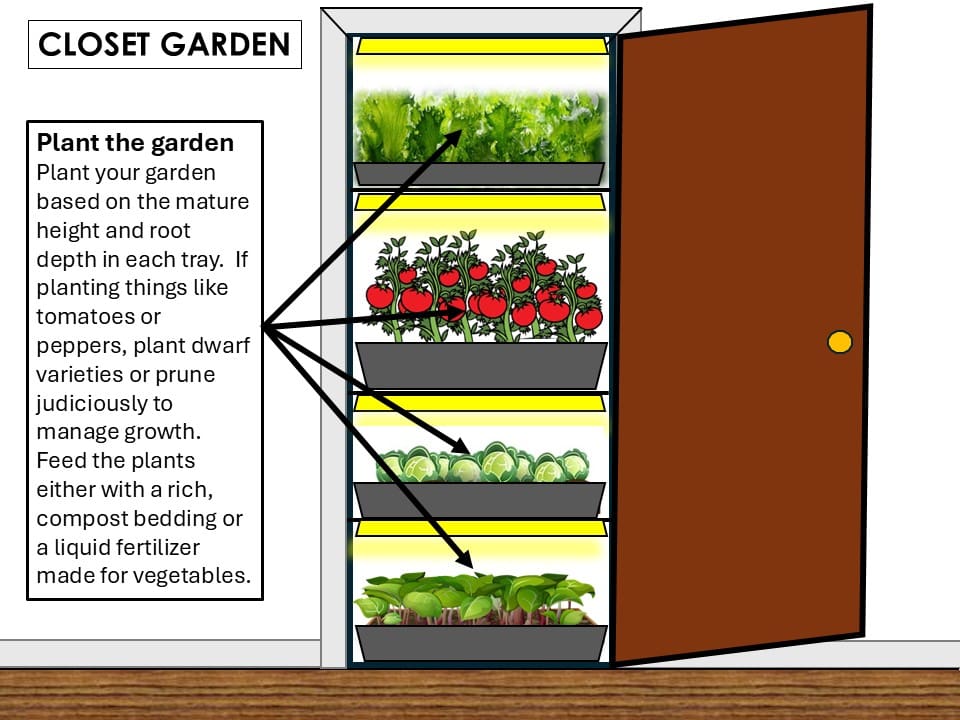
It’s finally time to plant. Most closet farmers plant from seed. It’s cheaper than buying sprouted seedlings and when your growing season is 365 days a year, you can wait for the seeds to sprout.
What you plant depends a lot on the time of year. Fall and winter are a great time to plant those vegetables you can’t grow outside. If there’s a particular vegetable you crave that seems to be getting more expensive in the off-season, plant that. And when you harvest, it’s time for the next step.
Step 6: Succession Planting
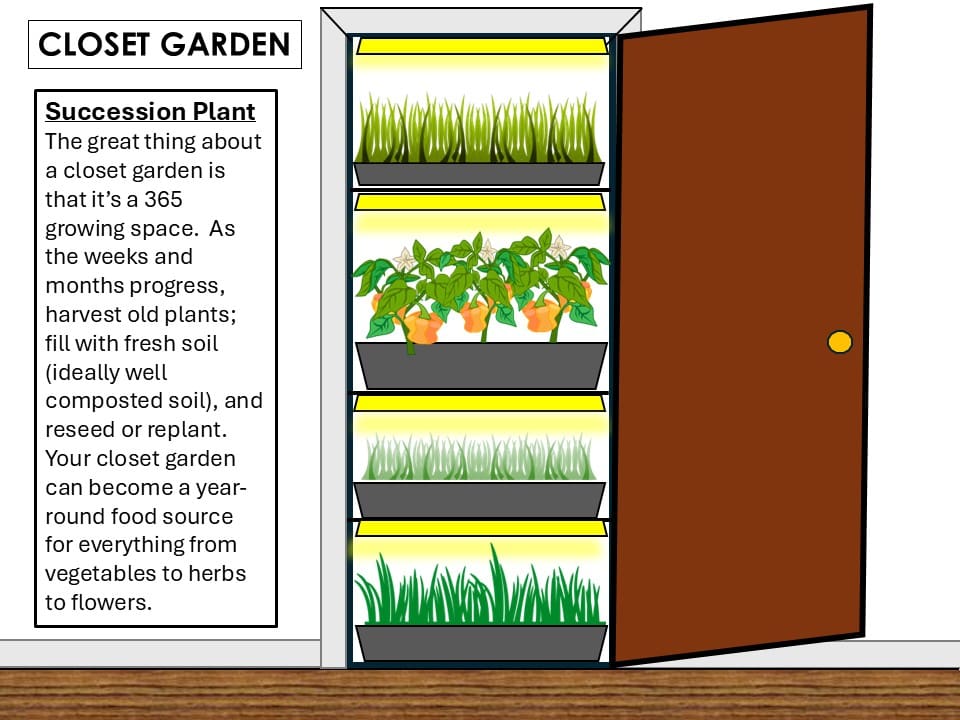
People who live in areas with long growing seasons are often able to get more than one crop out of their gardens. Most everyone can get multiple crops of radishes because most radishes mature in 30 days. When you’re planting and growing 365 days a year, succession planting is automatic. Think about what you can plant next after harvesting a tray.
And remember the Bush beans. WE mentioned them in our list, but Bush beans revitalize the soil. That’s not a real big deal with a closet garden because you can always refresh the soil in a tray with totally new soil, but why not? You could also use a liquid fertilizer like Miracle-Gro to feed your plants, but some people want to keep things organic with composted soil.
Step 7: Remember the Sprouts
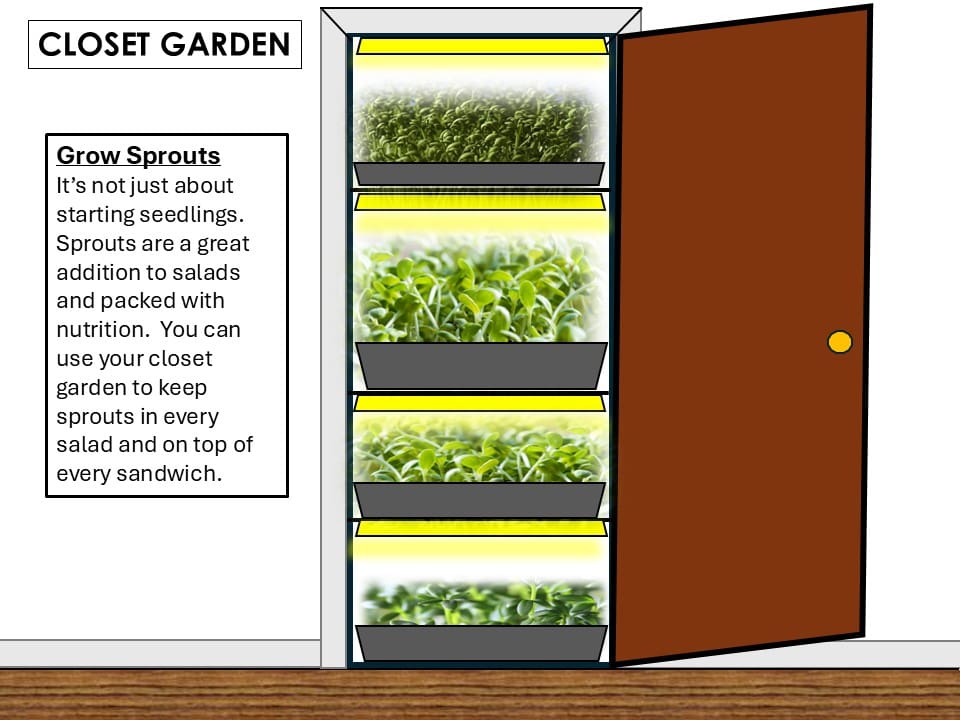
The sprouts from many vegetables and grains are remarkably nutritious. Many people make them a regular part of their salads, in soups and top their sandwiches with them. It’s easy to dedicate a tray or two (or all of them) to sprouts for a while. They can be grown any time of year, especially in summer when the outside gardens are really producing (assuming you have an outside garden).
Better yet, you can eat some of the sprouts and then take some of them outside in early Spring to harden them off and plant them in a garden or pot. And it’s not just about vegetables and the lonely strawberry, but flowers can be started in your closet farm as well. It’s all about what you want to grow – every day.
Step 8: Start Seedlings
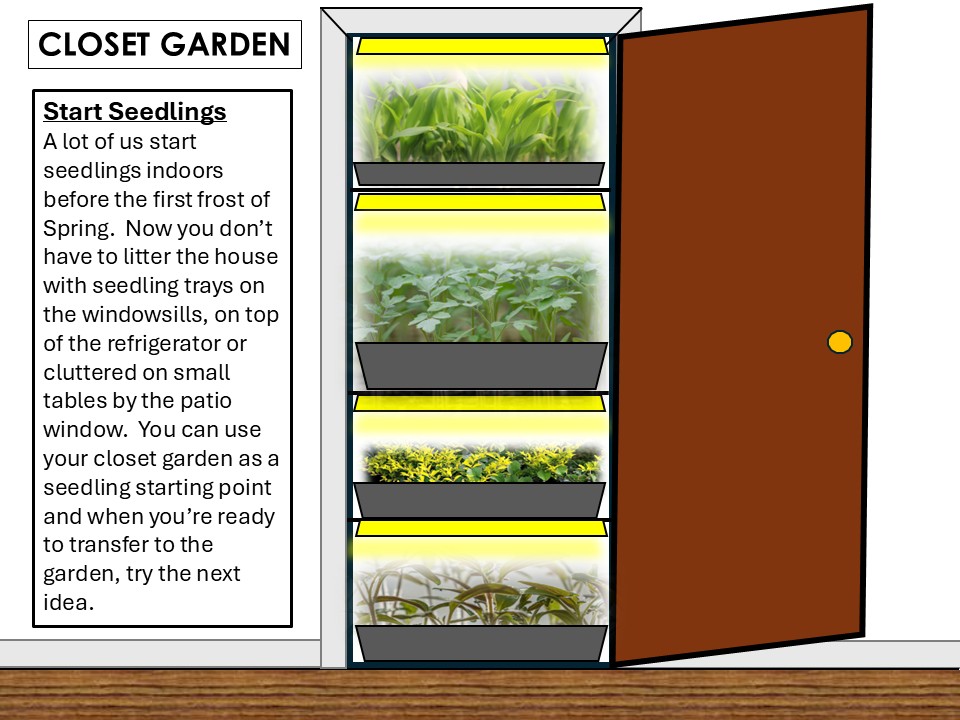
A lot of us see February as the time to think about the coming season ahead. It’s a traditional time to start seedlings indoors. The challenge always seems to be about finding the space in the house to scatter a bunch of seedling trays. We usually want them by a window with southern exposure; we have to water them; we usually have to sweep up the dirt underneath them; listen to the occasional complaint about the mess; and finally get them into the garden. And then we get surprised by a late frost.
A closet farm makes all of that simpler and you can always keep a few seedlings indoors just in case Jack Frost has any surprises for you
Finally…
Check on your closet farm every day. Watch for mold growing on the walls. If you see that, wipe it off with a washcloth soaked in diluted bleach and keep the door open for longer periods of time, or install a vent at the top and bottom of the door.
Keep an eye on your plants as well. The good news is you shouldn’t have any insect problems, but mold and fungus on the leaves are a possibility. If you spot any mold, spray the leaves with a weak dilution of vinegar and water or pull off the leaves or the whole plant. After all, you’ll always have the time for the plants to recover or regrow.
If You Have a Spare Closet…
A closet farm may be worth a try. We’ve covered a lot of benefits and once you get used to having fresh anything all year long, you may start to value your closet farm as much as you value your refrigerator as a food source.
Get Instructions for 70+ DIY Projects
If you enjoyed the DIY Closet Farm, you probably want to see this. You can find more projects like this one in No Grid Survival Projects, more precisely 70+ DIY builds perfect for anyone who wants to have a self-sufficient life.
These 3 projects are perfect for this summer:
• Water from thin air – A small device that pulls drinking water right out of the air, and it works best when the weather is hot.
• No-power air conditioning – Stay cool inside through the hottest months without touching the electric bill.
• Pest-proof raised beds – Hoop house beds that protect your plants from bugs and bad weather while they grow.
What I like best about No Grid Survival Projects is that for every project, it tells you the cost, the difficulty, and the time before you start, with step-by-step photos and links to the exact materials. This saves you a lot of time you’d otherwise spend at Home Depot or other stores to gather all the right materials. You can use this time to build the actual project.
Also, all of these projects are made for people like us who want to produce what we need ourselves instead of depending on the grid, the store, or anyone else.
If that’s the life you want, take a look at what’s waiting inside.
👉 See all 70+ projects in No Grid Survival Projects
You may also like: 
7 High-Yield Crops for Small Spaces
The Only 7 Seeds You Need To Stockpile For A Crisis (Video)
Plant These Herbs Once and You’ll Have Them Forever
9 Plants That Grow With No Water
2026 Spring Medicinal Planting Guide