If you store food in quantity, pantry moths are a matter of when, not if. They find their way into homes on purchased grain, flour, dried fruit, nuts, birdseed, and pet food. A single infested bag of cornmeal brought home from the grocery store can seed an infestation that spreads to every open container in your pantry within weeks. By the time most people notice the problem, moths are flying, larvae are webbing across shelves, and the infestation has been building for longer than they realize.
Pantry moth traps are a real and useful tool, but they are widely misunderstood. Most people buy a trap, stick it in the pantry, and assume the problem is being handled. It is not. Pheromone traps catch adult male moths. They do not kill eggs, larvae, or pupae, which are the stages doing the actual damage to your food. Used alone without the elimination process they are designed to support, traps will catch moths indefinitely without ever ending the infestation.
This guide covers what pantry moths are, how pheromone traps actually work, how to use them as part of a complete elimination strategy, what the full cleanup process looks like, and how to prevent the infestation from coming back. For anyone building a serious food storage system, whether for homesteading, prepping, or simply reducing grocery trips, this is one of the most practical pest management topics you can get right.
What Pantry Moths Are and How They Infest Your Food
The pantry moth most commonly encountered in North American homes is the Indian meal moth (Plodia interpunctella), though the Mediterranean flour moth (Ephestia kuehniella) and the almond moth (Cadra cautella) cause similar problems and are addressed by the same control measures. The Indian meal moth is identifiable by its distinctive wing pattern: copper or bronze-colored outer wings with a pale gray band near the body.
The life cycle has four stages: egg, larva, pupa, and adult. Understanding this cycle is essential to understanding why traps alone are insufficient.
Adult female moths lay 100 to 400 eggs directly on or near food sources. The eggs are tiny, off-white, and nearly invisible to the naked eye. They hatch within 2 to 14 days depending on temperature. The larvae, which are small cream-colored caterpillars with a brown head, are the damaging stage. They burrow into grains, nuts, dried fruit, flour, and processed foods, feeding and leaving behind webbing, silk threads, and frass (excrement) that contaminate far more food than they actually consume. Larvae feed for 2 to 3 months before pupating in cracks, corners, and crevices away from the food source. Adults emerge, mate, and the cycle repeats.
According to University of California Integrated Pest Management, pantry moth infestations typically originate from infested packaged goods purchased at retail rather than from moths entering from outdoors. The moths or their eggs enter the home inside sealed packaging and establish from there. This means that even a spotless pantry can develop an infestation from a single purchased bag, and that all dry goods brought into the home are potential vectors regardless of where they come from.
How Pantry Moth Traps Work
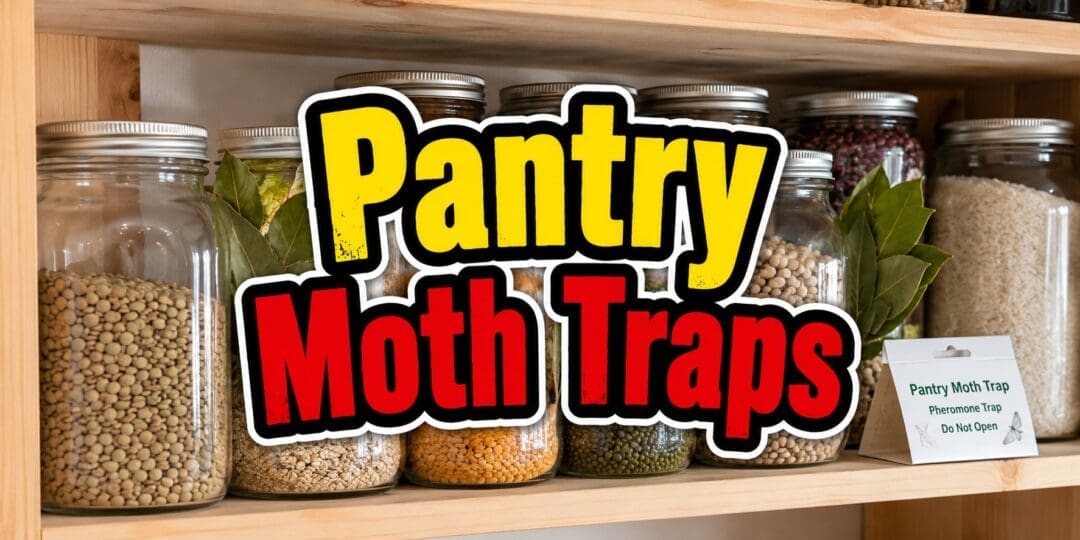
Pantry moth pheromone traps work by mimicking the sex pheromone released by female Indian meal moths to attract mates. The synthetic pheromone lure is embedded in or attached to a sticky trap. Male moths follow the pheromone gradient to the trap and become stuck on the adhesive surface. They cannot escape and die on the trap.
This is genuinely useful for two reasons. First, it provides monitoring: a trap that starts catching moths tells you that adult moths are present and active, which means an infestation either exists or is being introduced. The number of moths caught per week gives you a rough measure of population size and whether your control efforts are having an effect. Second, reducing the male population reduces mating success and therefore the number of fertilized eggs being laid, which slows the reproduction cycle.
What traps do not do is address any other life stage. Eggs, larvae, and pupae are unaffected by pheromone traps. A pantry with a heavy larval infestation will continue to develop even if every adult male is caught immediately, because the females that mated before being caught are still laying eggs and the larvae already in the food are still feeding and developing. Traps are a monitoring and suppression tool, not a standalone solution.
Types of Pantry Moth Traps
Pheromone sticky traps
These are the standard pantry moth trap available at most hardware stores, home improvement stores, and online. They consist of a cardboard or plastic enclosure, a sticky adhesive surface, and a pheromone lure. The enclosure protects the sticky surface from dust and gives the moths an enclosed space to enter. Most commercial products are designed for the Indian meal moth specifically and use synthetic versions of the cis-9, trans-12-tetradecadienyl acetate pheromone blend that female Plodia interpunctella produce.
Effectiveness varies between products primarily based on the quality and freshness of the pheromone lure. Lures lose potency over time and should be replaced every 3 months or as directed by the product instructions. A trap with an expired lure catches almost nothing. Keep replacement lures on hand or replace the entire trap unit on schedule.
Pantry moth trap placement
Placement matters significantly. Pheromone traps work at relatively short range because the pheromone plume disperses and dilutes with distance. Place one trap per pantry or kitchen cabinet zone, positioned at roughly the same height as where food is stored. Do not place traps directly on or next to food items, which could become contaminated with adhesive or trap contents. Eye level on a shelf corner or hung from an upper shelf bracket are effective positions.
Do not place multiple traps in the same small space. Multiple pheromone sources in close proximity can create a confusing signal gradient that reduces each trap’s effectiveness. One trap per 100 square feet of storage area is a practical guideline.
Electronic and UV traps
Some products use UV light in combination with a sticky surface to attract and catch moths. These are more effective against a broader range of flying insects but are less specifically targeted than pheromone traps for Indian meal moths. They require a power source and are better suited to larger storage areas or pantries where general flying insect monitoring is desired alongside moth control. For a typical kitchen pantry, a standard pheromone sticky trap is more cost-effective and equally functional.
Using Traps as Part of a Complete Elimination Process
Traps work best as part of a systematic elimination process rather than as a standalone measure. The full process for eliminating a pantry moth infestation has five components: inspection and removal of infested food, deep cleaning, treatment of the space, prevention of reinfestation, and ongoing monitoring with traps.
Step 1: Full pantry inspection and removal
Empty the entire pantry completely. Every item comes out, including items in sealed packaging that you believe to be unaffected. Inspect each item individually. Signs of infestation include webbing or silk threads in or around the packaging, small cream-colored larvae, small irregular holes in packaging, clumped or webbed grains, and a musty odor. Any item showing signs of infestation goes directly into a sealed plastic bag and out to the trash. Do not compost infested material.
Items in intact, sealed rigid containers such as glass jars or sealed metal tins are generally safe if there are no signs of infestation inside. Items in paper bags, cardboard boxes, thin plastic bags, or plastic film that has any breach should be treated as suspect and inspected closely. Moths and their larvae can penetrate thin plastic packaging and cardboard with ease.
According to the USDA Food Safety and Inspection Service, while pantry moth larvae in food do not pose a direct health hazard in the way that bacteria do, heavily infested food is not fit for consumption due to larval webbing, frass contamination, and the general degradation of food quality. Infested food should be discarded without hesitation.
Step 2: Deep cleaning the pantry space
Once the pantry is emptied, clean every surface thoroughly. Larvae pupate in cracks, corners, shelf brackets, wall-shelf joints, and any crevice that provides a protected surface. This is where a large proportion of the next generation of moths is waiting to emerge. Standard wiping is not sufficient. Use a stiff brush or vacuum with a crevice attachment to get into all joints, corners, and under shelf brackets. Pay particular attention to the back corners of shelves, the underside of shelf surfaces, and the ceiling of the pantry if it has one.
After vacuuming, wipe all surfaces with a solution of hot water and white vinegar, or with a food-safe all-purpose cleaner. Vinegar does not kill eggs or larvae directly but the cleaning action physically removes them and their adhesive webbing. Immediately dispose of the vacuum bag or empty the canister into a sealed bag and discard outside the home. Larvae can and will crawl back out of a vacuum canister if given the opportunity.
Step 3: Treatment of cracks and crevices
For persistent infestations where pupae are established in wall cracks or structural crevices, a targeted application of food-safe diatomaceous earth (food-grade DE) into cracks and along shelf-wall joints kills larvae and pupae through desiccation. Apply with a small brush or puffer applicator into cracks and joints after cleaning. Leave in place and reapply after each cleaning. Diatomaceous earth is inert, non-toxic to humans and pets, and does not contaminate food surfaces when used appropriately on structural surfaces rather than directly on food contact areas.
Some households use bay leaves as a deterrent: the aromatic oils in dried bay leaves repel moths and their larvae. Place whole dried bay leaves in the corners of shelves, tucked between jars, and in any crevice where food is stored. This is a traditional pantry practice with some empirical support and no downsides. Replace bay leaves every three to four months as the aromatic oils dissipate. Bay leaves will not eliminate an active infestation but they meaningfully reduce re-establishment after cleaning.
Step 4: Restocking with proper storage
Before restocking the pantry, assess your storage containers. Open bags and boxes are how pantry moths access food and spread through a pantry. Every item that goes back into the pantry should be in an airtight, rigid container: glass mason jars, sealed metal tins, or thick-walled airtight plastic containers. Thin plastic bags, paper bags, and cardboard boxes are not adequate storage for a pantry managing moth pressure.
For bulk grain, flour, rice, pasta, dried beans, and similar items, glass mason jars in quart and half-gallon sizes are the most practical and cost-effective sealed storage system for a homestead pantry. They are indefinitely reusable, impenetrable to moths at any life stage, stackable, visible, and easy to label. An investment in a comprehensive set of glass jar storage up front eliminates the primary vulnerability that allows pantry moth infestations to persist and spread.
Items that will be used within a week or two can be kept in their original packaging if it is intact and the contents were inspected and found clean. Items for longer storage should be transferred to sealed containers. New dry goods purchases should be inspected before storage and, for particularly vulnerable items like bulk flour, cornmeal, or birdseed, can be placed in the freezer for 72 hours before pantry storage to kill any eggs that may be present.
Related: How to Identify, Get Rid of, and Prevent Pantry Beetles
Step 5: Ongoing monitoring with traps
Once the pantry is cleaned and restocked, place fresh pheromone traps and check them weekly. A trap that begins catching moths again within two to three weeks after a thorough cleanup indicates that the infestation was not fully eliminated, most likely because pupae in structural crevices survived the cleaning and have now emerged as adults. If this happens, repeat the deep clean with more attention to the crevices and structural joints where pupae were likely harboring.
A trap that catches no moths for six to eight consecutive weeks after cleanup indicates that the infestation has been successfully broken. Continue monitoring at a lower frequency, checking traps monthly through the warmest months of the year when moth activity is highest. A single moth caught on a trap is not necessarily cause for alarm if it is isolated, but two or more moths in the same week warrants renewed inspection of stored goods.
Freezing as a Control Method
Freezing is one of the most effective and most underused tools for pantry moth control. All life stages of the Indian meal moth, including eggs and pupae, are killed by sustained exposure to temperatures below 0 degrees Fahrenheit (minus 18 degrees Celsius). Storing newly purchased dry goods in the freezer for a minimum of 72 hours before bringing them into the pantry kills any eggs or larvae present in the packaging and eliminates one of the primary pathways by which infestations enter the home.
The National Pest Management Association recommends freezing as a preventive measure for bulk dry goods including flour, cornmeal, whole grains, nuts, dried fruit, spices, and pet food, all of which are common infestation vectors. After freezing, allow the item to return to room temperature in a sealed bag before opening and transferring to pantry storage to prevent condensation from affecting food quality.
Freezing is also useful mid-infestation for salvaging items that may be early-stage infested but do not show obvious signs of larval feeding. Items treated with 72-hour freezing followed by careful inspection and transfer to sealed containers can often be retained rather than discarded.
Natural and Chemical Controls Beyond Traps
Bay leaves
As mentioned in the cleaning section, bay leaves have a legitimate and documented deterrent effect on pantry moths. The aromatic compounds in bay leaves, primarily eucalyptol and other volatile terpenoids, disrupt the olfactory sensing that moths use to locate food sources. Place whole dried bay leaves throughout the pantry, replacing them every three to four months. This is not a control for an active infestation but is a meaningful component of ongoing prevention.
Cedar
Cedar has a similar deterrent effect to bay leaves, primarily against clothes moths (Tineola bisselliella) rather than pantry moths, though some deterrent activity against pantry moths has been observed. Cedar blocks or sachets in a pantry provide marginal additional deterrence and no harm, but should not be relied upon as a primary control measure.
Diatomaceous earth
Food-grade diatomaceous earth applied along shelf edges, in corners, and into cracks kills larvae on contact through desiccation of their cuticle. It is effective as a physical barrier and as a crack-and-crevice treatment. It is not effective as a broadcast treatment on shelf surfaces where food is placed, as it would contaminate the food and has no impact on moths in flight or on eggs in food packages.
Professional treatment
For severe, persistent infestations that survive multiple rounds of deep cleaning, professional pest control can apply residual insecticide formulations into wall voids and structural crevices where conventional DIY cleaning cannot reach. This is rarely necessary for a standard kitchen pantry infestation but may be warranted for large food storage areas, commercial pantries, or infestations that have spread into wall cavities. The same thorough food removal and container upgrading is required alongside professional treatment.
Preventing Future Infestations
Prevention is far easier than elimination. Once you have cleared a pantry moth infestation, the following practices keep them from returning:
- Inspect all dry goods at purchase before bringing into the home. Check bag seams and packaging integrity. Refuse packages with any signs of damage
- Freeze new dry goods purchases for 72 hours before pantry storage, particularly flour, cornmeal, grains, nuts, dried fruit, and pet food
- Store all dry goods in airtight rigid containers. Glass mason jars are the gold standard. Anything less than an airtight seal is a potential entry and spread point
- Keep a pheromone trap in the pantry at all times as an early warning system. Replace the trap or lure every three months
- Place dried bay leaves throughout the pantry and replace them seasonally
- Rotate stock consistently. Items stored for long periods without being opened or inspected are more likely to harbor developing infestations that go unnoticed
- Keep the pantry clean and dry. Spilled grains, flour dust, and food debris in cracks and corners provide the food source and habitat that sustain moth populations between generations
- Check pantry traps more frequently in late spring through early fall when moth activity peaks with warmer temperatures
Root Cellar and Bulk Storage Considerations
For homesteaders with dedicated food storage areas, root cellars, and bulk dry goods storage, pantry moth management requires the same principles applied at a larger scale. The key additional considerations are:
Bulk grain stored in bins or buckets is particularly vulnerable because a single infested batch can spread through the entire storage before being detected. Inspect bulk grain at every access. Oxygen absorbers in sealed 5-gallon buckets kill all life stages of pantry moths and other grain pests by creating an anaerobic environment in which insects cannot survive. The USDA Food and Nutrition Service recommends oxygen absorbers as a standard practice for long-term dry grain storage.
Root cellars and storage rooms should have pheromone traps placed at the same density as kitchen pantries: one trap per roughly 100 square feet of storage area. Because these spaces are typically cooler and less ventilated than kitchen pantries, moth activity may be lower but the consequences of an established infestation in a large bulk storage area are significantly more severe than in a kitchen pantry.
All containers in bulk storage should be airtight and ideally opaque. Light exposure accelerates food degradation independently of moth activity, so sealed opaque containers serve both pest management and food preservation goals simultaneously.
The Amish Solved Pantry Problems Long Before Modern Pest Control
Long before plastic packaging, chemical sprays, and climate-controlled grocery stores, Amish families stored enormous amounts of flour, grain, dried beans, animal feed, and preserved food through every season of the year. And they learned quickly that poor storage attracts pests fast.
What made the difference was not expensive technology. It was discipline, food rotation, airtight storage methods, root cellar management, and practical systems that prevented infestations before they started.
The Amish Ways reveals many of the forgotten food storage and self-reliance methods Amish families still use today to preserve harvests, protect bulk food supplies, organize pantries, and maintain long-term food security without depending on modern systems.
For anyone serious about preparedness, homesteading, or building a resilient pantry that actually lasts, this is one of the most practical resources available today!
Final Thoughts
Pantry moths are a solvable problem. They require a systematic response rather than a single product, but the system is not complicated: find and remove the infested food, clean the space thoroughly, upgrade your containers, freeze incoming goods before storage, and monitor with traps on an ongoing basis.
The trap is the alarm, not the solution. When it catches something, that is your signal to go looking for the source. The source is always infested food or pupae hiding in a structural crevice. Find it, address it, and the trap goes quiet.
For a homestead with a serious food storage system, getting this right is not optional. The same investment in bulk dry goods that reduces grocery dependence and builds resilience is also the investment that feeds a moth population if it is not stored and managed correctly. Airtight containers and a pheromone trap on the shelf are cheap insurance for everything else in the pantry.
You may also like:
 Join The Exclusive Self-Sufficient Projects Facebook Group
An Insanely Effective Way to Build a 5 Year Food Stockpile (Video)
How Much Does Pest Control Cost? What You’ll Pay vs. What You Can Do Yourself
Organic Gardening: The Complete Guide to Growing Food Without Chemicals
2026 Spring Medicinal Planting Guide