You open a bag of flour you bought two months ago and something moves. Or you pour out a scoop of cornmeal and notice tiny brown specks that were not there before. Or you find a fine webbing coating the top of your rice bin. Welcome to the world of pantry beetles, the most common and most frustrating pest problem facing anyone who stores food in bulk.
For homesteaders, preppers, and anyone serious about maintaining a deep pantry, pantry beetles are not a nuisance you can afford to ignore. A single infestation left unchecked can move through your entire grain supply, contaminate months of stored food, and cost you far more than the value of whatever you lose to the bugs themselves.
The good news is that pantry beetles are entirely manageable once you understand what you are dealing with. This guide covers identification of every major species you are likely to encounter, how to eliminate an active infestation without toxic chemicals, and the storage practices that make re-infestation almost impossible.
What Are Pantry Beetles?
Pantry beetles is a general term for a group of small beetles and weevils that infest stored dry goods. They are not a single species but rather a collection of insects from several beetle families that share a common trait: they eat and reproduce in the dry grain, flour, spice, and seed products most of us keep in our kitchens and pantries.
Unlike flies or cockroaches, which enter your home from outside seeking food, pantry beetles are almost always introduced directly into your home inside infested products you purchase at the store. The eggs are laid inside grain products at the processing facility, the farm, or the warehouse, often before packaging. You bring the infestation home in the bag. Under warm indoor conditions, those eggs hatch and the population explodes.
This is important to understand because it means a spotless, well-organized kitchen is not immune. Anyone can end up with pantry beetles regardless of how clean their home is. The infestation is a food storage and supply chain problem, not a hygiene failure.
Common Pantry Beetles: Identification Guide
Knowing which pest you are dealing with tells you where to look for the source and how to address it most effectively. Here are the beetles most likely to show up in your stored food.
Sawtoothed Grain Beetle (Oryzaephilus surinamensis)
This is the most widespread pantry beetle in the world and almost certainly the most common one you will encounter. Adults are very small, about 1/10 inch long, slender, flat, and dark brown. The defining characteristic is the row of six saw-like teeth along each side of the section behind the head, though you will need a magnifying glass to see them clearly. Sawtoothed grain beetles do not fly, which limits how quickly they spread from one area of your pantry to another.
They infest flour, cereals, dried fruit, pasta, chocolate, sugar, bread, and virtually any grain-based product. They are especially troublesome because their flat body allows them to squeeze into packaging that appears sealed. The female lays 200 to 300 eggs over her lifetime, depositing them loosely in the food material. A small starting population can become a major infestation within a few weeks at room temperature.
Merchant Grain Beetle (Oryzaephilus mercator)
The merchant grain beetle looks nearly identical to the sawtoothed grain beetle and is treated identically for control purposes. The main distinguishing feature is a slightly larger head relative to body size, visible only under magnification. Unlike its close cousin, the merchant grain beetle can fly, which means it spreads more readily and may appear in areas of your pantry far from the original infestation source. It has a particular preference for oily products like nuts, seeds, and birdseed in addition to grains.
Confused Flour Beetle (Tribolium confusum) and Red Flour Beetle (Tribolium castaneum)
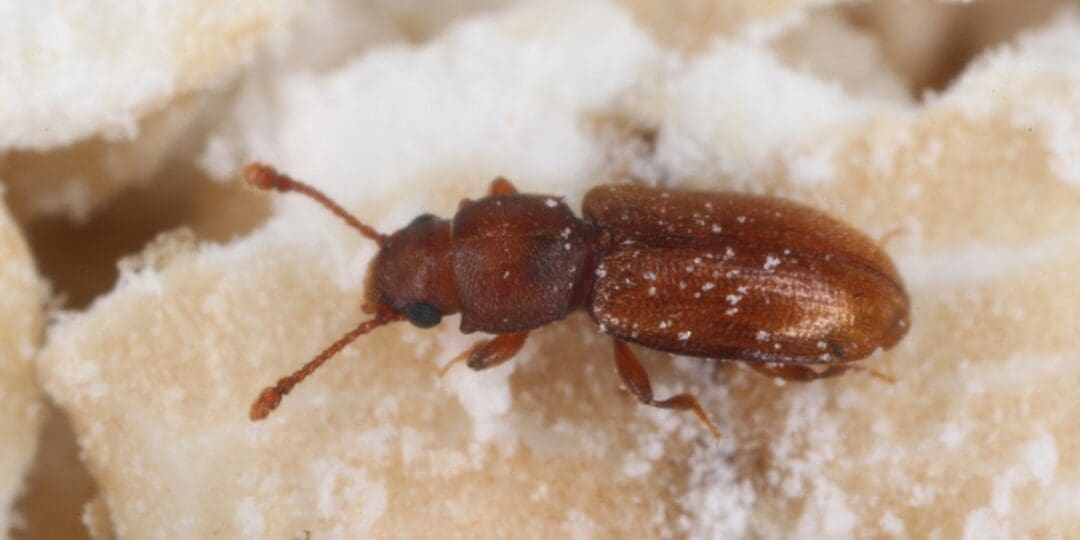
These two species are so similar that pest control professionals often treat them as a single problem. Both are about 1/7 inch long, reddish-brown, and oval-shaped. The confused flour beetle has gradually clubbed antennae while the red flour beetle has a more abruptly clubbed three-segmented club at the end, a difference visible only under magnification and rarely relevant for control purposes.
Flour beetles are the dominant pest in milled grain products. They are most often found in flour, cornmeal, spice mixes, dried beans, and cereal. They do not attack whole, undamaged grain kernels but will infest milled products, cracked grain, and any grain that has been damaged by other insects. One important behavioral note: flour beetles produce a pheromone that causes an off-flavor and darkens infested flour. If your flour smells musty or slightly chemical before you ever spot an insect, flour beetle contamination is a likely cause.
Research from Kansas State University’s stored grain research program documents flour beetles as among the most economically significant stored product insects in the United States. More information on their biology is available through the USDA Agricultural Research Service.
Drugstore Beetle (Stegobium paniceum) and Cigarette Beetle (Lasioderma serricorne)
These two beetles look almost identical: small, about 1/10 inch long, reddish-brown to brown, with a distinctive humped, oval shape that makes them look like a tiny grain of brown rice with legs. Both hold their head tucked down, giving them a bowed appearance when viewed from the side. The drugstore beetle has striated (ridged) wing covers while the cigarette beetle has smooth wing covers, a distinction visible under a hand lens.
What sets these beetles apart from others is the extraordinary range of materials they will eat. The drugstore beetle earned its name from infesting pharmacies because it eats dried plant materials of almost any kind, including spices, herbs, dried flowers, and even some pharmaceutical products. Both species are major problems in spice collections, dried herb pantries, and anywhere you store dried botanical materials. They also infest flour, grain, dried fruit, nuts, seeds, and pet food. If you maintain a medicinal herb pantry alongside your food stores, these are the beetles most likely to target it.
Weevils: Grain Weevil and Rice Weevil (Sitophilus granarius and Sitophilus oryzae)
Weevils are technically beetles in the family Curculionidae, and they are among the most damaging pantry pests because of how they reproduce. Adult weevils are small, about 1/8 inch long, dark brown to black, with the distinctive elongated snout (rostrum) that characterizes all weevils. The grain weevil does not fly; the rice weevil does, and it tends to be slightly smaller and may have faint reddish spots on its wing covers.
The reason weevils are so destructive is that the female chews a hole in a whole grain kernel, lays a single egg inside, and seals the hole with a waxy plug. The larva develops entirely inside the kernel, hollowing it out completely before emerging as an adult. You can have a heavy infestation inside your whole grains and see almost nothing on the surface until adults begin emerging. By the time you notice the adults, the grain is likely riddled with larvae. Weevils primarily attack whole grains, wheat berries, corn, rice, sorghum, and dried beans. They rarely infest milled flour or spices.
Khapra Beetle (Trogoderma granarium)
The Khapra beetle deserves special mention because it is one of the most destructive stored grain pests in the world and a federally regulated quarantine pest in the United States. It is brown, slightly hairy, and about 1/8 inch long. Adults do not eat much; the larvae are the destructive stage, and they can survive for years without food, making eradication extremely difficult once established. The larvae also shed their hairy skins, which can cause respiratory irritation.
Khapra beetle is not common in US homes but has been intercepted repeatedly at US ports of entry. If you import grain products from South Asia or the Middle East, exercise extra caution. If you suspect Khapra beetle, contact your local USDA Animal and Plant Health Inspection Service (APHIS) office rather than attempting DIY control.
How to Confirm You Have Pantry Beetles
Before you tear apart your pantry, confirm that what you are seeing is actually a beetle infestation rather than something else. Here is a straightforward inspection process.
- Empty your pantry completely. Pull everything out, including items in the back corners and on high shelves. Beetles spread to whatever is nearby once they exhaust the original source.
- Inspect every package. Look carefully at seams, folds, and any area where packaging material meets itself. Check the inside of bags and boxes. Look for adult beetles (small, brown, moving or dead), larvae (tiny cream or white grubs), and eggs (nearly invisible without magnification, but present as a dusty or gritty texture in heavily infested products).
- Check for webbing. Moth infestations and some beetle infestations produce fine webbing. If you see webbing, you may have Indian meal moths rather than beetles, which require slightly different treatment. Moth larvae are creamy white caterpillars; beetle larvae are more grub-like.
- Look for off-color or clumped grain. Heavily infested flour often turns slightly gray or tan. Grain products may clump together from larval activity and feces.
- Smell the product. Flour beetle infestations produce a distinctively musty, slightly chemical odor due to the quinone compounds the beetles release.
- Check non-food items too. Dried flowers, pet food, birdseed kept indoors, medicinal herb stores, and even some decorative items can harbor beetles that later spread to your food.
If you find evidence of infestation in one product, inspect every other dry good in the same area. Beetles spread readily from an open or loosely sealed package to neighboring containers.
Getting Rid of Pantry Beetles: Step-by-Step
There is no shortcut here. A half-measures approach will leave eggs in place that hatch within weeks, and you will be dealing with the same problem all over again. Do the job completely the first time.
Step 1: Remove and Dispose of All Infested Products
Any product that shows evidence of infestation goes out. Seal it in a plastic bag before putting it in an outdoor trash container. Do not compost infested grain products because the eggs and larvae will survive and the beetles will emerge in your compost area. When in doubt about whether a product is infested, throw it out. The cost of replacing a bag of flour is far less than the cost of a re-infestation.
Products that show no visible infestation but were stored near infested items should be treated with the freeze method described below before returning to the pantry.
Step 2: Freeze Suspect Products
Freezing is the single most effective non-chemical method for killing pantry beetles at all life stages. Place sealed packages or sealed bags of dry goods in your freezer at 0 degrees Fahrenheit or lower for a minimum of four days. This temperature reliably kills eggs, larvae, pupae, and adults. The University of Minnesota Extension recommends this method specifically for eliminating stored product insects in home pantries.
After freezing, allow the product to return to room temperature before opening to prevent condensation from forming inside the package and introducing moisture to your dry goods. Properly frozen and stored food is completely safe to eat after this treatment.
Step 3: Deep Clean the Pantry
Empty everything out completely. Vacuum all shelf surfaces, corners, cracks, and crevices thoroughly. Pay particular attention to shelf edges, the undersides of shelves, and any gaps between the shelf and the wall. Beetle eggs are tiny and can sit in a corner crack through an entire cleaning if you only wipe surfaces.
After vacuuming, wipe all surfaces with a cleaning solution. White vinegar diluted 1:1 with water works well and leaves no chemical residue that could affect your food. Let the pantry dry completely before returning any food to it.
Dispose of the vacuum bag or empty the canister outside immediately after cleaning. A vacuum bag full of beetle eggs sitting in a warm closet is a re-infestation waiting to happen.
Step 4: Inspect and Clean Surrounding Areas
Beetles do not stay in the pantry. Check drawers near the pantry, the area under the stove, any gaps between appliances and cabinets, and the tops of cabinets where dust accumulates. If you store pet food, birdseed, or livestock feed in or near the house, inspect those as well. Check any pantry items stored on countertops or in open bowls.
Step 5: Use Bay Leaves as a Deterrent
Bay leaves (Laurus nobilis) contain compounds that repel pantry beetles and other stored food pests. Place whole dried bay leaves in your dry goods containers, on pantry shelves, and in the corners of cabinets. This is not a treatment for an active infestation, but it functions as a deterrent once you have cleaned things out. Replace the bay leaves every 3 to 6 months as the volatile oils dissipate. This is an old homestead practice that holds up, and it does not introduce any chemicals to your food storage environment.
Step 6: Use Pheromone Traps for Monitoring
Sticky pheromone traps for stored product beetles are available from farm supply stores and online retailers. These traps use synthetic versions of the beetles’ own attractant chemicals to lure adults to a sticky surface. They do not eliminate an infestation on their own, but they are excellent monitoring tools. Place one or two in your cleaned pantry after treatment. If beetles appear on the trap within a few weeks, you did not fully eliminate the source and need to inspect again.
Preventing Pantry Beetles: Building a Beetle-Proof Storage System
Prevention is the real goal. Once you have dealt with an infestation, the right storage practices will make a recurrence highly unlikely. These are not theoretical best practices. They are the methods experienced homesteaders use to maintain large food stores without pest problems.
Use Airtight Hard-Sided Containers
This is the single most important change you can make. Beetles cannot chew through hard plastic, glass, or metal containers with properly sealing lids. Transfer all dry goods from their original packaging into airtight containers as soon as you bring them home from the store.
Good container choices in order of preference:
- Glass mason jars with new lids: airtight, inert, easy to inspect through the glass, and widely available in sizes from pint to half-gallon
- Food-grade plastic buckets with gamma-seal lids: the standard for bulk grain storage, available in 3.5 and 5 gallon sizes from homestead supply retailers
- Food-grade HDPE containers with gasketed lids: good for medium-quantity storage
- Heavy-duty glass canisters with rubber-gasketed clamp lids: attractive and functional for regularly used items
Avoid thin plastic bags, cardboard boxes, and clip-style chip bag closures. These do not stop beetles. The sawtoothed grain beetle in particular can work its way into packaging that appears well sealed because its flat body fits through gaps that seem too small to matter.
Freeze New Purchases Before Storing
The most reliable way to prevent introducing a new infestation is to freeze everything before it goes into your long-term storage. When you bring home a new bag of flour, rice, dried beans, or any other bulk dry good, seal it and put it in the freezer for four days before transferring it to your storage container. This kills any eggs or larvae that may have been introduced before you purchased the product.
This step is especially important for products that do not have tight factory seals, products purchased in bulk bins, and any grain purchased directly from a farm or mill. It adds a few days to your storage process but eliminates the single most common route of infestation.
Manage Temperature and Humidity
Pantry beetles thrive in warm, humid conditions. The optimal reproduction temperature for most species is between 65 and 90 degrees Fahrenheit, with relative humidity above 60 percent. Cooler, drier storage conditions slow reproduction dramatically and can make the difference between a manageable occasional beetle and a recurring infestation.
Keep your pantry area as cool as possible. Store bulk grains and long-term supplies in a basement, root cellar, or other cool area where temperatures stay below 65 degrees if possible. The USDA recommends storing grains at 50 to 60 degrees Fahrenheit with relative humidity below 60 percent for long-term storage. See their food safety storage guide here.
If you store food in a warm kitchen pantry, use food-safe oxygen absorbers or food-grade diatomaceous earth in your storage containers to create an inhospitable environment for beetle reproduction. Oxygen absorbers, when used in sealed containers, eliminate the oxygen that insects require to survive. They are widely used in long-term food storage and are available from homestead and prepper supply retailers.
Rotate Stock Consistently
First in, first out is the rule. Always use your oldest stored products first and put new purchases behind existing stock. Products that sit undisturbed for months or years are the most vulnerable to undetected infestation. Rotating your stock means you are regularly opening, inspecting, and using everything in your pantry rather than accumulating old inventory that could harbor a slow-building infestation.
Inspect Regularly
A quick monthly check of your pantry takes five minutes and can catch a problem before it spreads. Look at the containers you use least often. Check the corners of shelves. Look for any dead beetles, which are often easier to spot than live ones. If you have pheromone monitoring traps in place, check them each time you inspect.
Keep the Pantry Clean and Uncluttered
Spilled grain, flour dust on shelves, and crumbs in corners are beetle food and breeding habitat. Wipe up spills immediately. Sweep shelf surfaces every few weeks. Do not let broken packaging, old rubber bands, or other debris accumulate in corners. An uncluttered pantry is easier to inspect and harder for beetles to hide in.
Are Foods Infested with Pantry Beetles Safe to Eat?
This is a question people hesitate to ask, but it is worth answering directly. Foods infested with pantry beetles are not a health hazard in the sense of containing pathogens, bacteria, or toxins. The beetles and their larvae are not poisonous and do not carry disease. In many parts of the world, grain contaminated with small numbers of insects is simply sifted and used without a second thought.
That said, most people in North America prefer not to eat them, and the off-flavor produced by flour beetles in particular can make infested flour taste noticeably unpleasant. The practical standard is this: lightly infested grain that can be sifted clean and has no off-odor is generally safe to use. Heavily infested products with significant beetle feces, frass, and larval debris are best discarded due to quality issues even if not a direct safety hazard.
The U.S. Food and Drug Administration sets defect action levels for insect contamination in food products, acknowledging that minor contamination of dry goods is impossible to completely eliminate in commercial production. Guidelines available here!
Special Considerations for Bulk and Long-Term Storage
Anyone maintaining a serious food storage setup faces heightened pantry beetle risk simply because of the volume of product involved and the longer storage times. A single infested bag of wheat berries introduced into a bank of 5-gallon buckets can spread to neighboring containers within weeks if those containers are not truly airtight.
Additional precautions for bulk storage:
- Oxygen absorbers: Place food-grade oxygen absorbers in sealed buckets of whole grains and legumes. The resulting low-oxygen environment is fatal to insects at all life stages within a few days and also extends food shelf life by preventing oxidation.
- Diatomaceous earth: Food-grade diatomaceous earth (DE) can be mixed directly into stored grain at a rate of approximately 1 cup per 40 pounds. DE is composed of microscopic sharp silica particles that damage the exoskeleton of insects and cause them to dehydrate. It is non-toxic to humans and is an approved grain treatment. Use only food-grade DE, not the type sold for pool filtration, which is processed differently.
- Mylar bags inside buckets: For ultimate protection, seal grain in heat-sealed Mylar bags before placing them inside 5-gallon buckets. This dual-layer approach provides both the puncture resistance and structural support of the bucket and the true oxygen barrier of the Mylar film.
- Label with dates: Every container of bulk grain should be labeled with the product name and the date it was packed. This makes rotation straightforward and lets you flag any containers that have been sitting long enough to warrant extra inspection.
For comprehensive guidance on long-term food storage methods for homesteaders, the National Center for Home Food Preservation at the University of Georgia provides research-based information right here.
When to Call a Professional
Most pantry beetle infestations can be resolved entirely with the methods described above. You do not need a pest control company to address beetles in stored food. However, there are situations where professional involvement makes sense.
- If you have eliminated the infestation multiple times and beetles continue to reappear, there may be a structural source you are missing, such as an old bird’s nest in the wall cavity, a long-forgotten food product in a hard-to-reach space, or beetles moving in from a neighboring apartment or unit in a multi-unit building.
- If you suspect Khapra beetle based on the appearance of hairy, very resilient larvae that persist after thorough cleaning and treatment.
- If the infestation is affecting commercial food storage on a farm or homestead at a scale where individual container treatment is not practical.
In the case of a structural problem, a licensed pest management professional with experience in stored product insects can inspect wall voids, attic spaces, and other areas that are not accessible in a standard pantry cleanout.
You Might Also Need This!
A deep pantry is only half a preparedness plan.
You can protect flour from beetles, seal grains in buckets, freeze dry goods, and build an organized food storage system that lasts for years. But none of that changes one hard truth: food storage fails fast when your water supply is unreliable.
You can go weeks without many comforts. You cannot go long without clean water.
That is why serious preparedness is not just about protecting what is on your shelves. It is about making sure your household has a dependable source of water for drinking, cooking, cleaning, sanitation, and emergency use when normal systems stop working.
Water Smartbox is built around that exact idea. Its product page presents it as an off-grid, on-demand water system designed to help families create their own water supply in a few steps, without depending entirely on municipal lines. The page also describes it as a way to pull usable water from air humidity for household resilience.
That matters because pantry pests are only one threat to stored food.
Even perfectly protected dry goods become harder to use when:
- you cannot boil rice, beans, oats, or pasta
- you cannot wash dishes or prep food safely
- you cannot maintain basic hygiene in the kitchen
- you cannot clean containers, tools, or surfaces
- you are forced to ration every gallon in the house
In other words, food security depends on water security.
A well-stocked pantry gives you calories.
A reliable water solution helps make those calories usable.
That is where Water Smartbox fits into the bigger preparedness picture. While airtight containers, oxygen absorbers, and freezer treatment protect your food from insects, a water backup strategy helps protect your family from a much larger point of failure. The Water Smartbox page frames this as reducing dependence on vulnerable water infrastructure and creating a more self-reliant setup at home.
If you are already investing in long-term food storage, bulk grains, emergency supplies, and homestead preparedness, then it makes sense to strengthen the other side of the equation too.
Because storing food without securing water is like locking up ammunition with no firearm, or building a greenhouse with no sunlight. The system is incomplete.
Water Smartbox is worth a serious look for anyone who wants to:
- build a more independent home
- strengthen emergency readiness
- reduce vulnerability during outages or disruptions
- add a practical water layer to an existing food storage plan
- think beyond pantry shelves and prepare for the full picture
You can bug-proof your flour, seal your rice, and organize your pantry down to the last jar. But when the pressure drops, the taps stop, or restrictions hit, the families who planned ahead for water will be in a very different position from the ones who only planned for food.
That is why this matters.
If you want your preparedness plan to cover more than shelves and storage bins, take a look at Water Smartbox and see how it could fit into your household’s self-reliance strategy.
A protected pantry is smart.
A protected pantry plus a water plan is real preparedness.
Final Thoughts
Pantry beetles are common, persistent, and genuinely destructive to a well-stocked food store. But they are also entirely manageable with a systematic approach. Find the source, eliminate it completely, clean thoroughly, freeze any products you want to keep, and then rebuild your storage system with airtight containers and good habits. That combination stops most infestations permanently.
If you are serious about maintaining a deep pantry or long-term food supply, the time to upgrade your storage system is before you have a problem, not after. The few dollars you spend on good containers and an occasional bag of oxygen absorbers will save you far more in lost food and wasted effort down the road.
Beetles get in through the front door in the food you buy. They do not have to stay.
You may also like:
Join Our Official Facebook Group For More Homesteading Tips And Tricks
The Silent Stockpile Killer. Do You Have It In Your Pantry? (Video)
Apple Orchard Pests: How to Identify, Prevent, and Control Them
The Unseen Garden Pests You’re Accidentally Feeding
Deterring Unwanted Pests with Lemon and Baking Soda