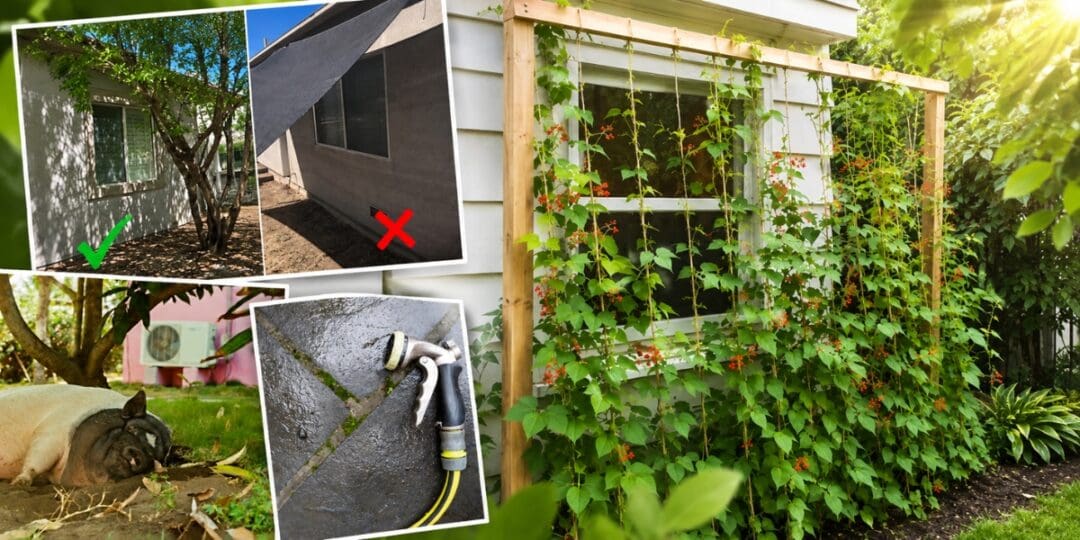
Every summer, you pay good money to fight the heat. The AC is on all afternoon, the electric bill keeps rising, and the house still feels hot by the evening. Meanwhile, the cheapest cooling system you can install doesn’t plug into anything. Instead, it grows and you can grow it yourself.
Plants can drop the temperature around your house by a surprising amount. The U.S. Department of Energy found that just three well-placed trees can save you $100 to $250 a year on energy, and a well-planned landscape can cut an unshaded home’s summer cooling costs by 15 to 50 percent. That’s why you need to see how to put your garden to work to your advantage.
In this article, I want to show you exactly how this works, where to plant what, which popular tip doesn’t work at all, and I’ll tell you more about a simple trellis project you can build in one afternoon that starts cooling a hot window this very season.
Why Plants Cool Better Than a Tarp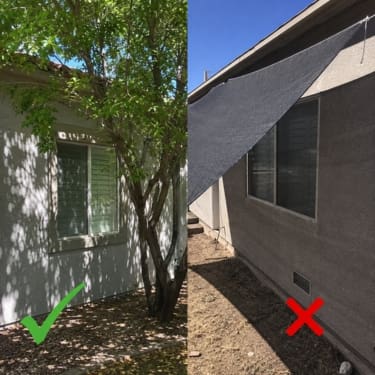
Here’s the part I find fascinating, and it’s something I didn’t understand for years. I used to think shade was shade. Hang a tarp, plant a tree, same difference, right? But it turns out I was wrong.
Plants do two jobs at once. The first is the obvious one. They block sunlight before it ever touches your roof, walls, and windows, so that heat never gets inside in the first place.
The second job is the one that surprised me. A plant pulls water up from the soil through its roots and releases it as vapor through its leaves, and that process pulls heat right out of the surrounding air. It works the same way sweat cools your skin on a hot day, except a single mature shade tree can move around 100 gallons of water this way every day.
A tarp only blocks light. A tree blocks light and actively cools the air around it at the same time. This is why researchers at Lawrence Berkeley National Laboratory measured tree-shaded neighborhoods running 3 to 6 degrees cooler than treeless ones on summer afternoons.
Also, one smart thing you can do is to use this device to gather water. As I said, the trees release vapors through their leaves and using this device can help you turn those vapors into liquid water you can use around your homestead.
The mechanism is simple; it works just like a dehumidifier, but the advantage of this device is that it is made so you can use it outside. Try using a regular dehumidifier outside and it will break down in less than a month.
Click here to start producing free water on your property →
Where to Plant Your Shade Trees
Placement matters more than the tree itself. A beautiful maple planted in the wrong corner of the yard shades nothing but grass while the other side of your house bakes all afternoon.
So, try to focus on the west and south sides of your home first. The west side takes the worst beating, because that’s where the sun sits during the hottest hours of the day, usually from mid-afternoon until evening. The south side catches strong sun through the middle of the day.
And here’s the trick that makes this work year-round: plant deciduous trees, the kind that drop their leaves in fall. In summer, the full canopy blocks the heat. In winter, the bare branches let the low sun shine right through and warm your house for free. It’s a system that adjusts itself twice a year without you lifting a finger.
Evergreens have a job too, but it’s a different one. Keep them on the north and northwest sides, where they block cold winter winds. Whatever you do, don’t plant a spruce or a pine on the south side of the house, because it will happily block your free winter sunshine along with the summer heat.
Depending on where you live, good deciduous choices include maples, oaks, and honey locust. Your local extension office can tell you which ones thrive in your soil, and I suggest you give them a call before you buy anything, because a tree is a 30-year decision. If you want to plan out your whole yard this way, Colorado State University Extension put together a guide on landscaping for energy conservation that covers shade, windbreaks, and how to sketch a plan for your own property.
Now, I know what you might be thinking. A tree takes forever to grow. Not as long as you’d expect. According to the Department of Energy, a 6-to-8-foot deciduous tree planted near the house starts shading your windows in its very first year, and depending on the species, it can shade your roof within 5 to 10 years. That first year of window shade already makes a difference you can feel in the room.
Give Your AC Unit Some Shade Too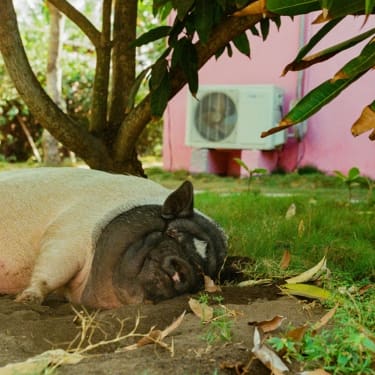
Here’s a placement tip that pays off fast: plant something to shade your outdoor AC unit. A unit sitting in full sun works harder to cool the air it pulls in, and shading it can boost its efficiency by as much as 10 percent. Just keep the plants a few feet back so air can still flow around the unit and you can get to it for maintenance.
Also, if you don’t have an AC, I want to tell you that you can build one yourself and it takes just a few hours. Beating the heat is difficult when the grid is fully functional, but imagine how hard it is when you live off-grid, or the grid is down.
The good news is that with just a few items you may already have around you can build a DIY Air Conditioner that is powered either by 12-volt DC power or standard household 120-volt electricity.
I want to be honest from the beginning: this is a style of air conditioning that works best in small enclosed spaces or if you sit near it. It will not cool down your entire house the same as a classic AC system. But, even with this disadvantage, this easy DIY project is much more efficient at cooling a space than a regular fan.
The fans just move the air around the room, but this system is actively producing cool air that it pushes out, and this is how it manages to make a difference and truly cool down a room during the summer.
If you want to cool down your house fast, you can see how to build it step-by-step here →
Vines: Shade in a Single Season
If you need cooling this summer, not in five years, vines are your answer. They grow shockingly fast, and because the leaves sit just inches from the wall, the cooling effect lands exactly where you need it.
A wall of thick vine foliage can lower the air right next to it by 10 degrees or more through transpiration, and it traps that pocket of cooler air between the trellis and your siding like a thermal buffer. Researchers at UC Davis have been studying vines for exactly this reason, since they shade buildings in one season while a tree is still a sapling.
But since we want to keep things safe for your house, there are two rules you need to follow.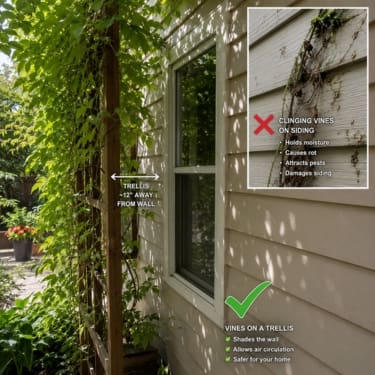
Never let clinging vines grow directly on wood siding – A clinging vine is one that glues itself straight onto a surface with tiny rootlets, the way English ivy and Virginia creeper do, while other vines just wrap themselves around whatever support you give them. The clinging kind holds moisture against the wood, and that leads to rot and pest problems. Clinging vines are only acceptable on solid brick or block, and even then I’d think twice.
Always grow vines on a trellis set away from the wall – A trellis placed about a foot out from the house gives you the shade and the cool air pocket while letting everything breathe. This is especially important if your summers run humid.
And just like with trees, pick deciduous or annual vines for the south and west sides so the winter sun can still reach the wall and warm it when you actually want the heat.
One quick note on getting new trees and vines established: they’ll need steady watering through their first summer, and the water you use matters more than you’d think.
If you’re worried that you don’t have enough water, then you need to see this simple rain harvesting system. Please stick with me because this one is not your classic rain catchment project.
It is called the 3-Barrel Water Harvesting System, and it was designed to meet the needs of homesteaders across the U.S. What I like the most about it is that besides the harvesting system, it also stores your water so you don’t have to worry about not having space for all that water.
The project is easy to make and you don’t need special skills or tools to get the job done. Also, you don’t need to limit it to three barrels, and this is the beauty of it. You can make it a 4-barrel system or a 12-barrel system. The choice is yours.
Also, this system is not stuck in one place. You can move it around and place it wherever you find it more suitable. For example, if you build it to gather water from the roof of your shed and now you want to get rid of that shed, you can simply move the system and maybe attach it to your house.
If you’re interested in building this system yourself and making sure you have a reliable water source on your homestead, you can find the full instructions here →
Use Your Plants to Move the Breeze Around
This is the method I almost never see anyone talk about, and it comes straight out of the Department of Energy’s landscaping guidance. You can arrange your plants to funnel summer breezes toward your house.
The idea works like a windbreak in reverse. Instead of blocking the wind, you plant a row of trees or a hedge on each side of the path the summer breeze usually takes, shaped like a funnel that’s wide out in the yard and narrows as it gets close to the house. The wind speeds up as the funnel tightens and pushes cooler air right through your open windows. And if you’re not sure which way your summer breeze usually blows, just watch which way the laundry on the line or the tall grass leans on a typical afternoon. That’s your answer.
There’s a smaller version of the same trick. Air moves fastest in the gap between the ground and the lowest branches of a tree, so if you prune the lower limbs off a tree or big shrub near a window, you channel the breeze upward and straight into the house.
Now, here’s the honest catch, and it’s important. This only helps if you cool your house by opening windows in the evening. If you run the AC with everything shut, moving air actually works against you, because it pushes hot, humid air through every little crack around your windows and doors. In that case, you want your plants deflecting wind away from the house instead. Same tool, opposite setup, so know which kind of house you’re running before you plant.
Also, you can use this method to create free energy. Buying a small off-grid wind turbine for your home can be quite expensive. But if you’re handy with tools, you can build a fully functional wind turbine at home using salvaged parts and a small motor you can get easily from Amazon.
You can use the plants from your garden to direct the wind to the turbine, or if you live in a windy area, you are lucky and you can simply install the turbine and start producing energy right away.
Click here and see how to build your own wind turbine →
Cool the Ground Around Your House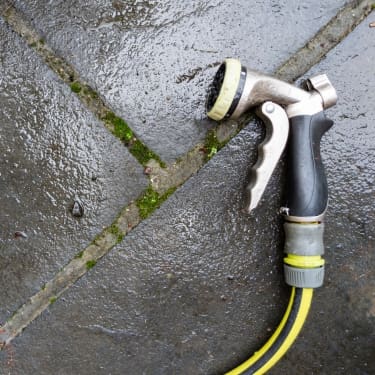
This one gets overlooked, and I ignored it myself for years. Bare pavement, gravel, and concrete soak up heat all day long and then radiate it back at your house well into the evening. The Department of Energy found that a shaded surface can be up to 25°F cooler than an unshaded one, and driveways, patios, and walkways are the worst offenders.
I had a strip of white gravel running along the back of my house for years because it looked tidy. Then one August evening I held my hand over it around sunset and it was still throwing heat like a griddle, hours after the sun had left it. That gravel came out the next spring and a bed of creeping thyme went in.
Anywhere you can, replace bare hot surfaces near the house with living ground cover. Low plantings, mulched beds, even plain healthy grass stay dramatically cooler than stone and concrete, and they stop feeding heat back into your walls after sunset. A shaded patio with plants around it becomes a place you can actually sit in July, and it stops acting like a radiator pointed at your kitchen window.
If you’re thinking that garden beds might be suitable for your home, then you can try building some self-watering raised garden beds. Imagine them like an upgraded version of regular garden beds, a version you no longer have to babysit. Also, if you decide to build that 3-barrel water harvesting system, you can connect it to the garden beds and this is how you create a self-sustaining system on your homestead.
Here you can see more about how you can build these beds and how to make them more efficient for your set-up.
Do Houseplants Actually Cool a Room?
Before we get to the project, I want to clear something up, because you’ve probably seen articles claiming that snake plants or peace lilies will cool your living room.
I wish it were true, but it isn’t. Houseplants do transpire, just like trees, but the amount of water a few potted plants release is tiny. To get any measurable cooling from transpiration indoors, you’d need something closer to a greenhouse than a living room, and all that moisture would make your house feel muggier, not cooler.
Keep your houseplants because you love them. They clean up a room and they’re good company. Just don’t expect them to lower the thermostat, and don’t spend money on a “cooling houseplant” collection some article promised you. The real cooling happens outside, between the sun and your walls.
DIY Project: A Bean Trellis Shade Screen
Now for the project I promised you, and this is how you do it. This is a lean-to trellis that shades a west-facing window with a wall of scarlet runner beans. It costs very little, it goes up in one afternoon, and the beans give you a harvest on top of the shade. I built my first one outside the kitchen window, and that room went from unbearable at 4 p.m. to genuinely comfortable.
What you need:
- Two 8-foot wooden posts, or furring strips (those cheap, thin boards from the lumber section)
- One 4-foot crosspiece
- Garden twine or a roll of trellis netting
- A packet of scarlet runner bean seeds (morning glories work too if you’d rather have flowers)
- A few screws and some basic tools
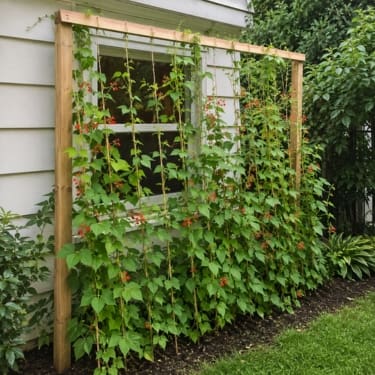
Step 1: Pick your spot. Stand outside your hottest window in the afternoon and find where the sun hits. You want the trellis about 12 inches out from the wall, never flat against the siding. That gap is what creates the cool air pocket and keeps moisture off your house.
Step 2: Set the posts. Sink the two posts about 18 inches into the ground, spaced as wide as the window plus a foot on each side. Tamp the soil firm around them. You can lean them back toward the house slightly at the top so the screen angles over the window like an awning.
Step 3: Add the crosspiece and strings. Screw the crosspiece across the top of the posts. Then run twine from the crosspiece down to the ground, tying each string to a small stake or a bottom rail, spaced about 6 inches apart. Or just staple trellis netting across the whole frame and save yourself the knot-tying.
Step 4: Plant your beans. Loosen the soil along the base, work in a little compost, and plant the seeds an inch deep and about 4 inches apart, right at the foot of each string. Water them well.
Step 5: Guide and water. Once the vines sprout, they’ll find the strings on their own, though you can gently wind a wandering one around its string to get it started. Keep the soil evenly watered.
Runner beans move fast. From planting, expect sprouts within a week or two and vines reaching the top of an 8-foot string in about 6 to 8 weeks. Plant in May and you’re sitting behind a living green wall by mid-July, right when you need it most.
At the end of the season, cut everything down, compost the vines, and the strings are ready for next year’s seeds.
Final Thoughts
The best part about cooling your house with plants is that the system gets better every single year while everything else you buy gets worse. Your AC loses efficiency with age. A tree just keeps growing, casting a little more shade each summer than it did the last.
Start small this year. One trellis, one tree, one shaded corner for the AC unit. You don’t need to redesign the whole yard in a weekend.
You may also like: 
How to Keep a Greenhouse Cool in Summer (10 Proven Methods)
See Why the Amish Paint Their Houses Red (Video)
The Only Way to Save Your Garden and Produce Water When It Doesn’t Rain
Why Your Garden Wilts in July Even When You Water Every Day
8 Cheap Ways to Cool Off Your House This Summer