
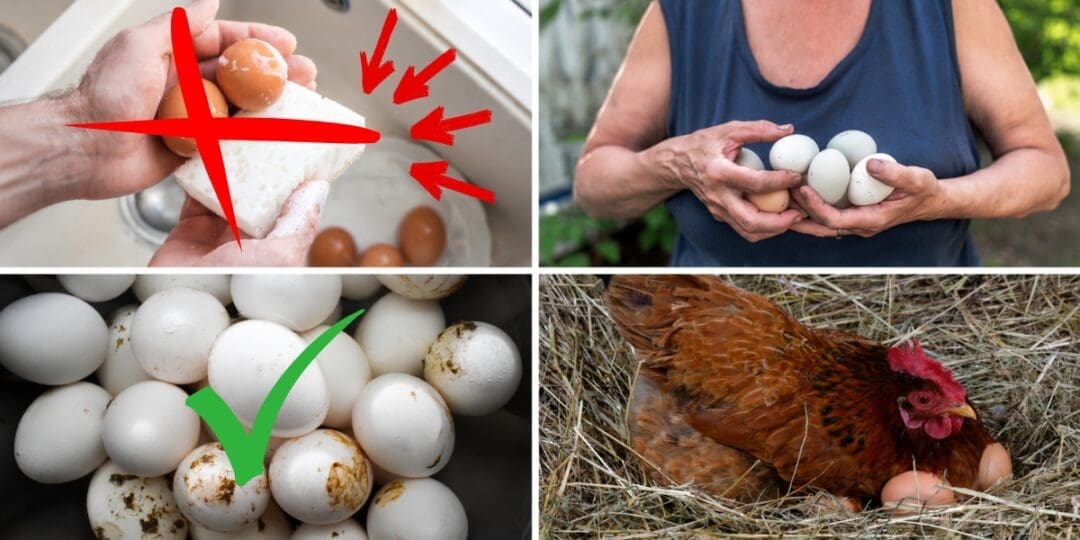
If you are raising your own chickens, or thinking about it, this is something to learn early on. Fresh eggs are not store eggs, and they should not be treated like store eggs.
The way you handle them right after collection makes the difference between eggs that last for months and eggs that go bad in your fridge within a few weeks.
So before you collect or buy your next batch of eggs, let me walk you through what I wish someone had told me years ago.
Why Washing Is the Worst Thing You Can Do to a Fresh Egg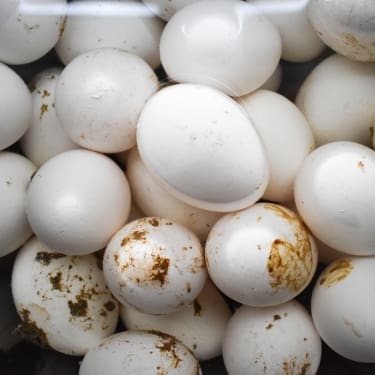
Every egg a hen lays comes with a built-in natural protective layer. We call it “the bloom,” and it’s what allows fresh eggs to sit on a counter for two weeks without spoiling.
Practically, this is a thin film that coats the entire shell on the surface. You can’t see it with the naked eye, but it’s there, and it’s doing an amazing job. The shell of an egg has thousands of tiny pores in it, and without something covering those pores, bacteria, moisture, and air would have the possibility of entering inside the egg. The bloom seals the egg up and protects it from the outside world.
Hens evolved this system because eggs were originally meant to grow into chicks. The bloom protects the developing embryo from contamination until the chick is ready to hatch, and that same protection works in your favor when the egg ends up in your kitchen instead.
And here’s what I want you to know: this coating is water-soluble. So once water touches the egg, the bloom starts to wash away. And once it is gone, it is gone for good.
People Used to Keep Eggs on the Counter
Before the modern food system existed, every family with chickens stored their eggs at room temperature, and the bloom did its job. The eggs stayed fresh for a couple of weeks without any electricity or any special containers.
Somewhere along the way, we got the idea that all eggs must be refrigerated all the time, no exceptions. That belief comes from the commercial egg industry, which has good reasons for chilling its product, but does not apply to your homestead at all.
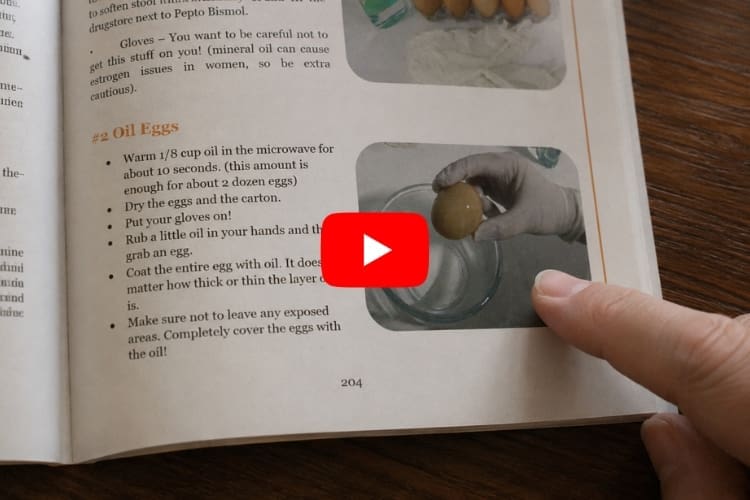
If you want to take this one step further, you should know that you can make your eggs last even longer than they already are by using this simple trick. The following method uses mineral oil to make your eggs more resistant.
The mineral oil acts like a second bloom and keeps the pores closed long after the natural one would have worn off. People have been doing this for over a hundred years, and it still works exactly the same today. I came across the full method here, on page 204. This is a book I keep coming back to when it comes to food preservation, and I wholeheartedly recommend it to anyone who wants to master canning and preserving methods for their homestead.
If you want to get your own copy, click here.
You’ll also get two exclusive bonuses: An Underground YEAR-ROUND Greenhouse in Your Backyard + Projects From 1900 That Will Help You in the Next Crisis
🥚 Quick Fact
The United States is one of the few countries in the world where eggs are routinely refrigerated. In many parts of Europe, eggs sit on the shelf at room temperature in the grocery store, right next to the bread and the canned goods. That is because their regulations do not require washing, so the bloom is still in place when the eggs reach the customer.
How to Deal With Dirty Eggs
Not every egg comes out of the nest box clean. Sometimes you’ll find one with a smear of mud, a feather stuck to it, or a little bit of droppings on the shell.
The best option is to clean those eggs without water.
Here is what I do. I keep a small soft brush and a clean dry cloth in my egg-collecting basket. When I bring eggs in, I look each one over. If there is dry debris on a shell, I gently brush it off or wipe it with the cloth.
You should be gentle when you do this. Pressing too hard or scrubbing with anything rough can also damage the bloom.
Do This and Get Clean Eggs Right From the Start
Not having dirty eggs to begin with is probably the simplest approach.
You can start with the nest boxes. Change the bedding regularly, not just when it looks dirty. I swap mine out every week or two, depending on how heavily the hens are using them.
Then you can try to collect eggs more often, ideally at least twice a day. The longer an egg sits in the nest, the more chances it has to get dirty.
Also, make sure you have enough nest boxes for your flock. One box for every four or five hens is the general rule. When hens have to compete for space, eggs get cracked, kicked, and trampled.
What to Do When You Can’t Skip Washing Fresh Eggs
Depending on what you plan to do with those eggs, there are some scenarios when you have to wash them.
One such scenario is if you are selling eggs to other people. Many states require washed eggs for retail sale, so you’ll need to check your local rules before you start handing eggs over to customers.
If you have to wash, here is how to do it the right way.
Use warm running water, not standing water. Not hot, not cold water. It should be warm, and this is important because the moderate temperature causes the egg’s contents to expand and push outward, which prevents bacteria from being pulled inside.
Never soak the egg in water. The longer water sits on the shell, the more time it has to get inside.
Skip the soap unless it is specifically labeled as food-safe. Most household dish soaps have fragrances and additives that you really do not want soaking into the eggs you are about to eat.
Dry the egg right away with a clean cloth or paper towel, and put it straight into the refrigerator.
Related: See How This DIY Box Turns Air Into Water (Try It on Your Homestead)
How to Store Fresh, Unwashed Eggs the Right Way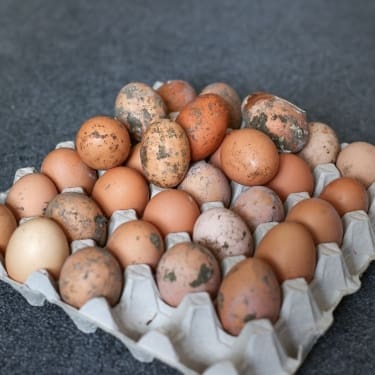
Ok, I made it clear that once an egg is washed, you need to store it in the fridge. But what about unwashed eggs? You just leave them on the counter, and that’s all?
Now I want to share some tips with you that should make everything easier and help you keep eggs fresh for a longer time.
Never store your eggs in direct sunlight. If you plan to keep them on the counter, make sure they are in the shade. Also, put them in a basket or a regular egg carton for extra protection.
Then, make sure you store your eggs with the pointy end pointing down. The air cell inside the egg sits at the wider, rounder end, and keeping that end up helps the air cell stay where it belongs. This slows down the natural breakdown that happens as the egg ages and keeps the yolk centered just how you want it.
Keep track of the eggs and try to use the old ones first. I write the collection date right on the shell with a pencil. Some folks use a marker. Either way, you should be able to tell rapidly which eggs have been sitting around longest.
Now, if you want to keep eggs on the counter for far longer than a few weeks, the Amish have been doing this for generations and they have a secret that keeps eggs fresh with zero electricity.
Their method uses salt, beeswax, and a little olive oil, and it keeps eggs good for around 3 months without refrigeration. You can find more about the method here, along with a few dozen other Amish preservation tricks I think every homesteader should know.
Click here for the full recipe.
How to Check if Eggs Have Gone Bad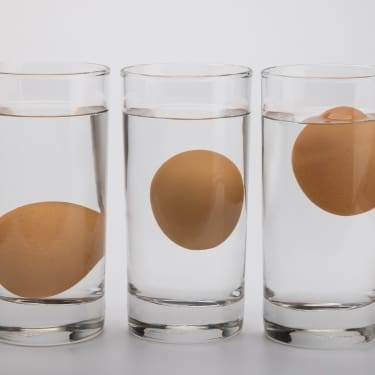
Even if you store your eggs perfectly, they will still spoil at some point if you keep them for too long. So, this if fo the moment you have some eggs and can’t remember which ones came in when.
This is the trick I use and this is how you can do the same.
Grab a bowl, fill it with water, and then gently put the eggs inside the water.
If the egg sinks and lies flat on its side, it is very fresh and you can use it for anything you want to make.
If it sinks but stands upright on one end, it is older but still safe to eat. Plan to use that one soon.
If the egg floats, throw it out. As eggs age, moisture slowly evaporates through the shell and the air cell inside grows. Once that pocket gets big enough, the egg becomes buoyant.
Final Thoughts
Learning how to correctly store your fresh eggs is a little but important skill. There is no need to occupy space in your fridge with eggs that can very well stay on the counter.
I need to be honest and tell you that it took me a while to trust this method. Years of habit and grocery store rules made it feel wrong somehow. But in the end, it was clear it’s effective, and since then, this is how I store fresh eggs.
You should also read: 
Can You Freeze Hard Boiled Eggs? Essential Tips for Safe Storage
How to Make Old-Fashioned Amish Ice-Box Pickles (Video)
What Happens When You Let Chickens Free Range Full Time
The Best Old Fashioned Pickled Eggs Recipe
These Animals Are Stealing Your Chicken Eggs























I watched a homesteader from Utah wax her eggs. They stayed fresh for up to six months. Any thoughts?
Yes, this is a really old method that is still working and keeps eggs fresh for months. The only thing to keep in mind is not to wash the eggs before you wax them. If you wash them, the trick won’t hold.