If you have ever bought a bag of “weed and feed” for your lawn, there is a good chance you already own 2,4-D without realizing it. It is one of the oldest and most widely used herbicides in the world, and it works differently than the glyphosate products most homesteaders are already familiar with.
This guide covers what 2,4-D actually is, how it kills weeds without harming your grass, what the safety research actually says, and how it compares to the other weed control options you have probably already considered.
What Is 2,4-D?
2,4-D, short for 2,4-dichlorophenoxyacetic acid, is a selective herbicide that has been used in the United States since the 1940s. According to the U.S. Environmental Protection Agency, it is registered for use in turf, lawns, rights-of-way, aquatic sites, forestry, and a variety of field, fruit, and vegetable crops, and it is sold in liquid, dust, and granule formulations.
It comes in several chemical forms, including acids, salts, and esters, which affect how it behaves once applied and how it should be handled. Products on garden store shelves are usually a salt or amine formulation, chosen for lower volatility and easier handling than the ester forms used in some agricultural settings.
How 2,4-D Kills Weeds Without Harming Grass
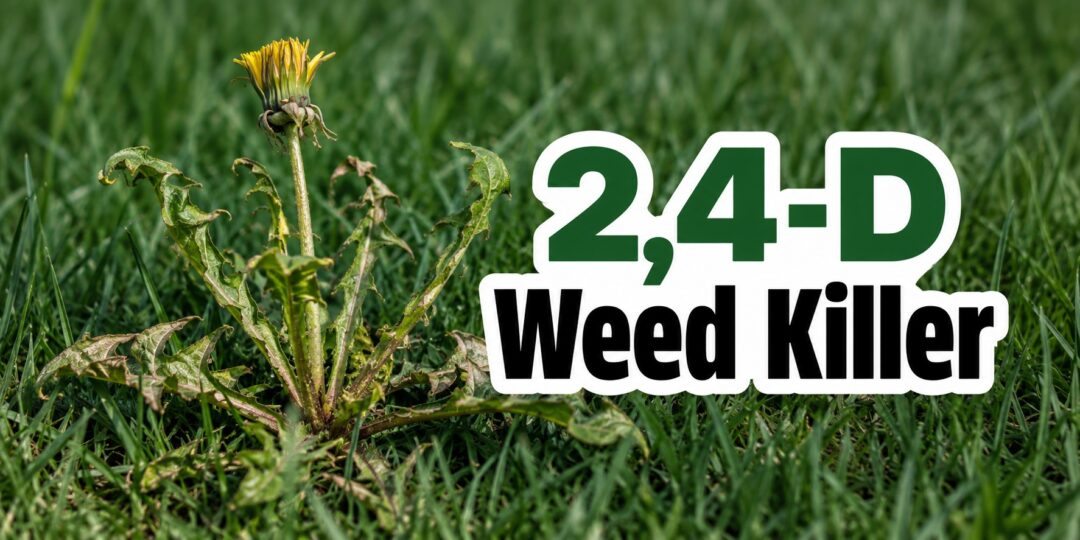
2,4-D belongs to a class of herbicides called synthetic auxins, compounds that mimic a plant’s natural growth hormones. According to the National Pesticide Information Center, it works by causing uncontrolled cell division in a plant’s vascular tissue, triggering abnormal growth, distorted leaves, and twisted stems that eventually kill the plant. This mode of action targets broadleaf plants specifically and has little effect on grasses, which is exactly why 2,4-D shows up in lawn products aimed at dandelions, clover, and chickweed without damaging the turf around them.
This selectivity is the core difference between 2,4-D and glyphosate, which kills essentially any green plant it touches, grass included.
Is 2,4-D the Same as Agent Orange?
This question comes up constantly, and the direct answer is no. The EPA addresses this specifically, explaining that Agent Orange was a mixture of two herbicides, 2,4-D and 2,4,5-T, along with kerosene and diesel fuel. The serious health concerns tied to Agent Orange trace back to 2,4,5-T’s contamination with dioxin, a toxic byproduct of that chemical’s manufacturing process, not to 2,4-D itself.
The EPA canceled all uses of 2,4,5-T in 1985, and dioxins are not found at detectable levels in the 2,4-D products sold and used today. The two chemicals are frequently confused because they were combined in that one historical product, but they are chemically distinct, and 2,4-D was never the component responsible for Agent Orange’s dioxin contamination.
Health and Safety Considerations
According to EPA testing data, 2,4-D generally has low toxicity for humans, though certain acid and salt forms can cause significant eye irritation, which is reflected in the caution or danger signal words found on product labels. The agency notes it is moderately toxic to birds and mammals, only slightly toxic to fish and aquatic invertebrates in most forms, and practically nontoxic to honeybees.
The ester forms are the exception on aquatic toxicity, and can be highly toxic to fish, which is why label directions around water bodies matter more with ester formulations than with amine or salt products.
Cancer Classification: What the Research Actually Shows
The EPA classified 2,4-D as “Group D, not classifiable as to human carcinogenicity” after its most recent formal review, concluding the available data is not sufficient to establish a cause-and-effect relationship with non-Hodgkin lymphoma in humans. The NPIC technical fact sheet notes that the International Agency for Research on Cancer placed the broader family of chlorophenoxy herbicides, which includes 2,4-D, in Group 2B, meaning possibly carcinogenic to humans, though IARC has not issued a specific rating for 2,4-D on its own.
One frequently cited case-control study found a modest association between 2,4-D lawn use and malignant lymphoma in companion dogs, though other researchers who reviewed that same study have questioned its conclusions. The overall research picture, more than three decades in, remains genuinely mixed rather than settled in either direction.
Pet Safety: A Real Concern Worth Taking Seriously
This is where the evidence is clearer. NPIC data indicates that dogs are more sensitive to chlorophenoxy herbicides like 2,4-D than most other animals, with documented signs including vomiting, muscle weakness, loss of coordination, excessive salivation, and lethargy following exposure, sometimes from eating treated grass.
The California Biomonitoring Program recommends limiting pet and child access to treated areas for at least one to two days after application, and ideally longer, along with removing shoes before entering the house and laundering any clothing soiled during application separately from other laundry.
How to Use 2,4-D Safely
- Spot-treat problem areas rather than blanket-spraying the entire yard
- Follow the label’s exact application rate. Residential turf products are capped lower than agricultural rates specifically to reduce exposure risk
- Keep children and pets off treated areas until the product has fully dried, and longer if the label recommends it
- Avoid application on windy days to prevent drift onto garden beds, neighboring properties, or water sources
- Store leftover product in its original container, away from children, pets, and any area prone to flooding
- Never dispose of unused herbicide by pouring it down a drain or onto bare soil. Look for a local household hazardous waste collection site
Environmental Persistence
2,4-D breaks down relatively quickly compared to many other herbicides. NPIC reports a soil half-life of roughly 10 days for the acid and common salt and ester forms under typical conditions, meaning most of the applied chemical breaks down within a few weeks rather than persisting for a full growing season.
It has low binding affinity in most soil types, which makes it relatively mobile, though rapid breakdown by soil microbes limits how far and how long it typically travels before degrading.
2,4-D vs. Glyphosate: Choosing the Right Tool
These two herbicides solve different problems, and confusing them leads to disappointing results in the yard.
- 2,4-D: selective, targets broadleaf weeds while sparing grass, ideal for lawns with dandelions, clover, or chickweed
- Glyphosate: non-selective, kills essentially any green plant including grass, better suited for clearing a bed entirely or spot-killing weeds in gravel or pavement cracks
If your goal is a weed-free lawn that stays intact, 2,4-D is the more appropriate tool. If you are clearing an area for a new garden bed or eliminating weeds in a driveway, glyphosate does that job instead. For a deeper look at glyphosate specifically, including its own safety profile, see our full breakdown of glyphosate herbicide.
Natural and Non-Chemical Alternatives
For homesteaders who would rather skip synthetic herbicides entirely, both the EPA and California’s biomonitoring program point to regular mowing and hand-weeding as effective non-chemical weed control methods. Vinegar-based sprays are another popular homestead alternative, though they work by burning back plant tissue on contact rather than the systemic, root-level kill that 2,4-D and glyphosate both provide, so they typically require repeat applications on established, deep-rooted weeds.
If you want the full method for building an effective vinegar-based weed spray at home, our vinegar weed killer recipe walks through the concentration and application details that make it actually work.
The Best Weed Control Skill Is Knowing How to Manage the Land Without Depending on a Bottle
Herbicides such as 2,4-D can be useful tools when they are chosen carefully and applied according to the label. But self-reliance means knowing what to do when the convenient, store-bought solution isn’t available – or when you simply want to depend on it less.
For generations, people maintained productive gardens, fields, orchards, and homesteads without a shelf full of modern chemicals. They learned how to read the land, manage unwanted plants, improve soil, grow and preserve food, repair what they owned, and make practical use of the resources already around them. Those abilities weren’t hobbies. They were everyday survival skills.
The Lost Skills of Independence brings that mindset back.
It’s a practical resource for anyone interested in recovering the forgotten skills and traditional know-how that helped earlier generations become far more self-sufficient. Instead of assuming that every problem requires another product from the store, you’ll discover ways to become more capable with your own hands, knowledge, and resources.
That matters whether you’re trying to build a more independent homestead today or preparing for a future in which supplies become expensive, difficult to find, or temporarily unavailable.
You can stockpile products, but every product eventually runs out. A skill you have truly learned can serve you again and again.
Frequently Asked Questions
How long does 2,4-D take to kill weeds?
Visible wilting and curling typically begin within a few days, with full weed death usually apparent within one to two weeks, depending on the weed species and growing conditions.
Can I use 2,4-D on my vegetable garden?
No. 2,4-D is not labeled for use on most vegetable crops and can damage or kill broadleaf food plants just as effectively as it kills weeds. It is intended for turf, lawns, and specific labeled agricultural uses.
Is 2,4-D safe to use around a garden pond or water feature?
Ester formulations of 2,4-D can be highly toxic to fish and aquatic invertebrates, so amine or salt formulations are the safer choice near water, and label directions regarding buffer distances should always be followed exactly.
Why does my lawn service use 2,4-D instead of glyphosate?
Because 2,4-D is selective for broadleaf weeds and leaves turfgrass intact, it lets a lawn service kill dandelions and clover without killing the lawn itself, something a non-selective herbicide like glyphosate cannot do.
You may also like:

Your OWN DIY Painkiller In A Jar (Video)
The Vinegar Weed Killer Recipe Every Homesteader Should Know
RM43 Weed Killer – What It Does And Why Many Homesteads Are Choosing Another Path
Glyphosate Herbicide Weed Killer – What You Need to Know
Organic Weed Killer – The Complete Guide to Every Method That Actually Works
How Big a Greenhouse Do I Need?