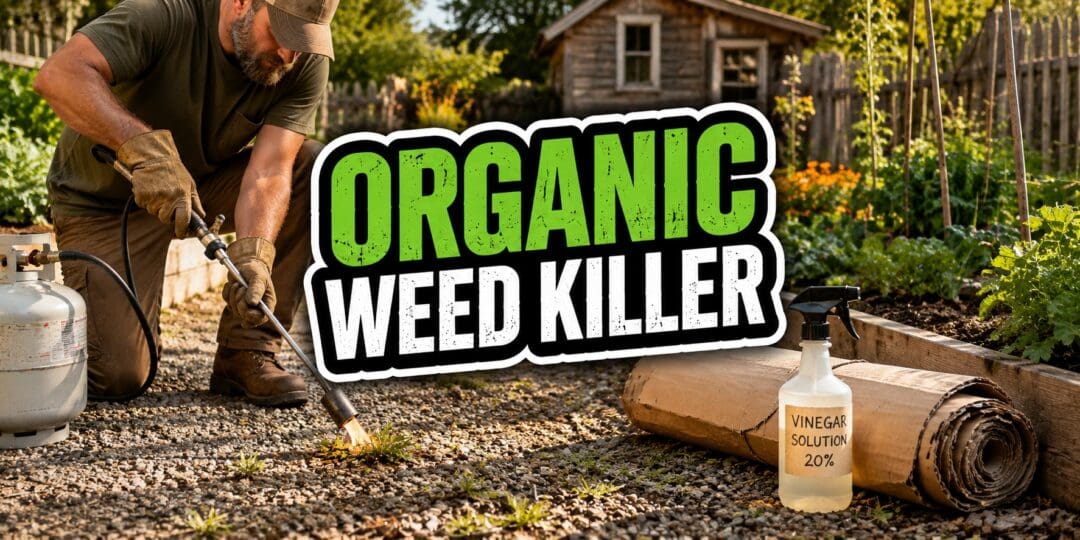
I gave up on chemical weed killers years ago, not because of any single scary headline, but because I did not want that stuff anywhere near the garden that feeds my family or the yard my dogs roll around in every day. The problem is that going organic does not mean picking one magic spray and calling it done. Different weeds, different growth stages, and different spots on your property all call for different tools.
This guide covers every organic method worth using, what each one is actually good at, where it falls short, and how to combine them so you are not fighting the same patch of weeds every single month.
Why Annual vs. Perennial Matters More Than the Method You Pick
Before you reach for anything, figure out what kind of weed you are dealing with, because this determines whether a method will work at all. Annual weeds, the ones that sprout from seed, grow, flower, and die within a season, are vulnerable to almost every organic method on this list. Kill the visible plant before it sets seed and you have won.
Perennial weeds are a different fight entirely. Dandelions, bindweed, Canada thistle, and similar deep-rooted or rhizomatous plants store energy underground and will simply regrow from the root after their top growth is destroyed. Contact killers like vinegar and flame weeding only damage the foliage you can see, so perennial weeds typically need repeated treatments over an entire growing season, not a single application, to exhaust the root reserves. Knowing which category you are up against before you start saves a lot of wasted effort.
Method 1: Vinegar and Salt Sprays
Household vinegar and salt-based sprays are the most common organic weed killers, and for good reason, they are cheap, fast-acting on contact, and made from ingredients most of us already have. These work by drawing moisture out of the leaf tissue, which is why they wilt young, thin-leaved weeds within a day but barely dent something with a thick, waxy leaf or an established root system.
I have a dedicated recipe and full breakdown of ratios, horticultural-strength vinegar, and application timing already on the site, so I will not repeat all of it here, but the short version is this: vinegar and salt sprays are excellent spot treatments for gravel paths, driveway cracks, and patio joints where you want nothing growing at all. They are not selective, so keep them away from anything you want to keep alive, and go easy with salt specifically since it accumulates in soil and can make an area inhospitable to future planting if you overuse it.
Method 2: Boiling Water
The simplest tool on this list is sitting in your kitchen right now. Pouring boiling water directly onto a weed scalds the leaf and stem tissue instantly, killing top growth on contact with zero cost and zero chemicals. It works on the same principle as flame weeding, intense heat rupturing plant cells, just delivered with water instead of fire.
The catch is coverage and precision. Boiling water cools fast, so you need to pour it directly onto the crown of the plant, not just nearby, and it is only practical for isolated weeds rather than a whole overgrown bed. It is my go-to for the occasional weed poking up through a sidewalk crack when I do not want to mix up a spray for just one plant.
Method 3: Flame Weeding
A propane torch or dedicated flame weeder kills weeds by rupturing plant cells with brief, intense heat, not by setting the plant on fire. According to Iowa State University Extension, the goal is a quick pass that causes cell sap to expand and burst the cell walls, after which the weed wilts and dies over the following hours to days rather than immediately.
Flame weeding excels on young annual broadleaf weeds in gravel, along fence lines, and between pavers where nothing else is growing nearby. It struggles with grasses, which protect their growing point with a sheath, and with perennials, which regrow from the root. University of Maryland Extension research notes that exposure times in the range of 65 to 130 milliseconds are sufficient to kill many annual weeds, which is why a slow, deliberate pass matters more than a quick blast.
Safety matters here more than with any other method on this list. Never flame weed during dry, windy conditions, keep a water source or extinguisher within reach, avoid conifers and dry mulch, which ignite easily, and never use it on poison ivy, since burning it releases the irritating oil into the air you are breathing.
Method 4: Soil Solarization and Tarping
This is the method I reach for when I want to reset an entire overrun bed rather than fight individual weeds. Solarization uses clear plastic sheeting stretched tightly over moist soil to trap solar radiation and heat the top several inches of soil to a temperature lethal to weed seeds and many soil-borne pathogens. According to UC ANR’s Integrated Pest Management Program, the process involves covering soil with clear plastic for four to six weeks during the hottest part of the year, which heats the top 12 to 18 inches of soil to temperatures lethal to a wide range of weeds and soil pests.
Water the bed thoroughly before laying the plastic, since moist soil conducts and holds heat far better than dry soil, and seal the edges completely so the heat cannot escape. Clear plastic outperforms black plastic for this purpose specifically because it lets light through to heat the soil directly rather than absorbing and radiating some of that heat away.
The limitation is time and technique. You need a genuinely hot, sunny stretch of weeks, and shallow tilling after removal is important, since digging deep can drag untreated seeds back up to the surface. Deep-rooted spreaders like bindweed and nutsedge are more resistant than shallow annual seeds, so pair solarization with follow-up hand removal on anything that resprouts.
Method 5: Corn Gluten Meal, the Organic Pre-Emergent
Every method above deals with weeds that already exist. Corn gluten meal is different, it is a pre-emergent, meaning it stops weed seeds from developing roots as they germinate rather than killing anything already growing. If you already have visible weeds, corn gluten meal will do nothing for them, so timing is everything with this one.
Apply it to bare soil a few weeks before your local weed germination window, which generally lines up with soil temperatures in the mid-50s Fahrenheit, and follow with a dry stretch of at least 48 hours, since rain lets the emerging seedlings recover before the drying effect finishes them off. Because corn gluten meal cannot distinguish weed seeds from the seeds you actually want, do not use it anywhere you plan to direct-seed vegetables or reseed a lawn in the following weeks. It also carries a modest nitrogen boost as a side benefit, so used consistently over a few seasons in the same beds, it doubles as a mild organic fertilizer while gradually depleting the weed seed bank.
Method 6: Mulching and Smothering
The least glamorous method is often the most effective long-term one. A thick layer of mulch, straw, wood chips, or even flattened cardboard covered with compost, blocks the light weed seeds need to germinate and physically smothers anything already trying to push through. Unlike every contact-based method above, mulching prevents new weeds from establishing in the first place rather than reacting to ones that already have.
Lay cardboard or several sheets of newspaper directly over the weedy area, overlapping the edges generously, then cover with three to four inches of mulch or compost on top. This works especially well in garden beds and around perennial plantings where you want permanent, low-maintenance suppression rather than a quick knockdown.
Combining Methods for Stubborn Perennial Weeds
If you are dealing with something like bindweed, thistle, or established dandelions, no single method above will finish the job in one pass. The combination that has worked best on my own place is repeated flame weeding or vinegar spray on new top growth every couple of weeks through the growing season, paired with a thick mulch layer to block light and slow regrowth between treatments. Each round of top-growth destruction forces the plant to spend stored root energy regrowing leaves, and enough repetitions over a season will genuinely exhaust smaller perennial patches, though the toughest infestations may take more than one year.
A Few Safety Notes Worth Taking Seriously
- Pets and kids: let vinegar and salt sprays dry completely before letting animals or children back into a treated area, and keep flame weeders and boiling water well away from curious pets.
- Soil health: repeated heavy salt applications build up in soil and can make an area unable to support plants for a long time afterward. Reserve salt for gravel, driveways, and areas where you never intend to grow anything again.
- Fire risk: never flame weed in dry, windy conditions or near mulch, dry grass, or wood structures.
- Non-selective sprays and heat: vinegar, salt, boiling water, and flame all damage whatever they touch, desirable plants included. Spot-treat carefully.
Grow the Way Our Grandparents Did
Getting rid of weeds naturally is only part of the equation. The real secret to a productive garden is using time-tested methods that build healthy soil, strengthen plants, and prevent many problems before they ever start.
That’s exactly what you’ll find in the Amish Ways Book.
Inside, you’ll discover generations of practical gardening wisdom—from natural fertilizers and homemade pest repellents to companion planting, seed saving, and old-fashioned growing techniques that helped families harvest abundant crops long before chemical herbicides and synthetic fertilizers existed.
If your goal is to grow healthier food while relying less on store-bought products, this book belongs on your shelf.
✔ Learn traditional Amish gardening techniques that still work today.
✔ Discover natural ways to improve your soil and boost harvests.
✔ Reduce weeds, pests, and plant diseases without harsh chemicals.
✔ Build a more self-sufficient garden using proven, low-cost methods.
Final Thoughts
There is no single organic weed killer that replaces the whole toolbox. Vinegar and boiling water handle quick spot treatments, flame weeding and solarization reset larger areas, corn gluten meal prevents next season’s seed bank from sprouting in the first place, and mulch does the quiet, unglamorous work of keeping weeds from coming back once you have cleared them out. Match the method to the weed you are actually fighting, be patient with perennials, and you will spend a lot less time hunched over a hoe by midsummer.
You may also like:
Join Our Facebook Group For Weekly Homesteading Advice
The 4 Valuable Antibiotics BIG PHARMA Doesn’t Want You To Stockpile (Video)
Seaweed Fertilizer – The Complete Guide to Feeding Your Garden with Ocean Nutrients
Glyphosate Herbicide Weed Killer – What You Need to Know
RM43 Weed Killer – What It Does And Why Many Homesteads Are Choosing Another Path