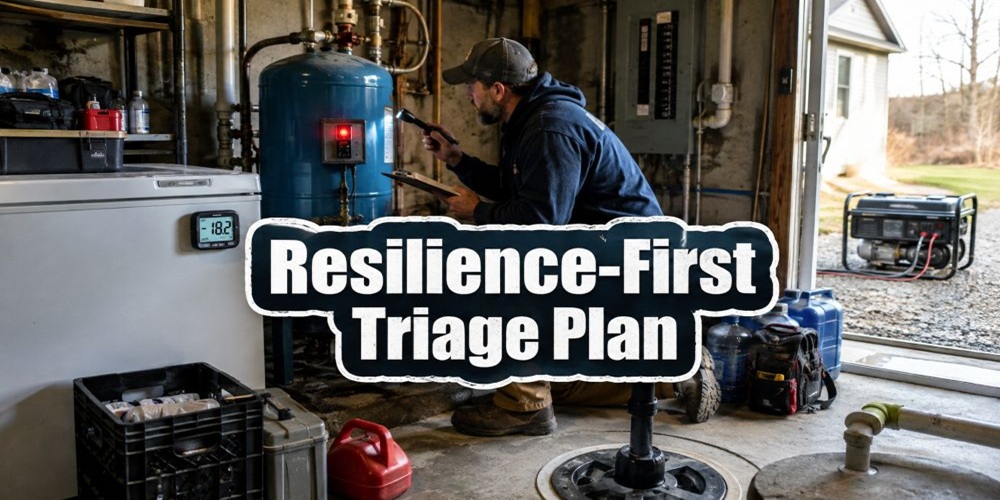
Self-sufficiency does not mean repairing every machine without help. It means understanding which household systems are essential, noticing failures early, protecting people and property, and keeping a workable backup while the real cause is diagnosed.
That distinction matters most when a well pump, freezer, generator, sump pump, water heater, dehumidifier, or heating system fails. These are not merely conveniences. They protect drinking water, stored food, a dry foundation, safe indoor temperatures, or the equipment that supports the rest of the home.
A resilience-first plan has four stages: stabilize the situation, document the failure, switch to a safe backup, and decide whether the next step is homeowner maintenance or professional diagnosis.
Build the equipment map before an emergency
Start with a simple inventory of the systems that the household cannot comfortably lose. The list will be different for a suburban home, rural property, apartment, or off-grid cabin, but it often includes:
- Main heating and cooling equipment
- Well pump, pressure tank, or municipal-water shutoff
- Sump, sewage, or drainage pumps
- Refrigerator and chest freezer
- Water heater or boiler
- Generator, inverter, battery bank, or transfer equipment
- Dehumidifier or ventilation equipment
- Garage or gate access needed during an outage
- Medical or accessibility equipment
- Network equipment used for alarms and communication
Record the manufacturer, model, power source, installation date, normal operating sound, key consumables, and the location of the owner’s manual. Photograph each model plate. Note which breaker, disconnect, valve, or fuel source serves the equipment, but do not operate controls you do not understand.
This map turns a stressful failure into a known event. It also helps reveal dependencies. A well pump may depend on grid power. A gas furnace may still require electricity for controls and the blower. A freezer alarm may depend on Wi-Fi. A sump pump may work perfectly until the same storm that brings water also interrupts electricity.
Stage one: stabilize without creating a second problem
The first response should protect people, food, water, and the building—not force the failed equipment to restart.
If a pump stops
Reduce water use and determine whether the problem affects the pump alone or the entire electrical supply. Avoid repeated resets. A breaker or overload that trips again is reporting a fault, not asking for another attempt.
For a well system, preserve potable water separately from water intended for washing or flushing. Do not connect improvised pumps, hoses, or containers in a way that can contaminate the well or household plumbing.
For a sump pump, move valuables away from the lowest area, confirm that the discharge route is not visibly blocked, and deploy a properly installed backup only as designed. Electricity and standing water are a dangerous combination; do not enter a flooded area with energized equipment.
If refrigeration fails
Keep refrigerator and freezer doors closed. Group frozen items together only if this can be done quickly. Use an appliance thermometer rather than touch or smell to judge temperature. Move critical food to a known-working freezer, cooler, or alternate storage before experimenting with the failed unit.
Record when the failure was discovered and the temperature when first checked. Food-safety decisions should follow current public-health guidance rather than assumptions about appearance.
If backup power fails
Disconnect nonessential loads and identify whether the failure comes from the generator, fuel supply, inverter, batteries, transfer equipment, or an overloaded circuit. Do not backfeed a home through a receptacle. Do not run combustion equipment indoors, in a garage, or near openings where exhaust can enter the building.
If a generator starts but repeatedly shuts down, stop and investigate according to the manual. Low oil, overload, fuel problems, overheating, blocked ventilation, or an electrical fault require different responses. Repeated restarting can damage the machine or create unsafe conditions.
If heating or hot water fails
Protect vulnerable occupants first. Close off unused rooms, reduce drafts, and use only approved supplemental heating equipment with clear space around it. Never use an oven, barbecue, or outdoor heater to warm an indoor space.
For boilers and fuel-burning equipment, unusual odours, soot, flame changes, venting problems, or a carbon-monoxide alarm require immediate professional or emergency attention.
Stage two: capture the failure before resetting it
Modern equipment often explains what happened, but the evidence disappears after power is cycled. Before resetting anything, collect:
- The exact time the issue was noticed
- Indicator lights and error codes
- Display readings, pressure gauges, and temperatures
- Unusual sounds, recorded from a safe distance
- Photos of leaks, frost, scorch marks, or damaged connectors
- Weather and outage conditions at the time
- Recent maintenance, refuelling, filter changes, or repairs
- Which connected systems are still operating
Write observations in plain language. “The pump is bad” is a conclusion. “The pressure gauge reads zero, the control has power, and the breaker has not tripped” is useful evidence.
Exact equipment identification matters because similar-looking products can have different controls, capacities, fuel requirements, and diagnostic procedures. A structured Local Fix Match household equipment directory can help identify the correct equipment category before recording the brand, model family, and exact model from the label.
Stage three: use backups as bridges, not permanent improvisations
A good backup reduces consequences while preserving a safe path to repair. It should not create a hidden new dependency.
Water resilience
Store a practical amount of potable water and rotate it. If the property depends on a well, consider a professionally designed backup appropriate to the well depth, pump type, electrical service, and local conditions. Gravity storage, approved hand pumps, battery systems, or generator support can each work in the right installation; none is universal.
Label non-potable water clearly. Keep hoses, containers, and transfer pumps clean and separated according to their use.
Cold-storage resilience
Use independent thermometers and temperature alarms. Avoid placing every freezer on the same circuit. Maintain an inventory so the most valuable or vulnerable food can be moved first. A small amount of organized backup capacity is more useful than a large freezer whose failure stays unnoticed.
Power resilience
List essential loads and their starting requirements. Motors and compressors can require substantially more power at startup than during normal operation. A generator or inverter that appears large enough based on running watts may still trip when a well pump or freezer compressor starts.
Transfer equipment, grounding, fuel storage, ventilation, and battery protection should be designed for the installation and applicable rules. The safe backup is the one that can be operated correctly by the household under stress.
Moisture resilience
For basements, crawl spaces, and humid climates, combine a primary pump or dehumidifier with independent water or humidity alarms. Test alarms separately from the equipment they monitor. A notification system should fail visibly if Wi-Fi, power, or its battery is lost.
Stage four: know the homeowner-maintenance boundary
Some failures come from normal owner-serviceable conditions:
- A clogged accessible filter
- A full condensate container
- A kinked external hose
- A loose removable battery connection
- Stale generator fuel handled according to the manual
- An overloaded backup circuit
- A blocked exterior vent or intake that can be cleared without disassembly
- A tripped control that resets once and remains stable
Other conditions should stop the DIY process:
- A breaker, fuse, overload, or safety control trips again
- Wiring is discoloured, melted, wet, or hot
- A battery is swollen, leaking, or physically damaged
- Fuel, refrigerant, combustion, or exhaust is involved
- A pressure vessel, well control, transfer switch, or permanent wiring must be opened
- The repair requires bypassing an interlock
- Sewage or contaminated water is present
- The diagnosis depends on electrical, pressure, combustion, or refrigerant measurements
Routine maintenance and diagnosis are different jobs. Cleaning a manufacturer-accessible filter may be normal maintenance. Deciding why a motor overheats or a pump cannot build pressure requires evidence and appropriate instruments.
Create a failure card for every critical system
Keep a one-page card near each essential system or in a shared household folder. Include:
1. Equipment name, brand, and model
2. Normal status lights, pressure, or temperature
3. Safe shutdown procedure from the manual
4. Location of the relevant disconnect and valve
5. Consumables and routine maintenance schedule
6. Backup method and its limitations
7. Last test date for the backup
8. Photos of the normal installation
9. Warranty and installer information
10. A blank section for error codes and symptoms
Review the cards twice a year and after any equipment change. Run backups under realistic but controlled conditions. A generator that starts with no load, a pump that has never moved water, or a battery that has not been capacity-tested may provide false confidence.
Resilience is a system, not a gadget
The strongest household plan does not depend on one “emergency” product. It combines early warning, accurate documentation, safe isolation, modest backup capacity, and a clear point at which qualified help is needed.
When essential equipment fails, avoid the urge to solve everything at once. Stabilize the household. Preserve the evidence. Use the backup within its limits. Then repair the confirmed problem instead of replacing parts based on guesses.
That approach is practical self-sufficiency: not pretending that every failure is a DIY task, but making sure one broken machine does not become a food loss, water crisis, flooded basement, unsafe heating choice, or prolonged disruption.
You may also like:
Amish Survival Hacks that Can Help You Thrive in a Long-Term Blackout (Video)
DIY First Aid Kit for Gardeners and Homesteaders
What We Learned After Our First Year of Total Self-Sufficiency
Join Our Homesteading Facebook Group For Unique Info You Won’t Get Anywhere Else