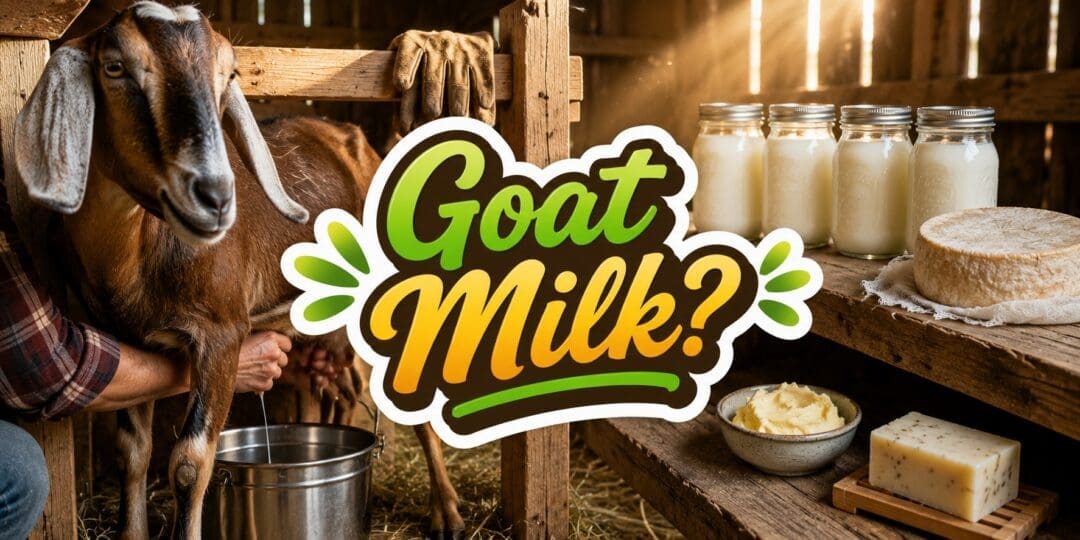
If you want one animal that punches well above its weight for self-sufficiency, the dairy goat is it. A single productive doe will give you fresh milk twice a day for the better part of ten months. From that milk you can make cheese, butter, yogurt, kefir, soap, and skin cream. The animal itself will clear brush, fertilize your pasture, and produce kids you can raise for meat, sell, or use as replacements. All of that from an animal that weighs about 130 pounds, fits through a standard gate, and can be managed by a ten-year-old.
Dairy goats are not beginner-proof. They require twice-daily milking without exception, clean equipment and proper chilling every single time, and a breeding cycle that means you are always managing the next generation as well as the current one. But for homesteaders who are serious about food independence, goat milk is one of the highest-return investments of time and land you can make on a small property.
This guide covers everything practical: which breeds actually work on a homestead, what goat milk contains and why that matters, how to handle it so it tastes clean and keeps well, and the full list of what you can make from it. No fluff, just what you need to know to get a dairy goat operation running and producing.
Why Goat Milk, Not Cow Milk
The obvious comparison is the cow, so let’s settle it early. A dairy cow produces far more milk than a goat, typically three to eight gallons a day against a goat’s half-gallon to two gallons. If you have a large family that drinks a lot of milk and has the land to support it, a cow makes sense. Most homesteaders do not fit that description.
Goats need less space, less feed, and are physically manageable without any special equipment or muscle. A mature dairy doe weighs 120 to 135 pounds for standard breeds and around 50 pounds for Nigerian Dwarfs. They adapt to a wide range of climates and are active browsers, meaning they will work through brush, weeds, and scrub that cows and sheep leave alone. As Mother Earth News points out, more of the world’s people consume goat milk than cow milk, a fact that surprises most Americans who have never lived outside the industrial dairy system.
Goats are also a natural starting point for homesteaders who are not ready for the full commitment of a cow. The infrastructure requirements are simpler, the feed costs are lower, and you can produce meaningful quantities of dairy products from a herd of two or three animals on a quarter-acre or less. When you want to scale up or transition to a cow later, everything you learned managing dairy goats transfers directly.
What Is Actually in Goat Milk
Goat milk and cow milk look nearly identical on a basic nutrition label, which is why the differences between them matter more than the raw numbers suggest. The composition of the fat, protein, and carbohydrate fractions is what changes how your body handles the milk, not just the total amounts.
Fat Structure and Digestibility
Goat milk fat globules are significantly smaller than those in cow milk. This larger surface-area-to-volume ratio means digestive enzymes, particularly lipase, can break them down more efficiently. Goat milk is also naturally homogenized, meaning the fat does not separate and rise to the top the way cow milk cream does. The fat simply stays suspended throughout the liquid. This is why making goat milk butter requires either a cream separator or a patient four-day wait for partial separation.
More practically important than fat globule size is the fatty acid composition. Goat milk contains approximately 30 to 35 percent medium-chain triglycerides, compared to 15 to 20 percent in cow milk. Medium-chain triglycerides are converted to energy more readily than long-chain fats and are less prone to being stored as body fat. They also digest faster, which is part of why people who struggle with cow milk digestion often find goat milk significantly gentler on their systems.
Protein and the Casein Question
Both goat and cow milk are roughly 80 percent casein and 20 percent whey protein. The critical difference is the type of casein. Cow milk is high in alpha-S1 casein, the protein most associated with milk allergies and digestive sensitivity. Goat milk contains significantly lower levels of alpha-S1 casein and produces a softer, looser curd when it reaches stomach acid. That softer curd moves through the digestive system faster and more completely, which is why many people who cannot tolerate cow dairy find they can handle goat milk without the bloating, discomfort, or inflammation they expect.
Research published in the National Institutes of Health / NCBI database describes goat milk as containing potential bioactive components that aid in the maintenance of proper metabolism and body function. The European Food Safety Authority concluded in 2012 that goat milk was suitable as a source of protein and bioactive peptides for infant nutrition, a significant finding given how stringent infant formula standards are.
Lactose
Goat milk is not lactose-free. Anyone with severe lactose intolerance needs to understand that clearly before they start drinking it. What goat milk does contain is slightly less lactose than cow milk, and the faster transit time through the digestive system means the lactose has less opportunity to cause problems. The result is that many people with mild to moderate lactose sensitivity tolerate goat milk without symptoms. People with severe intolerance, where even small amounts of lactose cause significant distress, should approach goat milk cautiously and in small amounts initially.
Minerals and Vitamins
Goat milk delivers solid mineral density. It is high in calcium, phosphorus, potassium, and magnesium, and is a good source of vitamin A in its natural form. The Michigan State University Extension notes that goat milk is higher in fat and calories compared to whole cow milk, and also contains more protein, vitamins, and minerals per serving. The higher mineral density combined with better digestibility means more of what you consume actually gets absorbed.
Choosing the Right Breed for Your Homestead
Breed selection is the first real decision in dairy goat management, and it is worth spending time on. The wrong breed for your goals and space will produce frustration and marginal results. The right breed will make the entire operation feel straightforward.
The core trade-off in dairy goats is volume versus butterfat. High-volume breeds produce more milk per day but at lower butterfat percentages. High-butterfat breeds produce less total milk but milk that is richer, creamier, and dramatically better for cheesemaking. If you want to drink milk daily, volume matters. If you want to make cheese, soap, and yogurt, butterfat is what you optimize for.
Alpine
Alpines are a strong all-around homestead choice. They are hardy, adapt well to a range of climates, and produce consistently. A well-managed Alpine doe can give one to two gallons per day at roughly 3 to 4 percent butterfat. They have outgoing, sometimes pushy personalities and can be more assertive than other breeds, which matters if you have children helping with chores. If your primary goal is a steady supply of drinking milk or milk for large-batch yogurt, an Alpine is a solid first choice.
Saanen
Saanens are the volume champions. Large, white, and docile, they routinely produce over two gallons per day and have earned the comparison to Holstein cows in the dairy goat world. Their butterfat runs low at around 2.5 to 3 percent, which limits their usefulness for cheese and soap where fat content drives quality. If you have a large family that goes through milk fast and you want the simplest possible management, a Saanen works. If you want to make cheese, it is the wrong tool.
Nubian
The Nubian is the most popular dairy goat breed in the United States, and for good reason on the homestead. Long floppy ears, expressive faces, and genuinely loud personalities are the trademarks. More importantly, Nubians produce milk with 4 to 5 percent butterfat, the highest of the standard-size breeds, making them excellent for cheesemaking, yogurt, and goat milk soap where rich fat content delivers quality. Daily production of one to one and a half gallons per doe is typical. Nubians are also an African breed and do well in hot climates where Swiss breeds like Saanens and Toggenburgs can struggle.
Nigerian Dwarf
Nigerian Dwarfs are the right answer for small properties, urban homesteads, and anyone who wants a manageable first dairy animal. They stand under two feet tall and weigh around 50 to 75 pounds, which means a child can handle them safely and your existing chicken or rabbit infrastructure can be adapted for their housing with minimal modification. The milk they produce compensates entirely for the lower volume. Nigerian Dwarfs average 6 to 10 percent butterfat, the highest of any dairy breed, with some individual animals hitting 10 percent or more in winter. That milk produces outstanding cheese and exceptionally creamy soap. Daily production of one to three quarts per doe is typical, which is plenty for a small household that also wants to make value-added products.
LaMancha
LaManchas are the only dairy goat breed developed in the United States, and they are distinctively recognizable because they appear to have almost no ears. What they actually have are two accepted ear types: the gopher ear, which is barely visible, and the elf ear, which is about an inch long. Beyond the unusual appearance, LaManchas are calm, quiet, and consistent. They produce one to two gallons per day at 3.5 to 4.5 percent butterfat, balancing volume and richness well. Their steady temperament makes them one of the better beginner breeds, and they handle confinement management without developing the barn-pacing behavior some more excitable breeds show.
Toggenburg
Toggenburgs are the oldest registered dairy goat breed in the world, developed in the Swiss Alps. They are a good cold-climate choice, known for steady production through hard winters, and their milk has a distinctive flavor that some people describe as slightly earthier than other breeds. Daily production of one to two gallons at around 3 to 3.3 percent butterfat is typical. They are a reserved, less demonstrative breed than Nubians or Alpines, which some homesteaders prefer.
The Milking Routine: What You Actually Do Twice a Day
Dairy goats must be milked twice daily, every twelve hours, without exception. Miss a milking and milk production drops. Miss several and you risk mastitis, a painful udder infection that can permanently reduce a doe’s output and damage tissue. The routine needs to become as automatic as feeding your chickens or checking your water lines. Here is what a solid twice-daily milking routine looks like.
Before You Start Milking
Have everything ready before you bring the goat to the stanchion. This means your stanchion is clean, your milking pail is sanitized and dry, you have a clean cloth or paper towels for udder prep, your strainer and storage jars are ready, and you have ice water or a cold bath prepared for rapid chilling. Rushing through preparation is how contamination happens.
Feed the goat her grain ration at the stanchion. A dairy doe in milk needs supplemental grain to support production. This is also your leverage for good milking behavior. An animal that gets grain only at milking time walks to the stanchion willingly and stands still.
Udder Preparation
Before milking, strip two or three squirts from each teat into a strip cup or onto a dark surface. Look for clots, stringiness, or abnormal color. These are early mastitis signs. Catching them here saves you from a full infection.
Wipe the udder and each teat with a clean warm cloth or teat wipe. This removes debris and the act of wiping triggers the milk letdown reflex. Work quickly once the doe lets down because the letdown window is not indefinite.
Milking
Grasp the teat at the top between thumb and forefinger, trapping milk in the teat cistern, then close your fingers sequentially downward to express the milk. Do not pull or strip downward aggressively. The motion is a squeeze and release, not a pull. Alternate teats and work at a steady rhythm. A well-trained doe with a full udder can be milked out in five to eight minutes.
Milk completely. Leaving milk in the udder signals the body to reduce production and increases mastitis risk. When the udder feels soft and empty and only a few drops come with each squeeze, you are done.
Post-Dip and Cleanup
After milking, apply a teat dip or barrier spray to each teat. The teat canal remains open for thirty minutes or more after milking, during which it is vulnerable to bacteria. Teat dip provides a protective barrier during that window. Let the goat stand at the stanchion for a few minutes rather than immediately putting her back in the pen where she might lie down in bedding with open teats.
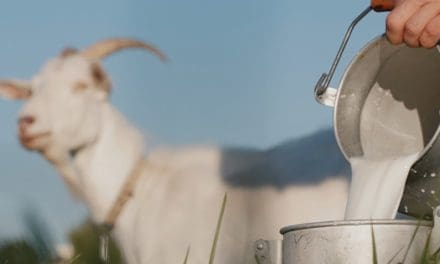
Wash your equipment immediately after every milking. Milk residue left in equipment is a bacterial breeding ground. Stainless steel pails and glass jars are the correct storage choices: they can be properly sanitized, do not absorb odors, and do not leach flavors into the milk. Plastic containers, even food-grade ones, hold residue in micro-scratches that accumulate over time.
Handling and Chilling: This Is Where Most Homesteaders Go Wrong
The single most common reason goat milk tastes “goaty” is not breed, not feed, and not the animal. It is slow chilling. Goat milk contains enzymes that begin breaking down the fat immediately after it leaves the udder. As those fats degrade, they produce the musky, barny, strong-flavored milk that gives goat dairy an undeserved bad reputation. Chill the milk fast and it tastes clean, sweet, and mild. Let it warm or cool slowly and you get the flavor most people associate with low-quality goat milk.
The Ice Bath Method
The most practical approach is to set your milking pail into a larger bucket of ice water before you start milking. The milk chills as it collects. When you bring it inside, strain it immediately through a stainless mesh strainer or milk filter into clean glass jars, and place those jars directly into a bucket of ice water or into the freezer for thirty to forty-five minutes before transferring to the refrigerator.
The target is to get fresh milk below 40 degrees Fahrenheit as quickly as possible, ideally within thirty minutes of leaving the udder. The Prairie Homestead recommends straining directly into pre-chilled glass jars and getting them into ice water immediately. Small jars cool faster than large ones, so if you’re storing in half-gallon jars, consider chilling in quarts first and consolidating later.
Storage Temperature and Duration
Store raw goat milk between 35 and 38 degrees Fahrenheit. A standard refrigerator set at its coldest often sits at 40 degrees, which is warmer than ideal and shortens shelf life noticeably. A dedicated small refrigerator for milk with a verified temperature gives you better control. Properly chilled and stored raw goat milk keeps for five to seven days. Frozen milk keeps for up to three months with minimal flavor change.
Other Factors That Affect Flavor
Keep bucks away from your milking does. The scent from an intact male can be absorbed by does and transferred to the milk. If you are using a buck for breeding, house him separately and make sure your does are not penned near him between milkings.
Diet affects milk flavor. Strong-flavored forages like onion grass, certain weeds, and some silages can produce off-flavors in milk. If your milk consistently has an unusual taste despite good chilling practice, look at what the doe is browsing or eating before milking. Switching her to hay and grain for several hours before milking and keeping her off certain pastures often resolves the issue.
What You Can Make from Your Goat Milk
This is where a daily surplus of fresh goat milk pays off. Every product listed below can be made in a home kitchen with basic equipment. None of them require specialized training, though each one has a learning curve for consistency and quality.
Fresh Drinking Milk
Properly handled fresh goat milk from Nigerian Dwarf or Nubian does is some of the best-tasting milk you can drink. Sweet, creamy, and mild when chilled correctly. If you have family members who have avoided dairy for years because of cow milk sensitivity, have them try well-handled fresh goat milk before writing off dairy entirely.
Chevre and Fresh Goat Cheese
Chevre is the starting point for homestead cheesemaking and a natural fit for goat milk. It requires nothing more than the milk, a mesophilic or thermophilic culture, and either rennet or an acid like vinegar or lemon juice to coagulate the milk. The curds drain in cheesecloth for several hours, then the cheese is salted and shaped. Total hands-on time is about twenty minutes spread across two days. A gallon of milk yields roughly one pound of fresh chevre. From there, variations on fresh goat cheese, including feta-style, herb-rolled, and aged versions, require the same basic skills with additional steps.
Related: Freeze Dried Cheese: The Complete Guide to Storing Cheese for 25+ Years
Yogurt
Goat milk yogurt has the consistency of Greek yogurt and the tang that comes from the milk’s natural character. The process is straightforward: heat the milk to 180 degrees Fahrenheit, cool to 110 degrees, stir in an active yogurt culture, and incubate for 6 to 10 hours in a warm location. An insulated cooler with a jar of hot water inside, a dedicated yogurt maker, or an oven with just the pilot light on all work for incubation. Longer incubation produces firmer, tangier yogurt. The milk’s natural butterfat means goat milk yogurt is creamy even without straining, though you can strain it through cheesecloth for a thicker consistency similar to labneh.
Kefir
Kefir is fermented goat milk made with kefir grains, which are symbiotic colonies of bacteria and yeast. You add the grains to fresh milk at room temperature, leave it for 24 to 48 hours, and strain out the grains, which you can reuse indefinitely. The result is a tangy, slightly effervescent drinkable dairy product high in probiotics. Kefir is one of the simplest value-added products to make because it requires no heating, no precise temperature control, and the grains propagate themselves over time so you never need to buy more.
Butter
Goat milk butter is possible but requires patience. Because goat milk is naturally homogenized, cream does not rise quickly the way it does in cow milk. You need to let fresh milk sit in the refrigerator for at least four days for cream to partially separate, then skim the cream layer carefully before churning. A gallon of goat milk from a high-butterfat breed like a Nigerian Dwarf will yield more cream than the same volume from an Alpine or Saanen. Once you have enough cream collected, churning is identical to cow milk butter: agitate at room temperature until the fat breaks, drain the buttermilk, wash the butter with cold water, and salt to taste. High-butterfat Nigerian Dwarf milk makes noticeably rich, pale yellow butter.
Cajeta and Goat Milk Caramel
Cajeta is a traditional Mexican goat milk caramel made by slowly reducing goat milk with sugar and a small amount of baking soda over low heat for an hour or more. The result is a thick, spreadable caramel with a depth of flavor that cow milk caramel does not match. It keeps for several weeks refrigerated and sells well at farmers markets. It is a good use of surplus milk on days when your storage is getting full.
Goat Milk Soap
Cold-process soap made with goat milk instead of water is smoother, creamier, and gentler on skin than water-based soap. The milk’s fats and proteins add to the bar’s emollient qualities. The process involves replacing some or all of the liquid in a soap recipe with frozen goat milk, which controls the temperature during lye addition and prevents the milk sugars from scorching. Goat milk soap is one of the highest-margin products you can sell from a homestead dairy. It has a long shelf life, ships easily, and consistently attracts buyers who want skin-care products made from real, identifiable ingredients. Penn State Extension notes that income from value-added goat milk products is an important part of the overall economics of a dairy goat operation for small producers.
Skin Lotion and Body Products
Beyond soap, goat milk can be incorporated into lotions, creams, and lip balms. The fat content and bioactive compounds make it a useful emollient base. Goat milk lotion requires a preservative if it contains water (which most do) and has a shorter shelf life than soap, but commands a premium price at markets and through direct sales.
Managing the Breeding and Lactation Cycle
Goats only produce milk after kidding. This is a biological constraint that shapes everything about a homestead dairy operation, and understanding it from the start prevents a lot of frustration.
Most dairy goat breeds are seasonal breeders, meaning they come into heat in the fall as days shorten. Breeding in the fall produces kids in late winter or early spring after a 150-day gestation. The doe freshens, meaning her milk comes in, when the kids are born. She then produces milk for 8 to 10 months before production tapers off, after which you breed her again and the cycle repeats.
If you want year-round milk, stagger your breeding across two or more does so that one is always in mid-lactation while the other is in late lactation or dry. A herd of three does managed this way can provide a fairly consistent milk supply throughout the year, with some seasonal dips but no complete dry periods.
You will have kids each spring. Kids from high-quality dairy does are sellable. Bucklings not kept for breeding are typically sold as meat animals or wethers. Doelings from good dairy lines command good prices as replacement does. Planning what you will do with kids before they arrive every year keeps this from becoming a problem.
Basic Health Management for a Dairy Herd
Dairy does are working hard. Lactation places significant demands on calcium, phosphorus, and overall energy balance. Feed quality directly determines milk quantity and quality, and corners cut on nutrition show up immediately in the milk bucket.
A milking doe needs quality grass hay available at all times, a grain ration sized to her production level (roughly a pound of grain per pound of milk produced daily is a common starting point), and a loose goat-specific mineral mix offered free choice. Goat-specific minerals are not optional. The mineral profile goats need differs meaningfully from what cattle or sheep minerals provide, and using the wrong mineral supplement creates deficiencies that compound over time.
Hoof trimming every four to six weeks prevents lameness, which kills production. A limping goat does not eat well, does not milk well, and is miserable. Trimming becomes easier with practice and the right tools. A monthly check of body condition, udder symmetry, and eye membrane color for parasite load is a minimum baseline. Establish a relationship with a vet who has experience with small ruminants before you need one urgently. Finding a goat-experienced vet during a crisis is the wrong time to be searching.
The Amish Built Real Food Independence Long Before It Became Trendy
Raising dairy goats is not just about milk. It is about building a household that produces its own food, medicine, soap, cheese, fertilizer, and long-term resilience from a small piece of land.
That mindset is exactly why so many preparedness-minded families have become fascinated with Amish self-sufficiency.
For generations, Amish families mastered practical livestock care, food preservation, home dairying, off-grid living, gardening, woodworking, herbal remedies, and low-tech systems that allowed them to thrive with far less dependence on modern infrastructure. While most people today are trying to relearn these forgotten skills from scratch, the Amish never abandoned them in the first place.
That is what makes The Amish Ways such a valuable resource.
Inside, you’ll discover practical old-world knowledge and proven homestead systems that helped families remain self-reliant for generations — including food production, animal care, preservation methods, natural remedies, and simple living strategies designed around resilience instead of convenience.
Inside The Amish Ways, You’ll Discover:
- Traditional livestock and homestead management skills
- Old-fashioned food preservation and storage methods
- Practical off-grid household systems
- Simple, sustainable farming techniques
- Herbal remedies and natural home medicine
- Low-tech solutions that still work during power outages and emergencies
- Self-sufficiency strategies built around independence and long-term stability
If the idea of producing your own milk, cheese, soap, and food security appeals to you, The Amish Ways is one of the best next steps you can take toward building a more resilient homestead lifestyle.
👉 Get your copy of The Amish Ways here!
Is Goat Milk Worth It on a Homestead?
Yes, with the right expectations. Two or three does on a well-run setup will supply a small family with more fresh dairy than they can use daily and enough surplus to make cheese, soap, and other products regularly. The twice-daily milking commitment is real and non-negotiable. You will miss events, vacations become logistics problems, and you need reliable backup coverage if you travel. Those are not problems unique to dairy goats. They are the realities of any livestock that requires daily attention.
What you get in return is a genuinely productive, self-sufficient food source on a small footprint. A goat can be fed largely from land you already have, produces multiple streams of value simultaneously, and keeps producing for a decade or more with good management. The learning curve is real but not steep. Most of what you need to know, you will learn in your first full year.
The global market for goat dairy products was valued at over 90 billion dollars in 2024 and is growing, driven by demand for digestible dairy alternatives and premium artisan products. Homesteaders with productive dairy does and the skills to make value-added products are positioned in the middle of a market that wants exactly what they can produce. Start with two does of a breed matched to your goals, build your chilling and milking routine until it runs automatically, and expand from there. The milk bucket fills twice a day whether you are ready for it or not. The question is what you do with what’s in it.
You may also like:
Join The Self-Sufficient Projects Facebook Group
How to Get 295 Pounds of Extra Food for Just $5 a Week (Video)
The $0.5 Livestock Feed That You Can Make at Home