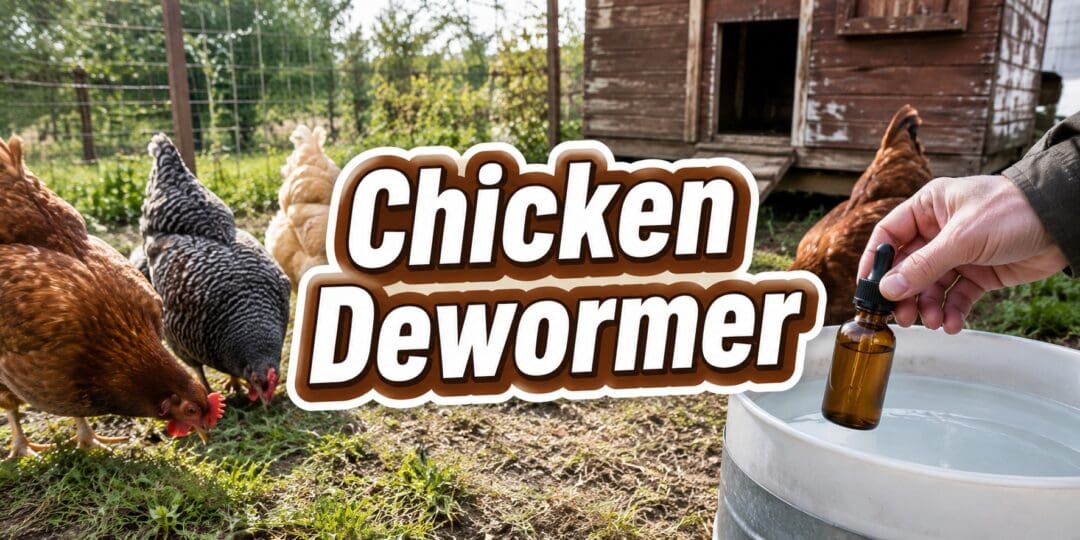
Every flock I’ve ever kept has carried some level of worms, and honestly, that’s normal. Chickens live outside, they peck at the ground, they eat bugs and slugs and each other’s droppings without a second thought, and worms are just part of that deal. The real question isn’t whether your birds have worms, it’s whether the load has grown heavy enough to hurt them, and if so, what to actually do about it. I’ve worked through the confusion of conflicting advice, off-label products, and “natural” remedies with more marketing than evidence behind them, so let’s walk through what actually works.
A Note Before You Begin
- This guide reflects common backyard flock management practices and current research, but it isn’t a substitute for veterinary guidance specific to your flock.
- If you’re treating a flock for the first time, or dealing with a heavy infestation, a fecal test through your vet or local extension office will tell you far more than guessing based on symptoms alone.
How to Tell If Your Flock Actually Has Worms
Most chickens carry a low-level worm burden without showing any signs at all, and a healthy bird with a balanced diet can manage that just fine. The trouble starts when the load climbs. According to Penn State Extension, clinical signs of a heavy worm burden can include diarrhea, depression, reduced weight gain, weight loss, anemia, worms visible in eggs, and decreased egg production, though none of these signs are specific enough to worms alone to serve as a diagnosis on their own.
- Weight loss or a bird that feels lighter than it looks under all that feather
- Pale comb and wattles, a sign the bird may be anemic
- Diarrhea or abnormal, foamy, or watery droppings
- Visible worms in droppings, which can look like long white string (roundworms) or flat, rice-grain segments (tapeworm segments)
- Reduced or stopped egg production, or worms occasionally found inside an egg
- Listlessness, reduced appetite, and dirty vent feathers
- For gapeworm specifically: neck stretching, head shaking, gasping, or open-mouth breathing
- Sudden death in severe, untreated infestations, particularly in young or already-stressed birds
The only way to actually confirm a worm burden and know which species you’re dealing with is a fecal float test. Your vet or local extension office can run one from a fresh droppings sample, and routine fecal testing every 2 to 3 months during warm, wet seasons, when parasite transmission runs highest, is a smart baseline for any flock owner who wants to treat based on actual need rather than guesswork.
The Worms You’re Actually Dealing With
Not all worms are the same, and knowing which one you’re fighting changes which dewormer will actually work. Here are the ones you’re most likely to run into in a backyard flock.
- Roundworms (Ascaridia galli): The most common internal parasite in chickens. Large, long, thin, yellowish-white worms that live in the intestine and can occasionally be found in eggs. Heavy infections can physically block the intestine.
- Cecal worms (Heterakis gallinarum): Small worms living in the ceca, the two pouches off the intestine. Usually not harmful on their own, but they’re the main carrier of the protozoan parasite that causes blackhead disease, which is why chickens and turkeys shouldn’t be housed together.
- Capillary worms (Capillaria species): Thin, hair-like worms (sometimes called threadworms) that live in the crop, esophagus, or intestine and can cause significant weight loss and inflammation even at moderate loads.
- Gapeworm (Syngamus trachea): Bright red, Y-shaped worms that live in the trachea. Less common but more dramatic, causing the gasping, head-shaking, open-mouth breathing that gives the parasite its name. Chickens pick it up from earthworms, snails, and slugs, or direct contact with infected birds.
- Tapeworms (Cestodes): Flat, segmented worms that require an intermediate host like a beetle, earthworm, fly, slug, or ant. Common in pastured or free-range flocks. Harder to treat than roundworms since not every dewormer is effective against them.
None of the internal worms above are transmissible from chickens to humans, which is reassuring, but they can absolutely tank your flock’s productivity and health if left unmanaged.
FDA-Approved and Common Off-Label Dewormers
This is where things get genuinely confusing for backyard keepers, because for decades there was no dewormer actually approved for chickens in the US. That changed. Safe-Guard AquaSol (fenbendazole) is now the only FDA-approved dewormer for home use in backyard chickens, and it’s genuinely worth understanding why that distinction matters before reaching for anything else on the farm store shelf.
- Safe-Guard AquaSol (Fenbendazole), FDA-approved: A water-soluble formulation dosed at 0.454 mg per pound of body weight, given daily in drinking water for 5 consecutive days. It treats and controls adult roundworms in meat birds, and both roundworms and cecal worms in laying and breeding hens. Critically, it carries zero egg withdrawal period when used exactly as labeled, which is a real advantage over every off-label option on this list.
- Fenbendazole (Safe-Guard, Panacur), other formulations: The older paste, liquid, and powder formulations of fenbendazole (originally labeled for other livestock or turkeys) are widely used off-label in chickens and have a strong safety track record, but they don’t carry the same officially studied zero-withdrawal status as AquaSol specifically. Many keepers still use a standard 10-day repeat treatment schedule with these.
- Ivermectin (Ivomec): An off-label option effective against most roundworms and external parasites like mites and lice, but not effective against tapeworms. It’s dosed in drops based on bird size, and it is very easy to get wrong. Backyard keepers report unofficial withdrawal times of around 21 days, since no formulation is officially labeled or studied for chickens.
- Albendazole (Valbazen): A broad-spectrum benzimidazole and one of the only options that reliably treats tapeworms in addition to roundworms, capillary worms, cecal worms, and gapeworms. Used off-label, given by mouth, typically repeated in two weeks.
- Levamisole: Effective against roundworms and several other species, but it has a narrower margin of safety and requires careful, accurate dosing based on bird weight.
Critical Safety Information
- Underdosing is one of the most common mistakes with any dewormer and it actively contributes to drug-resistant worm populations. Weigh your birds, or use a solid estimate for the group’s total weight, before calculating any dose.
- Ivermectin has a genuinely narrow margin of safety in chickens and has caused deaths from incorrect dosing. Most sources on backyard poultry health recommend using it only under veterinary guidance, not as a casual first choice.
- Only Safe-Guard AquaSol, used exactly as labeled, carries an FDA-confirmed zero egg withdrawal period. Every other product, including other fenbendazole formulations, ivermectin, albendazole, and levamisole, is being used off-label in chickens, meaning there is no officially studied withdrawal time. When in doubt, discard eggs for at least 14 days after treatment with any off-label dewormer, and consult your vet or extension office for product-specific guidance.
- Wear gloves when handling any dewormer concentrate and avoid skin, eye, or accidental oral exposure. These are genuine pharmaceuticals, not feed additives.
- Never deworm a flock that’s actively molting or under other significant stress unless a vet has confirmed it’s necessary; deworming itself is a physiological stressor.
How to Actually Administer a Dewormer
- Water-based treatments (like Safe-Guard AquaSol): remove all other water sources first thing in the morning, then offer only the freshly mixed medicated water so birds are motivated to drink it rather than holding out for their regular water
- Paste or liquid given by mouth: a pea-sized dollop of paste can be placed directly in the beak, or hidden inside a small piece of bread for birds that resist handling
- Pour-on formulations (like ivermectin pour-on): applied as drops directly to the skin at the back of the neck, dosed by bird size, never by guesswork
- Medicated feed: some fenbendazole products come as a feed-mixed formulation, useful for larger flocks where individual dosing isn’t practical
- Always calculate dose by actual or estimated body weight, not “one dose fits all birds”; a bantam and a heavy breed need very different amounts
- Most treatment protocols call for a repeat dose 10 to 14 days after the first, timed to catch any worms that hatched from eggs that survived the first round
Natural and Preventive Options: What Actually Holds Up
There’s a lot of enthusiasm online for pumpkin seeds, diatomaceous earth, garlic, and apple cider vinegar as chemical-free dewormers. I want to be straight with you about what the evidence actually shows, because a lot of what circulates in backyard chicken groups is more hope than proof.
Pumpkin seeds: The claim is that cucurbitacin in pumpkin seeds paralyzes worms so chickens can expel them. That compound is real, but the study behind the claim was done in a test tube, not in live chickens, and nobody has established how many seeds a bird would actually need to eat for any effect. Feed them as a healthy treat and a source of enrichment, not as your deworming plan.
- Diatomaceous earth (DE): Food-grade DE can help with external parasites like mites and lice, but it loses its mechanical, sharp-edged effectiveness the moment it gets wet, which is exactly the environment inside a chicken’s digestive tract. Its use as an internal dewormer is anecdotal, and it can irritate the eyes and lungs of both chickens and the humans applying it, so handle it carefully regardless of how you use it.
- Garlic and apple cider vinegar: Both are commonly added to water on the theory that they create a gut environment worms don’t like. There’s some mild antiparasitic activity reported in limited studies, but neither is considered a reliable substitute for a proven dewormer when a real infestation is confirmed.
Related: This Is Why You Should Have Diatomaceous Earth Around Your Property
None of this means natural approaches are worthless. They’re reasonable as part of an overall prevention and gut-health strategy, especially combined with good management. What they aren’t is a dependable treatment once a fecal test confirms a real worm burden. Treat a confirmed infestation with a product that’s actually proven to work, and save the pumpkin seeds and garlic for ongoing prevention and as treats your flock enjoys.
Prevention: The Part That Actually Moves the Needle
Every source I trust on this agrees: prevention does more for your flock’s worm load than any dewormer ever will. Ascaridia (roundworm) eggs can survive in soil for one to two years, so the ground your flock lives on matters enormously.
- Rotate pasture or run space if you possibly can. Divide the area into at least two sections, run the flock on one for 2 to 4 weeks, then rest it for a few months so sun and heat kill off eggs and larvae in the soil
- Keep bedding and litter dry; damp, wet conditions are exactly what worm eggs and their intermediate hosts (slugs, earthworms, beetles) need to thrive
- Clean coops regularly and compost manure properly rather than leaving it to accumulate where birds walk and forage
- Control intermediate hosts around the coop, since tapeworms in particular need an ant, beetle, earthworm, fly, slug, snail, or termite to complete their life cycle before a chicken ever picks them up
- Quarantine new birds for at least 30 days before introducing them to your flock, and run two fecal tests during that window before mixing them in
- Keep coops raised off the ground where practical, and consider wire mesh flooring or a mobile chicken tractor system if your space is limited, both of which reduce contact between birds and contaminated soil
- Support overall flock nutrition with adequate protein and vitamins A and B-complex, since a well-fed bird’s immune system tolerates a normal worm load far better than a stressed or malnourished one
- Don’t house chickens and turkeys together, since cecal worms carry the protozoan parasite responsible for blackhead disease, which is far more dangerous to turkeys
Should You Deworm on a Schedule, or Only When Needed
There are two honest schools of thought here, and reasonable flock owners land on different sides depending on their setup.
- Scheduled deworming: Treating on a fixed interval (often every 3 to 6 months) regardless of confirmed infestation. Simpler to manage, but it treats every bird whether they need it or not, which contributes to resistant worm populations over time.
- Test-then-treat: Running fecal tests periodically and only deworming when a real burden is confirmed. More effort upfront, but it avoids unnecessary chemical exposure and helps slow the development of dewormer-resistant worms in your flock and local environment.
My own preference leans toward test-then-treat wherever it’s practical, mostly because unnecessary treatment speeds up resistance, and resistant worms are a much harder problem to solve later than an extra vet visit now. If a full fecal panel isn’t accessible where you live, a twice-yearly scheduled treatment timed around your warm, wet season is a reasonable fallback.
Raise Chickens the Amish Way – Naturally and Successfully
Keeping a healthy flock isn’t just about treating problems—it’s about preventing them with time-tested practices that have worked for generations.
The Amish Ways Book is filled with practical, old-fashioned knowledge on raising chickens, preserving food, gardening, natural living, and building a more self-sufficient homestead. These proven methods can help you create a healthier, more productive flock while relying less on expensive modern solutions.
Whether you’re new to backyard chickens or managing a growing homestead, this book is packed with the kind of practical wisdom that’s becoming harder to find.
The Bottom Line
Worms are simply part of keeping chickens outside, and a light load isn’t an emergency. What actually matters is knowing the real signs of a heavy burden, confirming it with a fecal test rather than guessing, reaching for a dewormer that’s actually proven to work for the specific worm you’re dealing with, and following the label or your vet’s guidance on dosing and egg withdrawal. Pair that with real prevention, dry bedding, pasture rotation, and good nutrition, and most flocks stay ahead of the problem without ever needing an aggressive intervention.
You may also like: 
The Amish do this to every chicken coop in the spring. Why? (Video)
Step By Step For Butchering Chicken
Your Chicken Coop Could Be a Death Trap
These Animals Are Stealing Your Chicken Eggs
Build a Self-Cleaning Chicken Coop
Why Are My Chickens Losing Feathers?