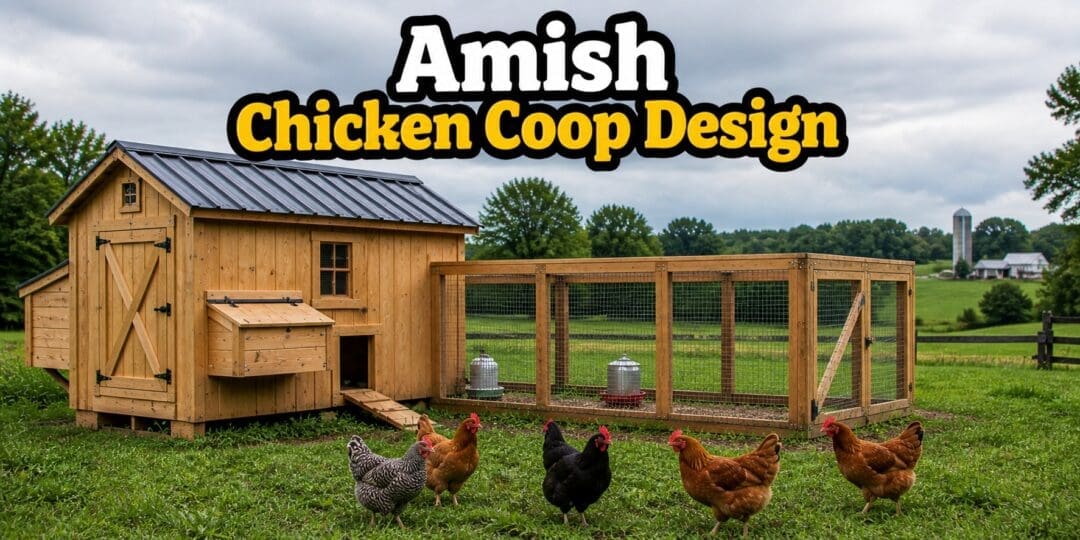
Walk onto any working Amish farm and you will find chickens that look good: alert, clean-feathered, active, with good body condition and a production rate that most backyard flock keepers would envy. The coop those chickens live in is almost certainly not elaborate. It is probably built from rough-sawn lumber, has no electricity running to it, and was put up in a day or two by the family that uses it.
That combination, productive flock, simple structure, no technology dependence, is not a coincidence. Amish chicken coop design has been refined across generations of practical use by people who kept chickens because they needed eggs and meat, not as a hobby. Every feature in a traditional Amish coop exists because it solves a real problem. Nothing exists because it looked good in a magazine.
This article breaks down what makes Amish coop design work, the specific features worth replicating, the materials and dimensions used, and how to build your own version whether you are starting from scratch or improving an existing structure.
The Core Philosophy: Function Over Everything
Modern chicken coop design has been heavily influenced by aesthetics. Walk through any farm store or browse any homesteading site and you will find coops shaped like barns, cottages, and Victorian houses, complete with decorative trim and painted shutters. These structures are not designed around chicken biology or practical management. They are designed around what appeals to people who have never kept a serious flock.
Amish coop design starts from a different question: what does the chicken actually need, and what is the simplest structure that provides it? The answer, refined over two centuries of working farm practice in communities across Pennsylvania, Ohio, and Indiana, produces coops that are rectangular, solidly built, well-ventilated, easy to clean, and oriented to take advantage of natural light and prevailing weather patterns.
According to research from Penn State Extension’s poultry program, the single most common cause of flock health problems in backyard and small farm settings is poor coop ventilation, followed by inadequate predator protection and insufficient space per bird. Amish coop design addresses all three of these directly. Decorative features address none of them.
Key Features of a Traditional Amish Chicken Coop
Orientation and Siting
A traditional Amish coop is sited with the primary window and access wall facing south. This does several things at once. South-facing windows maximize passive solar gain in winter, warming the interior without any energy input. They also provide maximum natural daylight to the birds, which directly supports egg production. Laying hens require a minimum of 14 to 16 hours of light per day to maintain production, and south-facing windows provide this naturally through most of the year without artificial lighting.
The back wall, facing north, is typically solid with minimal openings. This blocks the prevailing cold winter winds in most of the continental United States, which come predominantly from the northwest and north. Siting the coop with solid walls toward prevailing wind and open faces toward sun is not complicated design theory. It is basic passive climate management that costs nothing to implement and pays ongoing dividends in bird health and production.
The coop should sit on slightly elevated ground if possible, or be built with a foundation that keeps the floor above grade. Flat low-lying sites collect water under the structure, which accelerates floor rot and creates a moisture problem that affects air quality and litter condition inside.
Size and Space Per Bird
Amish coops are sized practically, not generously. The standard working formula in traditional Amish poultry management is 3 to 4 square feet of interior floor space per bird for heavy breeds kept with regular outdoor access, or 4 to 5 square feet for confined flocks. A flock of 20 laying hens therefore needs a coop of 60 to 80 square feet of floor space at minimum.
The University of Kentucky Cooperative Extension Service recommends a minimum of 4 square feet per bird for small flocks and notes that overcrowding is the primary driver of behavioral problems including feather pecking, cannibalism, and disease transmission in confined flocks. Amish farmers arrived at similar numbers through observation rather than research, which is one reason traditional practice and modern poultry science tend to agree on this point.
Coop height in traditional Amish construction is typically 6 to 7 feet at the eave, tall enough for a person to work comfortably inside without stooping. A coop you cannot stand up in is a coop you will not clean as often as you should. Cleaning frequency is directly linked to flock health, so anything that discourages cleaning is a real management liability.
Ventilation
Ventilation is where most homebuilt coops fail, and where Amish design gets it consistently right. Chickens produce significant moisture through respiration and droppings. A flock of 20 hens in a closed 80-square-foot coop can add gallons of moisture to the air overnight. If that moisture cannot escape, it condenses on walls and bedding, raises ammonia levels from decomposing manure, and creates the warm, wet, ammonia-laden conditions that are ideal for respiratory pathogens and frostbite.
Traditional Amish coops use a combination of ridge venting and low sidewall venting to create passive airflow that removes moisture-laden air without creating direct drafts on roosting birds. The principle is straightforward: warm moist air rises and exits through the ridge; fresh cooler air enters through low vents on the side walls below roosting height. Birds are not in the direct airflow path because the incoming air enters below where they sleep and the outgoing air exits above.
In practice this means: a continuous or intermittent ridge vent along the peak of the roof, covered with hardware cloth to exclude predators and pests, and vents on the side walls positioned 12 to 18 inches above the floor on opposite sides of the building. The side vents can be covered with hinged boards for winter management without eliminating ventilation entirely. Many Amish coops also include a row of venting just under the eaves on the south side, which serves double duty as a light source and a ventilation channel.
Windows and Natural Light
Windows in a traditional Amish coop are simple, south-facing, and sizeable relative to the floor area. A general guideline is 1 square foot of window area for every 10 square feet of floor space, which for an 80-square-foot coop means at least 8 square feet of south-facing glass or translucent panel.
Amish coops traditionally used whatever glass was available, often salvaged from other buildings. Modern builders can use the same approach: salvaged windows, polycarbonate roofing panels set into the south wall, or simple single-pane glass set directly into the framing. The point is adequate light, not architectural precision.
Windows should be covered with hardware cloth on the interior so they can be opened for summer ventilation without creating a predator entry point. A hinged shutter on the exterior allows them to be closed in severe weather.
Flooring
Amish coops use one of two floor types depending on the farm’s management approach: packed earth or rough-sawn wood planking raised on a sill plate above grade.
Packed earth floors are the traditional standard in older Amish construction. They are free to install, easy to manage with the deep litter method, and provide thermal mass that moderates temperature swings. The limitation is that they are vulnerable to predator digging and difficult to fully sanitize if disease enters the flock.
Raised wood plank floors, typically 2-inch rough-sawn pine or fir planking laid across floor joists set 16 inches on center, solve the digging problem and are easier to scrape clean during full cleanouts. They require more material and more construction effort, but produce a more durable and manageable floor over the long term. A hardware cloth skirt buried 12 inches deep and extending 12 inches outward from the foundation perimeter addresses the predator digging problem for earth-floor coops without the cost of a full wood floor.
Roost Design
Chickens sleep on roosts, not on the floor, and the design of those roosts affects bird health and management in concrete ways. Traditional Amish roost construction uses 2×4 lumber laid flat, wide face up. This is not an arbitrary choice. The wide flat surface allows chickens to cover their feet with their body feathers while roosting, which prevents frostbite in cold climates. Round dowel-style roosts, which look more natural, force birds to grip rather than settle flat, exposing their feet to cold air all night.
Roosts are positioned at a consistent height of 18 to 24 inches above the floor in most traditional Amish coops, with 8 to 10 inches of linear roost space per bird. Multiple roosts at the same height are preferred over a tiered ladder arrangement, because tiered roosts create competition for the highest position and the birds that lose that competition end up roosting directly below the droppings of those above them.
A droppings board positioned beneath the roosts and 12 to 14 inches below them catches the majority of overnight manure, which concentrates in that zone because chickens produce most of their daily waste while sleeping. Scraping the droppings board every few days extends the life of the floor litter significantly and reduces ammonia buildup without a full coop cleanout.
Nesting Boxes
One nesting box for every four to five hens is the standard Amish ratio. A flock of 20 hens needs four to five boxes. More boxes do not hurt but add material cost and take up wall space. Individual boxes are typically 12 inches wide, 12 inches deep, and 12 inches tall, built in a row along the wall opposite the main window to keep them in the darker, quieter zone of the coop. Hens prefer to lay in dim, protected spaces and will use boxes consistently if they meet those conditions.
Boxes are positioned 18 to 24 inches off the floor with a small landing board in front. Too high and older or heavier hens will not use them. Too low and they become attractive sleeping spots, which results in droppings-fouled eggs and displaced nesting behavior.
Traditional Amish nesting boxes are built from rough-sawn lumber with a sloped roof to discourage roosting on top of them. The front lip is 4 to 6 inches high to keep nesting material in the box. No specialized hardware is required. The entire bank of boxes can be built in an hour from scrap lumber.
Predator Protection
Amish farms experience the same predator pressure as any rural property: foxes, raccoons, opossums, weasels, mink, hawks, owls, and in many areas coyotes and dogs. Traditional coop construction addresses this through material choices and construction details rather than electronic deterrents.
- All openings including vents and windows are covered with 1/2-inch hardware cloth, not chicken wire. Chicken wire keeps chickens in but does not keep predators out. A raccoon can reach through standard chicken wire and pull a bird through the opening. Hardware cloth with 1/2-inch galvanized welded mesh prevents this
- Doors fit their frames tightly with no gaps larger than 1/4 inch. Weasels and mink can enter through surprisingly small openings. Traditional Amish coop doors use a simple barrel bolt latch on the outside and a hook-and-eye closure on the inside. Raccoons can open simple gate latches; a barrel bolt that must be lifted and slid requires a degree of manual dexterity they do not have
- The floor perimeter is sealed. Where wall meets floor there should be no gap. Rats enter coops through floor-wall junctions and once established are extremely difficult to eliminate
- The run, if attached, uses hardware cloth buried 12 inches deep with a 12-inch outward-facing apron at the base to prevent digging under the perimeter
Traditional Amish Coop Build: Dimensions and Materials
The following specifications describe a functional Amish-style coop for 20 to 25 laying hens. Adjust proportionally for smaller or larger flocks.
Footprint and Framing
An 8 by 12 foot footprint provides 96 square feet of floor space, comfortable for 20 to 24 hens at 4 square feet per bird with some margin. Frame with 2×4 construction lumber on 16-inch centers for walls, and 2×6 rafters for the roof to handle snow load in northern climates. Wall height should reach 7 feet at the eave on the south wall and 6 feet on the north wall, creating a single-slope shed roof that pitches toward the north. This roof pitch keeps the south wall full height for maximum window area and naturally sheds rain and snow away from the main access side.
Siding and Roofing
Traditional Amish construction uses rough-sawn board-and-batten siding, which is vertical boards with narrow strips covering the gaps between them. This siding style is cheap, durable, easy to install without specialized tools, and breathes slightly, which helps with moisture management in the wall cavity. Metal roofing, either corrugated steel or standing seam, is the Amish standard for farm buildings. It lasts 40 to 50 years with no maintenance, sheds snow cleanly, and is quieter in the rain than most people expect once chickens are inside.
Material List for an 8×12 Coop
- Pressure-treated 4×4 posts or concrete piers for the foundation: 6 to 8 pieces
- 2×6 floor joists, 8 feet long: 10 pieces
- 2-inch rough-sawn pine planking for floor: 96 board feet
- 2×4 studs, 8 feet: 40 pieces for wall framing
- 2×6 rafters: 10 pieces
- Board-and-batten siding or T1-11 sheet siding: enough to cover 320 square feet of wall area
- Corrugated metal roofing panels: enough to cover 110 square feet with overlap
- Ridge cap flashing: 12 linear feet
- 1/2-inch hardware cloth: 50 square feet for vents and windows
- Single-pane glass or polycarbonate panels for south windows: 10 to 12 square feet
- 2×4 lumber for roosts, nesting boxes, and droppings board: 30 to 40 board feet
- 1 solid wood door, 32 inches wide by 72 inches tall, with barrel bolt hardware
- Hinges, screws, and nails: standard framing hardware throughout
The Deep Litter Method: How Amish Farmers Manage Coop Bedding
Most Amish chicken keepers use the deep litter method to manage coop bedding year-round. This is not the same as neglecting to clean the coop. It is a deliberate management approach that uses microbial activity in the bedding layer to compost manure in place, generate modest warmth through decomposition, and reduce the frequency of full coop cleanouts without compromising bird health.
The method works as follows. Start with 4 to 6 inches of dry carbon-rich bedding material, traditionally wood shavings, straw, or dried leaves. When the surface becomes visibly damp or matted, add another 2 to 3 inches of fresh dry material on top rather than removing the wet layer. Turn the entire bedding mass with a pitchfork every week or two to introduce oxygen and mix the layers. Properly managed deep litter should smell like soil or fresh compost, not ammonia. Ammonia smell is the indicator that the system is failing, usually due to too much moisture and not enough carbon material or turning frequency.
Over a full season the litter builds to 12 inches or more. It is cleaned out completely once or twice per year, typically in spring and fall, and the resulting material is among the richest compost available for garden use. A single cleanout from an 80-square-foot coop produces enough composted material to heavily amend a substantial garden bed.
Research from the University of Arkansas Division of Agriculture has confirmed that well-managed deep litter maintains lower pathogen loads than frequently cleaned coops, likely because the active microbial community in the composting litter competes with and suppresses disease organisms. Traditional Amish practice arrived at the same conclusion through observation: flocks kept on deep litter consistently outperform flocks kept on bare or frequently stripped floors in terms of health and mortality rates.
Heating and Winter Management: The Amish Approach
Most Amish chicken coops have no electric heat. This is not a hardship management decision. It is a deliberate choice based on the understanding that chickens are remarkably cold-hardy animals that do not require supplemental heat in most North American climates, and that heated coops create dependency and management problems that unheated coops do not.
A healthy adult chicken can maintain its own body temperature down to well below freezing if three conditions are met: it is dry, it is out of direct drafts, and it has enough body condition from adequate feed intake. All three of these conditions are addressed by proper coop construction, not by a heat lamp. The most common winter poultry problem in heated coops is not cold. It is the house fire risk from heat lamps, which cause a significant number of barn and coop fires every year.
The National Fire Protection Association (NFPA) lists improperly used heat lamps as one of the leading causes of barn fires in the United States. Amish coops eliminate this risk entirely by building for passive thermal performance: thick walls, south-facing glass for solar gain, tight construction to eliminate drafts, and the modest heat generated by the flock’s own bodies and the deep litter composting process.
For breeds adapted to cold climates, which includes most dual-purpose and heritage breeds commonly kept on Amish farms, a well-built unheated coop with adequate ventilation, dry litter, and no drafts is all that is needed through a normal winter in zones 4 through 7. Frostbite on combs occurs in poorly ventilated coops with high humidity, not simply in cold ones.
Adapting Amish Coop Principles to Your Property
You do not need to replicate a traditional Amish coop exactly to benefit from its design principles. The core lessons apply to any scale and any level of construction skill:
- Orient for sun and wind: face the main windows south and put solid wall to the north. This costs nothing and pays dividends every winter
- Ventilate from ridge and low wall: passive airflow that removes moisture without drafts is the single most important design decision you can make for flock health
- Size for management access: if you cannot stand up and move freely inside it, you will not manage it properly. Build tall enough to work in
- Use flat roosts: 2×4 laid flat protects feet in cold weather and is the detail most builders get wrong when they switch to round dowels for aesthetic reasons
- Hardware cloth, not chicken wire: on every opening, always. The cost difference is small and the predator protection difference is significant
- Build a droppings board: it takes one afternoon to build, reduces the deep litter management burden substantially, and most people who build one say it is the single highest-value addition to an existing coop
These principles have been tested across two centuries of continuous practical use by people who depended on their chickens for food. They are not theoretical recommendations. They are what actually works at the scale and resource level that most homesteaders operate at.
Build It Once. Do It Right. Never Struggle With Your Coop Again.
If this article changed how you think about chicken coops, that’s just the surface.
The real advantage Amish families have isn’t one design—it’s a complete system. Every structure, every routine, every decision is built to work without waste, without guesswork, and without depending on the grid.
That’s exactly what the The Amish Ways Academy gives you.
Inside, you’ll learn:
- Proven coop, barn, and homestead designs that actually hold up over time
- Food systems that keep producing without constant inputs
- Low-tech solutions that replace expensive tools and fragile systems
- The practical mindset that turns simple setups into high-output results
This is the difference between trying to homestead… and building something that actually works year after year.
👉 See how the Amish really do it!
Because copying one coop helps…
but understanding the entire system changes everything.
Final Thoughts
The best chicken coop is not the most expensive one or the most beautiful one. It is the one that keeps your birds healthy, dry, and safe with the least ongoing effort from you. Amish coop design has been optimizing for exactly that outcome for generations.
Build simple. Build solid. Orient it right. Ventilate it properly. Use the right materials on the openings. Keep the bedding managed. Those six things, done consistently, produce a flock that performs and a coop that lasts. Everything else is optional.
You may also like: 
Join Our Homesteading Facebook Group!
This Water Machine Produces Up to 40 Gallons of Water Per Day (Video)
5 Amish Gardening Techniques You Should Know
10 Amish Canning Recipes You Should Know About
Build a Self-Cleaning Chicken Coop
Recognizing And Treating Common Chicken Diseases