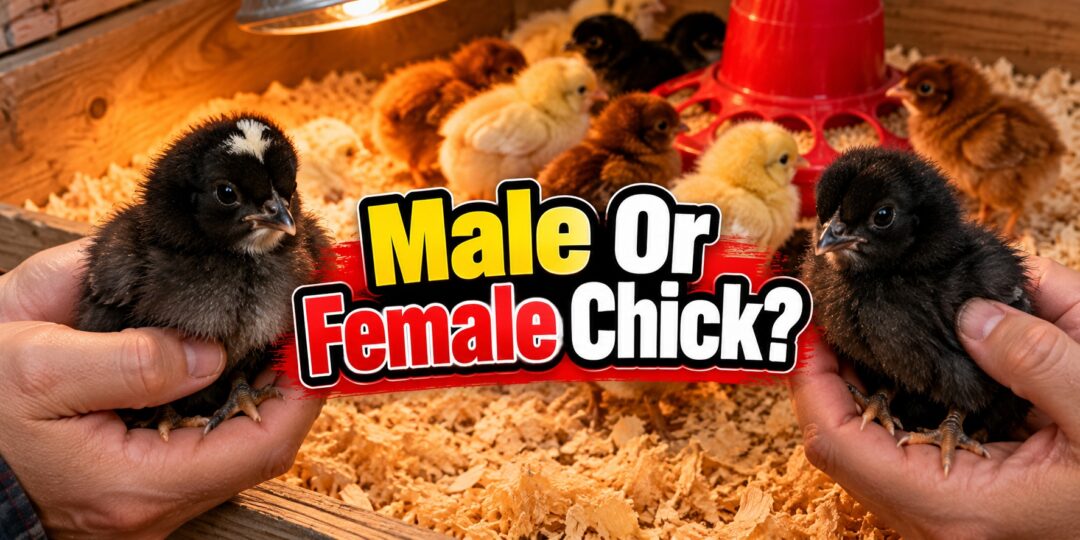
Every spring I stand over the brooder with a cup of coffee, staring at a box of fluffy chicks and trying to guess which ones will lay eggs and which ones will wake the whole valley at dawn. If you have done the same, you already know the frustrating truth: most day-old chicks look exactly alike.
That does not mean you are stuck guessing. Depending on the breed, you can sometimes tell on day one, and with almost any chick you can tell for sure within a few weeks if you know what to watch for.
Here is everything I have learned about how to tell if a chick is male or female, what actually works, and which old tricks you can safely ignore.
Why Sexing Baby Chicks Is So Hard
With most farm animals, you can tell males from females the day they are born. Chickens are different because a male bird’s reproductive organs sit inside the body, not outside.
As the University of Kentucky’s poultry extension explains, male and female chicks hatch at the same weight and show no distinguishing secondary sex traits at hatch, apart from down color or feather length in certain breeds. That is why even experienced keepers end up surprised now and then.
A little terminology helps here. A young female is called a pullet and a young male is a cockerel, and they become hens and roosters once they mature.
Method 1: Buy Sex-Link Chicks
If you want to know on day one, the easiest route is to start with chicks that tell you themselves. Sex-link chicks come from specific crosses of two different breeds, and the color of their down shows their sex right out of the egg.
According to the extension guide to sex-linked traits, black sex-links come from a barred hen crossed with a non-barred rooster, such as a Barred Plymouth Rock hen and a Rhode Island Red rooster. Both sexes hatch with black down, but the males have a white dot on their heads.
Red sex-links work in a similar way. A Rhode Island Red or New Hampshire rooster crossed with a Delaware hen gives you female chicks that grow up solid red like their father, while the males take on the Delaware pattern of their mother.
There is one catch I learned the hard way. The cross only works in one direction, and the offspring of a sex-link cross cannot be bred to make another sex-link generation, so you cannot keep the trick going with your own birds.
Method 2: Check the Wing Feathers
Feather sexing is the method most backyard keepers try first, and it can work well, but only in the right birds. It relies on a gene for fast or slow feathering that has been bred into certain commercial lines.
When a fast-feathering rooster is crossed with a slow-feathering hen, the female chicks feather faster than the males. On the female’s wing, the covert feathers are shorter than the primary flight feathers, while on the male, the coverts are as long as or longer than the primaries.
Timing matters. The extension guide notes that this difference is visible only for about the first one to three days after hatch, and after that the method no longer works.
To check, I hold the chick gently in one hand and fan out one wing with my other fingers. Two rows of noticeably different lengths suggest a pullet, while a row that looks even suggests a cockerel.
The honest truth is that most breeds do not carry this feathering trait at all. Mississippi State University Extension says feather appearance is the same in both sexes for most strains, so if you are raising heritage breeds from your own rooster, this test is closer to a coin toss.
Method 3: Look for Breed-Specific Color Clues
A few purebred breeds carry their own built-in hints. In Barred Plymouth Rocks, males hatch with a large white spot on top of the head, while females have a smaller, narrower spot.
The University of Kentucky puts the accuracy of that head-spot method at about 80 percent. In Rhode Island Reds and New Hampshires, male chicks often have a white spot on the down over the wing, but the size varies so much that it is not always reliable.
Some breeds, known as autosexing breeds, were developed so the sexes look different at hatch. If clear day-one sexing matters to you, it is worth asking your hatchery which breeds offer that.
Method 4: Vent Sexing (Best Left to the Pros)
Vent sexing is how commercial hatcheries sort chicks. A trained sexer holds the chick upside down, clears the vent, and looks for a tiny rudimentary male organ.
It sounds simple, but it is not. Mississippi State notes that there are more than fifteen different shapes to tell apart, and the training is so long that it makes little sense for a small flock owner.
I will not try it on my own chicks, and I would not recommend it to anyone without hands-on training. Squeezing a newly hatched chick the wrong way can injure it badly.
It is also why hatcheries commonly advertise sexing accuracy of around 90 percent rather than 100 percent. If you order ten pullets, do not be shocked when one of them starts crowing in the fall.
Method 5: Watch Them Grow (The Most Reliable Way)
For most of us, the surest answer comes with a little patience. MSU Extension says sexing by secondary sex traits can usually be done once chicks reach 4 to 6 weeks old.
Here are the signs I watch for as my birds grow up.
Combs and wattles come first. Cockerels usually develop larger, redder combs and wattles earlier than pullets, and in single-comb breeds like Leghorns, a male’s comb stands upright while a female’s often flops to one side.
Body and legs come next. Males tend to grow bigger, with thicker legs and a more upright stance, and they develop larger spurs as they mature.
Feathers give the clearest sign. Around a few months of age, cockerels grow long, narrow, pointed hackle feathers on the neck and saddle feathers on the lower back, while pullets keep rounder, softer feathers in both places.
Behavior can help too, though I treat it as a hint rather than proof. Cockerels often chest-bump and spar with each other early on, and the final answer arrives when one of them tries out his first wobbly crow.
A few breeds break the rules. The University of Kentucky notes that Sebright and Campine males are “hen feathered” and look like females, and Silkies are famously hard to sex because their fluffy feathers hide the usual differences.
Old Wives’ Tales That Don’t Work
I have heard plenty of folk tricks over the years at the feed store and the swap meet. Most of them are no better than flipping a coin.
The egg-shape test claims that long, pointy eggs hatch roosters and round eggs hatch hens. The University of Kentucky is clear that egg shape has nothing to do with the sex of the chick, and it does not even tell you whether the egg is fertile.
The pendulum test, where you dangle a needle or ring over a chick and watch which way it swings, falls in the same category. So do tricks like holding a chick upside down by its legs or by the scruff and watching how it reacts.
These tests can be fun with the kids, but do not plan your flock around them.
What to Do If You End Up With Roosters
Even with the best planning, you will probably raise a surprise rooster or two. Before you bring home straight-run chicks, check your local rules, because the University of Minnesota Extension notes that most city ordinances for backyard chickens prohibit roosters.
If you are allowed to keep one, a good rooster can watch over your hens and give you fertile eggs for hatching your own chicks. If you cannot keep him, consider rehoming him to a farm that wants one, or raising him for the table, which is what we usually do with extra cockerels on our place.
If you want to avoid the problem altogether, buy sex-link pullets or started pullets that are old enough for their sex to be obvious.
Raising Chickens Is Just One of the Skills Our Grandparents Took for Granted
Knowing which chicks will become hens and which will become roosters might seem like a small homesteading skill. But it belongs to a much bigger body of practical knowledge that previous generations relied on every single day.
They knew how to raise animals, grow and preserve food, repair what broke, make useful things from what they had, and keep a household running without depending on a store for every necessity.
Today, many of those skills have nearly disappeared.
The Lost Skills of Independence brings that forgotten know-how back together so you can start learning the practical skills that made earlier generations far more self-reliant.
You’ll discover old-fashioned methods for producing and preserving food, working around the homestead, making better use of your resources, and handling everyday needs yourself instead of immediately reaching for your wallet.
Because true self-sufficiency isn’t about owning the most equipment.
It’s about knowing what to do when you have to depend on yourself.
Whether you’re already raising chickens or you’re just beginning to build a more independent life, there’s always another useful skill worth learning.
Final Thoughts
Learning how to tell if a chick is male or female is part science and part patience. Sex-link crosses and feather-sexable lines can give you a good answer on day one, but for most breeds the most dependable method is simply raising them for a few weeks and watching combs, feathers, and behavior.
Keep a notebook by the brooder, take photos every week, and compare your guesses as they grow. By the second or third batch, you will be surprised how quickly you start spotting the cockerels before they ever crow.
You may also like: 
What Do I Feed Newborn Chicks? Everything I Wish I’d Known
Build THIS and Winter-Proof Your Whole Garden (Video)
Why Your Chickens Might Be Poisoning Their Own Eggs
Fur Hen – The Complete Guide to Fluffy, Fur-Feathered Chickens
Chicken Dewormer – The Complete Guide to Treating and Preventing Worms in Your Flock
Can Chickens Have Pineapple? What Every Flock Owner Needs to Know