Ask ten homesteaders what a good working dog looks like and you will get ten different answers, because the term covers jobs that have almost nothing in common with each other. A dog built to gather sheep from a hillside and a dog built to sleep in a barn full of goats for three years without incident are both working dogs, but they are essentially opposite animals in temperament, instinct, and daily behavior.
This guide is not a breed-picking list. It is a breakdown of the actual functional categories working dogs fall into, the biology behind why each category behaves the way it does, and how to figure out which category actually solves the problem you have on your property.
What Actually Makes a Dog a “Working Dog”?
Most people use working dog loosely, but there is a real organizing structure behind it. The American Kennel Club groups breeds by the job they were originally developed to do, including a dedicated Working Group for guarding and draft breeds, a Herding Group split off in 1983 specifically for livestock-moving breeds, a Terrier Group built around vermin control, and a Sporting Group covering hunting companions. These groupings exist because the underlying instincts genuinely differ, not just the size or coat of the dog.
The Science Behind Every Working Role
Understanding working dogs starts with a single behavioral framework, first documented in detail by researcher Raymond Coppinger, called the predatory sequence. A wolf hunting prey moves through a fixed chain of behaviors: orient, eye, stalk, chase, grab-bite, kill-bite, dissect, and consume. Every domestic working role exists because breeders selectively amplified some pieces of that chain while suppressing others.
This is not a loose metaphor. Genomic research published in Science Advances identified a specific working-line haplotype in the EPHB1 gene associated with elevated chase-bite motor patterns in herding dogs, showing that this behavioral fragmentation has a measurable genetic basis, not just training history.
- Herding dogs: bred to amplify orient, eye, stalk, and chase, while suppressing the grab-bite and kill-bite that would follow in a real hunt
- Livestock guardian dogs: bred to suppress nearly the entire sequence, treating livestock as family rather than prey
- Retrievers: bred to amplify chase and a gentle grab-bite, while completely inhibiting the kill-bite
- Pointers: bred to freeze at the eye and stalk phase rather than continuing into a chase
- Terriers: bred to amplify grab-bite and kill-bite, the exact opposite selection pressure from herding or guardian breeds
Every category below is really just a different edit of this same underlying sequence.
Herding Dogs
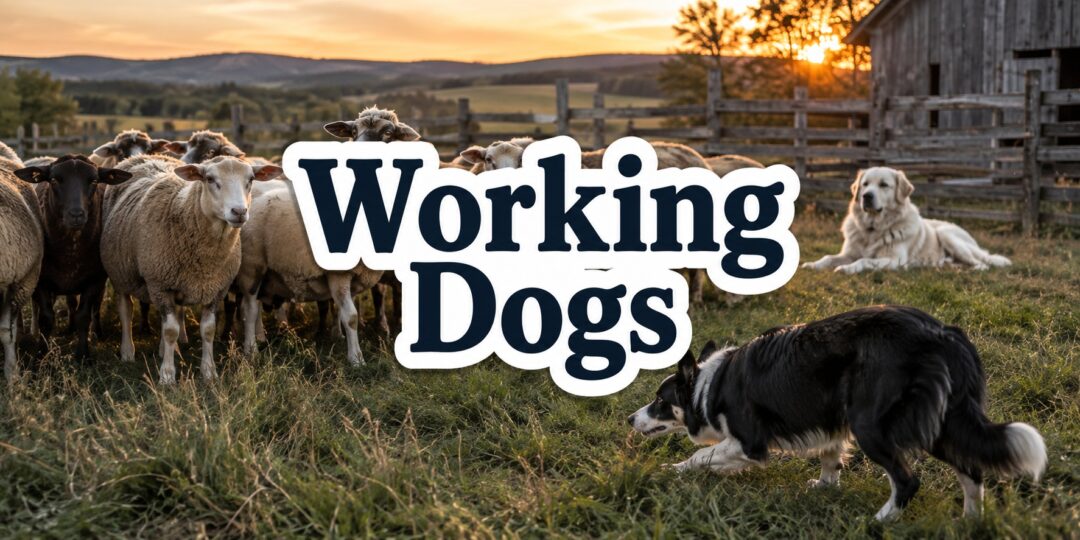
Herding dogs work by exploiting a prey animal’s instinct to flee from a predator’s stare and stalking posture, without ever completing the chase into an actual bite. According to research comparing predatory motor patterns across breeds, herding breeds like the Border Collie are specifically selected for an exaggeration of the orient-eye-stalk-chase portion of the sequence, while livestock guardian breeds like the Anatolian Shepherd are selected for inhibition of the entire sequence.
Headers vs. Heelers
Not all herding dogs work the same way. Headers, like the Border Collie, use intense eye contact and a low, creeping stalk to control a flock from the front, gathering animals toward the handler. Heelers, like the Australian Cattle Dog and Welsh Corgi, work from behind, using nips at the heels and a driving chase to push animals forward, a style suited to cattle that are far less intimidated by a stare than sheep are.
A herding dog left without livestock to work does not stop wanting to complete this sequence. Many end up herding children, cars, bicycles, or other pets in the household, which is one of the most common reasons herding breeds struggle as purely companion animals without a job.
Livestock Guardian Dogs
Livestock guardian dogs represent the opposite end of the spectrum: breeds selected over centuries to treat livestock as pack members rather than prey. According to the same comparative research, livestock-guarding breeds only weakly express predatory motor patterns at all, and a good guardian dog does not chase, stalk, or attempt to play with the animals in its care.
This is a fundamentally passive, presence-based role rather than an active one. The dog’s job is to live among the flock, bond with it from a young age, and confront or deter predators through sheer presence and vocal warning rather than aggressive pursuit. For a full breakdown of breeds, bonding, and training specific to this role, our dedicated guide to livestock guardian dogs covers it in depth.
Hunting and Gundogs
Hunting roles split the predatory sequence into far more specialized fragments than herding or guarding does, since different hunting tasks require different pieces of the chain.
- Pointers and setters: Freeze at the eye and stalk phase, holding a rigid point toward game rather than continuing into a chase, which lets a hunter approach and flush the bird themselves
- Retrievers: Amplify chase and a soft grab-bite while the kill-bite is almost entirely inhibited, allowing them to carry downed game back to the handler without damaging it
- Scent hounds: Specialize heavily in the orient phase, using scent tracking rather than sight to follow a trail over long distances, often with far less interest in the chase or catch itself
- Sighthounds: Specialize almost entirely in an explosive chase, built for a short, fast pursuit of visible prey across open ground
On a working homestead, this category is less commonly needed than herding or guardian roles unless active hunting, pest population control on a larger scale, or specific game management is part of the operation.
Terriers and Vermin Control
Terriers sit at the far end of the sequence from guardian dogs, bred specifically to amplify the grab-bite and kill-bite phases that guardian breeds have almost entirely suppressed. Their historical job was going after rats, moles, and other burrowing pests, either flushing them out or dispatching them directly. According to the AKC, terrier ancestors were bred specifically to hunt and kill vermin, and that instinct remains close to the surface in most terrier breeds today.
For a working homestead dealing with rats in a feed room, moles tearing up pasture, or other small pest pressure, a terrier fills a role no herding or guardian dog is built for. The tradeoff is a dog with genuinely high prey drive and a low tolerance for small animals it has not been specifically raised around, including household cats or poultry.
Multi-Purpose Farm Dogs
Not every working dog fits neatly into one category, and several traditional farm breeds were deliberately developed to blend pieces of multiple roles rather than specialize in one. These dogs might assist loosely with moving stock, alert to predators or strangers without functioning as a true livestock guardian, and handle some vermin control on the side. They tend to be a practical fit for smaller, diversified homesteads that do not have enough of any single job to justify a highly specialized dog, though they generally will not match a specialist’s performance at any one task.
How to Figure Out Which Working Role You Actually Need
- Do you need animals moved from place to place regularly? That points toward a herding dog, understanding that it needs an actual job to stay well-adjusted
- Do you need a constant, passive predator deterrent for a flock or herd? That points toward a livestock guardian dog, understanding that these dogs bond slowly and require patience during the first year
- Do you have a specific pest problem with rats, moles, or other small vermin? That points toward a terrier, understanding that the same drive that makes it effective also makes it a genuine risk around small pets
- Do you hunt or need game retrieved rather than simply killed? That points toward a gundog matched to the specific hunting style you practice
- Do you have a smaller, varied operation without enough of any one task to justify specialization? A multi-purpose farm breed may be the more practical fit
For breed-by-breed recommendations once you have identified the right category, our guide to the best dog breeds for homesteaders covers specific breeds suited to each of these roles in more detail.
Common Mistakes When Choosing a Working Dog
- Getting a herding breed as a purely companion animal with no outlet for its instincts, then being surprised when it herds children or chases cars
- Expecting a livestock guardian dog to actively confront and fight predators the way a herding or hunting breed might, rather than understanding its role is deterrence through presence
- Bringing a terrier into a home with small pets it was never properly introduced to as a puppy
- Assuming any large farm dog will naturally guard livestock without the early bonding period that livestock guardian breeds specifically require
- Choosing a breed based on appearance or size rather than the actual behavioral role it was bred to perform
A Working Homestead Needs More Than the Right Dog – It Needs the Right Skills
Choosing a working dog is really about understanding a problem and matching the right tool to the job. A herding dog moves livestock, a guardian protects the flock, a terrier tackles vermin, and a multi-purpose farm dog can handle several lighter duties around a diversified homestead.
But a capable dog is only one part of building a truly self-reliant property.
Previous generations also knew how to raise animals, grow and preserve food, repair what broke, build what they needed, make useful household supplies, and solve problems with whatever resources were available. Those practical abilities meant that when something went wrong, their first instinct wasn’t always to buy a replacement or call someone else.
That is the philosophy behind The Lost Skills of Independence.
This practical resource is about rediscovering the everyday skills that helped households and homesteads function long before modern convenience made so much of that knowledge seem unnecessary.
Because real independence isn’t about trying to do absolutely everything alone. It’s about having more options.
When you know how to produce, preserve, build, repair, improvise, and care for the things your household depends on, a broken supply chain, power outage, unexpected expense, or trip to an empty store becomes much easier to handle.
And just as choosing a working dog based purely on appearance instead of its actual purpose is a mistake, building a homestead around equipment without developing the skills to use and maintain it can leave you far less prepared than you think.
The Lost Skills of Independence can help you take the next step from simply owning a few homesteading tools and animals to developing the practical knowledge that makes genuine self-reliance possible.
Frequently Asked Questions
Can one dog perform multiple working roles well?
Rarely at a specialist level. A dog bred to suppress its predatory sequence for guardian work generally will not also excel at the chase-driven work of herding, and vice versa. Multi-purpose farm breeds can competently handle several light-duty roles, but usually will not match a specialist in any single one.
Do working dog instincts show up even without training?
Yes, largely. These behaviors are substantially instinctive rather than purely learned, which is exactly why herding breeds without livestock to work often redirect that instinct toward children, joggers, or other pets, and why terriers without supervised introduction can treat small household animals as prey.
Is a livestock guardian dog effective from day one?
No. Bonding to a flock and developing reliable guardian behavior typically takes many months to over a year, and puppies raised for this role usually need close supervision during that period rather than being left unsupervised with livestock immediately.
What is the biggest difference between a herding dog and a livestock guardian dog?
Herding dogs actively move livestock using an amplified version of predatory stalking and chasing behavior. Livestock guardian dogs do the opposite, suppressing those same instincts almost entirely and instead living passively among the animals they protect.
You may also like:
 Livestock Guardian Dogs: The Silent Protectors Every Homestead Needs
How To Hide Your Valuables and Stockpile In Plain Sight When SHTF (Video)
The Best Guardian Animals for Your Homestead (Besides Dogs)
Security Dogs You Should Never Have On Your Property
12 Ways To Mouse-Proof Your Homestead
Weed Killer Safe for Pets – The Complete Guide to Pet-Friendly Weed Control
Join Our Homesteading Facebook Group For Daily Tips And Tricks!