
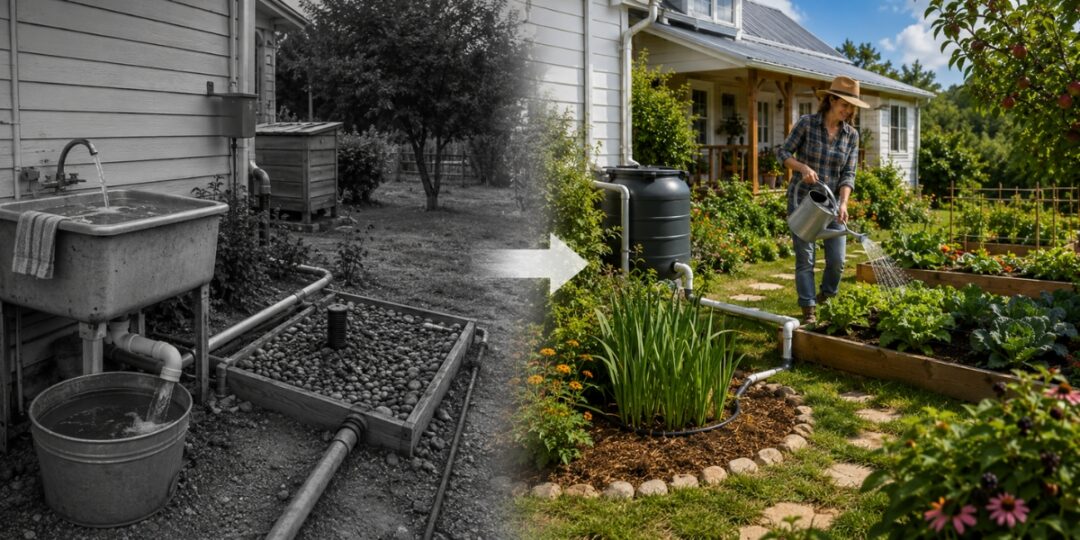
You already know graywater is worth saving. And you’ve seen the same short list a hundred times. Water the flower beds. Run the washer out to the lawn. You’ve probably poured a dishpan on the flowers yourself.
That’s all fine, and I do some of it too. But you didn’t start homesteading to keep flowers happy. You want the water you already paid to do some real work, the kind that saves money or covers you in a dry spell.
So this isn’t that list. These are five uses that fit the homesteading life, and a couple caught me off guard the first time I heard about them. The best part? None are complicated.
Here are some of the best graywater projects for homestaders and I also prepared a nice DIY project with full instructions for you.
What Counts as Graywater
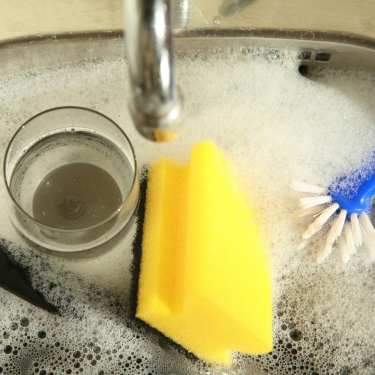
Graywater is the water that drains from your showers, your bathroom sinks, and your washing machine. It indeed has a little use, but it isn’t sewage.
Toilet water is blackwater, and it stays out of everything here. Kitchen sink water sits in its own gray area, because the grease and food bits turn rancid fast, so I keep mine out of the simple systems too.
Here’s the one rule that matters most. Whatever you wash with ends up in your soil, so the soap matters more than you’d think.
Steer clear of anything with these in it:
- Sodium and other salts – They break down soil structure and turn it alkaline, and salt-sensitive plants can’t take it.
- Boron and borax – Toxic to a lot of plants, even in small amounts.
- Bleach and fabric softeners – Hard on the tiny soil life that keeps everything healthy.
Go with a liquid, low-sodium detergent, or plain castile soap. And don’t let graywater sit more than a day, or the bacteria multiply and it starts to stink. Use it fresh and you’ll never have that problem.
One soap I like using on my homestead is this homemade honey-and-oat soap. This is the perfect mix between soothing and practical everyday use. And one bonus of it is that it is an amazing choice for anyone struggling with eczema and skin rashes.
If you want to start making this soap at home, you can find the full step-by-step recipe here.
Also, this is a safe soap if you want to reuse gray water. Nothing in it is toxic, and this is what makes it so high-quality. 100% organic soap.
Use Graywater to Heat Your Shower Water
Since I want to show you some of the most interesting uses for graywater, let’s start with one that has nothing to do with your garden.
Think about your shower. You pay good money to heat that water, you stand in it a few minutes, and then it runs down the drain still warm. All that heat, gone. The Department of Energy figures that 80% to 90%of the energy you spend heating water goes straight down the drain with it.
There’s a simple gadget that grabs some of it back, called a drain-water heat recovery unit, and the idea is easier than the name. It’s a copper drainpipe with a second copper tube coiled tight around the outside. Your warm drain water slides down the inside, your cold incoming water runs up the outside, and the heat passes from one to the other through the copper. It’s the same reason your cold hands warm up around a hot mug.
A good unit claws back up to about 60 percent of the heat you’d have lost, so your water heater does far less work, and that trims a fifth to a third off your water heating bill.
When Mark and I were redoing a bathroom, we looked into one. They aren’t cheap up front, but there’s nothing to maintain, and the double copper wall keeps your drinking water and drain water apart, so it passes code. Worth a look if you’re remodeling anyway.
But if you want a constant off-grid source of heated water, I got you. This solar water heater system is very easy to build and is 50% made out of plastic bottles.
If you have many plastic bottles on your property and you are not sure what to do with them, put those plastic bottles to work and turn them into a water heater.
You can find more about this project, from instructions to blueprints and practical illustrations here.
Keep a Green Firebreak Alive in a Dry Year
If you live somewhere the summers are dry and you are concerned about fires, this graywater solution could save more than money.
You might already be keeping the ground around your buildings clear of anything that’ll carry a flame. But clearing isn’t your only tool. A band of well-watered, high-moisture plants works as a green firebreak, because living green growth is a lot harder to light than dry grass.
The trouble is water. Keeping that belt lush through fire season takes exactly the water you’re trying to hang onto when things get dry.
And that’s where graywater comes in. You run your laundry and shower water out to that buffer and keep it green all summer without touching your well or your rain barrels. The soap water even carries a little nitrogen and phosphorus, so you’re feeding those plants while you water them. Green, watered growth near the house slows a fire down, and graywater is the cheapest way I know to keep it alive through a drought.
Just keep the water in the soil and under mulch, never sprayed on the leaves, and you’ve successfully turned dirty water you were about to let go down the drain into fire protection for your house.
Grow a Willow Patch
A lot of homesteads, mine surely does, have that one soggy corner. Low spot, heavy clay, water just sits there. You can use that nasty corner for this exact project.
You plant a patch of willow and let it drink the graywater for you. Willow is thirsty and grows fast, and here’s the part that surprised me. A willow works like a natural pump. It pulls water up through its roots and lets it out through its leaves as vapor, so a good stand of it uses up just about every drop you send it, nutrients and all.
In parts of Europe, they build these as “zero discharge” beds, meaning nothing runs out the far end.
Then there’s the bonus. You cut the willow rods every year, and those rods could be later used to make stakes and plant supports, for weaving a rough basket or trellis, for a living fence if you shove fresh cuttings into the ground, and the odds and ends dry into quick kindling.
Also, another interesting way to take advantage of a willow tree is to help it indirectly produce fresh water for you.
Since the willow tree is so good at filtering and then transforming the graywater that it drinks into vapors, you can capture those vapors and convert them into liquid, fresh water. For this, all you need to do is install this water collector box in your garden near the willow tree.
This box is a device specially designed for this job. It takes water vapor from the atmosphere and transforms it into liquid water. Its special mechanism does that constantly, which means you can use it as a constant source of water you can have on your property.
Now, using it near plants known to release a lot of water vapor in the air is the optimal way to use it, but you can simply place it in your garden, and it will still work. You’ll just get less water.
If you want to get this device for yourself, you can find it here for a special price.
Use It for Jobs That Don’t Need Clean Water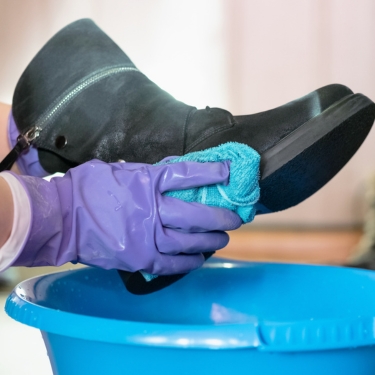
I keep a bucket in the shower to catch the cold water while it warms up. I use that water to clean the mud off my boots, rinse garden tools and the wheelbarrow before they go back in the shed, and Mark, my husband, uses it on the tractor tires and the mower deck.
And a five-gallon bucket of soapy wash water is perfect for scrubbing down the concrete pad in front of the barn, or wetting the gravel drive to hold the dust down before folks come up the lane.
This is water that would have otherwise been wasted and now we found good use for it.
Keep the Compost Pile Working Through a Dry Spell
Your compost pile needs moisture to work. If it’s too dry, everything just sits there instead of breaking down. In the heat of summer, keeping a pile damp can eat up more water than you’d expect.
So instead of dragging the hose over, pour your graywater on it.
A hot, active pile takes graywater with no trouble at all. All that bacteria is already hard at work, and it handles the soap water right along with everything else. The bit of nitrogen even helps the pile cook. You pour it on, turn the pile, and let it work. And I learned an even better way to make compost from here.
One word of caution. Use this on a working pile that still has cooking to do, not on finished compost headed for the salad beds. Let it cure the way it should, and by the time it’s ready, that compost is clean and good to go.
DIY Project: A Laundry Line That Feeds Your Fruit Trees
If you want one project that makes the most out of every wash day, run a laundry-to-landscape line out to your fruit trees. Fruit trees are the perfect target. They drink a lot, their roots sit deep enough that the water never touches the fruit you’ll eat, and one good tree can soak up all the water from a load of laundry.
And here’s what makes it easy. Your washing machine already has a pump built in, so as long as you’re not asking it to climb a hill, you don’t need to add anything to move the water. The flatter and more downhill the run, the better.
Start by installing a three-way diverter valve on the machine’s drain hose, which is the one piece you don’t want to skip. Flip it one way and the water goes to the sewer or septic like always. Flip it the other and it heads out to your trees. That valve keeps you legal, and it allows you to choose what water goes to your garden. For example, if one time you use bleach, you can switch the valve and let that water go in the sewers.
Right after the valve, at the high point of the line, add a small air vent (a plumber calls it an air admittance valve, a couple of dollars). It lets the line drain between loads instead of sitting full and going sour.
From there, run one-inch tubing out toward your trees. Keep it as straight and downhill as you can, and never glue a cap on the open end, because the line has to breathe or it’ll fight the pump. Branch it with tee fittings so the water splits out to a few trees instead of dumping in one spot.
At each tree, dig a mulch basin. That’s just a shallow pit, about a foot deep and a couple feet across, out at the drip line. The drip line is the ring on the ground right under the outer tips of the branches, and that’s where the tree’s feeding roots are.
Fill the pit with coarse wood chips and lay your tubing outlet into it. The chips strain out the lint, the soil underneath does the real cleaning, and the basin should drink itself dry within a day. If water’s still standing after that, run a branch to another basin so it can’t sit and breed mosquitoes. Cover each outlet with a couple inches of mulch or a flat stone so nothing’s left exposed.
Then keep a few habits:
- Use a plant-safe liquid detergent – Low in sodium, no borax, no bleach.
- Send the rough loads to the sewer – Flip the valve back for bleach, dye, or dirty diapers.
- Move the water around – Feed different trees on different days, and give them rainwater now and then, so salt never builds up in one spot.
A single fruit tree can need fifteen gallons or more per day, so a couple of loads a week can carry a fig or a citrus through a dry summer on laundry alone. Do check your local rules first, though. Some states let you put in a washer-only system with no permit, while others want you to pull one before you start.
Final Thoughts
It’s well known that graywater is one of the best water resources on a homestead. The problem is that most people don’t know how to use it properly.
This is what I wanted to do with this article. I wanted to offer you some useful methods to make the most of this water many simply throw away.
If you want to live off-grid, small things like this are what will help you survive. And even if you don’t live off-grid, knowing how to reuse graywater will help you save money.
You may also like: 
These 10 Watering Mistakes Waste 50% of Your Water
How to Make Wild Soap, Step-By-Step (Video)
7 Old-Fashioned Ways to Find Water on Your Land
How to Build a DIY Rainwater Collector
The Only Way to Save Your Garden and Produce Water When It Doesn’t Rain


















Good article, thank you for the tips 🙂
Glad you liked it 😁