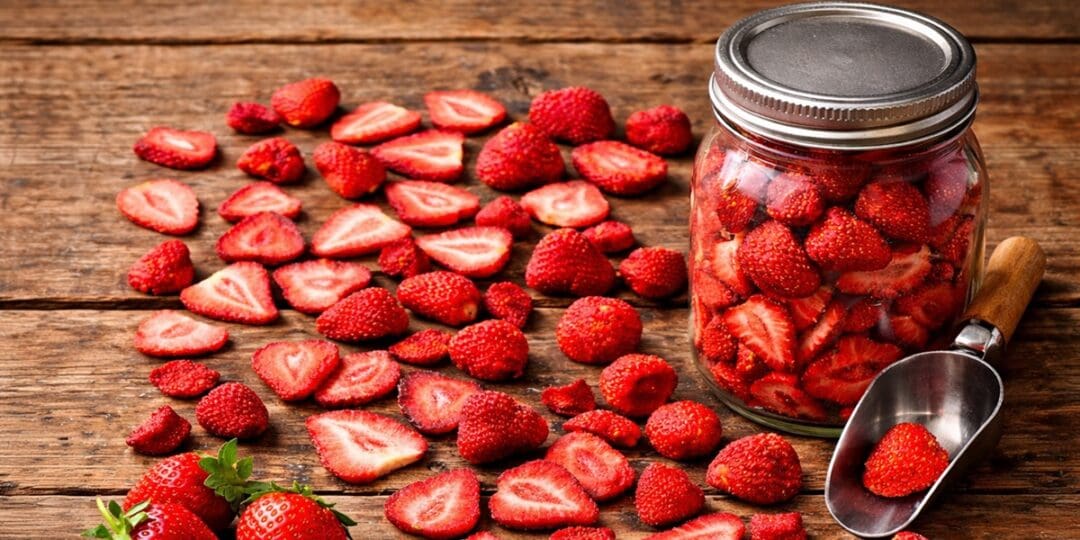
Fresh strawberries are one of the best things about summer. They are also one of the most perishable crops you can grow or buy. A flat of strawberries picked at peak ripeness has maybe three days before it starts going south, and if you are growing your own, you know that the harvest does not come in conveniently. It comes all at once, faster than you can use it.
Freeze drying solves that problem better than any other preservation method. It removes nearly all moisture from the berry without heat, which means the color, flavor, and nutritional content stay intact. The result is a shelf-stable product that lasts up to 25 years in proper storage, reconstitutes into something close to fresh when you need it, and works straight out of the bag as a snack, ingredient, or emergency food supply.
This guide covers all of it: what freeze drying actually does, whether it is worth doing at home versus buying commercially, how to run the process from fresh berry to sealed bag, how long your product will last and under what conditions, and the best ways to put freeze dried strawberries to work in your kitchen. The USDA Agricultural Research Service has documented freeze drying as the gold standard for nutrient retention among all common food preservation methods, and the practical results back that up.
What Freeze Drying Actually Does to a Strawberry
Freeze drying, technically called lyophilization, works in two stages. First, the food is frozen solid. Then the chamber pressure is dropped with a vacuum pump and gentle heat is applied to the shelves. At low pressure, the ice inside the frozen strawberry does not melt into liquid. Instead it sublimates, converting directly from solid ice to water vapor, which is pulled out of the chamber and collected on a cold condenser coil.
The process removes 98 to 99 percent of the moisture from the berry while leaving its cellular structure essentially intact. That is why freeze dried strawberries snap cleanly when you break them and dissolve almost instantly on your tongue. The cell walls are there; the water that normally fills them is gone.
Conventional dehydrating uses heat to evaporate liquid water, which shrinks and toughens the fruit, degrades heat-sensitive vitamins, and changes color and flavor chemistry. A study in the Journal of Food Science and Technology found that freeze dried strawberries retained significantly higher levels of vitamin C and anthocyanins than heat-dehydrated strawberries. Anthocyanins are the antioxidant compounds responsible for the red color in strawberries and are associated with cardiovascular and anti-inflammatory benefits. If nutritional density matters to your food storage goals, freeze drying is not just better by degree. It is a different category of result.
Should You Buy Freeze Dried Strawberries or Make Your Own?
This is the first practical question, and the honest answer is: it depends entirely on your volume, budget, and goals.
The Case for Buying
Commercially freeze dried strawberries are widely available through brands like Augason Farms, Mountain House, Thrive Life, and bulk suppliers. If you need a modest supply for emergency rotation, occasional baking, or trail food, buying is often the more sensible starting point. You get a known product, known shelf life documentation, and no equipment investment.
The cost runs roughly $20 to $35 per pound for quality commercial freeze dried strawberries, which sounds steep until you account for the water weight removed. One pound of freeze dried strawberries represents approximately 10 to 12 pounds of fresh fruit. On that basis, the economics are more reasonable, though still higher than home production at scale.
- Best for: Small storage goals, no freeze dryer access, infrequent users
- Typical cost: $20 to $35 per pound freeze dried
- Shelf life: 25 years sealed, per most commercial brands
- Downside: Ongoing cost adds up fast at scale; no control over source fruit quality
The Case for Making Your Own
If you are growing strawberries, buying flats at harvest season, or building a serious multi-year food storage system, a home freeze dryer becomes a genuine investment rather than an extravagance. The leading consumer unit is the Harvest Right, available in small, medium, large, and extra-large configurations. Current pricing starts around $2,800 for a small unit and runs to $5,000 or more for large capacity.
The math works when you look at it over time. A medium Harvest Right processes 7 to 10 pounds of fresh strawberries per batch. At current retail prices for fresh strawberries of $2 to $4 per pound in season, you are producing freeze dried strawberries for a fraction of the commercial cost once the machine is paid off. Most homesteaders with a serious food storage operation find the machine pays for itself within two to three years of regular use across all foods, not just strawberries.
Beyond cost, home production gives you control over the source. You know exactly what variety went in, whether it was organic, and when it was processed. The Harvest Right support documentation notes that home units produce results equivalent to commercial operations when operated correctly, with the same 20 to 25 year shelf life achievable under proper storage conditions.
- Best for: High-volume storage goals, homesteaders with their own or local fruit, serious preppers
- Equipment cost: $2,800 to $5,000+ depending on unit size
- Per-batch cost: Primarily electricity and packaging materials after equipment purchase
- Upside: Full control over source, volume, variety, and packaging; lowest long-term cost per pound
What You Need Before You Start
If you are making your own, get these supplies in order before your first batch:
- Home freeze dryer: Harvest Right is the dominant consumer brand; size your unit to your intended batch volume
- Mylar bags: Use 5-mil thickness for food storage; quart and gallon sizes are standard for strawberries
- Oxygen absorbers: 300cc for quart bags, 2000cc for gallon bags; these are non-negotiable for long-term storage
- Impulse heat sealer: Seals mylar bags with a consistent airtight closure; more reliable than a household iron
- Airtight glass mason jars: Good for shorter-term storage or everyday use; pair with a vacuum sealer and jar attachment
- Sharp knife or mandoline slicer: Consistent slice thickness ensures even drying across the batch
- Permanent marker and labels: Date and label every bag before it goes into storage
How to Freeze Dry Strawberries: Step by Step
Step 1: Select and Prep Your Berries
Use ripe, firm strawberries. Overripe or bruised berries will produce inferior results and can introduce off-flavors into the batch. Wash thoroughly under cold running water and dry completely before cutting. Surface moisture adds to cycle time and can cause uneven drying.
Hull and slice to a consistent thickness between one-quarter and three-eighths of an inch. Consistent thickness is the single most important prep factor. Thin and thick pieces drying together means some finish early and others are still wet when you think the batch is done. Whole small strawberries can be freeze dried but expect a cycle of 40 to 48 hours rather than the standard 24 to 36.
Step 2: Load the Trays
Arrange slices in a single layer on the freeze dryer trays. They can sit close together but must not overlap. Overlapping creates moisture traps and leaves you with pieces that are not fully dried in the contact zones. Load all trays to a similar depth so the cycle finishes evenly.
Step 3: Pre-Freeze (Optional but Recommended)
Slide the loaded trays into a standard chest freezer for four to six hours before running the freeze dryer. Pre-freezing skips the initial freeze stage of the machine’s cycle, cutting one to three hours off total run time. Strawberries contain roughly 91 percent water by weight, which means they benefit more from pre-freezing than lower-moisture foods.
Step 4: Run the Cycle
Load trays into the freeze dryer, seal the door, and start the cycle. Do not open the machine mid-cycle. The vacuum environment is what drives sublimation, and breaking it wastes time and can compromise the batch. For strawberry slices, expect 24 to 36 hours on a standard cycle.
Step 5: Test for Complete Dryness
This step is where most beginners make their one costly mistake. Before sealing anything, verify every piece is fully dry. A properly finished freeze dried strawberry slice will snap cleanly when bent, feel completely brittle with no pliable or soft zones, and be noticeably lighter than fresh. If any piece feels leathery or bends without snapping, it has residual moisture. Return the batch for an additional two to four hour drying cycle and test again.
Sealing incompletely dried product is the primary cause of mold in home freeze drying. There is no recovering a batch that was sealed wet.
Step 6: Package Immediately
Freeze dried strawberries are highly hygroscopic, meaning they begin pulling moisture from ambient air almost immediately on exposure. Work quickly. Remove one tray at a time, fill your bags or jars, add oxygen absorbers, and seal before moving to the next tray. Do not leave product sitting open in the room for more than 15 minutes.
For mylar bags: fill, drop in the absorber, press out air, and run the impulse sealer across the top. For mason jars: fill, add an absorber, and vacuum seal with a jar attachment. Label every container with the contents and date before storing.
Shelf Life and Storage: How Long They Actually Last
Properly packaged freeze dried strawberries stored in a cool, dark, stable environment have a documented shelf life of 20 to 25 years. This is not a rough estimate. It is validated by both manufacturer testing and research conducted for military ration programs, which have used freeze drying for long-term food logistics for decades. The Institute of Food Technologists identifies moisture, oxygen, heat, and light as the four primary degradation factors for shelf-stable food. Mylar bags with oxygen absorbers sealed in cool dark storage eliminate all four.
Shelf life by storage method:
- Mylar bags with oxygen absorbers, stored at 55 to 65 degrees Fahrenheit: 20 to 25 years
- Vacuum-sealed mason jars with oxygen absorbers: 2 to 5 years for best quality
- Unsealed zip-lock bags or open containers: 6 to 12 months before noticeable quality loss
- Left open to ambient air: begins absorbing moisture within minutes; usable for days to weeks
Temperature is not a secondary concern. Every 10-degree Fahrenheit reduction in storage temperature roughly doubles the effective shelf life of preserved food. A basement or root cellar at 60 degrees Fahrenheit delivers meaningfully better long-term results than a pantry shelf at 78 degrees, particularly if you are planning storage of a decade or more.
How to Use Freeze Dried Strawberries
As a Snack Straight from the Bag
Freeze dried strawberry slices are one of the better shelf-stable snacks you can keep on hand. The freeze drying process concentrates natural sugars as water is removed, making them noticeably sweeter and more intensely flavored than fresh. They are light, crispy, and satisfying for kids and adults. They travel well in a pack or bug-out bag and require no preparation.
Rehydrated for Cooking
To rehydrate, cover with cool or room temperature water and let sit for 15 to 30 minutes depending on slice thickness. They return to a soft, fruit texture suitable for any cooked application. The result is not identical to fresh, slightly softer cell structure, but they work well in jams, compotes, pie fillings, crumbles, and muffins. For jam making, rehydrated freeze dried strawberries actually perform well because the slight breakdown in texture speeds the cooking process.
Strawberry Powder
Grind freeze dried strawberries in a blender, food processor, or spice grinder and you get a fine, intensely flavored powder that keeps almost indefinitely in a sealed jar. Uses for strawberry powder include flavoring homemade yogurt, ice cream, and whipped cream, adding natural pink color to frostings and cake batters, mixing into oatmeal or overnight oats, and blending into smoothies. It dissolves cleanly without the texture issue you get with adding fresh or frozen fruit to a sauce.
Baking: Muffins, Scones, and Quick Breads
Freeze dried strawberry pieces can go directly into muffin and scone batter without rehydrating. They will absorb moisture from the batter during baking and soften appropriately. This avoids the problem of fresh or frozen strawberries releasing too much liquid and making the interior wet. Use about two-thirds of the volume you would use of fresh strawberries when substituting freeze dried directly into baked goods.
Granola and Trail Mix
Fold whole or crumbled freeze dried strawberries into homemade granola after baking. Adding them pre-bake will result in a mushy texture as the moisture from the oats rehydrates them during the oven cycle. Added after cooling, they keep their crisp texture and provide a concentrated berry flavor against the oats and nuts.
Smoothies and Drinks
Freeze dried strawberries blend smoothly from dry into any liquid. Add them straight to the blender with your other ingredients. They hydrate and blend in seconds. This is particularly convenient for emergency food use when fresh fruit is not available, giving you a nutritionally meaningful fruit component in a drink without requiring refrigeration or fresh supply.
Emergency and Long-Term Food Storage
For homesteaders and preppers building a serious food storage system, freeze dried fruit fills a gap that most storage plans leave open. Calorie-dense staples like grains, legumes, and proteins cover the survival basics, but fruit contributes vitamins, natural sugars, flavor variety, and morale value that matters significantly during an extended disruption. A pantry that includes freeze dried strawberries is a more nutritionally complete and more psychologically livable pantry than one that does not.
Freeze Drying vs. Dehydrating: An Honest Comparison
Dehydrating is a proven, affordable method and it deserves a straight comparison rather than being dismissed. The right choice depends on your goals.
Dehydrated strawberries are chewier, darker, and have a shorter shelf life of 3 to 5 years in sealed mylar under ideal conditions. A quality food dehydrator costs between $60 and $400. The National Center for Home Food Preservation at the University of Georgia, the most authoritative public resource on home food preservation in the United States, provides detailed guidance on both methods and makes clear that both are safe and effective when done correctly.
If your goal is 20-plus year shelf life and maximum nutritional retention, freeze drying is the right tool. If your goal is affordable preservation of this season’s harvest for use over the next few years, a dehydrator is a perfectly good and far cheaper solution. Many homesteaders use both: a dehydrator for herbs, jerky, and shorter-term fruit storage, and a freeze dryer for building long-term emergency food stores.
Frequently Asked Questions
How many fresh strawberries does it take to make one jar of freeze dried?
Strawberries are roughly 91 percent water by weight. One pound of fresh strawberries yields approximately 1.3 to 1.5 ounces of freeze dried product. A quart mason jar holds about 1.5 to 2 ounces of sliced freeze dried strawberries, meaning each jar represents close to 1.5 to 2 pounds of fresh fruit going in. This is why commercial freeze dried strawberries are priced the way they are.
Can you freeze dry strawberries without a machine?
No. True freeze drying requires a controlled vacuum environment that cannot be replicated at home without a freeze dryer. What some sources call freezer-method freeze drying is standard freezer storage, which does not remove moisture and does not produce the same shelf life or texture. If you do not have a freeze dryer, dehydrating is the correct alternative.
Can you freeze dry strawberry jam or puree?
Yes. Puree and jam can both be freeze dried, though the cycle runs longer due to higher density. The result can be used as-is or ground into powder. This is a practical way to preserve a surplus jam batch without relying on canning.
Do freeze dried strawberries need refrigeration?
No. Once sealed properly, they are shelf-stable at room temperature. After opening a sealed container, reseal tightly and use within a few weeks to prevent moisture absorption from ambient air from softening the product.
Final Thoughts
If you’ve ever watched a bumper crop spoil faster than you could preserve it, you already understand the real weakness in most modern food systems: they depend on perfect timing, perfect storage, and constant electricity. Freeze drying strawberries is one powerful solution, but it’s only one piece of a much bigger preparedness strategy.
For generations before refrigeration, before supermarkets, and long before industrial food supply chains, people preserved nutrient-dense foods that could last for years — sometimes decades — without losing their ability to nourish and sustain life. They built pantries that didn’t depend on the grid, the economy, or next week’s delivery truck.
That’s exactly what The Lost SuperFoods reveals.
Inside, you’ll discover dozens of long-lasting survival foods that don’t rely on fragile supply chains or constant refrigeration — foods designed to stay edible for years while still providing real nutritional value. Many of these foods were used by pioneers, explorers, soldiers, and homesteaders who had to rely on shelf-stable nutrition in uncertain conditions.
Think beyond freeze-dried fruit:
- Nutrient-dense foods engineered to last for decades
- Shelf-stable staples that store safely without refrigeration
- Traditional preservation techniques adapted for modern kitchens
- Long-term food solutions designed for real-world disruptions
- Compact, high-calorie foods ideal for emergency storage
- Forgotten recipes that combine longevity with real nutrition
While freeze-dried strawberries provide valuable vitamins and morale-boosting flavor, a truly resilient pantry includes a range of shelf-stable foods that cover calories, fats, proteins, and micronutrients. Variety is what turns survival food into a sustainable way of eating during extended disruptions.
The Lost SuperFoods helps you build a food supply that doesn’t expire when circumstances change.
If your goal is true food independence — the ability to feed yourself and your family no matter what happens to the grid, supply chains, or economy — this resource belongs next to your preservation tools.
👉 Discover the survival foods designed to last when everything else doesn’t.
You may also like: 
DIY Fruit Fly Trap: 7 Homemade Traps That Actually Work (No Chemicals Needed)
How to Make Bark Bread from a Tree that Grows on Almost Every Street in America (Video)
Freeze Dried Cheese: The Complete Guide to Storing Cheese for 25+ Years
Amish Popcorn: What It Is, Why It’s Different, and How to Grow Your Own
Join The Self-Sufficient Projects Facebook Group for useful information for your homestead!