
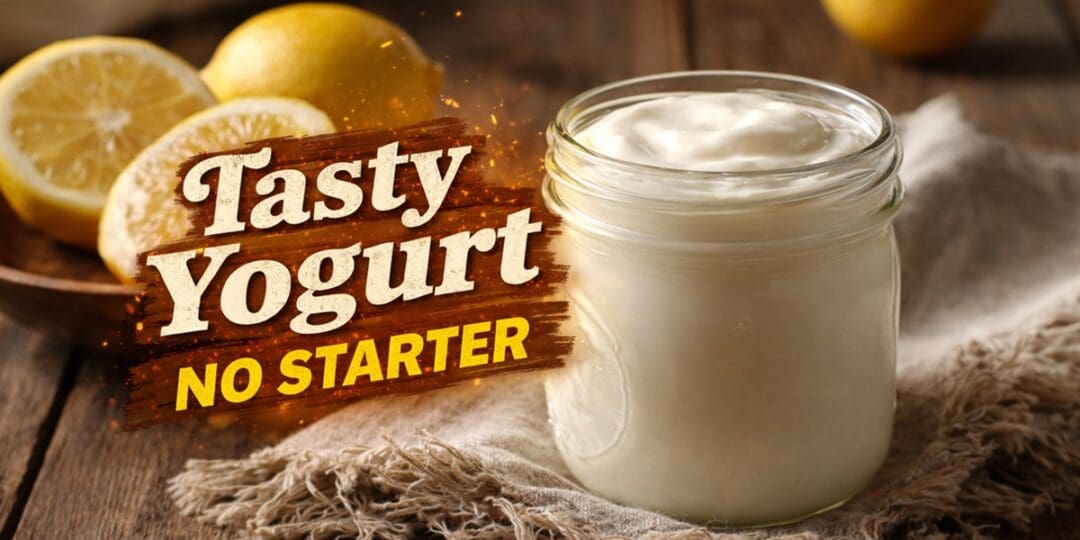
Most yogurt recipes tell you to start with yogurt. That is a circular problem if you are trying to be genuinely self-sufficient, if you live far from a store, or if you simply have a gallon of milk and nothing else. The good news is that yogurt existed long before commercial starter packets did. People have been fermenting dairy for thousands of years using wild cultures, acidic ingredients, and careful temperature control.
This guide covers six practical methods to make yogurt without a commercial starter culture. Some use pantry staples like lemon juice or vinegar to curdle and set the milk. Others rely on the wild bacteria naturally present in raw milk. One takes advantage of kefir. Each method is described in full with step-by-step instructions, honest notes on texture and flavor, and the real-world limitations you should know before you start.
Yogurt making is one of the oldest forms of food preservation. The FAO documents fermented milk traditions dating back over 5,000 years across Central Asia and the Middle East, long predating refrigeration or packaged cultures. Understanding how it works gives you genuine food independence.
How Yogurt Actually Forms: The Science in Plain Terms
Yogurt is the product of bacterial fermentation. Specific bacteria, most commonly Lactobacillus bulgaricus and Streptococcus thermophilus, consume the lactose (milk sugar) in warm milk and produce lactic acid as a byproduct. That lactic acid lowers the pH of the milk, causing the milk proteins (primarily casein) to denature and tangle together into the thick gel structure we recognize as yogurt.
Temperature is critical throughout this process. Milk is typically heated to around 180 degrees Fahrenheit first to kill competing bacteria and partially denature the proteins, which helps the yogurt set firmer. It is then cooled to the bacterial sweet spot of 110 to 115 degrees Fahrenheit before cultures are introduced and incubation begins. Too hot and the bacteria die. Too cool and fermentation slows to a crawl or stops.
When you make yogurt without a commercial starter, you are either replacing the bacteria with an acid that mimics their output (dropping the pH mechanically), or you are cultivating wild bacteria already present in the milk. Research published by the National Institutes of Health confirms that the lactic acid bacteria responsible for yogurt fermentation are widespread in raw milk and the natural environment, which is why traditional methods work reliably without commercial inoculation.
Equipment You Will Need
Before choosing your method, make sure you have these basics ready. The equipment is simple and most of it is already in a functional kitchen:
- A heavy-bottomed saucepan (stainless steel or enamel; avoid reactive aluminum)
- An instant-read or probe thermometer. Accurate temperature reading is non-negotiable.
- Glass mason jars with lids for incubation and storage
- A whisk and a ladle
- Cheesecloth for straining, if you want Greek-style thickness
- A cooler, oven with the light on, or insulated bag for incubation
A reliable thermometer is the single most important tool here. The USDA recommends using calibrated thermometers for all home food preparation to avoid unsafe temperature zones. The bacterial danger zone for milk runs from 40 to 140 degrees Fahrenheit. Working cleanly and accurately within these ranges keeps your yogurt safe and consistent.
Choosing the Right Milk
Your milk choice has a significant effect on the final product, especially when working without a commercial starter. Here is what you need to know:
Whole Milk
The best all-around choice. The higher fat content contributes to a creamier texture and a richer flavor. It sets more reliably with both acid and wild fermentation methods.
2% Milk
Works well but produces a thinner result than whole milk. Suitable for all methods. Straining afterward is often necessary for good texture.
Raw Milk
Essential for the wild fermentation method. Raw milk contains the live bacteria that make natural yogurt fermentation possible without any outside inoculation. It also tends to produce a more complex, slightly tangy flavor.
Ultra-Pasteurized (UHT) Milk
Avoid this for yogurt making. The ultra-high-heat treatment used in UHT processing (around 275 degrees Fahrenheit for 2 to 5 seconds) denatures proteins so thoroughly that they do not reset properly during yogurt fermentation. According to Penn State Extension, UHT milk consistently produces poor results in home yogurt making and should be avoided in favor of standard pasteurized or raw milk.
Method 1: Lemon Juice or White Vinegar (Acid-Set Yogurt)
This is the most accessible method and requires nothing beyond milk and an acidic pantry ingredient. It does not produce live probiotic cultures, but it does produce a thick, tangy, versatile dairy product that performs like yogurt in cooking, baking, and eating. Think of it as a yogurt-adjacent product rather than a true fermented yogurt.
Ingredients
- 1 quart (4 cups) whole milk
- 3 to 4 tablespoons fresh lemon juice or plain white vinegar
Instructions
- Heat milk in a heavy-bottomed saucepan over medium heat, stirring frequently to prevent scorching.
- Bring to 180 degrees Fahrenheit, then remove from heat.
- Allow to cool to 110 degrees Fahrenheit.
- Stir in 3 tablespoons of lemon juice or white vinegar.
- Pour into clean mason jars. Do not disturb for 10 minutes.
- Check texture. If not set to your liking, add another tablespoon of acid and wait 5 more minutes.
- Refrigerate once set. The yogurt will firm further as it cools.
Texture note: This method tends to produce a softer set than bacterial fermentation. Straining through cheesecloth for 1 to 2 hours produces a thicker, more spoonable result.
Flavor note: Lemon juice adds a bright citrus tang. White vinegar produces a cleaner, more neutral tartness. Both are acceptable, but the choice affects the final flavor profile. The USDA’s FoodData Central database confirms that lemon juice and vinegar are both food-safe acidulants appropriate for home dairy preparation.
Method 2: Citric Acid Powder
Citric acid is a crystalline powder derived from citrus fruits. It is sold in the canning and brewing sections of most grocery stores and online in bulk. It performs the same acid-set function as lemon juice but with more precision since you are working with a measured quantity rather than a variable liquid.
Ingredients
- 1 quart whole milk
- 1/2 teaspoon citric acid powder dissolved in 1/4 cup cool water
Instructions
- Heat milk to 180 degrees Fahrenheit, then remove from heat.
- Cool to 110 degrees Fahrenheit.
- Stir in the citric acid solution slowly.
- Pour into jars and allow to set undisturbed for 10 to 15 minutes.
- Adjust citric acid up by 1/8 teaspoon on next batch if the set is too soft.
Citric acid is the same ingredient used to make fresh mozzarella at home. It is a reliable, shelf-stable tool for home dairy projects. The National Center for Home Food Preservation at the University of Georgia lists citric acid as an approved acidulant for home food preparation. Stored in a sealed container in a dry pantry, it lasts for years, making it a practical addition to a self-sufficient household’s supplies.
Method 3: Buttermilk as a Starter
Store-bought buttermilk contains live lactic acid bacteria cultures that are closely related to yogurt cultures. While this technically means you are using a purchased product, it is a different product than yogurt starter, is widely available, and produces a genuine live-culture fermented yogurt rather than just an acid-set product.
Ingredients
- 1 quart whole milk
- 1/4 cup plain buttermilk (with live cultures, check the label)
Instructions
- Heat milk to 180 degrees Fahrenheit. Remove from heat.
- Cool to 110 to 115 degrees Fahrenheit.
- Whisk in buttermilk.
- Pour into jars, cover loosely, and incubate at 110 degrees Fahrenheit for 8 to 12 hours.
- Refrigerate without stirring. The set will firm in the refrigerator.
Incubation options: Place jars in an oven with only the light on (oven light alone typically holds 100 to 110 degrees Fahrenheit). Alternatively, use a cooler filled with warm water, a heating pad set to low, or a dehydrator set to 110 degrees.
The live cultures in buttermilk are primarily Lactococcus lactis strains. Research from the Journal of Dairy Science documents that these cultures are effective at acidifying milk and producing a fermented product with measurable probiotic activity, making buttermilk a legitimately functional alternative starter.
Method 4: Kefir as a Starter
Plain, unsweetened kefir contains a broad spectrum of live bacterial and yeast cultures. A small amount stirred into warm milk before incubation will inoculate the milk and produce a tangier, slightly effervescent yogurt with a high probiotic count. If you already make your own kefir at home, this gives you a completely self-contained system.
Ingredients
- 1 quart whole milk
- 2 to 3 tablespoons plain kefir (live cultures)
Instructions
- Heat milk to 180 degrees Fahrenheit, then cool to 110 degrees Fahrenheit.
- Whisk kefir into the cooled milk.
- Pour into jars and incubate at 108 to 112 degrees Fahrenheit for 6 to 10 hours.
- Check at 6 hours. Kefir-started yogurt often sets faster than traditional methods.
- Refrigerate once it reaches your preferred tartness level.
Expect a tangier result than standard yogurt. Kefir cultures are more diverse than typical yogurt cultures and include both bacteria and beneficial yeasts. A review in Nutrients journal found that kefir contains up to 61 strains of bacteria and yeasts depending on origin, and that regular consumption is associated with improved gut microbiome diversity. This makes kefir-started yogurt among the most probiotic-rich options on this list.
Method 5: Wild Fermentation Using Raw Milk
This is the most self-sufficient method on the list. It requires no purchased culture or acid. Instead, it relies on the naturally occurring lactic acid bacteria that live in raw, unpasteurized milk and on dairy equipment surfaces. This is how yogurt was originally made before commercial cultures existed.
Important: This method requires raw milk from a trusted source. Pasteurized milk has had its natural bacteria killed and will not ferment reliably using this method. If you have access to a local dairy farm or keep your own dairy animals, this method closes the loop entirely.
Ingredients
- 1 quart raw whole milk
Instructions
- Pour raw milk into clean mason jars. Do not heat it.
- Cover loosely with cheesecloth or a coffee filter secured with a rubber band.
- Place jars in a warm location: 95 to 110 degrees Fahrenheit is ideal.
- Wait 24 to 48 hours. Warmer temperatures speed fermentation; cooler temperatures slow it.
- Check for thickening and a tangy smell. When the milk has set into a soft curd and smells pleasantly sour, it is ready.
- Consume within 2 weeks.
Raw milk fermentation carries different food safety considerations than pasteurized milk methods. The FDA’s raw milk advisory provides a clear overview of the safety profile of raw dairy. Healthy adults who have access to fresh, clean raw milk from animals they know generally ferment it safely. The lactic acid produced during fermentation is itself a preservative that inhibits pathogen growth. However, those who are immunocompromised, pregnant, elderly, or feeding young children should consult a physician before consuming raw fermented dairy.
Method 6: The Perpetual Yogurt Method (Saving Your Own Culture)
Once you have successfully made yogurt by any method that produces live cultures (buttermilk, kefir, or raw milk methods), you can perpetuate that culture indefinitely by saving a few tablespoons of each batch to start the next. This is how traditional yogurt making was sustained across generations before commercial starters existed.
How to Save and Reuse Your Culture
- When your yogurt batch is finished and set, reserve 2 to 3 tablespoons in a small sealed jar.
- Refrigerate immediately. This reserved yogurt is your next starter.
- Use within 5 days for best results. Older saved cultures weaken and become less reliable.
- For every new batch, use 2 tablespoons saved yogurt per quart of milk. Process as normal.
- If your saved culture is older than 5 days, freeze it in ice cube trays and use one cube per batch.
Culture degradation is a real concern over many generations of re-culturing. Bacterial populations can shift, weaken, or become contaminated over time. The Cornell University Department of Food Science recommends refreshing home cultures every 4 to 6 weeks with a new inoculation source to maintain culture strength and safety. If your yogurt takes longer than usual to set, smells off, or produces an unusual texture, start fresh rather than continuing with a compromised culture.
Side-by-Side Comparison of All Methods
| Method | Difficulty | Pros | Cons / Notes |
| Store-bought plain yogurt | Fastest (simplest) | Reliable, predictable cultures | Requires a store trip; not truly starter-free |
| Raw milk (wild cultures) | Moderate | Truly self-sufficient, unique flavor | Needs access to raw milk; variable results |
| Lemon juice or vinegar | Easy | Uses pantry staples, no culture needed | Thinner texture; mild tang only |
| Buttermilk | Easy | Adds rich flavor, widely available | Still requires a purchased product |
| Citric acid | Easy | Very consistent, measurable | Less probiotic benefit than live cultures |
| Kefir | Easy | High probiotic count, strong tang | Stronger flavor some find too sour |
| Saved yogurt (perpetual) | Requires first batch | Fully self-sustaining long-term | Culture weakens over many generations |
Incubation Without a Yogurt Maker: Practical Options
The methods that involve live bacterial cultures all require maintaining a temperature of 108 to 115 degrees Fahrenheit for 6 to 12 hours. This is easy to achieve without any specialized equipment:
Oven with Light On
Most ovens hold 95 to 115 degrees Fahrenheit when the oven light is the only heat source with the door closed. Check yours with a thermometer before relying on it. This is the most hands-off method and works overnight without attention.
Insulated Cooler with Warm Water
Fill a cooler with water heated to 115 degrees Fahrenheit. Place your yogurt jars inside and close the lid. The cooler holds temperature for 4 to 6 hours. Replace water if incubation will run longer.
Instant Pot or Slow Cooker
Most Instant Pot models have a Yogurt setting that maintains ideal temperature automatically. Some slow cookers on their lowest setting hover in the correct range, though this varies by model. Always verify with a thermometer.
Dehydrator
A food dehydrator set to 110 degrees Fahrenheit is one of the most precise incubation tools available for home use. Place jars directly on the dehydrator trays with the lid set loosely on top.
Regardless of method, avoid disturbing your yogurt during incubation. Movement breaks the protein matrix as it is forming and results in a grainy, watery texture. University of Wisconsin-Madison’s Center for Dairy Research notes that consistent temperature and minimal agitation during incubation are the two most critical factors in producing a smooth, firm set.
Troubleshooting Common Problems
Yogurt is too runny
Most common cause is temperature dropping too low during incubation, or incubation time being cut short. Try extending incubation by 2 hours. Straining through cheesecloth always resolves texture issues regardless of cause.
Yogurt tastes too sour
Incubation ran too long or temperature was too high. Taste your yogurt at 6 hours if using live cultures. Once it reaches your preferred tartness, move it to the refrigerator immediately. Fermentation slows dramatically in cold temperatures.
Yogurt did not set at all
If using an acid method, the milk temperature may have been too high when acid was added (killing acid activity) or too low (failing to denature proteins). If using a live culture method, the milk may have been too hot when cultures were added, killing them. Always verify temperatures with a thermometer.
Yellowish liquid pooling on top
This is whey, a normal byproduct of yogurt fermentation. It is not a sign of spoilage. Stir it back in for a thinner yogurt, or pour it off and use it in smoothies, bread baking, or as a protein-rich cooking liquid.
If your yogurt smells unpleasant (not tangy, but actively foul), has an unusual color, or shows visible mold, discard it and start over with clean equipment. The FDA’s food safety guidelines for fermented dairy are clear that when in doubt about the safety of a fermented product, it is better to discard than consume. Your batch is inexpensive. Food poisoning is not.
Using Your Homemade Yogurt
Yogurt made without commercial starters performs identically to store-bought in cooking and eating applications:
- Eat it plain with honey and fresh fruit
- Use it as a substitute for sour cream in dips, dressings, and toppings
- Strain it for 8 to 12 hours to make labneh, a soft yogurt cheese that can be seasoned with herbs and olive oil
- Use it in marinades for chicken and lamb (the lactic acid tenderizes meat)
- Substitute it for buttermilk in pancakes, quick breads, and muffins at a 1:1 ratio
- Blend it into smoothies for protein and creaminess
- Use it as a base for tzatziki, raita, or other yogurt-based sauces
If your yogurt came from a live culture method, it retains the probiotic benefit through all cold applications. Cooking with yogurt kills the live cultures but preserves the protein, calcium, and B vitamins. The Harvard T.H. Chan School of Public Health documents that regular yogurt consumption is associated with improved gut health, enhanced immune function, and better bone density outcomes, primarily through the action of live cultures and calcium content.
Frequently Asked Questions
Can you really make yogurt without any starter at all?
Yes, but the definition of ‘starter’ matters. If you mean commercially packaged yogurt starter culture, absolutely. You can use acidic pantry ingredients like lemon juice, vinegar, or citric acid to curdle and set milk into a yogurt-like product. If you want live probiotic cultures without buying a packet, raw milk fermented at warm temperatures will develop wild bacterial cultures naturally. Both approaches produce a tangy, thick, fermented dairy product.
How long does homemade yogurt last without commercial preservatives?
Properly made and refrigerated homemade yogurt lasts 2 to 3 weeks. The acidity of the finished yogurt inhibits the growth of harmful bacteria. Always use clean equipment and store in sealed glass jars. If you see mold, unusual color, or off smells, discard it.
Does the acid-set method produce probiotics?
No. Adding lemon juice or vinegar acidifies the milk mechanically rather than through bacterial fermentation. The result is a thick, tangy product that resembles yogurt in texture and taste but does not contain live probiotic cultures. For probiotic benefit, use methods involving live bacteria: raw milk fermentation, kefir, or a small amount of live-culture yogurt as your starter.
What milk works best for homemade yogurt?
Whole milk produces the thickest, creamiest yogurt. 2% works well but yields a thinner result. Skim milk produces a very thin yogurt that often needs straining. Raw milk from grass-fed cows is ideal for wild fermentation methods. Ultra-pasteurized (UHT) milk is the worst option as the high-heat processing denatures proteins and inhibits fermentation. Always check the label.
Why is my yogurt runny?
The most common causes are milk that was too cool during incubation, incubation time cut short, or ultra-pasteurized milk that does not set well. If texture is consistently thin, try straining through cheesecloth to make a thicker Greek-style yogurt, or add 2 to 3 tablespoons of dry milk powder to the milk before heating to increase protein content.
Can I use plant-based milk to make yogurt without a starter?
The acid-set method works with full-fat coconut milk. Oat milk and almond milk have too little protein to set properly with acid alone and need additional thickeners like agar-agar. For the raw milk fermentation method, animal milk is required as the wild bacteria rely on specific milk proteins and sugars.
How do I make my yogurt thicker?
Strain it. Line a colander with cheesecloth, pour in your finished yogurt, and let it drain in the refrigerator for 2 to 4 hours for Greek-style thickness, or 8 to 12 hours for labneh, a soft yogurt cheese. You can also add dry milk powder before heating, or use a higher fat milk.
Final Thoughts
Making yogurt without a commercial starter is a practical, achievable skill with a long history behind it. The acid-set methods using lemon juice, vinegar, or citric acid give you a reliable, shelf-stable toolkit that works any time. The live culture methods using buttermilk, kefir, or raw milk give you genuine fermented dairy with real probiotic benefit. The perpetual culture method closes the loop entirely, building a sustainable system from a single successful batch.
The honest trade-off is consistency. Commercial starters are optimized for uniformity. These methods are slightly more variable, especially as you learn to manage temperatures and timing in your specific kitchen. The first few batches are a calibration exercise. Once you have your process dialed in, homemade yogurt becomes faster and cheaper than a store run.
Start with the lemon juice method if you want a same-day result and a low-stakes learning experience. Move to the buttermilk or kefir method when you want live cultures and genuine fermentation. Build toward the perpetual culture system once you are confident in your process. Real food independence is built one batch at a time.
Rediscover the Lost Kitchen Skills That Made Families Self-Sufficient
If the idea of making yogurt without a commercial starter caught your attention, you are already touching on something much bigger than just one recipe.
For generations, families did not depend on store-bought packets, specialized equipment, or modern conveniences to produce the foods they ate every day. They relied on knowledge passed down through experience — simple, practical techniques that turned basic ingredients like milk, flour, and garden vegetables into nourishing meals.
Those traditional skills are exactly what The Amish Ways Book helps bring back.
The Amish are widely known for their ability to live simply, independently, and sustainably. While modern households often rely on packaged foods and complicated gadgets, Amish kitchens still revolve around time-tested methods that work with minimal resources.
Inside The Amish Ways Book, you’ll discover dozens of traditional techniques that make everyday food preparation simpler, healthier, and far more self-reliant.
You’ll learn things like:
- How to make staple foods from scratch using simple ingredients
- Traditional ways to preserve food without modern processing
- Time-tested kitchen methods that reduce reliance on grocery stores
- Old-world fermentation, baking, and dairy skills like the yogurt methods you just learned
- Practical recipes and techniques designed for real homesteads and rural kitchens
These are not trendy “food blog” recipes. They are generational skills developed by communities that have lived independently for centuries.
And the truth is, those skills are becoming more valuable again.
When supply chains become unpredictable, food prices rise, or store shelves run thin, households that understand traditional food preparation always have an advantage. They know how to transform basic ingredients into nourishing food without needing specialized products.
The same mindset that allows someone to make yogurt without a commercial starter is the same mindset that allows a household to:
- Bake bread without relying on store yeast
- Preserve harvests for winter
- Turn raw ingredients into complete meals
- Reduce dependence on modern food systems
That is the philosophy behind The Amish Ways Book.
It is about rebuilding the kind of practical knowledge that once existed in nearly every home kitchen.
If you enjoyed learning how yogurt can be made using simple ingredients and traditional fermentation techniques, you will likely find The Amish Ways Book packed with skills that take that same self-sufficient mindset even further.
👉 Discover The Amish Ways Book here
Many readers say it feels like opening a window into a simpler, more capable way of living — where the kitchen becomes one of the most powerful tools for independence.
Because real food independence does not start at the grocery store.
It starts with knowledge.
You may also like:
 Join Our Facebook Group For Daily Homesteading Tips And Tricks
The Plant Doctors Are Begging People To Grow (Video)
What Happens if You “Water” Your Garden With Spoiled Milk
How to Start a Reliable Off-Grid Sourdough Culture Using Only Flour & Water
20 Foods You Can Preserve in Pantyhose





















COMMENT