Every July, my kitchen turns into a sauna. Between canning tomatoes, simmering beans, and roasting whatever the garden throws at me, the stove runs for hours and the house never cools down.
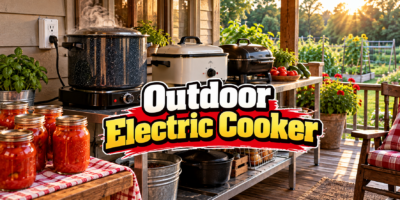
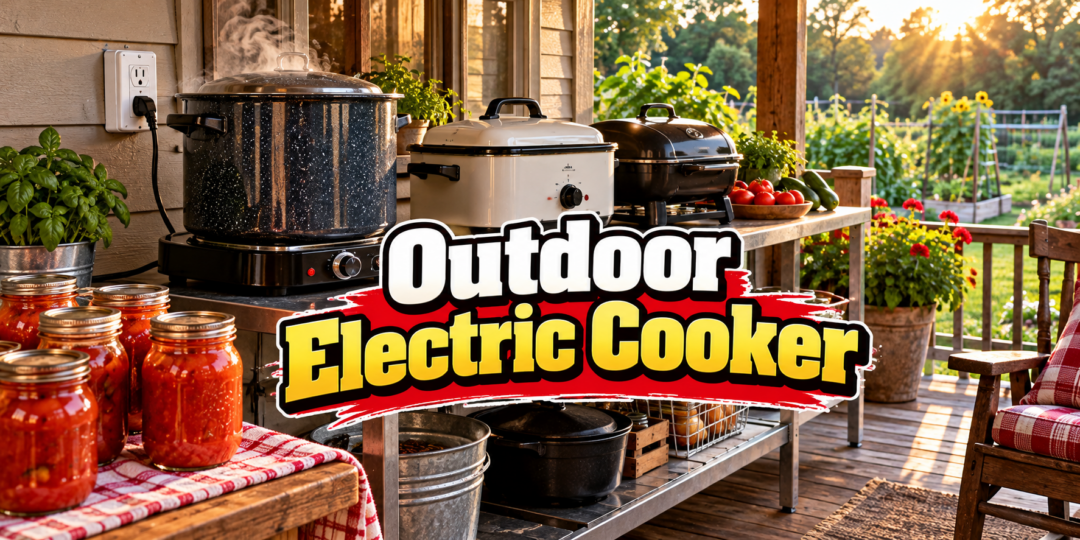
A few summers ago I finally did what our great-grandparents did and moved the hot work outside. The difference is that instead of a wood-fired summer kitchen, I set up an outdoor electric cooker station under the porch roof.
If you’re tired of heating up your house, can’t use a gas grill where you live, or just want a dedicated spot for messy, long-cooking projects, here’s everything I’ve learned about choosing, powering, and safely using an outdoor electric cooker.
What Counts as an Outdoor Electric Cooker?
There’s no single appliance called an outdoor electric cooker. It’s really a category that covers any plug-in cooking appliance you use outdoors.
- Electric grills: Countertop or pedestal grills with a heating element under the grate.
- Electric smokers: Insulated cabinets with a heating element and a wood-chip tray for low-and-slow smoking.
- Portable burners: Single or double induction or coil hot plates for pots and pans.
- Countertop workhorses: Roaster ovens, slow cookers, multicookers, and electric skillets.
- Specialty cookers: Electric pizza ovens, griddles, and electric water bath canners.
Most homesteaders end up with two or three of these rather than one do-it-all machine. I lean on a portable burner, a roaster oven, and a small electric grill more than anything else.
Why Cook With Electricity Outside?
It Keeps the Heat Out of Your House
This is the big one for me. Every hour a stove or oven runs indoors in summer is heat your air conditioner, or your family, has to deal with.
Electric cooking is also efficient, especially induction. ENERGY STAR notes that with induction, about 85% of the heating energy goes into what’s in the pot, compared to only about a third with gas, so less heat spills into the space around you.
It’s Often Allowed Where Flames Aren’t
Many apartments, condos, and townhome communities ban charcoal and propane on balconies and patios. Electric cookers are frequently the exception.
For example, the Prince William County, Virginia Fire Marshal prohibits charcoal and gas grills on multi-family balconies but states that electric grills are permitted and exempt from the 15-foot distance rule that applies to flame-fueled grills. Rules vary widely, so always check your local fire code, lease, or HOA before you buy.
No Fuel to Store
There are no propane tanks to refill, no charcoal bags getting damp in the shed, and no lighter fluid. You plug in, cook, and unplug.
Steadier Temperature Control
Electric appliances hold a set temperature well, which matters for things like smoking, slow-roasting, and simmering stock all afternoon. I can set my roaster oven and walk away to weed the garden without babysitting a fire.
Choosing the Right Type of Outdoor Electric Cooker
Electric Grills
Electric grills won’t give you the smoky char of charcoal, but they handle burgers, chicken, vegetables, and fish just fine. Look for one with a lid, an adjustable thermostat, and a removable grease tray that’s easy to clean.
Wattage matters. Most plug-in grills draw around 1,500 to 1,800 watts, which is close to the limit of a standard household circuit, so plan your power accordingly.
Electric Smokers
If you raise your own meat or hunt, an electric smoker is a great tool for jerky, smoked fish, ribs, and sausages. They hold low temperatures steadily for hours, which is exactly what smoking needs.
Choose an insulated model if you’ll smoke in cooler weather, and keep it out of the wind. A cold breeze can make a smoker struggle to stay at temperature.
Portable Induction and Coil Burners
A good portable burner turns any table into a stovetop. Induction burners are fast and efficient, while coil burners work with any pot, including aluminum.
Induction only works with magnetic cookware. ENERGY STAR suggests a simple test: if a refrigerator magnet sticks to the bottom of the pan, it will work on induction, so cast iron and most stainless steel are fine while aluminum and copper usually aren’t.
Roasters, Slow Cookers, and Multicookers
These are the unsung heroes of my outdoor setup. A roaster oven can bake bread, roast a turkey, or hold a big batch of beans, and it uses far less power than heating a full-size oven.
Slow cookers and multicookers are perfect for stews, stock, and pulled meat, and they sip power compared to a grill or burner. On canning days, one runs on the porch with dinner while the burner handles the jars.
Canning Outdoors With an Electric Burner
For many homesteaders, the real reason to cook outside is canning. Water bath canning puts out an enormous amount of heat and steam, and moving it outdoors is a game changer.
Not every burner is up to the job, though. The National Center for Home Food Preservation recommends a burner that’s level and sturdy, no more than 4 inches smaller in diameter than your canner, and with wattage about equal to a large household range burner, which is typically 1,750 watts or higher.
They also note they have not tested pressure canners on portable electric burners, so check your canner manufacturer’s guidance before trying it. A full canner is heavy, and many portable units simply can’t support the weight or deliver enough steady heat.
Induction brings its own limits. Penn State Extension points out that most major pressure canners are aluminum, so induction heating is not suitable for pressure canning unless you have a model specifically built with an induction-compatible base.
Wind is another outdoor factor. Penn State Extension also warns that a breeze can slow the canner coming to a boil and cause pressure or temperature to drop, so set up in a sheltered spot and keep a close eye on your gauge or boil.
Powering Your Outdoor Electric Cooker
Know Your Circuit Limits
A standard 15-amp, 120-volt household circuit can handle roughly 1,800 watts total, and it’s best not to push it to the limit for long periods. That means one high-wattage appliance per circuit is the safe rule of thumb.
If you plug a 1,500-watt burner and a 1,500-watt grill into the same outdoor outlet, you’ll trip the breaker, or worse, overheat the wiring. Spread big appliances across different circuits, or have an electrician add a dedicated outdoor circuit if you’ll be cooking outside regularly.
Use GFCI Protection and Outdoor-Rated Cords
Water and electricity are a dangerous mix, and outdoor cooking means steam, spills, and the occasional rainstorm. The Electrical Safety Foundation International advises that outdoor electrical equipment be plugged into circuits protected by ground fault circuit interrupters, and that portable GFCIs are available if your outlet isn’t protected.
ESFI also recommends using only extension cords marked for outdoor use and matching the cord’s amperage rating to the appliance. For cooking appliances, I avoid extension cords whenever possible and plug directly into a GFCI outlet, because a thin cord feeding a 1,500-watt burner can overheat.
Running a Cooker Off Solar or a Battery Station
If you have a solar setup or a portable power station, you can run some outdoor cookers off-grid, but do the math first. A 1,500-watt burner running for one hour uses about 1.5 kilowatt-hours, which will drain many portable stations quickly.
Lower-wattage appliances are a much better match. A slow cooker drawing around 200 watts for six hours uses roughly the same energy as that burner running for less than an hour, which is why slow cookers and well-insulated cookers pair so well with solar.
If you use a fuel generator instead, run it well away from the house, windows, and the cooking area. Generators produce carbon monoxide and should never be used in a garage, porch, or any enclosed space.
What It Costs to Run
Electric cooking is cheaper than most people expect. To figure out the cost, multiply the appliance’s wattage by the hours you use it, divide by 1,000 to get kilowatt-hours, and multiply by your electric rate.
At a rate of 15 cents per kilowatt-hour, a 1,500-watt burner running for an hour costs about 23 cents. A 200-watt slow cooker running for eight hours uses 1.6 kilowatt-hours, or about 24 cents for a whole day’s simmering.
Check your own bill for your actual rate, since prices vary a lot by region and season. Either way, the cost of a canning session on an electric burner is usually a small price for a house that stays cool.
My Starter Setup
If you’re building an outdoor cooking station from scratch, this is the short list I’d recommend. You can add more as you figure out how you actually like to cook outside.
- A heavy-duty portable burner rated for canning, or an induction burner if your cookware is magnetic
- An electric roaster oven or slow cooker for low-power, all-day cooking
- A sturdy metal table with a level, heat-resistant top
- A GFCI-protected outdoor outlet close to the table
- An instant-read food thermometer
- A fire extinguisher rated for kitchen fires
- Weatherproof covers or a dry indoor shelf for storage
Setting Up a Safe Outdoor Cooking Station
My station lives on a covered section of the porch with a sturdy metal table, a GFCI outlet within reach, and nothing flammable nearby. A roof overhead keeps rain off the appliances, but the sides stay open for airflow.
Even though electric cookers don’t have an open flame, grease fires and hot surfaces are still real hazards. The U.S. Fire Administration recommends moving grills away from siding, decking, and other things that can catch fire, keeping kids and pets at least three feet back, and staying with the grill the entire time it’s cooking.
Set every appliance on a level, heat-resistant surface, not on a plastic table or wooden railing. Keep a fire extinguisher rated for kitchen fires nearby, and never pour water on a grease fire.
Finally, think about cords as tripping hazards. Route them along walls or table legs so nobody catches a foot on a cord attached to a pot of boiling water.
Outdoor Food Safety
Cooking outside doesn’t change the food safety rules, but it does make it easier to forget them. Flies, warm temperatures, and distractions all add risk.
Always use a food thermometer rather than guessing by color. The safe minimum internal temperatures are 165°F for all poultry, 160°F for ground meats, and 145°F for whole cuts of beef and pork with a 3-minute rest.
Keep raw meat on a separate tray and use clean plates and utensils for cooked food. Cover dishes to keep insects off, and get leftovers into the refrigerator within two hours, or within one hour on very hot days.
Weather and Maintenance
Most electric cookers are designed for outdoor use but not for outdoor storage. Rain, dew, and dust can damage controls and heating elements over time.
Unplug every appliance as soon as you’re done, let it cool completely, and then cover it or bring it inside. I keep my burner and roaster on a shelf in the mudroom and carry them out when needed.
Clean grease trays and drip pans after every use, since built-up grease is a fire risk and attracts critters. Before each season, check cords and plugs for cracks or fraying, and replace anything damaged rather than taping it up.
Never cook in the rain with an exposed appliance, and stop cooking if there’s lightning nearby. A covered porch helps, but it doesn’t make an electric appliance waterproof.
What an Outdoor Electric Cooker Can’t Do
As much as I love my outdoor setup, it has one big weakness: it depends on electricity. When the power goes out, so does my summer kitchen, unless I’ve got a solar system or battery backup big enough to run it.
That’s why I keep backup cooking methods that don’t need the grid at all. I cover several of them in my guide to no-electricity cooking techniques, and you can even put together a full meal without gas, electricity, or fire using solar reflector ovens.
A thermal cooker is another great partner for an electric setup, since you only need a short burst of heat to start the meal. I talk about mine in my homestead pantry tour, and a simple DIY solar oven is an easy weekend project that costs next to nothing to run.
What Happens to Your Outdoor Kitchen When the Power Goes Out?
Rediscover the Lost Skills That Don’t Depend on Electricity!
An outdoor electric cooker can make homestead life easier. It keeps your kitchen cool, makes preserving your harvest more convenient, and helps you prepare meals without heating up the entire house.
But there’s one problem that even the best electric cooker can’t solve.
The moment the electricity stops, so does your ability to cook.
And if that outage lasts for days or weeks, suddenly the conveniences you’ve come to depend on become useless.
Our great-grandparents didn’t have electric grills, induction burners, or portable power stations. Yet they managed to cook meals, preserve their harvests, maintain their homes, and provide for their families with tools and knowledge that required little or no electricity.
What did they know that we’ve forgotten?
That’s exactly what The Lost Skills of Independence helps you rediscover.
This collection of traditional knowledge and practical self-reliance skills is designed to help you become less dependent on modern conveniences and more capable of handling everyday challenges and unexpected emergencies.
Imagine knowing how to:
- Cook without relying on electricity: Explore traditional cooking methods and practical alternatives for preparing meals when modern appliances aren’t available.
- Preserve food using time-tested techniques: Rediscover the knowledge behind drying, fermenting, storing, and preserving food so your harvest doesn’t go to waste.
- Make better use of what you already have: Learn practical approaches to repairing, reusing, and maintaining everyday household essentials instead of constantly buying replacements.
- Become more independent from modern utilities: Explore traditional skills that can help you manage basic household needs when electricity and other services are interrupted.
- Build a more resilient homestead: Develop useful skills for growing, preparing, preserving, and managing essential resources.
- Pass forgotten knowledge to the next generation: Reconnect with the practical wisdom that once helped families thrive with fewer resources and less technology.
Here’s something worth thinking about:
You can spend hundreds of dollars building the perfect outdoor electric cooking station. But if you don’t know how to prepare a meal without plugging something into an outlet, you’re still dependent on a system you cannot control.
True independence isn’t about owning more equipment.
It’s about knowing what to do when that equipment stops working.
The skills that helped previous generations get through difficult times haven’t become obsolete. In many ways, they’ve become more valuable than ever.
You don’t have to abandon modern conveniences to benefit from traditional knowledge. You simply need to make sure they’re not your only option.
Because a well-equipped outdoor kitchen is useful when everything works. But knowing how to feed your family when nothing works? That’s real independence.
Final Thoughts
An outdoor electric cooker is one of the simplest upgrades a homestead can make. It keeps your house cooler, makes canning season more bearable, and often works where flame-fueled grills aren’t allowed.
Start with one versatile appliance, like a sturdy portable burner or a roaster oven, and build from there. Plug into a GFCI outlet, respect your circuit limits, keep a safe setup, and pair it with a few no-power backup methods, and you’ll have a summer kitchen that works hard without heating up your home.
You may also like:
 How Long to Cook Corned Beef in a Slow Cooker
What Happens When You Pour Honey Over Jalapenos? (Video)
7 “Must-Have” Kitchen Tools That Are a Waste of Money
How to Cook Chicken Feet: A Homesteader’s Guide From Cleaning to Plate
I Made Bone Broth WRONG for Years! This Method Changed Everything
How to Make Yogurt Without Starter: 6 Methods That Actually Work