Water is one of those resources that feels unlimited right up until something interrupts it.
A power outage can stop a well pump. A broken main can leave a house without municipal water. A drought can empty rain barrels faster than expected. And even when plenty of water reaches the house, hardness, sediment, iron, unpleasant taste, or other water-quality problems can make it less useful than it should be.
For anyone interested in becoming more self-sufficient, the goal should not simply be to install a filter or collect a few barrels of rainwater.
A better goal is to build a household water system with several layers:
- a reliable primary source;
- water-quality testing;
- treatment matched to actual conditions;
- efficient storage;
- backup water for interruptions;
- equipment that can be maintained without unnecessary complexity.
The best setup will look different for every property, but the planning process is surprisingly similar.
Start by Understanding Where Your Water Comes From
Before buying filters, tanks, pumps, or softeners, identify exactly what enters the house.
Most properties rely primarily on one of three sources:
- a public water system;
- a private well;
- a private rainwater or stored-water system.
Some homesteads use more than one.
A well may supply household water while harvested rainwater handles irrigation. A municipal-water home may keep stored emergency water and use rain barrels around the garden.
Each source presents different challenges.
Municipal Water
Public water systems are treated and monitored, which eliminates much of the responsibility that comes with operating a private drinking-water source.
That does not mean every homeowner will like every characteristic of the water.
Depending on the local supply, people may notice:
- hardness;
- chlorine taste or odor;
- sediment;
- scale on fixtures;
- staining;
- other aesthetic concerns.
Before treating municipal water, find out what you are actually trying to change.
The local utility’s water-quality report can be a useful starting point.
Private Wells
A private well provides a level of independence that many homesteaders value, but it also transfers responsibility to the property owner.
Unlike a public water system, a private well is not continuously treated and monitored by a utility.
EPA recommends that private wells be tested regularly and specifically advises annual testing for total coliform bacteria, nitrates, total dissolved solids, and pH, with additional testing based on local conditions.
A well-water strategy should therefore begin with testing rather than assumptions.
Rainwater
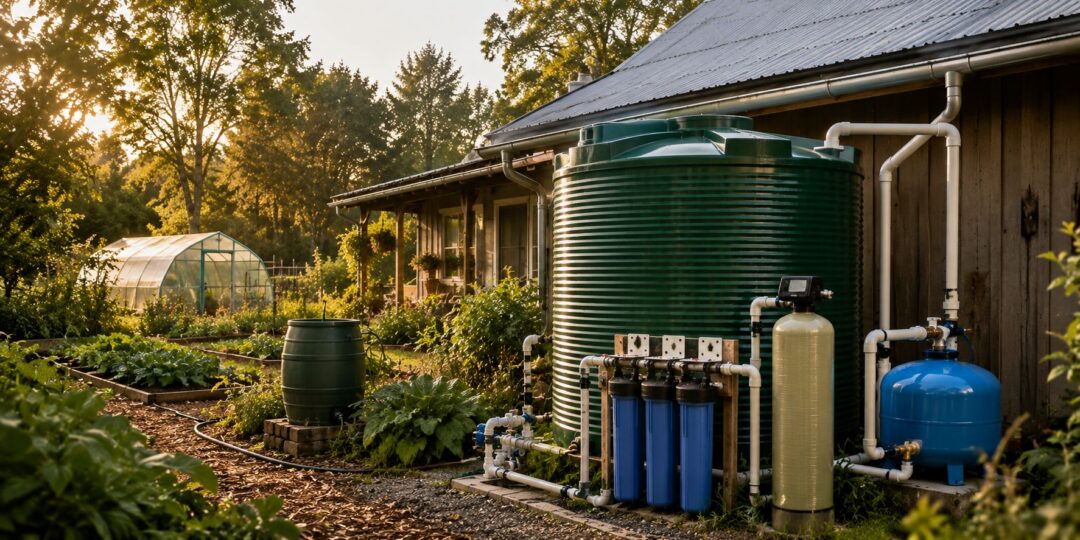
Rainwater harvesting is useful for resilience because it creates a second water source without continuously drawing from a well or public supply.
But collected rainwater should not automatically be treated as drinking water simply because it looks clear.
Water can pick up contaminants from:
- roofing materials;
- gutters;
- airborne particles;
- bird and animal waste;
- storage tanks;
- plumbing components.
The CDC advises that rainwater intended for drinking, cooking, or bathing should be appropriately tested and treated for its intended use.
For many homesteads, rainwater is easiest to use first for applications that do not require potable water.
Test First, Treat Second
This is probably the most important principle in home water treatment.
Do not start with:
What filter should I buy?
Start with:
What is actually in my water?
Different treatment methods solve different problems.
A sediment filter does not perform the same job as a water softener. A softener does not replace disinfection. Activated carbon does not solve every dissolved contaminant. And reverse osmosis is not automatically necessary for every faucet in a house.
Testing prevents homeowners from building an expensive collection of equipment that does not address the real problem.
Match the Treatment to the Problem
Once you understand the water, treatment becomes much easier to plan.
Sediment Filtration
Sediment filters are designed to capture suspended particles.
They may be useful where water contains:
- sand;
- rust particles;
- silt;
- visible debris.
A sediment stage can also protect downstream treatment equipment from unnecessary contamination.
Activated Carbon
Carbon filtration is commonly used to address certain tastes, odors, chlorine, and some organic compounds.
It can be useful in municipal-water homes where the water is safe but the homeowner dislikes its taste or smell.
Carbon filters require replacement, however. A neglected filter should never be treated as permanent infrastructure.
Water Softening
Hard water contains dissolved calcium and magnesium.
The minerals themselves are not the same thing as dirt floating in the water, which is why an ordinary sediment cartridge does not solve hardness.
Hard water can contribute to:
- scale on faucets and showerheads;
- mineral buildup in plumbing fixtures;
- deposits inside water-heating equipment;
- soap-performance problems.
Ion-exchange water softeners are one common method for reducing hardness.
When a home has several water-quality issues at once, it is useful to evaluate whole-home water treatment options as a system rather than choosing individual pieces of equipment independently.
The order of treatment equipment can matter, especially where well water contains a combination of sediment, hardness, iron, or other conditions.
Reverse Osmosis
Reverse osmosis is generally more appropriate for targeted drinking-water treatment than for casually treating every gallon used by the house.
A point-of-use system at the kitchen sink may make more sense than processing water used for showers, toilets, and irrigation.
Treatment should match the required water quality.
Disinfection
Water containing microbial contamination requires a treatment method designed for that problem.
Options may include ultraviolet treatment or other disinfection technologies depending on the situation.
This is an area where water testing and proper system design are especially important.
Do not assume that a generic cartridge filter makes microbiologically unsafe water safe to drink.
Separate Potable and Non-Potable Water Uses
One of the easiest ways to make a property more water-efficient is to stop assuming that every task needs drinking-quality water.
Think about the water used around a homestead.
It may go toward:
- drinking;
- cooking;
- bathing;
- laundry;
- toilet flushing;
- livestock;
- garden irrigation;
- washing tools;
- cleaning equipment;
- emergency storage.
Those uses do not all require identical treatment.
Use Rainwater Where It Makes Sense
Harvested rainwater can be particularly useful for irrigation and other suitable non-potable applications, subject to local rules and safe system design.
This reduces demand on wells and public water supplies.
If rainwater and potable plumbing both exist on the property, keep the systems properly separated. CDC specifically warns against allowing untreated rainwater to contaminate a treated drinking-water system.
Cross-connections are not an area for experimentation.
Build Water Storage Before You Need It
A water source and a water reserve are not the same thing.
A well may contain plenty of groundwater, but without electricity the pump may not deliver it.
Municipal water may normally be dependable, but service interruptions still happen.
Storage provides time to respond.
Start With Household Emergency Water
Keep a reasonable supply of safe drinking water available for interruptions.
Rotate it as appropriate for the storage method being used.
Then think about broader homestead needs.
How much water would you require for:
- livestock;
- essential cleaning;
- limited food preparation;
- garden survival;
- sanitation?
The answer may be much larger than expected.
Use the Right Tanks
Water-storage tanks should be selected for their intended use.
Consider:
- whether the water will be potable;
- tank material;
- UV exposure;
- temperature;
- algae prevention;
- accessibility;
- overflow;
- drainage;
- freeze protection;
- cleaning access.
A large tank that cannot be inspected or cleaned easily can become a maintenance problem.
Think About Pumps as Part of the System
Water independence often depends on electricity.
A private well is a good example.
There may be thousands of gallons of water underground, but the household still loses access if the pump cannot operate.
That makes pump resilience worth considering.
Depending on the property, backup planning might involve:
- generator capacity;
- battery backup;
- solar-compatible pumping;
- gravity-fed storage;
- manually accessible emergency water.
You do not necessarily need all of them.
The objective is to identify the single point of failure in your current setup.
If losing grid power means immediately losing all usable household water, that is the weakness to address.
Do Not Forget Water Pressure
A water system needs adequate pressure as well as adequate supply.
Changes in pressure can affect:
- showers;
- appliances;
- irrigation;
- water heaters;
- filtration equipment;
- livestock watering systems.
Private-well systems commonly rely on pressure tanks and controls to maintain usable household pressure.
Filters and treatment equipment also introduce resistance to flow.
Installing several treatment stages without considering flow rate and pressure drop can create disappointing performance at fixtures.
This is why system planning is more useful than buying equipment one component at a time.
Protect the Water Heater From the Water
The water heater is one of the most water-quality-sensitive appliances in the home.
Hardness and sediment can create maintenance problems over time.
Tank-style heaters may accumulate material at the bottom of the tank, while tankless heaters have relatively narrow heat-exchanger passages where scale can interfere with flow and heat transfer.
If the property has significant hardness, treatment decisions should therefore consider more than how the water feels in the shower.
Water quality can affect the plumbing equipment itself.
Design for Easy Maintenance
Self-sufficiency does not mean installing equipment and forgetting about it.
A resilient system is one you can inspect, service, and understand.
When laying out treatment equipment, leave enough room to:
- replace filter cartridges;
- add salt where applicable;
- clean tanks;
- operate bypass valves;
- inspect pressure gauges;
- reach pumps;
- drain equipment;
- repair plumbing.
Label valves and pipes.
Keep basic information about:
- filter sizes;
- replacement intervals;
- tank capacities;
- pump model numbers;
- water-test results;
- maintenance dates.
This may sound overly organized until something stops working on a Sunday morning.
Include Bypass Valves
A treatment component should not necessarily be capable of shutting down the entire home’s water supply simply because it needs maintenance.
Where appropriate, bypass arrangements allow water to continue flowing while a softener, filter, or other component is serviced.
The same philosophy applies throughout a resilient homestead:
Avoid unnecessary single points of failure.
Keep Spare Consumables on Hand
If your system depends on a proprietary filter cartridge and you do not have a replacement, the nearest supply may suddenly feel very far away.
Useful spare items may include:
- sediment cartridges;
- O-rings;
- filter housings seals;
- appropriate treatment media;
- pump-control components;
- commonly used plumbing fittings.
There is no reason to stock an entire hardware store.
Just identify the small, inexpensive components that could disable an otherwise functional system.
Use Graywater Carefully
Water that has already served one purpose may sometimes be useful for another.
Graywater strategies can reduce total household consumption, particularly in dry climates.
But not all wastewater is graywater, and local requirements vary.
Kitchen wastewater, toilet waste, and water contaminated with hazardous substances require different handling from relatively clean water produced by certain household uses.
Graywater systems should be planned according to local regulations and appropriate health practices rather than improvised simply because the water looks clean.
Build Redundancy Without Building Complexity
There is a temptation in self-sufficient living to add another device for every possible problem.
That can backfire.
Every additional:
- pump;
- valve;
- controller;
- sensor;
- filter;
- tank;
- electrical connection
creates another maintenance point.
The best system is not necessarily the one with the most equipment.
It is the simplest system that can reliably meet the property’s needs.
For many households that may mean:
Primary source → necessary treatment → household plumbing
plus:
Rainwater collection → storage → garden
and:
Emergency potable-water reserve
That is already substantially more resilient than depending on one source with no backup.
A Practical Water-System Checklist
When evaluating your own property, work through these questions.
Water Source
- Where does the household water come from?
- What happens if that source fails?
- Does the system depend on grid electricity?
Water Quality
- When was the water last tested?
- What problems were actually identified?
- Are treatment devices solving confirmed problems?
Treatment
- What does each piece of equipment do?
- Is treatment applied to the entire house when it only needs to serve one fixture?
- Can treatment equipment be bypassed for maintenance?
Storage
- How much potable water is stored?
- How much non-potable backup water is available?
- Are storage tanks accessible for cleaning?
Distribution
- Is water pressure adequate?
- Can filters or undersized piping restrict flow?
- Are potable and non-potable systems safely separated?
Maintenance
- Are replacement filters available?
- Are valves labeled?
- Are maintenance dates recorded?
- Can major components be reached without dismantling the room around them?
Self-Sufficiency Starts With Knowing Your System
A reliable water system does not have to be complicated.
The strongest approach is usually:
- know the source;
- test the water;
- treat only the problems that actually exist;
- store enough water for interruptions;
- create sensible backup options;
- maintain the equipment you depend on.
Rain barrels, wells, filters, softeners, pumps, tanks, and treatment systems are all useful tools.
But none of them creates resilience by itself.
Real water independence comes from understanding how the pieces work together and knowing what you will do when one of them stops working.
A household with a modest but well-planned water system can be far more self-sufficient than one filled with expensive equipment that nobody knows how to maintain.
You may also like: 
Join Our Exclusive Facebook Group HERE!
How to Make Wild Soap, Step-By-Step (Video)
7 Old-Fashioned Ways to Find Water on Your Land
How to Build a DIY Rainwater Collector
The Only Way to Save Your Garden and Produce Water When It Doesn’t Rain
DIY UV Water Sterilizer That Kills Every Pathogen
The Best Time to Water Plants: A Natural Grower’s Guide