10-10-10 is probably the most recognizable bag on the fertilizer shelf, and also one of the most misunderstood. It gets reached for as a default, all-purpose choice for everything from tomatoes to lawns, when in reality it’s the right answer far less often than its popularity suggests.
This guide covers what those three numbers actually mean, when 10-10-10 genuinely earns a spot in your shed, and when a soil test would steer you toward something else entirely.
What Does 10-10-10 Actually Mean?
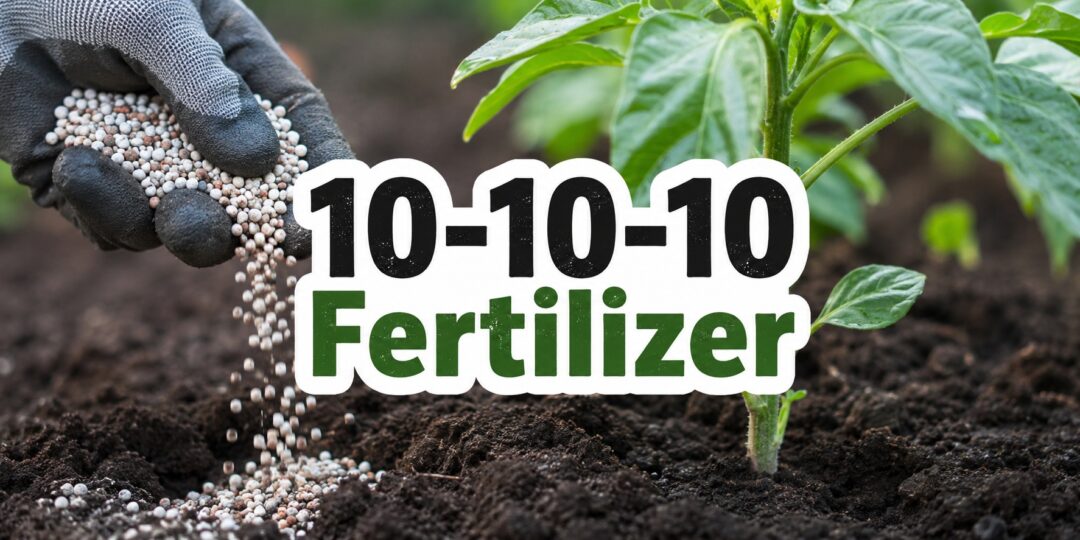
The three numbers are the guaranteed analysis, required by law on every fertilizer label, listing the percentage by weight of nitrogen (N), phosphorus as P2O5, and potassium as K2O, always in that order. According to University of Minnesota Extension, 10 pounds of a 17-18-28 fertilizer contains 1.7 pounds of nitrogen, 1.8 pounds of phosphate, and 2.8 pounds of potash, and the same math applies to 10-10-10: a 50-pound bag contains 5 pounds each of nitrogen, phosphate, and potash.
Because all three numbers are equal, 10-10-10 is classified as a balanced fertilizer, meaning it supplies nitrogen, phosphorus, and potassium in equal proportion rather than emphasizing one nutrient the way a lawn fertilizer (high nitrogen) or a bloom booster (high phosphorus) would.
What’s in the Other 70%?
A 50-pound bag of 10-10-10 contains 15 pounds of active nutrient and 35 pounds of something else. According to New Mexico State University Extension, that remaining weight is a carrier material, such as potassium chloride or potassium sulfate for the potassium portion, which helps distribute the nutrients evenly and makes the product safe and practical to handle and spread.
Is 10-10-10 Organic or Synthetic?
Nearly all 10-10-10 fertilizer on the market is a synthetic, inorganic product, typically built from ingredients like ammonium nitrate, urea, and phosphoric acid. These dissolve and become available to plants quickly, which is part of why 10-10-10 tends to need more frequent reapplication than an organic alternative, since fast availability also means faster loss through leaching or breakdown.
True organic fertilizers rarely land on an exact 10-10-10 ratio, since they’re derived from natural materials like bone meal, blood meal, or fish emulsion, each with its own naturally occurring nutrient balance rather than an engineered one.
When 10-10-10 Makes Sense (and When It Doesn’t)
- New garden beds with unknown soil fertility, where a balanced starting point is a reasonable default before you have soil test data
- General-purpose feeding across a mixed garden with many different plant types, none of which have specialized needs
- Vegetables at transplanting and again at fruit set, which university trial data has linked to real yield improvements in crops like tomatoes
It makes far less sense once you actually know what your soil needs. If a soil test shows your phosphorus or potassium levels are already adequate or high, adding more of either through routine 10-10-10 use accomplishes nothing except wasted money and, as covered further down, a real environmental cost.
Why You Should Soil Test First
UMN Extension is direct about this: if you cannot find a fertilizer with the exact ratio your soil test recommends, choose a product that matches as closely as possible, prioritizing the nitrogen recommendation, and avoid exceeding the phosphorus recommendation specifically because of water quality concerns. Most soils already carry adequate phosphorus and potassium, and nitrogen is usually the nutrient actually in short supply.
A basic soil test costs relatively little and tells you exactly what’s already present in your soil, which is the only reliable way to know whether a balanced fertilizer like 10-10-10 is actually addressing a real deficiency or just adding nutrients your soil didn’t need.
How to Calculate How Much You Need
Fertilizer recommendations from a soil test are usually given as pounds of a specific nutrient per acre or per 1,000 square feet, not pounds of product. Converting between the two takes one extra step.
- Divide your recommended nutrient rate by 43,560 (square feet per acre) to get the rate per square foot
- Multiply that by the square footage of your actual growing area
- Divide the result by the decimal form of the nutrient percentage on your bag (10-10-10 means 0.10) to get the pounds of product needed
For a small garden bed or container, this often works out to just a tablespoon or two, which is why NMSU Extension’s guidance specifically warns that it’s easy to over-apply fertilizer when working in these small volumes.
How to Apply 10-10-10
- Granular: Broadcast evenly over the soil surface and work into the top 2 to 4 inches before planting, or side-dress established plants a few inches from the stem and water it in
- Liquid: Dilute according to label instructions and apply directly to the soil around the root zone, which delivers nutrients faster than granular but requires more frequent reapplication
- Water thoroughly after any granular application. Fertilizer sitting dry on the soil surface isn’t available to plant roots and can scorch foliage or stems it contacts directly
- Apply in the morning or evening rather than the heat of the day to reduce the risk of burning foliage
Best Uses for 10-10-10
- Vegetable gardens with mixed crops and no known specific deficiency
- Establishing new flower beds or lawns where soil fertility hasn’t been tested yet
- Light-feeding perennials and shrubs, such as goji berries, which need only a modest annual boost rather than heavy feeding
- General maintenance feeding through the growing season on soil that tests roughly balanced across all three nutrients
For plants with genuinely specialized needs, root and bulb development benefits more from a higher-phosphorus formula, and heavy nitrogen feeders like leafy greens or lawns generally respond better to a fertilizer weighted toward nitrogen instead.
10-10-10 vs. Other Common Ratios
- 10-10-10: Balanced, general-purpose use across most plant types
- Higher first number (like 21-0-0 or 30-10-10): Nitrogen-heavy, suited to lawns and leafy vegetables that prioritize green growth
- Higher middle number (like 10-20-10): Phosphorus-heavy, better for root development, bulbs, and flowering or fruiting plants
- Higher third number: Potassium-heavy, often used going into fall or winter to build cold hardiness and disease resistance
- Low or zero phosphorus blends: The right choice when a soil test already shows adequate or high phosphorus, avoiding unnecessary buildup
The Environmental Downside Nobody Mentions
This is the part most fertilizer marketing skips entirely. According to the EPA, excess nitrogen and phosphorus that isn’t absorbed by plants can wash into waterways, where it fuels algae blooms that deplete oxygen and harm fish and other aquatic life. Nutrient pollution is described as one of America’s most widespread and costly environmental problems, and routine, untested application of balanced fertilizers is part of what drives it.
This is precisely why applying 10-10-10 without knowing your soil’s actual needs isn’t just wasteful, it can actively contribute to a problem showing up far beyond your own garden fence. Applying only what a soil test recommends, at the right time of year, meaningfully reduces this risk.
Common Mistakes
- Applying 10-10-10 as a default without ever soil testing, adding phosphorus and potassium that may already be abundant
- Over-applying in small containers or raised beds, where it’s easy to misjudge the small quantities actually needed
- Skipping the watering-in step, leaving granules sitting on dry soil where roots can’t access them
- Using 10-10-10 late in the season on fruiting vegetables, when the nitrogen content can push leafy growth at the expense of fruit production
- Applying right before heavy rain, increasing the risk of nutrient runoff before plants have a chance to take it up
Knowing What Your Soil Needs Is a Skill – Not Something a Bag Can Tell You
Walking into a garden center and grabbing a bag of 10-10-10 is easy. Knowing whether your soil actually needs it, how much to apply, and when adding more fertilizer could do more harm than good requires something far more valuable: practical knowledge.
That distinction is at the heart of The Lost Skills of Independence.
For generations, successful households and homesteads depended on people who understood how to grow food, improve their soil, preserve a harvest, raise animals, build and repair useful things, and make the most of the resources already around them. They couldn’t simply buy a product for every problem, and that forced them to develop skills that continued paying dividends year after year.
Today, we’ve gained convenience, but we’ve also become remarkably dependent on stores, products, services, and supply chains for things people once knew how to handle themselves.
The Lost Skills of Independence is about bringing that practical knowledge back.
Instead of merely stockpiling supplies, it helps you develop the kind of hands-on self-reliance that remains useful whether you’re dealing with rising prices, shortages, an extended power outage, or simply trying to make your property more productive and less expensive to run.
Because the most self-sufficient gardener isn’t necessarily the person with the shed full of fertilizer. It’s the person who understands what the soil needs, how to improve it, how to avoid wasting resources, and how to produce more with what they already have.
And that principle extends far beyond the garden.
Every skill you reclaim, growing, preserving, making, repairing, improvising, and providing for yourself, is one less thing your household has to depend entirely on someone else to supply.
Frequently Asked Questions
Can I use 10-10-10 on all my plants?
It’s safe for most plants in moderate amounts, but it isn’t optimized for any particular one. Plants with specific needs, like heavy-nitrogen lawns or phosphorus-hungry bulbs, generally do better with a fertilizer matched to that need.
How often should I apply 10-10-10?
Because it’s a fast-release synthetic fertilizer, it typically needs reapplication every 6 to 8 weeks during the growing season, though always follow the specific product label, since formulations vary.
Is 10-10-10 safe for vegetables I plan to eat?
Yes, when applied according to label directions and worked into the soil rather than left on edible plant surfaces. Wash produce before eating as you normally would.
What happens if I use too much 10-10-10?
Over-application can burn plant roots and foliage due to excess salts, push excessive leafy growth at the expense of flowers or fruit, and contribute to nutrient runoff into nearby waterways.
You may also like:
Amish Survival Hacks that Can Help You Thrive in a Long-Term Blackout (Video)
Seaweed Fertilizer – The Complete Guide to Feeding Your Garden with Ocean Nutrients
Is Rabbit Manure a Good Fertilizer?
Bone Meal Fertilizer: The Secret Soil Booster Hiding in Your Kitchen
Join Our Homesteading Facebook Group For Unique Info You Won’t Get Anywhere Else