A backup generator is exactly the kind of gear an EMP or major solar storm could take out in an instant, and it is also exactly the piece of equipment you would need most in the aftermath. That combination makes generator protection a genuine priority, but building a cage for something this large comes with problems a phone pouch or ammo can never has to deal with.
This guide walks through the parts nobody else covers: how to size a cage around something generator-shaped, why you cannot simply run your generator inside one, and how to actually build a setup that keeps the thing usable when you need it.
Why a Generator Needs Its Own EMP Protection Plan
Backup power sits at the center of most EMP preparedness planning. The Department of Homeland Security’s own EMP protection guidelines list having an EMP-protected backup power source, or a generation source not connected to the grid, as a baseline Level 1 recommendation for anyone serious about resilience. That guidance was written for critical infrastructure operators, but the underlying logic applies just as much to a homestead generator.
Modern inverter generators are the most vulnerable type, since they rely on circuit boards to convert raw engine output into clean, stable power. Older, purely mechanical carbureted generators with simple points-and-coil ignition systems have far less solid-state circuitry to damage, but even they typically include some electronic components today, like digital control panels or electric start modules, that an EMP could still take out.
The Problem Nobody Mentions: You Cannot Run a Shielded Generator
This is the single biggest difference between protecting a generator and protecting a radio or a laptop. A phone can sit in a sealed Faraday bag indefinitely. A running generator cannot, because it needs a continuous supply of intake air for combustion and cooling, and its exhaust has to go somewhere.
Sealing a running generator inside a metal enclosure is not just impractical, it is dangerous. The Consumer Product Safety Commission warns that generator exhaust produces carbon monoxide fast enough to incapacitate or kill within minutes in an enclosed space, and that opening vents or doors is not sufficient ventilation to make it safe. A sealed metal cage is, if anything, worse than a garage in this respect.
This is not a theoretical concern. The CDC’s carbon monoxide guidance is unambiguous that fuel-burning equipment, including generators, should never run in any enclosed or semi-enclosed space, regardless of how much airflow seems to be available.
The practical takeaway: a Faraday cage protects your generator while it is off and in storage, not while it is running. If an EMP event happens, the plan is to remove the generator from its shielded enclosure, inspect it, and then run it outdoors in open air the same way you always would.
Sizing Your Faraday Cage for a Generator
Generators come in a wide range of sizes, and your enclosure needs real clearance on every side, not just enough room to wedge the unit inside.
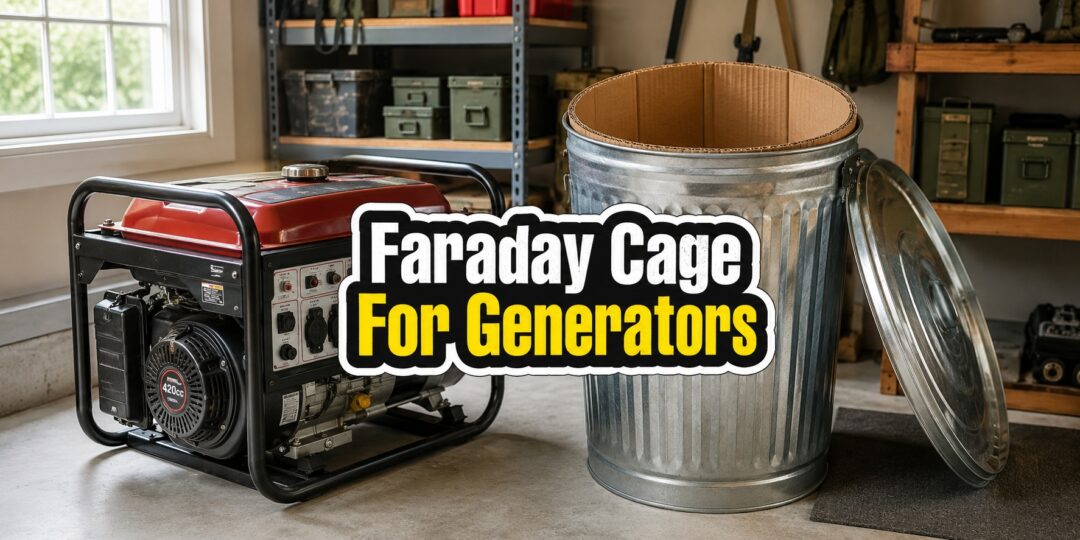
- Small inverter generators (1,000 to 2,200 running watts): Roughly the size of a large cooler. A galvanized steel trash can or a heavy-duty plastic tote lined with metal mesh can work well.
- Mid-size generators (3,000 to 5,000 running watts): Noticeably bigger and heavier. A large steel trunk, a metal storage cabinet, or a purpose-built plywood box lined with copper mesh or aluminum flashing is more realistic.
- Large standby or towable generators (6,000 watts and up): These generally are not practical to cage in a container at all. A small shielded shed or dedicated enclosure is the only workable option at this size.
Whatever size you land on, leave at least two to three inches of clearance between the generator and the shielding material on every side. That gap is where your insulating liner goes, and it is what keeps the generator’s own metal frame from touching the cage wall.
Materials: Trash Can vs. Steel Box vs. Copper Mesh Enclosure
- Galvanized steel trash can: Cheapest and most accessible option for small generators. Needs a tight-fitting lid and a non-conductive liner inside.
- Military surplus ammo cans (for accessories, not the generator itself): Excellent for storing spare spark plugs, a control module, or a small battery charger alongside the generator, since these seal extremely well.
- Welded or bolted steel box: More labor and cost, but it gives you a custom fit with a hinged, gasketed lid, which is worth it for a mid-size generator that does not fit standard containers.
- Copper or aluminum mesh over a wood frame: Lighter weight than solid steel and easier to build around an oddly shaped generator, though the mesh openings need to be small relative to the wavelengths you are trying to block, generally a quarter inch or smaller.
If a full hard-sided cage is not practical for your situation, EMP shielding fabric is a lighter-weight alternative sized for larger items like generators and can be wrapped around the unit and cinched closed, though it will not offer quite the same physical protection as a rigid steel enclosure.
Step-by-Step: Building a Faraday Cage for a Portable Generator
Step 1: Prepare the Generator for Storage
Drain the fuel or add a fuel stabilizer, since gasoline left sitting for months will degrade and can gum up the carburetor. Disconnect the battery if the generator has electric start, and let the engine cool completely before enclosing it.
Step 2: Line the Container With a Non-Conductive Layer
Cardboard, thick cloth, rubber matting, or a wooden liner all work. The goal is simple: nothing metal on the generator should ever touch the metal of the cage, since contact creates a direct path for energy to reach the generator instead of routing around it.
Step 3: Place the Generator Inside
Center the generator so it has clearance from the walls on all sides, including the bottom and the lid. If cables, spare parts, or a small control panel are stored alongside it, make sure none of them touch the container’s metal surface either.
Step 4: Seal Every Seam
A cage is only as good as its weakest gap. Conductive metal tape across the seam where the lid meets the body closes small gaps that would otherwise let energy leak through. For a hinged box, this means taping or gasketing the entire perimeter of the lid, not just the corners.
Step 5: Store in a Stable, Dry Location
A garage floor, a shed, or a basement corner all work, as long as the container will not sit in standing water or extreme heat that could damage the fuel system or the generator’s own internal seals over a long storage period.
Do You Need to Ground the Cage?
For a fully enclosed, sealed container like this, grounding is not required for the shielding itself to work. A sealed metal box blocks external fields by routing the energy around its own conductive surface, whether or not that surface is connected to the earth.
Grounding becomes relevant when cables, antennas, or wires run from outside the enclosure to something inside it, since an ungrounded conductor crossing that boundary becomes a direct path straight through your shielding. A generator in storage, fully disconnected with no cables entering the container, does not have this problem, so skip the anxiety about grounding rods and focus your effort on sealing the seams instead.
What About a Shielded Shed for a Standby Generator?
For a large, permanently installed standby generator, a small dedicated shed lined with copper or galvanized steel mesh is the more realistic long-term option, since these units are far too large and heavy to fit in any container.
The tradeoff is the same ventilation problem, scaled up. A shielded shed still needs an air intake and exhaust path for the generator to run at all, and any opening large enough to pass air is also a potential opening for electromagnetic energy unless it is engineered as a honeycomb vent or waveguide, a level of complexity most homeowners will not attempt. For most self-reliant households, the more realistic approach is to keep the standby unit’s spare electronic control module, ignition components, and any backup inverter separately shielded in a smaller container, accepting that the generator body itself will need to be inspected and possibly repaired after a severe event.
Common Mistakes That Ruin Generator EMP Protection
- Sealing the generator inside the cage while it is running, which risks fatal carbon monoxide buildup
- Skipping the insulating liner, letting the generator’s frame touch the cage wall directly
- Using a container with a loose-fitting lid or large gaps around hinges
- Storing a full tank of untreated gasoline for months, leading to fuel system problems unrelated to EMP but just as likely to leave the generator unusable
- Forgetting spare parts, like a control board or ignition module, that are just as vulnerable as the generator itself and just as easy to shield separately
Your Generator Is Only One Piece of the Survival Puzzle
Protecting your generator from an EMP is a smart move. But if the grid stays down for days, weeks, or even longer, electricity quickly becomes only one of many problems you’ll have to solve.
What happens when you can no longer rely on the grocery store, running water, repair shops, pharmacies, or the countless other services we normally take for granted?
That’s where The Lost Skills Of Independence comes in.
This guide is built around the practical skills our grandparents and great-grandparents depended on before modern convenience made them seem unnecessary. Instead of simply telling you what supplies to stockpile, it focuses on something far more difficult to lose: the knowledge to produce, repair, preserve, improvise, and take care of essential needs yourself.
Inside, you’ll discover practical old-fashioned skills that can help you become more self-reliant, including ways to grow and preserve food, make useful things from basic materials, handle everyday problems without immediately depending on outside services, and put traditional know-how back to work around your home and property.
A Faraday cage might help make sure your generator survives the initial event. The Lost Skills Of Independence is about helping you prepare for everything that comes afterward.
Because eventually the fuel runs out. Batteries die. Replacement parts become difficult to find. Stores may not reopen when you expect them to.
When that happens, the most valuable thing you have may not be another piece of equipment.
It may be knowing how to do things for yourself.
Frequently Asked Questions
Can I keep my generator in its cage and just run it during a real EMP event?
No. The generator has to come out of the shielded container to run safely, both because it needs open airflow for combustion and cooling, and because running it sealed inside risks lethal carbon monoxide buildup.
Do I need a professional-grade Faraday cage, or will a trash can work?
For a small inverter generator, a galvanized steel trash can with a tight lid and a proper non-conductive liner is a legitimate, widely used option. Larger generators need a bigger custom enclosure.
Should I store the generator fully assembled or remove parts first?
Keep it assembled for simplicity, but disconnect the battery if it has electric start, and either drain the fuel or use a stabilizer, since fuel degradation is a bigger practical risk to a stored generator than most EMP scenarios.
Is it worth shielding an older, non-electronic generator?
Even older generators typically have some electronic components today, such as digital control panels, so shielding is still worthwhile, though the risk is generally lower than with a modern inverter generator.
You may also like:
You Probably Won’t Survive An EMP Without This (Video)
Aluminum Foil for Faraday Cage
Faraday Cage Fabric: A Practical Guide for Everyday Preparedness
EMP Proof Vehicles For Homesteaders