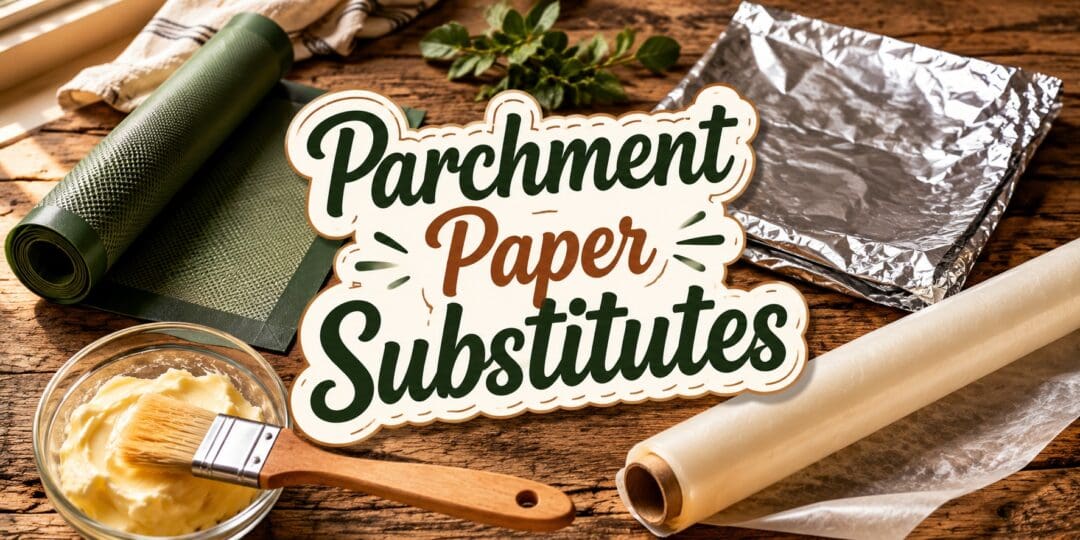
You are halfway through mixing a batch of cookies when you reach into the drawer and find an empty roll. No parchment paper. This happens more often than it should, and the good news is that a reliable parchment paper substitute is almost certainly already in your kitchen or pantry right now.
This guide covers ten practical alternatives to parchment paper, explains exactly when each one works, and gives you the honest truth about the situations where nothing truly replaces it. Whether you are baking, roasting, steaming, or storing food, you will find a workable solution here.
What Parchment Paper Actually Does
Before reaching for a substitute, it helps to understand what parchment paper is doing in the first place. Parchment paper is a cellulose-based paper that has been treated with sulfuric acid or zinc chloride during manufacturing, which creates a non-stick, heat-resistant, moisture-resistant surface. Most standard parchment paper is rated safe to use at temperatures up to 420 to 450 degrees Fahrenheit (215 to 230 degrees Celsius).
In the kitchen, parchment paper does three main jobs:
- Non-stick surface: prevents cookies, roasted vegetables, fish, and other foods from adhering to pans
- Easy cleanup: catches drips, fats, and crumbs so pans stay clean
- Even heat distribution: creates a slight buffer between the food and direct pan heat, which helps with even browning
A substitute needs to replicate at least one of these functions adequately for your specific use case. According to the USDA’s food safety guidelines on cooking surfaces and materials, whatever surface comes into contact with food at high temperatures should be food-grade and heat-rated, which is why not everything makes the cut.
10 Parchment Paper Substitutes That Actually Work
1. Silicone Baking Mat (Best Overall Substitute)
A silicone baking mat is the most direct replacement for parchment paper and outperforms it in several ways. Made from food-grade silicone reinforced with fiberglass, these mats are reusable, non-stick, and rated for temperatures up to 480 degrees Fahrenheit (250 degrees Celsius). They sit flat on your baking sheet and give you a consistent non-stick surface every time.
The main advantage over disposable parchment is durability. A quality silicone mat lasts for hundreds of uses, which makes it a genuinely self-sufficient kitchen investment. The main limitation is size: you need a mat that fits your specific pan, and they cannot be cut to size the way parchment can.
Best for: cookies, roasting vegetables, baking bread rolls, macarons, anything that benefits from even heat and a non-stick surface. Not ideal for steaming packets, funnel shapes, or any application requiring you to fold or mold the liner.
2. Aluminum Foil
Aluminum foil is probably the most universally available substitute. It handles high heat without any issue, wraps and molds easily, and is excellent for roasting and broiling. The key thing to know is that foil is not non-stick on its own. Food will stick to ungreased foil, sometimes stubbornly.
The fix is simple: brush or spray the foil lightly with oil or butter before placing food on it. For anything with a lot of sugar content, like glazed carrots or caramelized onions, even greased foil may stick. In those cases, use a slightly heavier coating or accept that some food will stay behind.
Best for: roasting meat, fish, and vegetables; lining pans for savory dishes; wrapping food for the oven. Avoid using foil with acidic foods like tomatoes or citrus at high heat for extended periods, as the acid can react with aluminum and affect flavor.
3. Greased Baking Pan (No Liner at All)
For many baking tasks, the simplest parchment paper substitute is just a well-greased pan. Butter, shortening, or cooking spray applied generously to the pan surface creates a fat barrier that prevents sticking for most baked goods. Adding a dusting of flour over the butter, the classic butter-and-flour method used for cake pans for generations, provides even better release.
This method works best when the recipe calls for a greased pan anyway. Research on baking surface interactions shows that fat-coated metal surfaces reduce adhesion effectively for most standard batters. It is less reliable for delicate items like meringues, thin cookies, or anything with very low fat content, where sticking is more likely.
Best for: cakes, brownies, quick breads, muffins, savory casseroles, and most standard baked goods. Not ideal for cookies without fat content, sticky glazed items, or anything you need to lift cleanly off a flat sheet.
4. Wax Paper (With Important Limitations)
Wax paper looks almost identical to parchment paper but behaves very differently at heat. It is coated with a thin layer of paraffin wax, which melts at oven temperatures. This means wax paper should never go into a hot oven, as the wax will melt off, smoke, and potentially catch fire at high temperatures.
Where wax paper genuinely shines is in applications that do not involve direct oven heat: lining counters and cutting boards for messy prep work, wrapping foods for refrigerator or freezer storage, layering between baked goods to prevent them from sticking together, and use in the microwave where temperatures stay moderate and there is no direct heating element.
Best for: food prep surfaces, food storage wrapping, layering baked goods in containers, microwave use. Never use in a conventional oven or under the broiler.
5. Greased and Floured Parchment Alternative: The Brown Paper Bag
This is an old homesteader trick that works surprisingly well. Cut a brown paper bag open and flatten it, then grease it generously with butter or oil. The paper handles moderate oven heat reasonably well for baking tasks that do not exceed 375 degrees Fahrenheit (190 degrees Celsius).
The limitations are real: brown paper is not designed for oven use, so you should not push temperatures above medium heat, and you need to watch the oven more carefully than you would with parchment. But for a rural kitchen without a grocery run nearby, it is a practical heritage solution that has worked in kitchens for well over a century.
Best for: moderate-temperature baking as an emergency substitute, lining the bottom of cake pans, roasting at low to medium heat. Do not use for high-heat roasting, broiling, or anything above 375 degrees Fahrenheit.
6. Cooking Spray Directly on the Pan
A high-quality cooking spray applied directly to a baking sheet can substitute for parchment in many everyday baking scenarios. Non-stick cooking sprays coat the metal surface with a thin layer of oil and lecithin, which together significantly reduce sticking. For most cookies, sheet cakes, and roasted vegetables on a flat pan, this works well enough.
The downside is cleanup. Without a liner of any kind, baked-on residue goes directly onto the pan. For dishes with sugary sauces, cheese, or high-fat drippings, expect more scrubbing. A well-seasoned cast iron pan or a quality non-stick pan used with cooking spray can minimize this problem considerably.
Best for: quick baking tasks when you have no other option, non-stick pans, cast iron. Less ideal for anything with heavy caramelization or sticky sauces.
7. Reusable Parchment Paper (Silicone-Coated)
Some products on the market are marketed as reusable parchment paper and are coated with a thin silicone layer on both sides. Unlike standard parchment, these sheets can be washed and reused many times. They behave almost identically to regular parchment paper in the oven and are an excellent self-sufficient kitchen choice for reducing waste without switching entirely to silicone mats.
The performance is very close to disposable parchment, and for homesteaders trying to reduce single-use materials, these are worth keeping in stock. The only real trade-off is cost per sheet on the initial purchase, which is quickly offset by their extended lifespan.
Best for: any task where you would use regular parchment paper. Nearly a direct swap in both performance and handling.
8. Cast Iron or Non-Stick Pan (Tool Swap Instead of Liner)
Sometimes the best parchment paper substitute is not a liner at all but a different pan. A well-seasoned cast iron skillet or a quality non-stick pan eliminates the sticking problem at the source. For cookies, cornbread, eggs, sauteed greens, and most stovetop and oven cooking, a properly maintained non-stick or cast iron surface performs better than any liner over the long run.
Cast iron in particular has proven durability that fits naturally into a self-sufficient kitchen philosophy. Research on cast iron cooking surface properties confirms that a well-seasoned cast iron surface develops genuine non-stick qualities through polymerized oil layers that accumulate with use.
Best for: long-term kitchen setup where you want to reduce dependence on disposable liners entirely. Requires proper seasoning and maintenance for cast iron, and careful cleaning for non-stick cookware.
9. Banana Leaves or Corn Husks (Traditional and Fully Natural)
In many traditional food cultures around the world, large plant leaves have served as both cooking surfaces and food wrappers for thousands of years. Banana leaves are widely used in South and Southeast Asian, Caribbean, and Latin American cooking to wrap foods for steaming, grilling, or baking. Corn husks are the traditional wrapper for tamales. Both are biodegradable, food-safe, and add subtle aromatic qualities to food cooked in them.
For homesteaders with access to these materials, this is as self-sufficient as kitchen substitutions get. Banana leaves need to be briefly passed over an open flame or blanched in hot water to make them pliable before wrapping. They are not suitable for open-pan baking as a flat liner, but for steaming packets and wrapped preparations they are excellent.
Best for: steamed and wrapped foods, grilling packets, traditional preparations. Not suitable as a flat baking sheet liner.
10. Oiled Cheesecloth or Muslin
For steaming applications specifically, a square of lightly oiled cheesecloth or unbleached muslin cloth laid in a steamer basket substitutes well for parchment in that context. It prevents food from falling through the steamer holes while still allowing steam to circulate. It is washable, reusable, and costs very little.
This works for steamed dumplings, vegetables, fish, and other steamed preparations. It has no application for oven baking.
Best for: steamer baskets and steam cooking only. Not for oven use.
Comparison at a Glance
Here is a quick reference for matching your substitute to the task:
- High-heat oven roasting (above 400F): aluminum foil (greased), silicone mat, greased pan
- Cookies and baked goods: silicone mat, greased and floured pan, reusable silicone parchment
- Delicate baked items (macarons, meringues): silicone mat only
- Steaming: cheesecloth, banana leaves, parchment if you have it
- Food prep and counter lining: wax paper, brown paper, foil
- Food storage and freezer wrapping: wax paper, foil
- Microwave: wax paper, paper towels
- Long-term liner-free cooking: cast iron, quality non-stick cookware
When No Substitute Will Do
There are a handful of tasks where parchment paper is genuinely difficult to replace and the substitutes fall noticeably short.
Macarons and meringues are the clearest example. These items have almost no fat and stick tenaciously to any surface with the slightest imperfection. A silicone mat works, but foil and greased pans do not. If you bake these regularly and do not have a silicone mat, parchment is worth keeping in stock specifically for this purpose.
En papillote cooking, where food is enclosed in a folded parchment packet and steamed in its own juices inside the oven, also has no exact equivalent. Foil works as a substitute but changes the cooking character because foil is not breathable the way parchment is, trapping steam differently.
Candy making and caramel work are another area of caution. Molten sugar at high temperatures will stick aggressively to foil and greased pans. A silicone mat is the only reliable parchment substitute for poured candy and caramel work.
Tips for Getting the Most Out of Any Substitute
Regardless of which substitute you use, a few practices will improve your results across the board.
- Always preheat your pan before placing food on foil or a greased surface. A hot pan helps release food more cleanly than a cold one.
- Use enough fat when greasing. A thin coat is not enough for anything sticky. Be generous with butter or oil, especially on the sides and corners of pans.
- Let baked goods cool slightly before attempting to lift them. Most items release more cleanly once they have set for five to ten minutes after coming out of the oven.
- If something sticks despite your precautions, run a thin offset spatula under the food in slow, short strokes rather than prying from one edge. This dislodges items with far less breakage.
- For roasted vegetables and meats, slightly higher heat and fewer items on the pan reduces steaming and improves browning and release on any surface.
The Self-Sufficient Kitchen Approach to Parchment Paper
From a self-sufficiency standpoint, depending on a single disposable product for a core kitchen function is worth reconsidering. The most resilient kitchen setup is one where you have multiple tools and methods that overlap in function.
Building a small collection of silicone mats in your most-used pan sizes eliminates most parchment paper needs at a stroke. A well-seasoned cast iron collection handles the rest of everyday cooking. Keeping a box of foil for high-heat roasting and the occasional foil packet covers the remaining edge cases. With those three things, a roll of parchment paper becomes a specialty item rather than a staple.
That shift from single-use dependency to durable, reusable tools is exactly the philosophy behind building a genuinely self-sufficient homestead kitchen, one that keeps working regardless of what the supply chain is doing.
Learn the Forgotten Skills That Keep a Homestead Running
Knowing how to replace everyday kitchen supplies is just one part of becoming truly self-sufficient. The Amish Ways Book is packed with practical, time-tested knowledge on food preservation, home cooking, gardening, natural cleaning, frugal living, and traditional skills that helped families thrive long before modern conveniences.
Whether you’re building a resilient homestead or simply want to rely less on the store, this book is filled with simple techniques you can start using right away.
👉 Get your copy of The Amish Ways Book and bring generations of practical wisdom into your home.
Final Thoughts
Running out of parchment paper mid-recipe is a minor kitchen crisis, and now you have ten solid answers for it. The right parchment paper substitute depends entirely on what you are making: a silicone mat for baking, foil for roasting, a greased pan for most standard oven work, and wax paper for prep and storage.
The longer-term answer, for anyone thinking about kitchen resilience and reducing reliance on disposable supplies, is to invest in silicone mats and well-seasoned cookware so that parchment paper becomes optional rather than essential. Your kitchen will be more flexible, more durable, and considerably more self-sufficient for it.
You may also like: 
Don’t Forget To Join Our Facebook Group For Weekly Homesteading Advice
The 4 Valuable Antibiotics FEMA Doesn’t Want You To Stockpile (Video)
Turn Your Kitchen Scraps Into Medicine (It’s Easier Than You Think)
Big Mason Jars: The Self-Sufficient Kitchen’s Best Friend
DIY Hidden Pantry For Your Kitchen
Lactic Acid Fermentation – A Complete Guide for the Home Homesteader