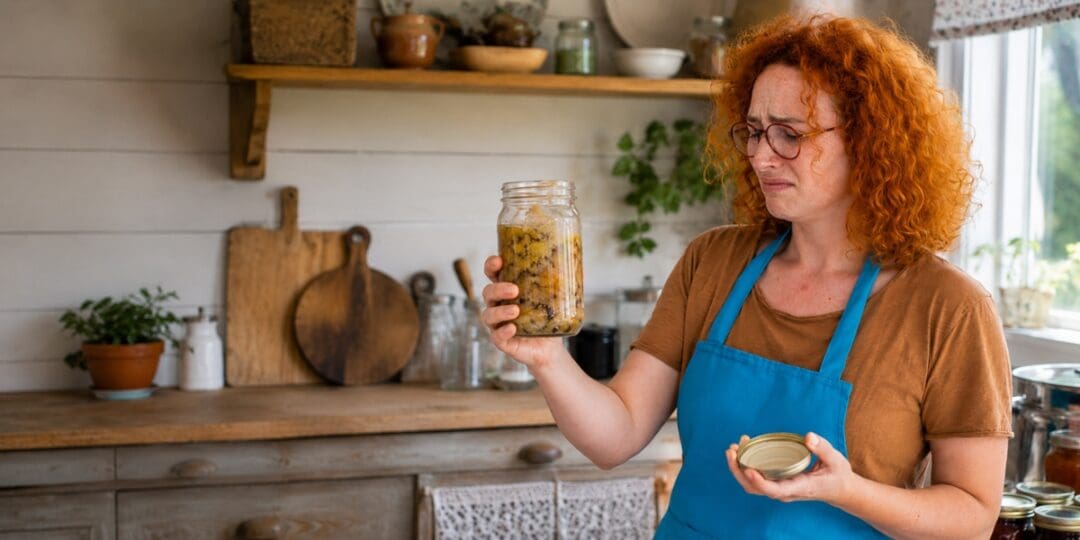
Has this ever happened to you before? You go into your pantry ready to grab a jar of whatever you canned last season you look at it… and something is… not right?
The jar does not look the same way it used to when you put it in the pantry and this is kind of unsettling. You know that some changes are normal, but at this point, you are not sure whether this is a safe jar or not.
The thing is that there’s a clear difference between food that’s just a little ugly and food that’s actually dangerous. The problem is, nobody tells you what to look for.
So today I want to walk you through the signs I look for every single time I pull a jar off the shelf. Some are probably things you already know, while others are little tricks you learn as you get more and more experienced and I really want to share them with you.
How to Make Sure You Get the Best Canned Goods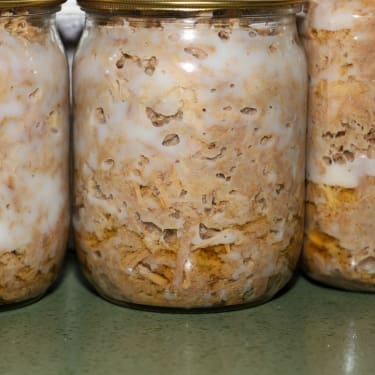
Before we start, I want to make it clear that if your canning process is proper, your goods will be too. If you respect the technique, you almost never deal with dangerous jars that can get you sick.
Something that helped me big time was learning the right way to can food. You and I both know canning is not rocket science, but there are some tips most homesteaders don’t know, especially those who have just started living independently.
For example, things like knowing the right temperatures for each product you want to can, the “fingertip tight” method, or why living up in the mountains means you have to can differently than folks closer to sea level. These are all things most people are not aware of, and this is why your canned products are short-lived.
I wanted to get the best info, and that’s why I decided to learn from the best, learn directly from the Amish. Their canning methods have been tried and tested for generations. You probably saw it for yourself if you ever bought something from them at the local market, or at least you’ve heard about it anyway.
So, in this article, you’ll see how you can spot a dangerous jar, but if you want to avoid all this trouble in the first place, you can steal some knowledge from the Amish.
Here are some unusual recipes I learned from them:
• Beef Stew With Vegetables
• Hot Packing
• Beef Chilli
They are not your usual recipes when it comes to canning, but once preserved properly, they can last for years in your pantry and all of them are perfect when you want a quick, healthy meal but you don’t have time for a full cooking session.
You can see more about these recipes and the canning techniques used by the Amish here.
If you want video support, you can join The Amish Ways Academy. All videos are presented by Eddie Swartzentruber, who grew up in Minnesota’s largest Amish settlement and has firsthand experience with all the canning techniques the Amish use.
👉 See more info about the Academy

How to Spot Spoiled Jars
Now, if you already have some canned goods in your pantry or cellar, you’re here to learn how to differentiate between safe jars and dangerous ones.
Here are the best ways to tell your food has gone bad, all based on visible clues.
Be careful, because even just one of these signs means your jar should no longer be in your pantry.
Let’s start!
The Lid Doesn’t Pop
This is the first check I do. Run your finger across the center of the lid. It should be slightly concave, pulled down by the vacuum, and it should not move when you press on it. If it gives even a little, if you hear a click when you push down, the seal is broken. Don’t taste it. Don’t smell it. Just toss the whole jar.
A lid that lost its seal somewhere along the way means air got in, and once air gets in, bacteria follow it.
Bulging or Swollen Lids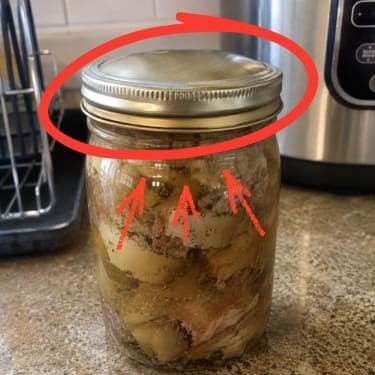
This is the opposite of a popped lid, and it’s a bigger warning sign. If the center of the lid is pushed up or the lid looks puffy and rounded, this means gases are building inside.
Spoilage bacteria and yeast produce gas as they grow, and that gas has nowhere to go, so it will just accumulate inside the jar and create that swollen lid look. A bulging lid means something is alive in there, and it shouldn’t be.
For store-bought cans, the same rule applies. If the ends of a metal can are pushed outward or flip when you press on them, do not open it. It’s for sure spoiled and not safe.
Streaks of Dried Food Running Down the Outside
Here’s one you might miss. Hold your jar up at eye level and slowly turn it. Look very carefully for streaks of dried food running down from under the lid.
Those streaks mean the jar leaked at some point, probably while it was processing or cooling. Even if the seal sealed back up afterward, the contents are no longer safe.
I do this check on every jar before I even open it. It takes about three seconds and it made me get rid of some troubled jars.
Spurting or Fizzing on Opening
When you crack the seal on a properly canned jar, you should hear a soft pop or hiss of air going in, not out. If liquid spurts up when you open it, or the contents foam, hiss, or fizz like a soda, gas has built up inside, so it means bacteria have made their way into the jar.
I’ve had this happen a couple of times over the years, and it’s the kind of thing you don’t second-guess. Cap the jar back up if you can, double-bag it, and get it out of the house.
Rising Bubbles in the Liquid
Hold the jar steady at eye level and just watch. If the jar is properly sealed and properly processed, the liquid should be still. If you see little bubbles rising up through the food, that’s once again gas being produced inside the jar, so it’s a jar that is actively spoiling.
This trick works best with clear liquids like pickle brine or fruit syrup. With cloudier foods like soup or chili, you may need to tip the jar gently and watch how the liquid moves.
Here’s What Causes All of These Problems
The 5 problems listed above all have something in common: they are all caused by two factors: mechanical/processing problems or biological problems.
Now, some can be caused by both factors at the same time, but for example, the bulging lid or the fizzing on opening are almost always caused by bacteria that somehow managed to survive the canning process, so biological causes.
The first category, the mechanical/ processing problems, means there was something wrong with your jars to begin with. Maybe a chipped rim, a ring put too tightly, or you simply reused the flat lid, and this compromised the jar.
Things like these can happen, and it’s not a big deal when you need to toss one jar. But what would happen if this affected your whole batch?
Oh well, this is a completely different story, and I am sure it’s one you’d want to avoid.
The easiest way to keep your jars safe is by not making common mistakes. For example, here are 7 “deadly” canning mistakes anyone can make. Once you know them, you’ll have safe cans that last longer.
👉 Click here to see the mistakes.
Weird Color
You know very well that foods have their colors. For example, green beans should be green, not gray, right? Tomatoes should be red, not brown. Beef should be deep red-brown, not black or pink-gray.
Some color shift is normal over time, especially with light-colored vegetables or anything stored where light reaches it. But a big shift from what you canned, or any color you can’t explain, means the food is not safe.
Cloudy Liquid Where It Should Be Clear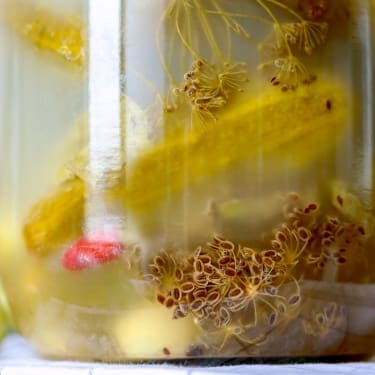
Pickles should sit in clear brine. Fruit should sit in clear syrup. Broth should be clear or close to it. If the liquid has turned milky, cloudy, or hazy, something unpleasant is going on in there.
I want to still say that some foods naturally throw a little sediment to the bottom of the jar. For example, both tomatoes and spinach do this. If it’s just a thin layer of debris on the bottom, it’s usually not a big deal.
But if you notice cloudiness floating in the whole liquid, you can be more than sure that you are looking at a jar that should no longer be in your pantry.
Mold
This is an easy one. If you see mold, it’s clear that something is not going according to plan. Mold can show up as cotton-like white, blue, black, or green growth on top of the food or stuck to the underside of the lid.
As you can see, mold comes in many ways, and sometimes it’s just a tiny dot, but other times it’s a whole fuzzy colony.
What I want to tell you now is some unfortunate news: even a tiny dot of mold means the whole jar goes. The old advice about scraping mold off jam or applesauce is outdated and dangerous, so please don’t follow it.
Mold sends roots down into the food that you cannot see, and some molds produce toxins that can make you sick. So, just throw the jar out.
An Off Smell
A good jar of canned food should smell like itself; it should smell like good food you want to eat.
If you open a jar and get a whiff of something sour, yeasty, fermented, sharp, or just plain weird, that’s for sure spoilage.
But here’s the catch, and I want you to remember this. A jar can carry deadly botulinum toxin and smell completely normal. The smell test only helps you catch some kinds of spoilage. Smelling fine doesn’t mean a jar is safe to eat. That’s why it’s also important to consider the other sigs I have put on this list.
According to the National Center for Home Food Preservation, the toxin is invisible and odorless, which is why the rules around suspect jars are so strict. Never, ever taste food from a jar to see if it’s still good. If a jar looks wrong, it goes in the trash.
Sharp Dents, Rust, or Leaks on Store-Bought Cans
In case you’re buying some commercial cans too, this matters. Run your finger around the top rim and bottom rim of a can. Then check the side seam, which is that subtle vertical line down the body. If there’s a dent crossing any seam, especially a sharp dent with a point or crease you can feel, the seal may be compromised.
According to the USDA, a deep dent is one you can lay your finger into. Those go in the trash.
The same is true for rust. Surface rust that wipes off is usually fine. Rust that has pitted the metal or eaten through it is not ok. The holes produced by rust are tiny, but air still uses them to enter the can, and this is how bacteria start growing.
Strange Texture
Open the jar and look at the food. The food you canned should still hold itself and should not look mushy.
For example, pickles should be crisp or at least have some bite. Meat should hold together. If something has turned slimy, slick, sticky, or come apart in a way it shouldn’t, set the jar aside.
Funny Behavior of the Jar Itself
This is a lesser-known sign that I want you to know about. Sometimes a jar of bad food will start to weep liquid out from under the seal slowly.
You’ll see a little ring of stickiness around the jar on your pantry shelf, or you’ll notice the rim is wet when nothing else around it is.
This means the seal failed and the pressure inside is pushing food out.
Walk through your pantry every couple of months and look at the shelves themselves, not just the jars. Any sticky ring or dried drip is your sign.
How to Store Canned Goods (the Right Way)
Most of us keep our jars in the pantry. This is not a mistake; a lot of panties are perfect for that, but the most important thing you need to keep an eye on is the temperature.
For example, I know many families who have their pantry in their kitchen. This makes it accessible and it seems like the perfect spot for a pantry. But let’s look at this again and this time let’s keep the above information about temperature in our minds.
If you think about it once more, you might realize that a pantry attached to a kitchen might not be the best idea at all.
The kitchen is the place you cook and this means hot temperatures and humidity. This is exactly where you DON’T WANT to keep your canned goods. Most of them should be kept in a dry, cool place. The exact opposite of a kitchen pantry.
This leaves you with very few right options. If you have space, you can try to keep them in your basement, and if you don’t, you can try a root cellar.
The root cellar is the gold standard when it comes to storing canned goods. Temperatures stay in the 40s to low 50s naturally, humidity is balanced, and there’s no light.
The food you store in a root cellar can last its full shelf life because the conditions are perfect and this slows down every chemical reaction that makes the food spoil faster.
This is also how the Amish manage to store their food for crazy long periods of time without spoiling, sometimes for years in a row.
👉Here you can find a short documentary-style video about how to build a root cellar the easiest way possible.
Spoiler: The presented root cellar does more than keep your stockpile safe…
Final Thoughts
I know that after all the hard work you put into canning those jars, throwing some of them out feels terrible. I understand this feeling very well because it happened to me many times. But I’d gladly toss a jar of canned meat than end up in the hospital.
Hopefully, when canning is done right, by following tested recipes and processing times, spoilage is rare. Most of the jars on your shelf are going to be just fine. I don’t want you to be afraid of canned food. After all, this is one of the most reliable practices on a homestead. All I want is for you to be more careful about spoilage signs.
You may also like: 
Join Our Homesteading Facebook Group!
Never Buy Batteries Again (This Trick Saves $500/Year) (Video)
Why the Amish Are Immune to Inflation and How You Could Be Too
The Secret Trick That Cuts Fruit Canning Time in Half
Why Raising Rabbits Is the No. 1 Investment in 2026