Last week at the grocery store, I saw a woman ahead of me putting items back on the shelf. A jar of peanut butter and a bag of apples. She was probably doing the math in her head, deciding what her family could skip that week. Mark and I have been there. Maybe you have been too.
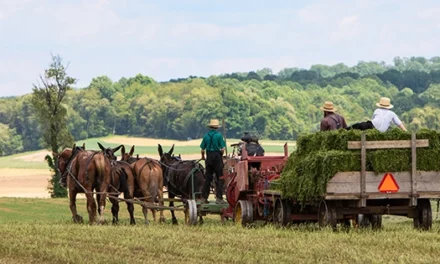
The same day, I passed an Amish farm and saw a young man loading produce into a buggy. He looked genuinely happy about it, and I was almost certain every bit of what he was carrying had come straight off the farm and was ready to be sold.
The Consumer Price Index rose 2.7% for the year ending December 2025, with food up 3.1%. Then March 2026 hit and the all-items index jumped 3.3%, with energy spiking 12.5%. The Amish? They feel almost none of it. (bls.gov)
Nobody is completely immune to inflation, but the Amish know something the rest of us forgot. And the best part is that both you and I can use these principles on our homesteads.
The 5-Step Spending Rule the Amish Live By
Before they start spending money, an Amish household runs a need through five filters. In this specific order:
- Make it. Can we build, sew, grow, or cook this ourselves?
- Mend it. Can we fix or repair what we already have?
- Make do. Can we live without it for now, or use something else we own?
- Barter for it. Can we trade goods, food, or labor with someone in the community? (See how to barter like the Amish here)
- Buy it. Pay cash. Borrowing is a last resort, and almost never for consumer goods.
Think about how backwards this is from how most people shop. They notice a need, hop into the car, and rush to the store. On the other hand, the Amish walk through every other option first.
Here’s where following these principles paid off for us last summer. Our chest freezer died on the hottest week of August, with about $400 worth of meat inside. The replacement Mark priced out was $749, plus tax, plus delivery. But instead of buying a new one, he called a friend two roads over who runs a small appliance repair business on weekends.
The compressor relay had failed. Forty-two dollars in parts, two hours in our garage, a pot of chili for his trouble. We saved the meat and the freezer is still humming as I type this.
If you want to have peace of mind and be sure you have a backup in case your fridge fails, just like ours did, you can build an Amish fridge. This is a sustainable, electricity-free food preservation solution that takes one weekend to build and is ideal for any homesteader who prefers the old-school approach.
Watch the video below and see exactly how this setup keeps food cold without electricity, refrigerant, or a single moving part.

How a Work Party Can Save You $2,000
The Amish call their work gatherings frolics. Hundreds of neighbors show up to build, quilt, butcher, or harvest, all without pay. The work gets done in a day instead of weeks, and everyone eats together afterward.
This is the part most homesteaders miss. We pride ourselves on complete independence, but the Amish model is not just about being independent. They rely on their community a lot, and they teach us how to be interdependent while sharing our lives with the right people. Nobody pays a contractor when twenty neighbors will frame a shed for the cost of lunch.
The $1,680 a Year Most Families Burn for Nothing
This is the section I want you to read twice.
The average American household carries around $9,148 in credit card debt as of late 2025. The average APR on cards accruing interest sat at 22.30% in the fourth quarter of 2025 (source). Run those numbers and the average household pays roughly $1,680 a year in interest alone. Money that buys nothing. No groceries. No firewood. No seeds.
That $1,680 isn’t a luxury but a tax you pay the bank for the privilege of being in debt.
The Amish reject commercial insurance, Social Security, and consumer credit. When somebody gets very sick, the community pays the hospital bill in cash. When a barn burns down, the church takes up a collection. They don’t need to carry credit cards.
Obviously, you are not going to cancel your health insurance tomorrow. That would be reckless, and I’d never advise you to do something like this. But just think about it. We are not talking about health here, but about all of those things you might buy and use just once. Do you really want to be in debt for things you don’t really need? Or do you want to buy just useful items and the ones you can use for bartering?
A Backyard Garden Can Pay You $740 a Year
Researchers from Kansas State University’s extension program found that home gardens can produce between $180 and $1,300 worth of food per season above what you spent on inputs. The range depends on what you grow, how big your plot is, and whether you preserve the surplus.
I keep a notebook in my kitchen drawer where I track what I put up each year. Last summer I canned 47 quarts of tomato sauce, 32 jars of pickles, 18 quarts of green beans, and froze enough corn and berries to get us through to June. After subtracting seed and jar costs, I landed at about $740 saved.
Now I want to share with you a great rule for all gardeners: grow what’s expensive to buy and what stores well. Don’t waste raised bed space on lettuce that costs $1.99 a head. Plant tomatoes, peppers, garlic, winter squash, and sweet potatoes.
What the Amish Actually Buy (It’s Not What You Think)
Here’s a misconception I’d like to clear up. The Amish aren’t living in 1850 anymore. Some of them made peace with technology.
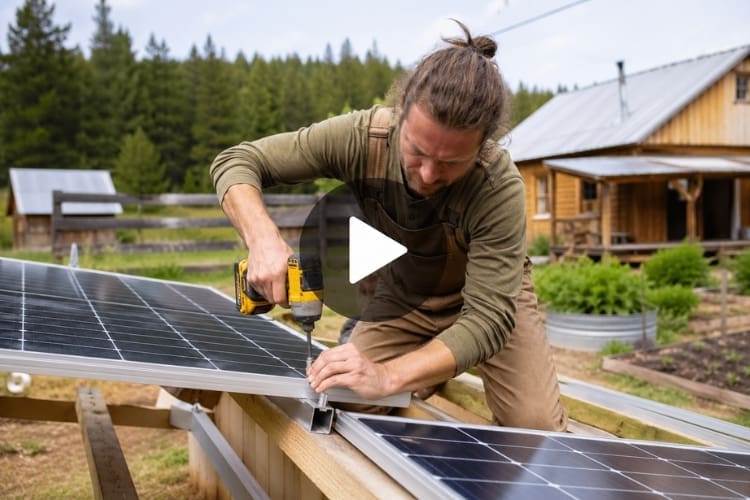
A typical Amish farmhouse in many communities runs on propane. Propane refrigerators, propane stoves, propane lights, propane water heaters. Workshops use diesel generators and pneumatic tools powered by air compressors. Many Amish carpenters work with battery-powered drills, saws, and lights charged off solar panels or generators. Some progressive communities even allow stripped-down word processors and shared business phones in a shanty at the end of the lane.
When they need to travel beyond buggy distance, they hire what locals call an “Amish taxi.” This is a neighbor with a van who drives them to the hospital, the bulk store, or a wedding three counties over. They pay by the mile. They don’t own the car, but they use one when the need is real.
The principle they live by is what matters: own the technology that builds your life, rent the technology that connects you to the outside world, and refuse the technology that pulls your family apart.
Inflation-Proof Skills Nobody Can Take From You
Money loses value every year, but a skill you’ve built into your hands? That’s personal capital that doesn’t devalue when the dollar does.
A few worth mentioning:
- Bread baking. A loaf of bread at the store is now $4. The flour, salt, and yeast to make one at home costs about 60 cents.
- Basic plumbing. Replacing a wax ring on a toilet is a $15 part and takes twenty minutes. The plumber charges $250.
- Food preservation. Canning, fermenting, dehydrating, smoking. Every jar in your pantry is a future grocery trip you don’t have to make.
- Sewing and mending. A patched pair of work pants beats a $40 replacement.
- Small engine repair. Lawnmowers, chainsaws, tillers, generators. The shop charges $90 an hour.
Each one of these is a skill the Amish learn before they’re sixteen. Each one stays with you for life, regardless of what the Fed does next month.
The thing is that many of those skills you can’t learn just from YouTube. Having insight from an expert is what makes the difference between the skills you truly developed and some shallow project you tried once and failed.
That’s why I want to point you toward The Amish Ways Academy. It’s run by Eddie Swartzentruber, who grew up in one of the most conservative Amish settlements in the country. He spent his whole childhood without electricity, plumbing, or store-bought medicine, and now he’s filming everything he learned before the knowledge is gone.
Click here and see what’s in the Academy!
Four Amish-Style Habits to Start This Week
Run the 5-step rule on your next purchase over $50. Before you click buy, walk through make, mend, make do, barter. Even if you end up buying it, you’ll catch one out of every four purchases you would’ve made on autopilot.
Build your own little frolic group. Find two or three families nearby who think as you do. Trade labor on big projects instead of hiring out. Start with one Saturday this month. Pick a project at one homestead and rally the others.
Kill the highest-interest debt you carry. Pick the card or loan with the worst APR and throw everything you can at it. The interest you stop paying is the rawest, fastest “raise” you’ll ever get. Farmland tracks inflation over time, but only after you’ve stopped feeding the bank first.
Track every jar, every loaf, every repair. Keep a notebook. Write down what you would’ve paid retail. By December, you’ll have a number that changes how you see your homestead. Mine was $740 from canning alone last year, and that was just the tomatoes, pickles, and beans.
Final Thoughts
In reality, the Amish are just very good at avoiding all the things that make inflation hurt. They are not completely immune, but they downsize the effects that much that you could say they are not affected at all.
Every credit card balance, every monthly subscription, every appliance you replaced when you could’ve fixed it, every meal you bought when you could’ve grown it. Each one is a string tying you to the price of things you don’t control. This is the lesson I learned after reading about their lifestyle for years. The Amish cut those strings, one at a time, generation after generation, until almost none were left.
Now I am aware that cutting all of these things might not be the best choice for you and me, but you know the drill: just take what makes sense for you and your homestead. Most of us aren’t going to give up cars, insurance, or the internet. But you can still cut some.
You may also like: 
Join Our Homesteading Facebook Group!
This Water Machine Produces Up to 40 Gallons of Water Per Day (Video)
7 Amish Blacksmithing Skills That Will Save You $500 a Year