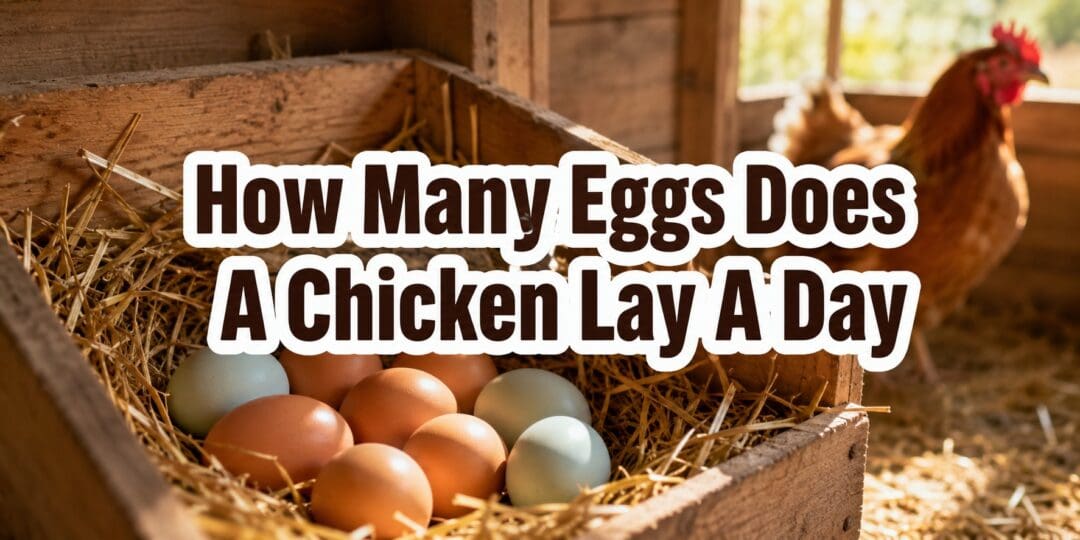
The honest answer is that a healthy hen can lay at most one egg a day, and most don’t even do that. It physically takes a hen 24 to 26 hours to build a single egg from the inside out, so the math never quite lines up with a clean 24-hour cycle. That small gap is the whole reason your flock doesn’t hand you seven eggs every single week like clockwork. Here’s what’s actually going on inside a hen, and what real numbers to expect from your own birds.
Why a Hen Can’t Lay Every Single Day
An egg isn’t assembled instantly. It starts when the ovary releases a yolk, then spends roughly 20 of those 24 to 26 hours building the shell out of calcium as it travels down the oviduct. Because that whole process runs a couple of hours longer than a full day, a hen’s laying time creeps a little later every single morning. Eventually that drift pushes her into the afternoon, and rather than lay dangerously late in the day, she’ll skip laying entirely for a day and reset back to a morning schedule.
This is also why two eggs from one hen in a single day is genuinely rare, not a sign of an especially productive bird. It usually means her internal cycle briefly glitched and released two yolks close together rather than one, and it’s not something that happens reliably or repeatedly.
So What’s a Realistic Number?
For a strong laying breed in good health with plenty of light, expect roughly 5 to 6 eggs a week, not 7, which works out to somewhere around 250 to 300 eggs in a full year during her best laying season. That’s the ceiling for a genuinely excellent hen. Plenty of backyard birds, especially heritage and dual-purpose breeds kept more for homesteading value than pure egg output, land well below that.
- Daily: 1 egg maximum, and only some days even then
- Weekly: 4 to 6 eggs for a healthy, well-fed hen in her prime laying season
- Monthly: roughly 20 to 24 eggs under good conditions
- Yearly: 200 to 300 eggs depending heavily on breed, age, and how the flock is managed
Most hens also don’t lay in one smooth continuous run all year. They tend to lay in clusters, roughly 8 to 12 eggs in a row, then take a day or two off before starting the next cluster, which is completely normal rather than a sign something’s wrong.
Breed Makes a Genuinely Big Difference
Chickens have been selectively bred for very different jobs, and egg output varies a lot depending on which job a particular breed was built for. White Leghorns, ISA Browns, Golden Comets, and Black Stars sit at the top of the list, commonly laying 5 to 6 eggs a week. Rhode Island Reds, Plymouth Rocks, Australorps, and Wyandottes are considered solid, dependable layers at 4 to 5 eggs a week, a step down from the specialist breeds but still very productive for a homestead flock.
- Excellent layers (5 to 6 eggs/week): White Leghorn, ISA Brown, Golden Comet, Black Star
- Good layers (4 to 5 eggs/week): Rhode Island Red, Plymouth Rock, Australorp, Wyandotte
- Moderate, dual-purpose layers: Orpingtons, Sussex, and most heritage breeds kept for both meat and eggs rather than eggs alone
It’s worth putting this in perspective against where the modern layer actually came from. The wild ancestor of the domestic chicken, the red junglefowl, lays only about 12 eggs a year in its natural state. Every high-producing breed on a modern homestead is the result of decades of deliberate selective breeding stacked on top of that baseline, not something that just happens naturally in the wild.
Age Changes the Numbers Every Single Year
A pullet typically starts laying somewhere between 18 and 22 weeks old, and just like a person adjusting to a brand-new routine, it can take her a little while to settle into a consistent rhythm. Her first full year is her best year, and production declines in a fairly predictable pattern after that.
- Year 1: peak production, up to around 250 eggs for a good layer
- Year 2: roughly 80 percent of her first-year output
- Year 3: roughly 70 percent of her first-year output
- Year 4: roughly 60 percent of her first-year output
Hens can keep laying, in gradually smaller numbers, until they’re 5 to 8 years old, even though most commercial operations replace hens well before that age purely for economic reasons. On a backyard homestead, there’s nothing wrong with keeping an older, slower-laying hen around for the years of eggs she’s already given you, plus the pest control and composting help she keeps providing either way.
Light Is the Real Trigger, Not the Calendar
Egg production isn’t actually driven by season directly, it’s driven by daylight length, which just happens to track the seasons closely. Daylight stimulates a hen’s pituitary gland to release the hormones that keep her laying, and hens need roughly 14 to 16 hours of light a day to sustain strong production. That’s exactly why egg baskets fill up fast in late spring and summer and slow down noticeably as days shorten into fall and winter.
- Natural light-driven slowdown in fall and winter is completely normal and not a sign of a health problem
- Supplemental coop lighting on a timer, extending light to around 14 to 16 hours total, can keep production steady through the darker months if you want consistent winter eggs
- Many homesteaders choose to let hens rest naturally through winter instead, treating the seasonal slowdown as a normal part of the flock’s yearly rhythm rather than something to fight
Molting Stops Egg Production Completely, and That’s the Point
Once a year, usually as days shorten heading into fall, hens go through a molt, shedding and regrowing their feathers. Egg laying typically stops entirely during this period, sometimes for several weeks, because a hen’s body is redirecting protein and energy toward regrowing feathers instead of building eggs. This isn’t a malfunction. It’s a scheduled biological reset, and pushing a molting hen to keep laying through it isn’t something you can force or should try to force.
Other Everyday Factors That Move the Number
Beyond breed, age, and light, a handful of practical, day-to-day factors can noticeably shift how many eggs actually show up in the nesting box.
- Nutrition: a complete layer feed with adequate protein, calcium, and vitamins is non-negotiable for consistent production. A hen short on calcium specifically will struggle to build strong shells even if everything else is right.
- Stress: moving hens to a new coop, introducing new flock members, a predator scare, or even a disrupted routine can cause a temporary dip or pause in laying.
- Illness and parasites: internal parasites, respiratory illness, or mite infestations all divert a hen’s energy away from egg production.
- Water access: a hen without consistent clean water will drop off in laying quickly, since eggs are mostly water by weight.
- Overall flock health and housing: overcrowded, poorly ventilated, or unsanitary coops add chronic stress that shows up directly in reduced egg output.
A Quick Myth to Clear Up: Egg Color and Nutrition
It’s a common assumption that darker or more colorful eggshells mean more nutritious eggs. They don’t. Shell color is purely a function of breed genetics, brown eggs from a Rhode Island Red, blue-green eggs from an Ameraucana or Easter Egger, white eggs from a Leghorn, and has no bearing on what’s actually inside. If you’re choosing a breed based on egg color for fun or variety in the basket, that’s a completely valid reason. Just don’t expect a nutritional difference to come with it.
Want to Raise Chickens the Way Generations of Homesteaders Have?
Knowing how many eggs a chicken can lay is only one piece of building a productive backyard flock. The real difference comes from understanding the timeless practices that keep hens healthy, productive, and low-maintenance throughout the year.
Amish Ways brings together practical, field-tested homesteading knowledge passed down through generations, including:
- How to choose the best chicken breeds for eggs, meat, or dual-purpose flocks
- Coop designs that naturally promote healthier birds and fewer problems
- Feeding strategies that improve egg production without unnecessary expense
- Seasonal flock management, including winter care, molting, and predator protection
- Natural methods for preventing common health issues
- Brooding chicks, expanding your flock, and raising chickens with confidence
- Traditional self-sufficiency skills that go far beyond poultry, including gardening, food preservation, livestock care, and sustainable living
Whether you’re collecting your first egg or managing a growing homestead, Amish Ways offers practical advice rooted in simplicity, stewardship, and generations of real-world experience—not passing trends.
If you enjoyed this guide and want to build a healthier, more productive homestead, Amish Ways is the perfect next step. Discover proven techniques that help you raise happier chickens, harvest more from your land, and embrace a more self-reliant way of life.
The Bottom Line
A chicken laying one egg every single day of the year simply isn’t how the biology works, and expecting it sets up backyard flock owners for unnecessary worry over completely normal behavior. The real, honest ceiling is one egg roughly every 24 to 26 hours, which nets out to 5 to 6 eggs a week and 250 to 300 eggs a year for a genuinely excellent layer in her first productive year. Breed, age, daylight, molting, nutrition, and stress all move that number up or down, and a slower season isn’t a problem to solve, it’s just what a real, living hen actually does.
You may also like: 
Join Our Homesteading Facebook Group For Tips To Help You!
The Amish do this to every chicken coop in the spring. Why? (Video)
Chicken Dewormer – The Complete Guide to Treating and Preventing Worms in Your Flock
How Long Do Chicken Eggs Take to Hatch? A Complete Incubation Guide
How to Build a Predator-Proof Automatic Chicken Coop Door