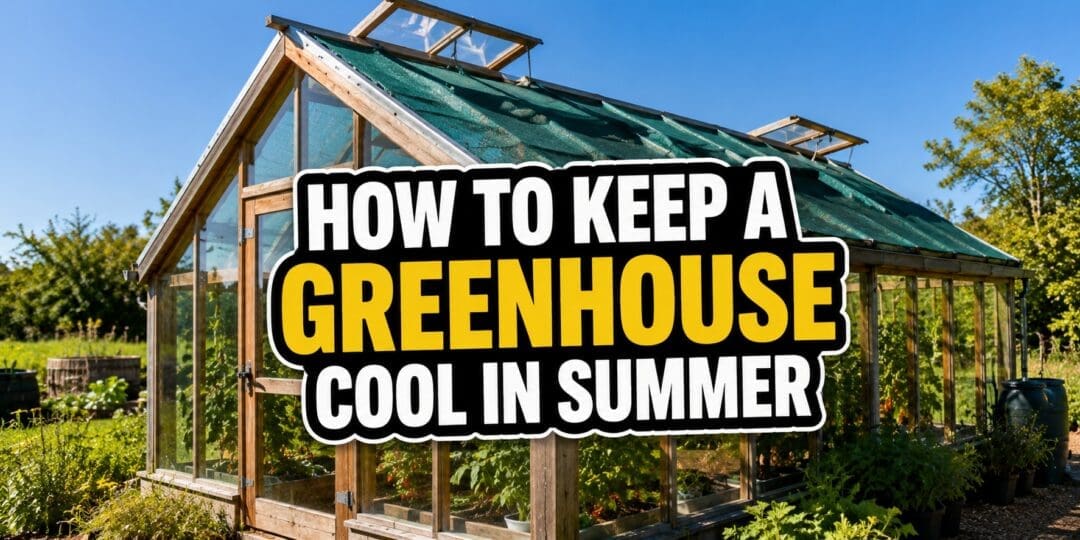
A greenhouse is one of the most rewarding investments a homesteader can make. It extends your growing season, protects tender plants, and gives you control over your food production in a way that open-bed gardening never can. But that same enclosed structure that keeps frost out in winter becomes a serious liability in summer. Temperatures inside an unmanaged greenhouse can climb 30 to 50 degrees Fahrenheit above the outside air, turning your growing space into an oven that kills seedlings, bolts your greens, and shuts down fruiting crops almost overnight.
Learning how to keep a greenhouse cool in summer is not complicated, but it does require understanding the specific ways heat builds up in an enclosed structure and applying the right combination of strategies for your climate and setup. This guide covers ten proven methods, from free and simple fixes you can implement today to longer-term upgrades worth the investment.
Why Greenhouse Temperatures Spike So Dramatically
A standard outdoor garden absorbs solar radiation and dissipates heat through wind movement, evaporation from soil and leaf surfaces, and radiant cooling into open sky. A greenhouse traps all three of those heat-release pathways. The glazing, whether glass, polycarbonate, or poly film, allows short-wave solar radiation in but blocks the long-wave infrared radiation that tries to escape, creating a classic greenhouse effect inside the structure itself.
Humidity compounds the problem. As plants transpire and soil moisture evaporates, the air inside becomes humid and dense, which holds heat even more efficiently than dry air. On a cloudless summer day, interior temperatures can spike within minutes of sunrise and stay elevated for hours after sunset if there is no active cooling strategy in place.
According to research published by university extension programs, most common greenhouse crops including tomatoes, cucumbers, and peppers experience measurable yield decline when daytime temperatures consistently exceed 85 to 90 degrees Fahrenheit. The University of Massachusetts Extension notes that high temperatures not only stress plants directly but also disrupt pollination, reduce fruit set, and create conditions favorable to fungal pathogens.
1. Maximize Ventilation First
Before spending money on equipment, make sure your greenhouse is using its existing ventilation capacity fully. Most greenhouses are designed with roof vents at the ridge line and lower side vents near the base. When both are open simultaneously, hot air rises and escapes through the top while cooler outside air is drawn in at the bottom, a process called the stack effect or convective ventilation.
The problem is that manual vents are often left closed out of habit or forgotten during busy periods. Automatic vent openers, which use a heat-sensitive wax piston to open vents when interior temperatures reach a set threshold, cost between 20 and 40 dollars each and are one of the highest-return investments a greenhouse grower can make. Install them on every roof vent you have.
The rule of thumb from most greenhouse design guidelines is that total vent area should equal at least 15 to 20 percent of the floor area of the greenhouse. If your current vent area falls short of that, adding additional roof or side vents before summer arrives is worth the time.
2. Add Shade Cloth
Shade cloth is the single most effective passive cooling tool for a summer greenhouse. It works by intercepting solar radiation before it enters the glazing, reducing the amount of energy that has to be managed inside. A 30 to 50 percent shade cloth is appropriate for most general greenhouse crops. If you are primarily growing shade-tolerant crops like lettuce, spinach, and herbs during the hottest months, 50 to 70 percent cloth keeps temperatures more manageable.
Exterior shade cloth is significantly more effective than interior shade cloth because it prevents heat from entering the structure in the first place rather than shading plants after the energy has already converted to heat inside. If exterior installation is not practical for your structure, interior cloth still provides meaningful temperature reduction and is worth using.
Aluminet shade cloth, a reflective woven material, reduces temperatures more effectively than standard black knitted cloth because it reflects rather than absorbs solar radiation. The National Sustainable Agriculture Information Service recommends reflective shade materials for operations in regions with intense summer sun, noting the additional temperature reduction compared to standard woven alternatives.
3. Use Evaporative Cooling
Evaporative cooling works on the same principle as human sweating: when water evaporates, it absorbs heat from the surrounding air, lowering the temperature. In dry climates with low summer humidity, evaporative cooling can reduce interior greenhouse temperatures by 10 to 20 degrees Fahrenheit at very low cost.
Wet Wall Systems
A wet wall or evaporative cooling pad system consists of a porous cellulose or aspen fiber pad kept wet by a recirculating water pump, positioned on one end of the greenhouse, with an exhaust fan on the opposite end drawing air through it. As air passes through the wet pad, water evaporates and the air temperature drops before it moves through the growing space. Commercial wet wall systems are sized based on greenhouse volume, and many small greenhouse operations build effective DIY versions using commercial evaporative cooler pads and a simple box fan.
Misting Systems
Overhead misting nozzles installed on a timer can reduce air temperature significantly when the outside humidity is low. The challenge is that misting increases humidity inside the greenhouse, which can promote fungal disease if used excessively or in climates that are already humid. In arid regions, a well-managed misting system is highly effective and low cost to operate. In humid climates, limit misting to ventilation periods when there is active airflow to carry moisture out.
4. Maintain Adequate Plant Spacing
Crowded plants trap heat, restrict airflow between leaf surfaces, and create humid microclimates that stay hot long after ambient temperatures drop. During summer, maintaining generous spacing between plants is not just a pest management consideration but a direct temperature management tool. Each plant generates heat through its metabolic processes and releases significant moisture through transpiration. When plants are spaced properly, that heat and moisture can dissipate rather than accumulate.
Thinning aggressively in summer, removing slower plants and giving vigorous ones more space, often produces better overall yields than trying to maintain a full stand through heat stress. The USDA Agricultural Research Service has documented the relationship between canopy density, air circulation, and heat stress in enclosed growing environments, confirming that reducing plant density in high-temperature periods measurably improves individual plant performance.
Related: 12 Trees Every Homesteader Should Plant In Their Backyard
5. Apply Interior Whitewash or Shade Paint
Whitewash painted directly onto the outside of greenhouse glazing reflects a portion of incoming solar radiation and reduces interior temperatures. Traditional lime whitewash washes off gradually over the season and can be applied each spring, fading naturally by autumn when light becomes more valuable than shade. Commercial shade paint formulations offer more precise shade percentages and weather more predictably than lime whitewash.
This approach works best for fixed glass or polycarbonate greenhouses where external shade cloth is difficult to install or anchor. Apply whitewash to the south and west faces of the structure where direct summer sun exposure is highest, leaving north-facing panels clear to maximize diffuse light.
6. Use Thermal Mass Strategically
Thermal mass is any dense material that absorbs heat slowly during the day and releases it slowly at night. In summer greenhouse management, thermal mass works to buffer temperature spikes during peak heat hours by absorbing excess energy that would otherwise stay as hot air. Water is the most effective thermal mass material per unit of cost and weight.
Painting large water containers black and positioning them where they receive direct sun during morning hours allows them to absorb heat during the day and release it slowly after dark. In summer, this moderates peak daytime temperatures. The same containers provide frost protection in shoulder seasons, making them a year-round investment. Fifty-five-gallon food-grade drums, IBC totes, or even rows of black-painted gallon jugs along the north wall of the greenhouse all work effectively.
Large stones and concrete blocks also serve as thermal mass but are less effective per pound than water. For growers managing summer heat on a tight budget, even repurposing black-painted plastic bottles filled with water along the north wall provides meaningful temperature buffering at essentially zero cost. The principles behind passive thermal management in greenhouse environments are covered in depth by the Cooperative Extension System as part of their integrated greenhouse management resources.
Related: Organic Gardening: The Complete Guide to Growing Food Without Chemicals
7. Increase Airflow with Circulation Fans
Even with roof vents fully open, air inside a greenhouse can become stratified, with very hot air pooling at the ridge while the area around plants stays still and humid. Horizontal airflow fans, also called HAF fans, break up this stratification by keeping air moving continuously throughout the growing space.
HAF fans are positioned to create a circular airflow pattern around the perimeter of the greenhouse at plant height, rather than blowing air directly at crops. A common configuration uses two fans on opposite walls angled slightly toward the center, creating a figure-eight airflow pattern. The fans run continuously on low speed, consuming very little power while dramatically improving air mixing, reducing disease pressure, and keeping the effective temperature around plant foliage closer to the actual air temperature.
Exhaust fans mounted at the ridge line and triggered by a thermostat provide active air exchange when passive ventilation is insufficient. Set the thermostat to engage the exhaust fan when interior temperatures exceed 85 degrees Fahrenheit. Pair the exhaust fan with automatic louvered intake vents on the opposite end of the structure to ensure adequate air intake volume.
8. Water in the Morning and Manage Soil Moisture
Watering timing affects greenhouse temperatures more than most growers realize. Watering in the morning allows the evaporation from wet soil and plant leaves to contribute to cooling during the hottest part of the day, which typically runs from late morning through mid-afternoon. Evening watering, by contrast, raises humidity during the cooler overnight period when evaporation is slow, creating conditions that favor fungal disease without providing meaningful daytime cooling.
Maintaining consistent soil moisture also helps plants manage heat stress directly. Well-hydrated plants keep their stomata open and continue transpiring even as temperatures rise, which provides localized cooling around the leaf surface. Water-stressed plants close their stomata as a survival response, halting both transpiration and photosynthesis, which causes them to heat up faster and suffer more damage at a given temperature than adequately watered plants.
Related: 5 Forgotten Soil-Revival Methods That Can Save Your Harvest
9. Choose the Right Crops for Summer
One of the most practical long-term strategies for summer greenhouse management is shifting your crop selection to match what the season naturally supports. Trying to maintain cool-season crops like lettuce, spinach, and brassicas through peak summer in an overheated greenhouse is a constant battle. Heat-tolerant crops like peppers, eggplant, sweet potatoes, and heat-set tomato varieties thrive in the conditions a summer greenhouse naturally creates when managed well. The Penn State Extension offers detailed guidance on matching crop selection to greenhouse conditions across seasons, including variety recommendations for high-temperature summer production.
For growers committed to producing greens year-round, positioning them in the coolest microzone of the greenhouse, typically the north end furthest from afternoon sun, and providing supplemental shade directly over those beds gives them the best chance of surviving summer temperatures. Heat-tolerant lettuce varieties including Jericho, Nevada, and New Red Fire are worth seeking out for summer production.
10. Consider Roof Vent Positioning and Orientation
If you are planning a new greenhouse or have the opportunity to modify an existing one, the orientation and positioning of roof vents has a significant impact on natural cooling effectiveness. Ridge vents that run the full length of the greenhouse on both sides of the peak allow maximum hot air escape and create the strongest stack effect ventilation. A single small roof vent on one side of the peak is a common design compromise that significantly limits passive ventilation capacity.
Greenhouse orientation also matters. A greenhouse oriented with its long axis running east to west maximizes winter light capture but also maximizes summer heat gain from low-angle morning and afternoon sun on the end walls. An east-west orientation is generally preferred in cold climates. In hot climates, a north-south orientation with shade provided by mature trees or a building on the west side reduces afternoon heat gain substantially.
Learn the Old-School Greenhouse Tricks the Amish Still Use
Most modern gardeners try to fight summer greenhouse heat with expensive gadgets, electric cooling systems, and constant adjustments. But long before automated systems existed, Amish growers learned how to keep greenhouses productive using practical low-tech methods that still work remarkably well today.
Inside The Amish Ways, you’ll discover traditional homesteading techniques for managing heat, airflow, water, seasonal planting, food production, and self-sufficient growing without relying on complicated technology or fragile systems. Many of these methods were developed specifically for people who needed reliable harvests no matter what the weather or economy looked like.
If you want to grow more food with less stress, lower costs, and simpler systems that have stood the test of time, this is the kind of knowledge worth learning now — before you actually need it.
👉 Learn more about The Amish Ways here and discover the forgotten homestead skills modern gardeners are rushing to relearn.
Putting It All Together: A Practical Summer Cooling Plan
No single method solves the summer heat problem entirely. The most effective approach combines several strategies tailored to your climate, budget, and greenhouse design. In most temperate climates, the combination of automatic vent openers, exterior shade cloth at 30 to 40 percent, and circulation fans addresses the majority of summer heat issues at reasonable cost.
In hot, dry climates, adding evaporative cooling through a wet wall system or carefully managed misting brings interior temperatures down to productive levels even when outside temperatures are extreme. In humid climates, evaporative cooling is less effective, and the emphasis shifts to maximizing ventilation area, managing plant density, and choosing heat-tolerant varieties.
Start with the free fixes: open every vent, space plants generously, water in the morning, and shift toward heat-tolerant crops. Then add shade cloth and automatic vent openers. From there, evaluate whether your specific situation warrants fans, a wet wall, or thermal mass additions. A greenhouse that stays consistently below 90 degrees Fahrenheit during summer, even on the hottest days, is achievable in most climates with the right combination of these strategies, and the difference in yield and plant health makes every bit of the effort worthwhile.
You may also like:
Make Sure To Join The Facebook Group For Valuable Advice You Won’t Find Anywhere Else
The Herbs You Need to Keep Close During Dark Times (Video)
How Big a Greenhouse Do I Need?
What Is a Freestanding Greenhouse? Everything You Need to Know