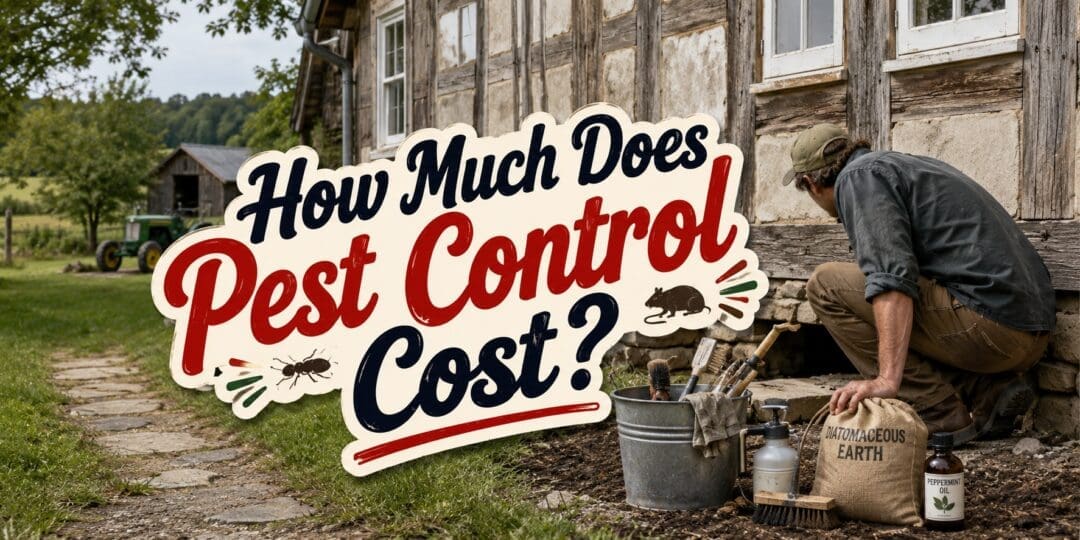
Pest control is one of those costs that can range from almost nothing to several thousand dollars depending on what you are dealing with, how established the infestation is, and whether you are paying someone else to handle it or managing it yourself. For homesteaders and self-sufficient households, that range is important to understand because the right answer is not always the same.
Some infestations are dangerous, fast-moving, or structurally threatening enough that professional intervention is the only sensible choice. Others are entirely manageable with a combination of prevention, physical controls, and targeted home treatment that costs a fraction of a professional visit. Knowing which is which, and knowing what professional services actually cost when you do need them, puts you in a position to make an informed decision rather than a panicked one when something shows up in your walls or your garden.
This guide breaks down current pest control costs by pest type and service model, explains what drives the price, covers the questions to ask before hiring, and walks through which infestations are realistically suited to DIY management on a homestead property.
What Professional Pest Control Costs: A Full Breakdown
General pest control (ants, cockroaches, spiders, earwigs, silverfish)
A one-time general pest control treatment for a standard single-family home typically runs $150 to $300. This covers the inspection, treatment of identified problem areas, and a follow-up visit if the initial treatment does not resolve the issue within the guarantee period, which is typically 30 days.
Quarterly or annual service contracts, which many pest control companies push as their primary business model, run $400 to $700 per year for a standard home depending on region, home size, and the company’s pricing structure. These contracts typically include four quarterly visits plus free call-back service if a covered pest problem reappears between scheduled visits.
For a homestead property with outbuildings, multiple structures, or acreage, expect pricing to scale with square footage and complexity. Some companies charge per structure; others price based on total square footage treated.
Termites
Termite treatment is where pest control costs escalate most dramatically because the stakes are highest. According to the National Pest Management Association, termites cause an estimated $5 billion in property damage in the United States annually, the majority of which is not covered by standard homeowners insurance. The treatment cost is painful but the untreated alternative is worse.
Liquid barrier treatment, which involves trenching around the foundation and injecting termiticide into the soil to create a treated zone that termites cannot cross, costs $800 to $2,500 for a standard home depending on linear footage of foundation and soil conditions. This is the most common and most widely used treatment method.
Termite bait systems, which place bait stations around the property perimeter that termites carry back to the colony, cost $1,200 to $3,500 for initial installation plus $300 to $500 annually for monitoring and bait replenishment. They are slower-acting than liquid treatment but less chemically intensive and increasingly popular for properties where groundwater concerns make liquid injection less desirable.
Whole-structure fumigation (tenting), used primarily for drywood termite infestations where the colony is inside the structure rather than in the soil, costs $1,500 to $4,000 for a standard home and requires the occupants and all plants and animals to vacate for 24 to 72 hours. This method is primarily used in warm coastal climates where drywood termites are common.
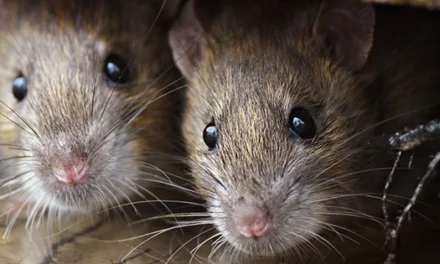
Rodents (mice and rats)
Rodent control pricing depends heavily on whether you are dealing with mice, rats, or both, and on whether the infestation is in a single accessible area or has spread through wall voids and multiple zones of a structure.
A standard mouse control treatment, which includes inspection, exclusion recommendations, snap trap or bait station placement, and a follow-up visit, runs $150 to $400. Rat control is priced higher because rats are more difficult to eliminate, more damaging, and often require more extensive exclusion work: $200 to $600 for a basic treatment program.
Exclusion work, physically sealing the entry points through which rodents are entering the structure, is often priced separately from the extermination itself and can add $200 to $1,000 to the total cost depending on the number of entry points and the difficulty of access. On a homestead property with older construction, crawl spaces, and outbuildings, exclusion work can be extensive.
For ongoing rodent pressure, which is common on rural properties adjacent to fields, woodlands, or livestock areas, a quarterly service contract that includes trap monitoring and exclusion maintenance runs $300 to $600 annually.
Bed bugs
Bed bug treatment is among the most expensive pest control services because the pest is difficult to eliminate completely, treatments often require multiple visits, and the most effective methods are labor-intensive. A single infested bedroom treated with heat remediation, the most effective and least chemically intensive method, costs $600 to $1,500. Whole-home heat treatment runs $1,500 to $4,000 depending on home size.
Chemical treatment using residual insecticides applied in multiple targeted applications costs $300 to $900 but typically requires two to three visits spaced two weeks apart to catch newly hatched nymphs that survived the first treatment. Chemical treatment is less expensive but has a higher re-infestation rate than heat treatment when the source of the infestation, typically used furniture or luggage from travel, has not been identified and eliminated.
Bed bugs are primarily an issue for homesteaders who travel or purchase used furniture or textiles. Rural properties that do not have frequent guest traffic or secondhand goods coming in are at significantly lower risk than urban households.
Wasps, hornets, and yellow jackets
A single wasp or hornet nest removal, including treatment of the nest and removal of the structure, runs $100 to $400 depending on nest location, size, and accessibility. Ground nests (yellow jackets) are generally less expensive to treat than aerial nests in eaves, wall voids, or tree branches. Nests inside walls require drilling access points and are priced at the higher end of the range.
Multiple nests on a large property can require multiple service calls or a higher flat-rate quote for a comprehensive treatment. On homestead properties with structures, outbuildings, and significant wooded area, wasp pressure in summer and fall can be persistent and recurring.
Fleas and ticks
Indoor flea treatment runs $150 to $350 for a standard home and typically requires a follow-up visit two weeks later to address eggs and larvae that survived the initial treatment. Outdoor yard treatment for fleas and ticks runs $100 to $300 per application and is most commonly priced as a seasonal service with three to four applications from spring through fall.
For rural and homestead properties where livestock, pets, and wildlife corridors create persistent tick habitat, professional yard treatment has limited effectiveness unless the treatment perimeter is large and the habitat is actively managed. Border treatment along wood lines and tall grass areas is more effective than broadcast yard treatment but costs more due to coverage area.
Moles and voles
Mole and vole control, which is more common on homestead and rural properties than in urban settings, is priced per treatment or per season. Trapping programs run $150 to $500 per visit depending on property size and activity level, with most effective programs requiring multiple visits over several weeks. Bait programs are less expensive per visit but have variable effectiveness and raise concerns about secondary poisoning of raptors and predatory mammals that consume poisoned rodents.
What Drives the Price: The Key Variables
Pest type
The pest being treated is the primary driver of cost. General household pests are cheapest to address. Structural pests like termites and carpenter ants are most expensive because the stakes are highest and the treatments most involved. Difficult-to-eliminate pests like bed bugs and German cockroaches command premium pricing because they require multiple visits and specialized equipment.
Infestation severity and duration
A fresh, localized infestation caught early costs significantly less to resolve than an established infestation that has been developing for months. This is consistently the best argument for early intervention: a $200 treatment applied in October when you first notice mouse activity is almost always cheaper than a $600 to $1,000 exclusion and extermination program required after a winter of unchecked colonization.
Property size and structure type
Larger homes, homes with crawl spaces and basements, older construction with more entry points, and properties with multiple structures all command higher treatment prices. Homestead properties typically fall at the high end of this variable because they have more square footage, more outbuildings, more points of entry, and are in closer proximity to the pest populations that generate ongoing pressure.
Geographic region
Pest control pricing varies significantly by region. Services in major metropolitan areas typically run 20 to 40 percent higher than rural markets. However, some pests are endemic to specific regions and command higher prices there than in areas where they are rare: termite treatment in the Southeast and Texas is priced aggressively because the market for it is large; the same treatment in Montana or Minnesota is priced higher per treatment because it is uncommon and requires more specialized equipment and expertise.
Treatment method
Heat treatment, fumigation, and bait systems are more expensive than liquid chemical treatment. Organic and low-toxicity treatment options, where available, are typically priced at a 20 to 40 percent premium over conventional chemical treatment. Exclusion work is always priced separately and adds significantly to the total cost of any rodent or wildlife control program.
What to Ask Before Hiring a Pest Control Company
Not all pest control companies are equivalent and the price range for any given service is wide enough that shopping and asking the right questions matters.
- Is the company licensed and insured in your state? Pest control licensing is regulated at the state level and requirements vary. A licensed applicator has passed state examinations on pesticide safety and application. An unlicensed operator is both a legal liability and a practical risk
- What specific pesticides will be applied, and will you provide the product labels? Under federal law, pesticide labels are legally binding documents that govern how a product can be used. A reputable company will provide them without hesitation
- What is the guarantee period and what does it cover? A 30-day callback guarantee for general pest control is standard. Some companies offer longer guarantees for termite treatment or annual contracts. Understand exactly what triggers a free follow-up visit and what falls outside the guarantee
- Is exclusion work included in the quote or priced separately? Many low-ball quotes for rodent control omit exclusion work, which is where the actual long-term solution lies. Get clarity on this before signing
- What are the re-entry intervals after treatment? Some treatments require occupants to vacate for a period and have specific restrictions on re-entry for children, pregnant women, and pets. Know this before scheduling
- Get at least three quotes for any treatment above $300. The pest control market is competitive and pricing for the same service can vary 40 to 60 percent between companies in the same area
DIY Pest Control: What Homesteaders Can Realistically Handle
The self-sufficient household approach to pest control is the same as its approach to most things: understand the problem, assess what you can handle yourself, and call professionals for the situations where the risk or complexity exceeds your capability. For most homestead pest scenarios, a significant proportion of the work is DIY-appropriate.
Rodent prevention and light infestation
The most important rodent control work on a homestead is exclusion, and exclusion is entirely DIY-appropriate. Walk the foundation of every structure and identify every gap larger than a quarter inch. Steel wool stuffed into gaps and covered with expandable foam, hardware cloth over larger openings, and door sweeps on exterior doors address the majority of rodent entry points. This costs $50 to $150 in materials and eliminates the entry points that a professional would address at $200 to $1,000 in labor.
For active mouse infestations of fewer than a dozen animals in a defined area, snap traps baited with peanut butter and placed in runs along walls catch the population within one to two weeks. Check and reset daily. A dozen snap traps cost $10 to $15 and have indefinite reuse life. The professional markup for this service is substantial.
Garden and outdoor pests
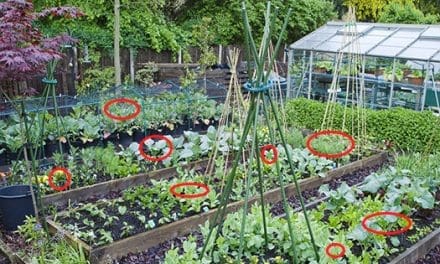
For garden insects, aphids, cucumber beetles, cabbage worms, squash vine borers, and the full range of common vegetable garden pests, professional pest control is rarely the right answer. Physical controls including row cover fabric, hand removal, companion planting, and beneficial insect habitat address most garden pest pressure without chemical application. Where targeted treatment is appropriate, insecticidal soap, neem oil, and Bacillus thuringiensis are all available retail, effective for their specific targets, and a fraction of the cost of a professional application.
Wasp and hornet nests in accessible locations
Single accessible wasp nests in early season, before the colony has reached full size, are DIY-appropriate for most people. A can of pyrethrin-based wasp and hornet spray applied at night when the colony is dormant knocks down a small nest for $8 to $12. Nests inside wall voids, large established nests in eaves or underground with a colony of several thousand workers, and nests in locations that require ladder access near the nest are better handled professionally
Fleas on pets and in limited indoor areas
Flea control on the animal itself, through veterinarian-recommended topical or oral treatments, is the most important single intervention and does not require pest control services. Indoor treatment with diatomaceous earth applied to carpets, cracks, and pet sleeping areas, left for 48 hours and vacuumed, kills adult fleas and larvae through desiccation. This approach costs $10 to $20 and is appropriate for light infestations. Established whole-home flea infestations with egg populations in multiple rooms are more effectively handled professionally because the follow-up timing for catching emerging nymphs is critical and difficult to manage without experience.
When to always call a professional
Some infestations are not appropriate for DIY management regardless of comfort level and tool access. Termites causing structural damage require professional treatment with termiticide, period. Carpenter ant infestations inside structural timbers require professional inspection to assess extent of damage and professional treatment to reach satellite colonies. Bed bug infestations that have spread beyond a single room are almost always more effectively and more quickly resolved by professional heat treatment than by DIY chemical applications that miss hidden populations. Wildlife inside the structure, bats, raccoons, opossums, or squirrels, involves both pest control and wildlife law considerations that require a licensed wildlife removal operator.
Natural and Low-Toxicity Approaches for the Homestead
For a self-sufficient household that prefers to minimize synthetic chemical use on property where food is grown and livestock are kept, several natural approaches are worth integrating into a broader pest management strategy before reaching for conventional pesticides or professional services.
- Diatomaceous earth: food-grade DE applied along baseboards, in crawl spaces, and around foundation entry points kills crawling insects including ants, cockroaches, and silverfish through desiccation. Effective, inexpensive, and safe around children, pets, and food production areas when applied correctly
- Boric acid: mixed with a small amount of sugar and water into a bait paste, boric acid is among the most effective ant and cockroach controls available. Worker insects carry it back to the colony where it kills the queen. Slow-acting but highly effective for established colonies when applied correctly in areas inaccessible to children and pets
- Essential oil deterrents: peppermint oil diluted in water and sprayed along entry points deters mice reliably when applied frequently. Cedarwood oil deters fabric-damaging moths and beetles in storage areas. These are preventive rather than curative and require consistent reapplication
- Predator encouragement: on homestead properties, encouraging natural predator populations, barn owls for rodent control, ground beetles and parasitic wasps for garden pest control, and free-range chickens for tick and insect management, provides ongoing pest pressure reduction at no chemical cost
- Physical exclusion: the most cost-effective pest management investment available on any property. Hardware cloth, door sweeps, copper mesh, and expanding foam seal entry points permanently without any ongoing chemical cost
Building Your Own Pest Management Budget
A realistic annual pest management budget for a homestead property depends on your region, property size, construction age, and whether you are managing ongoing pressure or starting from a clean baseline. A useful framework:
- Prevention and exclusion materials (annual): $50 to $150 for hardware cloth, expanding foam, door sweeps, and basic deterrents
- Trap and monitor supplies (annual): $20 to $50 for snap traps, sticky monitors, and replacement bait
- Natural treatment supplies (annual): $30 to $80 for diatomaceous earth, boric acid, insecticidal soap, neem oil, and row cover fabric for garden pest management
- Professional treatment reserve: set aside $200 to $400 annually as a reserve for situations that require professional intervention. Having this available without budget stress means you call when you need to rather than waiting until an infestation has become significantly worse
Total DIY-focused annual pest management budget for a homestead property: $300 to $680. Total annual cost if relying primarily on professional quarterly service contract plus incidentals: $600 to $1,200. The gap is real and consistent. The DIY approach requires more of your time and attention. The return on that investment is both direct cost savings and the deeper understanding of your property’s pest pressure and entry points that comes from managing it yourself.
The Amish Approach to Pest Control Worked Long Before Modern Chemicals
Long before expensive quarterly pest control contracts and synthetic sprays became the norm, Amish homesteads relied on something simpler: prevention, clean property management, natural deterrents, and practical building methods that discouraged infestations before they started.
That old-school approach is one reason many Amish farms still operate with fewer chemical inputs and far lower maintenance costs than the average modern household.
Inside The Amish Ways, you’ll discover dozens of traditional homestead techniques for maintaining a property naturally, including old-world methods for pest prevention, food storage, gardening, preserving structures, and building a more self-sufficient home using practical knowledge passed down for generations.
These are not trendy internet “life hacks.” They are proven systems refined through decades of real-world rural living.
If you want to reduce dependence on expensive services and learn the kind of practical self-reliance most people have forgotten, this is worth seeing.
👉 Discover The Amish Ways here!
Final Thoughts
Pest control costs what it costs because pest control is skilled work applied to a genuinely difficult problem. When you need it, the price is justified. The goal for a self-sufficient household is not to never pay for pest control. It is to pay for it only when the situation genuinely requires it, and to handle the rest through prevention, early intervention, and targeted DIY treatment that costs a fraction of a professional visit.
The homesteaders who spend the least on pest control over the long term are not the ones who ignore pest problems. They are the ones who take exclusion seriously, monitor consistently, act early when they see signs of activity, and maintain the habitat conditions that discourage pest establishment in the first place. That approach produces better outcomes than any service contract.
You may also like:
Join Our Facebook Group for More Tips, Tricks, and Guides on Homesteading And Gardening
Cut Down On Your Bills In 2026 With These Easy Amish Projects (Video)
How To Make A Safe and Effective Organic Garden Pest Control Spray
Easy DIY Garden Pest Killer You Can Make At Home
The Unseen Garden Pests You’re Accidentally Feeding
Replace Your Harmful Pesticides With THIS