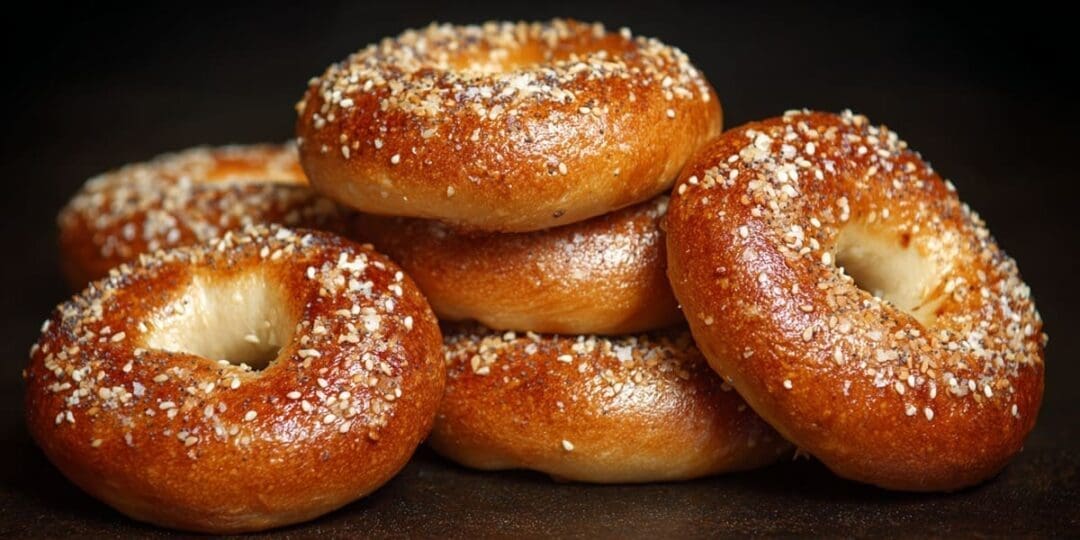
Bagels are one of those foods that appear deceptively simple. Flour, water, yeast, salt. Nothing exotic. Yet anyone who has attempted a proper homemade bagel recipe quickly discovers the truth: bagels are not just bread with a hole.
Traditional bagels are defined by process, not ingredients.
Unlike standard rolls or loaves, authentic bagels rely on a sequence that has remained largely unchanged for generations: mix, knead, shape, boil, then bake. That brief boil — often skipped in modern shortcuts — is what creates the dense crumb, glossy crust, and unmistakable chew.
When done correctly, homemade bagels deliver a texture and flavor profile that mass-produced versions rarely achieve.
Let’s break down the traditional approach in detail.
A Brief Look at Bagel Tradition
Bagels have roots stretching back centuries, traditionally associated with Eastern European baking practices. They were valued not only for taste but for practicality:
- Dense and filling
- Durable compared to soft breads
- Made from inexpensive staples
- Easily stored or transported
Their firm structure made them ideal for working families. Their ingredients made them accessible. Their preparation methods made them reliable.
Bagels are, at their core, survival food refined by culture.
What Makes a True Bagel Different
A proper bagel is defined by three characteristics:
- Dense Crumb
Bagels are intentionally less airy than bread. - Chewy Texture
Developed through high-protein flour and boiling. - Glossy, Structured Crust
A direct result of the boil.
Skipping traditional steps produces bread rolls — not bagels.
The Science Behind Boiling
Boiling bagels before baking is not decorative tradition. It is structural engineering.
- Surface starches gelatinize
- Crust formation begins immediately
- Interior expansion becomes restricted
- Moisture distribution stabilizes
This produces the characteristic chew and shine.
Longer boil = thicker crust & more chew
Shorter boil = lighter texture
Traditional bakeries understood this long before food science gave it vocabulary.
Ingredients (Traditional Bagel Dough)
Core Dough:
- 4 cups bread flour
- 1½ cups warm water
- 2 teaspoons active dry yeast
- 2 tablespoons sugar or honey
- 2 teaspoons salt
For Boiling:
- Large pot of water
- 1 tablespoon sugar or honey
Optional Toppings:
- Sesame seeds
- Poppy seeds
- Dehydrated onion
- Everything seasoning
- Coarse salt
Why Bread Flour Matters
Traditional bagels use higher-protein flour.
More protein = more gluten development = more chew
Using all-purpose flour often results in softer, less structured bagels. They may taste pleasant, but the signature texture suffers.
Bagels are meant to resist slightly.
Preparation – Homemade Bagel Recipe
Step 1 – Yeast Activation
Combine warm water, yeast, and sugar.
Allow 5–10 minutes for foam development.
No foam = inactive yeast = failed rise.
This step prevents wasted effort.
Step 2 – Dough Formation
Add flour and salt.
Mix until cohesive, then knead thoroughly.
Traditional bagel dough is:
- Firm
- Elastic
- Slightly stiff
This density is intentional. Soft dough produces soft bagels.
Step 3 – Kneading for Structure
Bagels require strong gluten development.
Knead for 8–10 minutes minimum.
Look for:
- Smooth surface
- Elastic resistance
- Dough that springs back
Under-kneading = weak structure & poor chew.
Step 4 – First Rise
Allow dough to rise 60–90 minutes.
Bagels do not need dramatic expansion.
A modest rise is sufficient.
Overproofing weakens dough strength.
Step 5 – Traditional Shaping Method
Divide dough evenly.
Roll into tight balls.
Pierce center and gently stretch.
Proper shaping ensures:
- Even baking
- Uniform crumb density
- Stable structure
Avoid thin centers — they collapse easily.
Step 6 – The Boil (Critical Stage)
Bring water to gentle boil.
Add sugar or honey.
Boil bagels 30–45 seconds per side.
Effects of boiling:
- Seals exterior
- Defines crust texture
- Controls oven expansion
Excessive boiling toughens crust unnecessarily.
Step 7 – Baking for Flavor Development
Bake at 220°C (425°F) for 18–22 minutes.
Deep color is essential.
Golden-brown crust = full flavor & proper structure.
Pale bagels often taste underdeveloped.
Cold Fermentation (Traditional Enhancement)
Many traditional methods include refrigeration.
After shaping:
- Cover bagels
- Refrigerate 12–24 hours
Benefits:
- Improved flavor complexity
- Better crust formation
- More controlled texture
Slow fermentation refines dough character.
Texture Control Variables
Bagels are highly adjustable.
For More Chew:
- Use bread flour
- Extend boil slightly
- Increase kneading
For Softer Interior:
- Slightly shorter boil
- Minor hydration increase
Small changes produce noticeable differences.
Common Homemade Bagel Problems
- Flat Bagels
Often caused by overproofing. - Wrinkled Surface
Typically from insufficient boiling. - Excessively Tough Crust
Boil time too long. - Weak Structure
Under-kneading or low-protein flour.
Bagel dough rewards precision.
Water Chemistry Considerations
Traditional bakeries often benefited from mineral-rich water.
Harder water can subtly improve gluten strength.
While not mandatory, it explains regional texture differences historically observed.
Bagel Variations (Traditional Adaptations)
Once the base dough is mastered:
- Cinnamon raisin
- Garlic & onion
- Whole wheat blends
- Honey bagels
- Seeded crust variations
Bagels are remarkably adaptable without abandoning tradition.
Nutritional & Practical Value
Bagels offer practical advantages:
- High satiety
- Stable structure
- Freeze-friendly
- Excellent carriers for preserved foods
They pair naturally with:
- Cured meats
- Fermented spreads
- Shelf-stable toppings
Historically, this mattered greatly.
Why Traditional Recipes Still Matter
Modern convenience encourages dependency on processed foods. Yet traditional baking methods remain powerful tools of self-reliance.
Bagels are built from:
- Shelf-stable ingredients
- Minimal equipment
- Repeatable techniques
No preservatives required.
No specialized additives needed.
Just knowledge.
Final Thoughts
A proper homemade bagel recipe is less about novelty and more about respecting process. Tradition persists because it produces superior texture, flavor, and reliability.
Bagels are a perfect example of how simple ingredients, correctly handled, create exceptional results.
And perhaps more importantly…
They represent skills that remain valuable regardless of circumstance.
Knowledge Beyond the Kitchen
Learning traditional baking is a strong step toward food independence — but it is only one piece of a much larger picture.
The Lost Super Foods is a deeply practical resource exploring forgotten recipes, long-lasting survival meals, and preservation techniques used by generations who lived without modern supply chains.
Inside you’ll discover:
- Shelf-stable breads & staples
- Long-lasting comfort foods
- High-calorie survival meals
- Preservation strategies that work
- Recipes designed for resilience
These are not trendy kitchen experiments.
They are time-tested food solutions.
If you value self-sufficiency, preparedness, and practical food knowledge that holds up under pressure…
Click here to explore The Lost Super Foods!
Because knowing how to make bagels is rewarding.
Knowing how to feed yourself when systems fail is empowering.
You may also like:
50+ Items You Should Stockpile Before The Next Great Depression (Video)
Tinderbread: The Fireproof Biscuit That Lasts Forever
How to Make Cowboy Bread (Lasts Months in Your Pantry)
How To Make Bread Last For Up To 5 Years
Stop Throwing Away Stale Bread. Do This Instead