
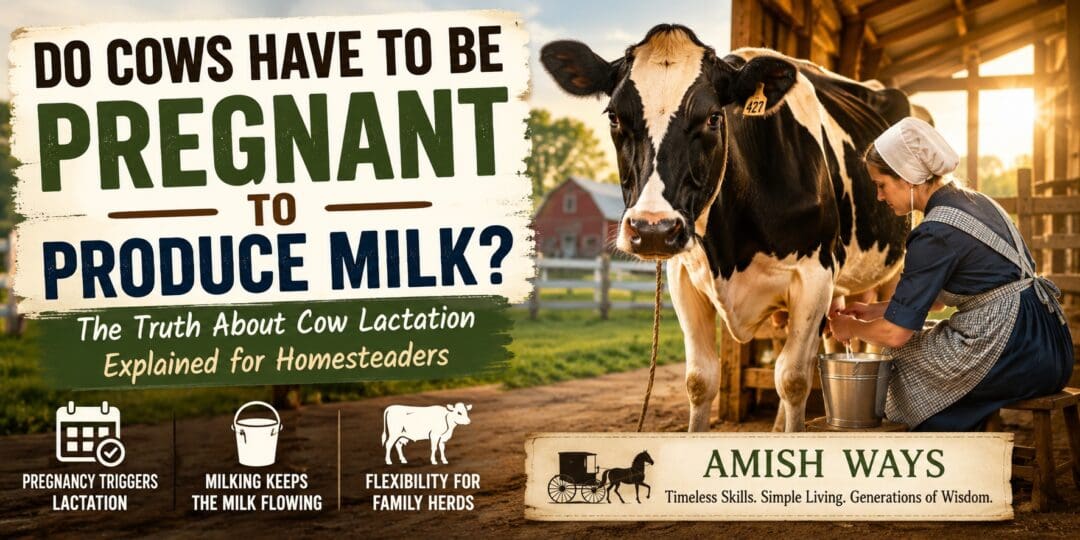
This is one of the questions I get asked most often by people visiting my homestead, usually while they’re watching me milk a cow that very clearly isn’t pregnant at that moment. It’s a fair question, and the honest answer has a little more nuance to it than a simple yes or no. Here’s exactly how it works, based on both the biology involved and my own years of managing a small family milking herd.
The Short Answer
A cow has to become pregnant and give birth to start producing milk in the first place, but she does not need to stay pregnant to keep that milk flowing afterward. Pregnancy and calving are the trigger that switches lactation on. Once it’s on, regular milking is what keeps it going, not an ongoing pregnancy. A cow can, and often does, spend a good chunk of her lactation completely open, meaning not pregnant, and continue producing milk the entire time.
Why Pregnancy Triggers Lactation in the First Place
Milk production in cattle, like in every mammal, is built around raising offspring, so the biology is designed to switch on around birth. During pregnancy, a surge of hormones, prolactin chief among them, prepares the udder for the job ahead. Veterinary physiology research describes how mammary gland development that begins at puberty only fully completes during pregnancy, with milk secretion actually starting in the final part of gestation as prolactin rises. This is why a first-time heifer needs to calve at least once before she’ll ever produce milk. There’s no shortcut around that first pregnancy for a natural lactation to begin.
Once the calf is born, that first milk is colostrum, thick, antibody-rich, and completely different in composition from the milk that follows over the coming days as her supply transitions into regular milk. This transition happens automatically as part of the hormonal cascade of calving, not something a farmer has to manage or trigger separately.
What Actually Keeps the Milk Flowing After That
Here’s the part that surprises people. After calving, milk production is maintained primarily by the physical act of milk removal, either a calf nursing or a person milking her, not by an ongoing pregnancy. University of New Hampshire Extension’s overview of the lactation curve describes a full lactation cycle running around 305 days from calving to dry-off, moving through early, mid, and late lactation phases as production rises, peaks, and gradually declines. None of those phases require the cow to be pregnant. The udder keeps producing as long as it keeps getting emptied regularly, which is the basic supply-and-demand principle behind milk production in every mammal.
This is exactly why a family milk cow on a small homestead can go months without being rebred and still fill your bucket every single day. As long as you keep milking her on a consistent schedule, her body keeps making milk to replace what’s removed, pregnancy or no pregnancy.
Why Dairy Farms Rebreed Cows Anyway
If pregnancy isn’t required to sustain milk production, you might wonder why commercial dairies work so hard to get cows pregnant again so quickly after calving. It comes down to economics and the shape of the lactation curve. Since production naturally peaks a couple of months after calving and then tapers off toward the 305 day mark, dairies want a fresh calving every twelve to thirteen months to keep each cow’s production consistently near that early, high-output phase rather than drifting for years through a long, slowly declining tail end. Michigan State University Extension notes that dairy herd health and production are optimized when a high percentage of cows become pregnant again before 130 days in milk, keeping the whole herd on a tight, predictable annual cycle.
For a commercial operation milking hundreds of cows, that tight annual rhythm is what makes the whole business model work. For someone like me with one or two family cows, that pressure simply doesn’t apply the same way, which opens up more flexibility than most people realize.
How Long Can a Cow Keep Milking Without Getting Pregnant Again?
Longer than most people assume. Research into what’s called extended lactation, deliberately delaying rebreeding well past the traditional window, has found that cows can maintain solid, and sometimes even improved, milk yields over a longer stretch without a new pregnancy. A review published through the National Center for Biotechnology Information found that dairy cows managed with extended lactation and a longer calving interval can maintain or even slightly increase daily milk yield, while also reducing the number of calves produced over a cow’s lifetime, an approach some farms are exploring specifically to ease the imbalance between milk demand and unwanted calf numbers.
On my own homestead, this is basically the approach I’ve landed on with my main milk cow. Rather than rushing to get her rebred within the traditional two to three month window, I let her lactation run considerably longer before I even think about breeding again, since I’m milking for my own family’s needs rather than trying to hit a commercial production target. She stays in milk far longer than a commercial dairy would keep her going, and I skip a calving cycle I don’t actually need.
The Dry Period: Why Cows Eventually Need a Break
Eventually, though, every lactation does need to end, and this is where pregnancy comes back into the picture, just not in the way people expect. The dry period, typically the final six to eight weeks before a cow’s next calving, gives the udder time to rest and regenerate at the cellular level before the next lactation begins. Research on mammary gland involution explains that this is a genuine biological reset, with old, worn-out milk-producing cells being cleared out and replaced by fresh ones through a controlled process of cell turnover, setting the udder up to produce well again in the next lactation.
This dry period only becomes necessary again once a cow is pregnant and approaching her next calving. If you never rebreed a cow at all, she’ll typically keep milking for a long stretch, but production gradually declines over time without the reset that a new pregnancy and dry period provide. Most homesteaders eventually do rebreed for exactly this reason: not because the cow needs to be pregnant to make milk today, but because a future pregnancy and a proper dry period are what keep her productive in the years ahead.
What About Induced Lactation?
There’s one more wrinkle worth mentioning, mostly out of curiosity than practicality. It’s possible, through a carefully managed hormone protocol, to induce lactation in a cow that has never been pregnant at all, essentially tricking her body into producing milk without ever carrying a calf. This is a rare, intensive practice used mostly for research or genetic preservation purposes rather than something practical for a working homestead. It requires precise veterinary management and doesn’t produce the natural onset you’d get from an actual pregnancy and calving. I mention it mainly because people occasionally ask, but it’s not a realistic path for anyone raising a family milk cow.
Discover the Timeless Wisdom of Amish Living
Raising a family milk cow is just one example of the practical knowledge that has been passed down through generations. Amish Ways explores the simple, self-reliant lifestyle of Amish communities, sharing traditional skills, old-fashioned farming methods, food preservation techniques, and everyday practices that still work today.
Whether you’re dreaming of a more sustainable lifestyle or simply want to learn proven homesteading techniques, you’ll find inspiration and practical advice rooted in generations of experience.
Final Thoughts
So, do cows have to be pregnant to produce milk? They have to become pregnant once and give birth to start the process, but after that, regular milking is what keeps the milk coming, not a continuous pregnancy. Most cows spend a significant portion of their lactation completely open. Dairies rebreed quickly to keep production efficient on a commercial scale, but a homesteader with one or two family cows has real flexibility to extend that lactation window, as long as you understand that a future pregnancy and dry period are still part of keeping her productive for years to come.
You may also like:
Join Our Homesteading Community HERE!
How To Build An Endless Hot Water System Without Electricity (Video)
Goat Milk: The Complete Homesteader’s Guide to Raising, Milking, and Using It
How to Preserve Milk for Years
Soft Milk Bread Without An Oven


















1%2527%2522