
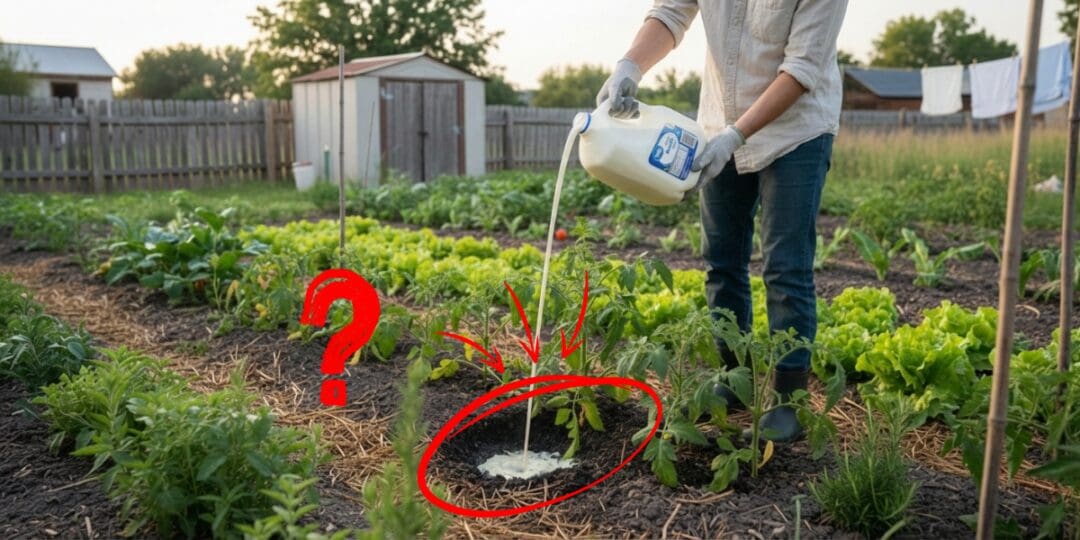
You open the fridge, reach for the milk carton, and notice it expired three days ago. Your instinct says toss it. But what if that sour milk could be better than commercial fungicidesfor plants? Homesteaders used spoiled milk in their gardens for centuries, a practice most of us have forgotten or never learned in the first place.
Now, before you dump it straight onto your tomatoes, there’s more to this story than the usual “milk has calcium” advice you’ve been hearing about. Here’s what actually happens when dairy goes into the soil.
Why People Used to Keep Spoiled Milk Around
Not so long ago, people were not big fans of tossing expired milk. In Europe homesteaders routinely poured sour milk around their vegetables, and Korean Natural Farming still uses fermented milk products as a cornerstone practice.
Spoiled milk is packed with the same bacteria that make yogurt and sauerkraut. These organisms break down milk proteins into nitrogen that your plants can certainly use.
But besides the nitrogen, spoiled milk also offers microorganisms. The bacteria in soured milk feed the plants, and even more importantly, they colonize the soil. This is a key because these good bacteria compete with disease-causing organisms. Traditional farmers in dairy regions observed fewer fungal problems on crops treated with whey or sour milk.
What Actually Happens When You Water Your Garden with Spoiled Milk 
Pour spoiled milk into your garden bed, and within hours, soil microorganisms start breaking it down. The liquid portion penetrates quickly, while milk solids (proteins and fats) take longer to decompose. You’ll see a spike in microbial activity within 24-48 hours as bacteria consume the lactose and proteins.
And here’s something else. Slightly soured milk (a few days past expiration) works better than completely rotten milk. Once milk reaches the chunky, separated stage with clear whey, it’s harder for the soil to process and more likely to cause problems.
How Can This Make Your Garden Thrive?
The big surprise with spoiled milk is not the nutrients. You can use other methods to achieve that, such as compost, animal manure, mulching, eggshells, and so on. What makes the spoiled milk method so effective is the disease control it offers and the bacteria that enhance the soil once you start using it.
Research from the Connecticut Agricultural Experiment Station found that diluted milk sprays reduced powdery mildew on pumpkin leaves almost as well as chemical fungicides. In field trials, milk was about 50–70% as effective as conventional fungicides at controlling visible mildew.
The study also found that pumpkin plants treated with milk produced better harvests. Milk-treated plants achieved about 40–50% of the yield improvement seen in plants treated with chemical fungicides, meaning milk sprays still noticeably boosted crop quality and production compared to doing nothing.

This kind of natural disease prevention becomes even more valuable when you’re growing medicinal plants that you will consume and other herbs that need to stay chemical-free. The same goes for any crop where you can’t risk contamination. Knowing you have natural alternatives in your toolkit changes how you approach garden health.
Since spring is just around the corner, this is the time I prefer to restock my herb seeds. Generally, I start planting them mid-March since the soil temperature is ideal for germination. To respect this plan, I always buy seeds by the end of February.
This Medicinal Garden Kit has every staple plant any homesteader needs: painkilling herbs such as chicory, California poppy, which helped me with my crippling insomnia, chamomile, or what some people call the natural antibiotic, and many more.
I want to extend my herb garden, so I will combine the seeds I managed to gather from the plants I grew last year with the new ones. If you want reliable seeds and a strong start, it’s worth checking them out. Click here to order your seeds and get ready for spring planting!
Things to Be Careful About Before You Start
Let’s address a problem that not many talk about regarding the spoiled milk method. This milk smells terrible, and that smell attracts every raccoon, opossum, and rat that happens to wander around your property. The smell is manageable if you dilute heavily and apply directly to soil rather than foliage, but it’s still there for 2-3 days.
Unfortunately, I had problems with rats and raccoons long before I started to use “smelly” fertilizers. Having a simple trash can in your backyard will attract them like a free buffet. What saved our homestead were the DIY traps my husband built. You can find more about the simple method he used in the following video.

Besides the smell, fat is another problem. Milk fats can coat soil particles and create hydrophobic layers that repel water. If you apply too much milk, especially whole milk, rain and irrigation will have them run off instead of soaking in. This is an even more concerning problem in clay soils.
Never use too much milk at once. This is a mistake most people make when they start, but it can kill your plants. Over-application causes nitrogen burn. Milk proteins are high in nitrogen, and dumping undiluted milk gives plants more than they can handle. You’ll see yellowing leaves with brown tips within days.
How to Use Spoiled Milk in Your Garden the Right Way
Dilute, dilute, dilute. This is something you have to do each time you decide to use this method. Mix one part spoiled milk with four parts water for soil application, or one part milk to ten parts water for the sprays you’re going to use on the leaves of the plants. More than this risks all the problems I mentioned above.
Apply to the soil around plants, not directly on stems. For leaf application (disease prevention only), spray early morning so leaves dry quickly. Never spray in full sun as the milk can burn leaves in sunny weather.
Another thing I need to mention is that you can’t use this method forever. Once every two weeks is the maximum for soil application. And once a week for fungal prevention sprays. More frequent application leads to unwanted salt and fat buildup.
👉 Use Salt Like THIS and Your Food Will NEVER Spoil Again!
The type of milk you use can offer some advantages, but in the long run, it doesn’t matter that much. Pasteurized milk works fine; raw milk has more diverse bacteria, but it isn’t a must. Whole milk versus skim makes little difference, except that skim has less fat to cause water repellence issues. If you’re using milk fortified with vitamin D, that’s fine, as the small amount won’t affect anything.
Make sure to first test on a small area. Every garden has different soil biology, and what works in my raised beds might cause problems in your clay-heavy ground.
Alternative Uses That May Work Better
To be honest with you, for most homesteaders, composting spoiled milk makes more sense than direct application. This is more effective when you want to get the nutrients and bacteria. Add it to your compost pile with plenty of carbon-rich materials (leaves, straw, wood chips). The smell dissipates as it breaks down, and you get the nutrients without the pest problems.
For homesteaders with pigs or chickens, feeding spoiled milk to livestock makes more practical sense than garden application. They’ll convert it to manure, which you can compost and use safely without odor or pest concerns.
Related: Don’t Throw Away Spoiled Milk! Do This Instead!
But keep in mind that if you want to use the spoiled milk for powdery mildew, direct application with a spray on the leaves is the only thing that will give you results. You can’t work around this one.
Final Thoughts
Spoiled milk can give your garden a boost and protect it against fungi, but it’s not a miraculous solution that will solve everything. The fungicidal properties are indeed real and useful. That alone makes it worth considering for powdery mildew-prone crops.
The nutrients and microorganisms are legitimate, though nothing special compared to other organic fertilizers. There are some better options out there, such as rice water.
For most situations, I’d choose composting or feeding to livestock over direct application. But if you’re already making dairy products and have whey to spare, or you’re fighting powdery mildew on your cucurbits, diluted spoiled milk is a worthy addition to your toolkit.
You may also like: 
The ONLY 39 Foods You Need in Your Stockpile (Video)
How to Preserve Milk for Years
What Happens If You Use Powdered Milk To Your Plants
Soft Milk Bread Without An Oven























I will look further into this spoiled milk theory. Not often that a have any, but since this is about microbes, a thought occurred to me. I make kefir and it’s rather foamy when I strain the grains. If I mix what’s left on the sides of my glass with water, can I put that on my soil or in my compost? The microbes are what ferments the milk.
Sure thing! Using up the kefir residue mixed with water is pretty much fine. Just make sure you mix 1 part kefir residue with about 4 parts water so you don’t overwhelm the plants.