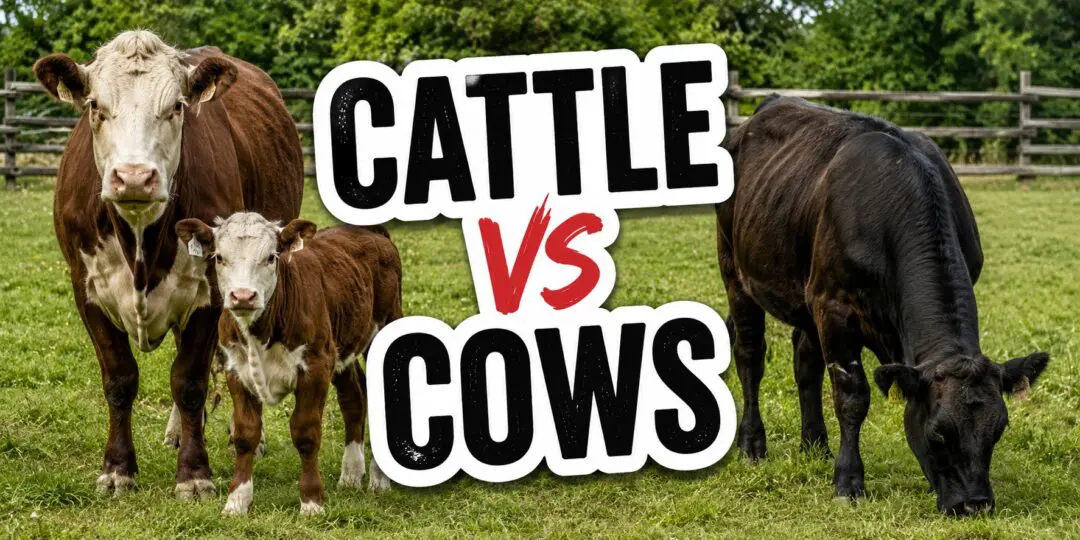
Most people use cattle and cows interchangeably, and honestly, most of the time it does not matter. But the moment you start planning to bring livestock onto your own land, that loose terminology stops being harmless and starts costing you money and confusion. Ask a livestock auction for cows when you actually need steers, or tell a feed store you are buying cattle when you specifically want a milking animal, and you will get puzzled looks at best and the wrong animal at worst.
Here is the short version: cattle is the umbrella term for the entire species, covering every age and sex. Cow refers specifically to an adult female that has already given birth. Everything else, bulls, steers, heifers, and calves, is a more specific term nested under the word cattle. This guide breaks down exactly what each term means, why the distinction matters for anyone raising livestock, and how to avoid the mix-ups that trip up almost everyone new to cattle.
Cattle Is the Umbrella Term
According to Purdue Extension’s breakdown of beef cattle terminology, cattle is the accurate term to use when referring to a mixed group of adult male and female bovine animals, and using cow as a catch-all for every animal in a pasture is technically incorrect once you know better. Cattle is what is known grammatically as a plurale tantum, meaning it functions as a plural word with no true singular form. You cannot correctly say one cattle. You would instead say one cow, one bull, or one head of cattle if the sex and age are unknown.
Think of cattle the way you think of poultry. Poultry describes chickens, ducks, geese, and turkeys collectively, but you would never call a rooster a hen just because both are technically poultry. Cattle works the same way. It is the correct collective term, while cow, bull, steer, and heifer are the specific labels underneath it.
Cow: A Very Specific Term Most People Misuse
A cow, in the accurate agricultural sense, is an adult female that has already given birth to at least one calf. A young female that has not yet calved is not a cow, she is a heifer, regardless of her age or size. Cornell CALS’ beef cattle terminology reference confirms this same distinction, defining cattle broadly as any animal belonging to the bovine species while reserving cow specifically for a female that has calved.
This matters enormously if you are buying your first animal. A seller advertising heifers and one advertising cows are not offering the same product, even if both animals look similar in size and both are female. A bred heifer close to calving might be marketed as a springer, while that same animal is only correctly called a cow once she has actually given birth.
Bull: The Intact, Breeding-Age Male
A bull is a sexually mature, non-castrated male used for breeding. Bulls are noticeably larger and more muscular than other cattle, with a thick neck, a pronounced crest over the shoulders, and a naturally more aggressive temperament driven by testosterone. A Farm and Dairy explainer citing Oklahoma State University Extension notes that a single bull can breed roughly 25 to 30 cows in a season, which is why most cow-calf operations, including small homestead herds, only need to keep one or two bulls even with a much larger group of females.
Bulls require more caution than any other class of cattle. Their size, strength, and hormone-driven behavior make them the most dangerous animal on a typical homestead, and many small operations choose to skip keeping a bull entirely, opting instead to use artificial insemination or borrow a neighbor’s bull only during breeding season.
Steer: A Castrated Male, and the Animal Behind Most Beef
A steer is a male that has been castrated, typically as a young calf, specifically to prevent it from breeding and to make it calmer and easier to manage. Castration also changes the animal’s hormone profile in a way that improves meat tenderness and marbling. According to Cornell’s beef terminology glossary, steers are cattle castrated before reaching sexual maturity, which distinguishes them from a stag, an older bull castrated after developing adult bull characteristics, which retains a coarser, more bullish appearance even after castration.
For homesteaders raising cattle strictly for meat, steers are usually the animal of choice. They grow efficiently, handle safely, and do not carry the management complications that come with an intact bull on the property.
Heifer: A Young Female That Has Not Yet Calved
A heifer is a female that has not given birth. Once she calves for the first time, she officially becomes a cow, though some regions and operations use the term first-calf heifer for a short transitional period after that first birth. University of Tennessee’s cattle and beef market definitions guide defines a heifer simply as a female bovine that has not produced offspring, a definition used consistently across breeding programs, sale barns, and market reporting.
Heifers are typically bred for the first time between 12 and 15 months of age, once they reach adequate body weight and reproductive maturity, and they carry a calf for roughly nine and a half months before calving for the first time and earning the title of cow.
Calf: Any Young Bovine, Regardless of Sex
A calf is simply a young bovine under one year old, male or female. Once a calf is weaned off milk, it is sometimes called a weanling, and once it passes the one-year mark it becomes a yearling. A male calf destined to remain intact is called a bull calf, while one that will be castrated is simply referred to as a steer once the procedure is done. A female calf is a heifer calf. The Cornell CALS glossary confirms that calves refers to young cattle of either sex under one year of age, with no distinction made by gender at this life stage.
Ox: A Working Animal, Not a Separate Breed
An ox is not a distinct type of cattle, it is a castrated adult male, typically the same animal you would otherwise call a steer, that has been trained specifically as a draft animal for pulling plows, carts, or heavy loads. Historically, oxen were often mature steers selected for their size and calm temperament and trained over one to two years to work in a yoke. Any breed of cattle can theoretically become an ox, though larger, more even-tempered breeds are traditionally favored for the role.
Quick Reference: Cattle Terminology at a Glance
- Cattle: the umbrella term for the entire species, covering all ages and both sexes
- Cow: an adult female that has given birth to at least one calf
- Bull: an intact, sexually mature male used for breeding
- Steer: a castrated male, typically raised for beef
- Heifer: a young female that has not yet given birth
- Calf: a young bovine of either sex, under one year old
- Ox: a trained, castrated male used for pulling and farm labor
- Bullock: a term used in some regions, especially outside North America, for a young bull or a castrated male
Why This Distinction Actually Matters on a Homestead
Getting this terminology right is not just about sounding knowledgeable at the feed store, though that helps too. It directly affects the decisions you make when building a small herd:
- Buying for meat: steers and heifers not intended for breeding are typically the most cost-effective and manageable choice, since they are calmer than bulls and do not require breeding management
- Buying for milk: you need a cow, specifically one that has already calved and is in or approaching a lactation cycle, not a heifer that has never given birth
- Buying for breeding: a bull is a significant, sometimes dangerous, long-term commitment, and many small operations are better served renting breeding services or using artificial insemination instead of keeping one full time
- Selling or trading animals: using precise terminology when advertising or negotiating prevents misunderstandings about an animal’s age, temperament, and intended use
The Bottom Line
Cattle is the correct term for the species as a whole. Cow is one specific role within that species, reserved for females that have already calved. Once you have this framework down, the rest of the terminology, bull, steer, heifer, calf, and ox, falls into place quickly because each term is simply describing a specific combination of age, sex, and reproductive or working status. Whether you are buying your first dairy cow, raising a couple of steers for the freezer, or just want to stop getting corrected at the sale barn, understanding cattle vs cows is the first real step toward speaking the language of the people who have been raising these animals for generations.
You may also like:
 Join Our Humble WhatsApp Homesteading Community
Do You Know Why You Should Never Put A Tall Fence Around Your House? (Video)
What Do Cows Eat? A Complete Guide to Cattle Nutrition for Homesteaders
Dexter Cows: The Small Cattle With a Big Role in Self-Sufficiency
Common Cowkeeper Mistakes Even The Most Advanced Can Make