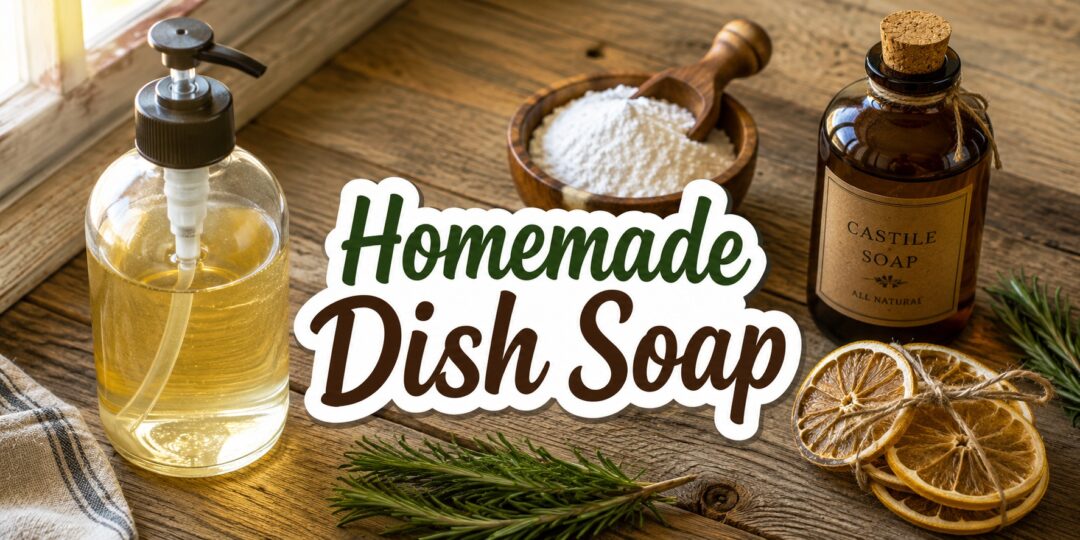
Every homesteader reaches a point where buying another plastic bottle of dish soap off the grocery shelf starts to feel wrong. It is one small purchase, sure, but multiply it across a year and you have a pile of single-use plastic, a list of ingredients you cannot pronounce, and money leaving your household for something you could have made yourself in twenty minutes. Homemade dish soap is one of the most accessible DIY household projects there is, and once you understand the ingredients and the underlying chemistry, you can dial in a formula that works as well as or better than anything from the store.
This guide covers everything: the science behind how soap cleans, the core ingredients and what each one does, multiple recipes from basic to advanced, troubleshooting advice, cost comparisons, and how to store and use your finished product effectively. Whether you are starting from scratch or looking to refine a formula you have already tried, this is the reference you need.
Why Make Your Own Dish Soap?
The reasons homesteaders make their own dish soap fall into a few consistent categories, and they tend to reinforce each other once you start.
- Cost savings are real but modest on a per-batch basis. The more significant financial benefit comes from concentrating your formula so that a small amount goes further than a commercial bottle, and from buying ingredients in bulk that serve multiple household purposes. Washing soda, castile soap, and white vinegar all do double or triple duty in a well-stocked homestead cleaning cabinet.
- Ingredient transparency matters more to some people than others, but once you start reading commercial dish soap labels it is hard to stop noticing the long list of synthetic surfactants, preservatives, colorants, and fragrance compounds. The Environmental Working Group’s Guide to Healthy Cleaning rates hundreds of commercial dish soaps and finds that many receive poor scores for ingredient disclosure and potential health or environmental concerns. A homemade formula puts you in complete control of what goes on your dishes and down your drain.
- Reduced plastic waste is straightforward: a batch of homemade dish soap made with bulk ingredients in a reusable dispenser eliminates several plastic bottles per year per household. Across a homestead that is also making its own laundry detergent, hand soap, and surface cleaners, the reduction adds up meaningfully.
- Self-reliance is the deeper motivation for most people reading this. The ability to keep your kitchen clean without a supply chain is a genuine preparedness asset. The ingredients for homemade dish soap store for years, cost very little, and give you one less dependency on systems you do not control.
How Dish Soap Actually Works: The Basics
Understanding the chemistry behind dish soap makes you a much better formulator. You do not need a chemistry degree, but grasping three concepts will explain why every ingredient in a dish soap formula is there.
Surfactants are the active cleaning agents in any soap or detergent. The word is short for surface-active agents. A surfactant molecule has one end that is attracted to water (hydrophilic) and one end that is attracted to oils and fats (hydrophobic). When you add dish soap to greasy water, the surfactant molecules orient themselves around grease particles with their oil-loving ends inward and their water-loving ends outward, forming structures called micelles. The micelles suspend the grease in the water so it can be rinsed away. This is why soap cleans grease: it bridges the gap between water and oil.
In homemade dish soap, the primary surfactant is almost always liquid castile soap or a potassium-based soap derived from plant oils. These provide genuinely good grease-cutting ability, though they can be sensitive to hard water (more on that below).
pH matters because cleaning power increases with alkalinity. Most grease and food soils are acidic or neutral, and an alkaline cleaning solution breaks them down more effectively. Baking soda and washing soda are both alkaline boosters commonly added to dish soap formulas. Washing soda (sodium carbonate) is significantly more alkaline than baking soda (sodium bicarbonate) and provides more cleaning power, but it can also be harder on skin with extended contact.
Hard water is the most common reason homemade dish soap fails for people who made it correctly. Hard water contains dissolved calcium and magnesium ions that react with soap molecules to form insoluble compounds called soap scum. The result is reduced lather, white film on dishes, and a soap that feels like it is not working. If you have hard water, your formula needs to account for it. Salt, citric acid, and washing soda are all tools for managing hard water in homemade formulas.
Core Ingredients and What They Do
These are the building blocks of virtually every homemade dish soap formula. Understanding each one lets you troubleshoot problems and adapt recipes to your water and preferences.
Liquid Castile Soap
Castile soap is a plant-oil-based soap, traditionally made with olive oil but now commonly made with a blend of olive, coconut, hemp, and jojoba oils. It is the backbone of most homemade dish soap formulas, providing the primary surfactant action. Dr. Bronner’s is the most widely available brand, but many other quality castile soaps exist. Look for unscented or lightly scented versions if you plan to add your own essential oils.
The saponification process that creates castile soap converts plant oils and an alkali (potassium hydroxide for liquid soap) into soap molecules and glycerin. The glycerin byproduct is what gives castile-based soaps their skin-conditioning quality relative to synthetic detergent-based products.
Washing Soda (Sodium Carbonate)
Washing soda, sold under brand names like Arm and Hammer Super Washing Soda, is sodium carbonate. It is distinct from baking soda (sodium bicarbonate) and significantly more alkaline, with a pH around 11. In dish soap formulas, washing soda acts as a water softener and cleaning booster. It binds to the calcium and magnesium ions in hard water, preventing them from interfering with the soap’s cleaning action. It also increases the overall alkalinity of the formula, improving grease-cutting performance.
Washing soda can be made at home by spreading baking soda on a baking sheet and heating it in a 400 degree F oven for about an hour. The heat drives off water and carbon dioxide, converting sodium bicarbonate to sodium carbonate. The finished product looks slightly different: less fluffy, more dense, and slightly yellowed.
White Vinegar
White vinegar is acidic (pH around 2.4) and serves several functions in homemade cleaning products. In dish soap, it acts as a rinse aid when added in small amounts, helping prevent water spots and mineral deposits on dishes and glassware. It also has mild antimicrobial properties and helps cut through grease.
One important note: do not mix vinegar directly with castile soap in your formula. The acid in vinegar reacts with the alkaline soap molecules and unsaponifies them, essentially turning them back into their component oils. The result is a curdled, oily mess that does not clean well. Vinegar works best as a separate rinse aid added to your dishwasher’s rinse aid compartment, or used on its own as a final rinse rather than combined in the dish soap formula itself.
Baking Soda (Sodium Bicarbonate)
Baking soda is a mild abrasive and alkalinity booster with a gentler profile than washing soda. It is useful in dish soap formulas as a mild scrubbing agent for stuck-on food and as a deodorizer. It is gentler on skin than washing soda and appropriate for formulas intended for regular hand-contact use. However, it provides less water-softening and grease-cutting power than washing soda.
Salt (Sodium Chloride)
Plain table salt or kosher salt thickens liquid soap formulas through a process called salt thickening, where sodium ions interact with the surfactant structure to increase viscosity. A small amount of dissolved salt (typically one to two teaspoons per cup of soap) can transform a thin, watery formula into a satisfyingly thick dish soap. Salt also has mild preservative properties that extend shelf life.
Essential Oils
Essential oils serve two purposes in homemade dish soap: fragrance and mild antimicrobial action. The most commonly used essential oils for dish soap are lemon, orange, tea tree, lavender, and peppermint. Citrus oils (lemon and orange) are particularly popular because their fresh scent is associated with cleanliness and they complement the degreasing action of the soap. Tea tree oil has well-documented antimicrobial properties and is a good choice for formulas intended for cutting boards and surfaces that contact raw meat.
Use essential oils at a rate of 0.5 to 1 percent of the total formula weight (roughly 10 to 20 drops per cup of finished soap). More than this is wasteful and can cause skin sensitization with repeated use. Always use genuine essential oils, not fragrance oils, which are synthetic compounds with no antimicrobial benefit and which may contain allergens.
Vegetable Glycerin
Vegetable glycerin is a humectant, meaning it attracts and holds moisture. Adding a small amount (one to two teaspoons per batch) to your dish soap formula helps protect skin from the drying effects of repeated dish washing. It also adds a slight viscosity boost. Glycerin is inexpensive, widely available, and a worthwhile addition to any dish soap formula used for hand washing.
Basic Homemade Dish Soap Recipe
This is the starting point: a simple, effective formula that works well in moderately hard to soft water and is gentle enough for regular hand use.
You will need:
- 1 cup liquid castile soap (unscented)
- 1/4 cup water
- 1 tablespoon washing soda
- 1 teaspoon vegetable glycerin
- 15 to 20 drops essential oil of your choice (optional)
- 1 teaspoon salt (for thickening, optional)
Instructions:
- Dissolve the washing soda in the water first. Stir until fully dissolved; this may take a minute or two. Washing soda does not dissolve instantly the way salt or baking soda does.
- Add the castile soap to the dissolved washing soda solution and stir gently. Avoid vigorous stirring or shaking, which creates excessive foam that is difficult to work with.
- Add the glycerin and stir to combine.
- If using essential oils, add them now and stir gently.
- If you want a thicker soap, dissolve the salt separately in a tablespoon of warm water and add it slowly to the mixture while stirring. Add slowly and stop when you reach your desired consistency, as adding too much salt can cause the soap to thicken beyond what is pourable.
- Pour into a clean dispenser bottle or pump bottle. A recycled commercial dish soap bottle works perfectly.
- Label with the date and ingredients. Shelf life is approximately two to three months at room temperature.
To use: Apply a small amount directly to a dish sponge or brush, or add a tablespoon or two to a basin of hot water. A little goes a long way; homemade castile-based soap is more concentrated than many commercial formulas.
Heavy-Duty Dish Soap for Greasy Jobs
When you are cleaning cast iron that someone used for bacon, or washing up after a big canning day, you need more grease-cutting power. This formula adds extra degreasing agents and is better suited to tough jobs, though it is slightly harder on skin with extended contact.
You will need:
- 1 cup liquid castile soap
- 1/4 cup washing soda
- 2 tablespoons white vinegar (added separately at the end, see note below)
- 1 tablespoon baking soda
- 1/4 cup warm water
- 20 drops lemon essential oil
- 20 drops orange essential oil
Instructions:
- Dissolve the washing soda and baking soda in the warm water, stirring until fully combined.
- Add the castile soap very slowly to the dissolved soda mixture, stirring gently as you pour.
- Add the essential oils and stir to incorporate.
- Pour into your dispenser. Do not add the vinegar to the main formula.
- Vinegar as a separate rinse aid: Keep a small spray bottle of undiluted white vinegar at the sink. After washing dishes with the soap formula, a quick spray of vinegar on glassware and a rinse with hot water eliminates water spots and mineral film. This gives you the benefits of vinegar without the incompatibility problem.
Liquid Dish Soap from Scratch: The Bar Soap Grate Method
If you already make your own bar soap, or if you have access to a good quality unscented bar soap, you can make liquid dish soap by dissolving grated bar soap in water. This method gives you more control over the soap base and is particularly useful for homesteaders who are already producing their own soap from wood ash lye or purchased lye.
You will need:
- 4 ounces (approximately 1 cup grated) plain bar soap, unscented
- 4 cups water
- 1 tablespoon washing soda
- 1 teaspoon vegetable glycerin
- Essential oils as desired
Instructions:
- Grate the bar soap on a fine cheese grater or food processor. Finer grating means faster dissolution.
- Bring the water to a simmer in a medium saucepan. Do not boil vigorously.
- Add the grated soap to the simmering water and stir until completely dissolved. This may take 10 to 15 minutes.
- Remove from heat and stir in the washing soda and glycerin.
- Allow to cool to room temperature. The mixture will thicken significantly as it cools; this is normal. If it sets too thick, add warm water a tablespoon at a time and stir to reach a pourable consistency.
- Add essential oils once the mixture has cooled (high heat drives off essential oil fragrance).
- Pour into dispensers. This formula tends to produce a thicker, more gel-like soap than the castile-based formulas.
The National Sustainable Agriculture Information Service maintains resources on homemade soap making and household product formulation as part of its sustainable homesteading curriculum, which is useful for homesteaders building out a complete DIY household product system.
Dish Soap Concentrate
If storage space is at a premium or you want to reduce the number of containers you are managing, making a concentrate that you dilute at the sink is a practical option. Concentrates also travel better for camping and off-grid use.
You will need:
- 2 cups liquid castile soap
- 2 tablespoons washing soda
- 2 tablespoons vegetable glycerin
- 30 drops essential oils
- No added water
Mix the washing soda and glycerin directly into the castile soap and stir gently until the washing soda is fully dispersed. Add essential oils. Store in a small bottle. To use, add one to two teaspoons of concentrate to a sink full of hot water, or apply a few drops directly to a wet sponge. A 16-ounce bottle of concentrate made this way will last a household of four roughly two to three months of daily dish washing.
Troubleshooting Common Problems
Most problems with homemade dish soap come down to a few predictable issues. Here is how to diagnose and fix them.
The Soap Is Too Thin and Watery
Thin soap is the most common complaint. It does not feel like it is working even if it actually is, and it pours out too fast. Solutions: add dissolved salt slowly to thicken (start with half a teaspoon dissolved in a tablespoon of warm water, add to the batch, and stir). Alternatively, reduce the water content in your formula next time. You can also add a small amount of xanthan gum (a quarter teaspoon per cup of soap) stirred in very thoroughly, which acts as a thickener without affecting cleaning performance.
The Soap Is Curdled or Separated
Curdling almost always means vinegar or another acid was mixed directly into the castile soap base. The acid unsaponifies the soap. If this happens, the batch is compromised and difficult to recover. Start fresh and keep acids separate from your soap base.
Separation (oil floating on top) can also occur if ingredients were not fully mixed or if the washing soda was not fully dissolved before adding the soap. Gently re-stir the batch; if it comes back together, it is fine to use. If it remains separated, the washing soda likely did not fully dissolve and you will need to strain it out and start the dissolving step again.
Soap Leaves a Film on Dishes
Film on dishes is almost always a hard water problem. Hard water minerals react with soap to leave a white or cloudy residue. Increase the washing soda in your formula to soften the water before the soap is added. Use a vinegar rinse after washing. If you have very hard water, consider adding a few drops of citric acid solution to your dishwater as a chelating agent, which binds the calcium and magnesium ions and prevents them from reacting with the soap.
The Soap Does Not Lather Much
Low lather is normal with castile-based soaps, especially in hard water. Lather is not a reliable indicator of cleaning power; it is a sensory expectation created by decades of commercial soap marketing. That said, if you want more lather you can add a small amount of fractionated coconut oil or increase the proportion of coconut-oil-based castile soap in your formula, as coconut oil soaps produce more lather than olive oil soaps.
The Soap Irritates Skin
Skin irritation usually means the formula is too alkaline, typically from too much washing soda. Reduce the washing soda in your formula and increase the glycerin. You can also try substituting baking soda for washing soda for a gentler formula. If you are using essential oils at high concentrations, reduce or eliminate them and see if the irritation resolves; some people are sensitive to specific essential oil compounds with repeated skin contact.
Scent Combinations Worth Trying
Fragrance is one of the most enjoyable parts of formulating your own soap. These combinations work well in dish soap and are popular with homesteaders.
- Lemon and rosemary: 15 drops lemon, 10 drops rosemary. Clean, herbal, effective. A classic kitchen scent.
- Orange and clove: 15 drops sweet orange, 5 drops clove. Warm and spicy with excellent antimicrobial coverage from the clove.
- Peppermint and tea tree: 12 drops peppermint, 12 drops tea tree. Fresh and clean with strong antimicrobial action. Good for cutting boards and high-use surfaces.
- Lavender and lemon: 15 drops lavender, 10 drops lemon. Soft and pleasant, good for households with children.
- Unscented: For those with fragrance sensitivities or households with infants, an unscented formula using only castile soap, washing soda, glycerin, and salt is perfectly effective and appropriate for all family members.
Cost Comparison: Homemade vs Commercial
The economics of homemade dish soap depend heavily on how you source your ingredients, but the numbers consistently favor making your own, especially at bulk purchase scale. A 32-ounce bottle of Dr. Bronner’s liquid castile soap costs approximately $14 to $16 and produces roughly three to four batches of dish soap at the basic recipe proportions. Washing soda, baking soda, salt, and glycerin cost only a few cents per batch when purchased in bulk. Essential oils add cost but are used in small quantities.
The USDA Economic Research Service tracks household expenditure on cleaning products. The average American household spends approximately $150 to $200 per year on cleaning supplies. Homesteaders who produce their own dish soap, laundry detergent, surface cleaners, and hand soap from shared bulk ingredients can typically cover the same cleaning needs for $30 to $50 in raw materials, a savings of well over 70 percent. The savings compound when you buy washing soda, castile soap, and essential oils in quantity.
Storage, Shelf Life, and Dispensing
Homemade dish soap made with castile soap and washing soda has a shelf life of approximately two to three months at room temperature before the essential oils begin to fade and the soap may start to separate. The formula itself does not go bad in a way that makes it unsafe or ineffective for much longer, but the fragrance and appearance degrade.
To maximize shelf life: store finished soap away from direct sunlight and heat, use a pump or flip-top dispenser rather than leaving the bottle open, and make smaller batches more frequently rather than large batches infrequently. If you notice the soap separating in the bottle after a few weeks, a gentle shake is usually sufficient to recombine it.
For long-term ingredient storage, castile soap keeps well for several years in a cool, dark location. Washing soda and baking soda are essentially indefinite shelf life ingredients if kept dry. Essential oils, stored in dark glass bottles away from heat, remain potent for one to three years depending on the specific oil. Citrus oils have shorter shelf lives than woodsy or floral oils.
The best dispensers for homemade dish soap are foam pump dispensers, which aerate the soap as it is dispensed and make it feel more voluminous than it is, reducing the amount used per wash. Standard pump dispensers also work well. Avoid squeeze bottles with very small openings, as thickened formulas can clog them.
Scaling Up for Homestead Use
If you are making dish soap for a large household, a homestead with multiple buildings, or as part of a broader homemade cleaning product operation, batch scaling is straightforward. All of the recipes above scale linearly: doubling every ingredient doubles the yield.
For large batches, mixing in a bucket with a long-handled spoon or a hand mixer on the lowest setting works well. Avoid using a standard stand mixer or immersion blender at high speed, as this incorporates too much air and creates foam that takes hours to settle. A hand whisk or spoon is sufficient and avoids the foam problem.
Consider making a master concentrate and storing it in labeled gallon jugs, then diluting into dispenser bottles as needed. This approach minimizes the number of times you are measuring small ingredient quantities and keeps your cleaning cabinet organized. A single afternoon of soap making can produce enough concentrate to last a family of four three to four months.
Beyond the Sink: Other Uses for Your Homemade Dish Soap
Once you have a working dish soap formula, it serves a surprising number of purposes beyond washing dishes.
- Vegetable wash: A few drops of dish soap in a bowl of cold water makes an effective produce wash for removing surface pesticide residue and wax coatings from store-bought vegetables and fruit. Rinse thoroughly after washing.
- Hand soap: Any dish soap formula made with glycerin is gentle enough for use as hand soap. Keep a pump by the sink and use it for hand washing as well as dish washing.
- Pest spray for the garden: A diluted solution of castile-based dish soap (one tablespoon per quart of water) is an effective contact spray for soft-bodied garden pests including aphids, spider mites, and whiteflies. Spray directly on pests, avoiding flower parts and new growth. The soap disrupts the insects’ outer cell membranes on contact.
- Floor cleaner: A small squirt of dish soap in a bucket of warm water makes a good general-purpose floor cleaner for tile, vinyl, and sealed hardwood.
- Stain pre-treatment: Apply a small amount of dish soap directly to a grease stain on clothing before laundering. The degreasing surfactants in the soap are highly effective on oil-based stains.
Want to Learn More Time-Tested Amish Household Skills?
If making your own dish soap appeals to you, imagine what else you could replace with simple, proven homestead knowledge. The Amish Ways Book is packed with practical techniques for creating everyday household essentials, preserving food, reducing waste, and living more independently without relying on expensive store-bought products.
Discover the traditional methods that have helped Amish families thrive for generations, and bring more self-sufficiency into your own home.
👉 Get your copy of The Amish Ways Book today and start building a more resilient household!
Final Thoughts
Homemade dish soap sits in a category of homestead projects where the learning curve is minimal, the cost is low, the payoff is immediate, and the skills transfer broadly. Once you understand what each ingredient does, you can adapt any formula to your water quality, your scent preferences, your skin sensitivity, and your cleaning needs.
Start with the basic recipe. Make a small batch, use it for a week, and notice what works and what you want to adjust. Most people find the formula needs only one or two tweaks to fit their specific situation. From there, scaling up and experimenting with the heavy-duty or concentrate versions is straightforward.
The larger benefit is harder to measure but just as real. Every bottle of commercial dish soap you stop buying is a small reduction in your dependency on supply chains, packaging systems, and ingredients you did not choose. Multiply that across a full homestead cleaning operation and across years, and the cumulative effect on your household’s resilience and costs becomes genuinely significant. The kitchen sink is as good a place as any to start.
You may also like:
Don’t Forget To Join Our Facebook Group!
Add This To Your Stockpile To Increase Its Shelf Life (Video)
Homemade Medicinal Nettle Soap (Step By Step Recipe)
DIY Anti-Microbial Laundry Soap
The Soap That Might Be Growing In Your Backyard
Weed Killer Safe for Pets – The Complete Guide to Pet-Friendly Weed Control