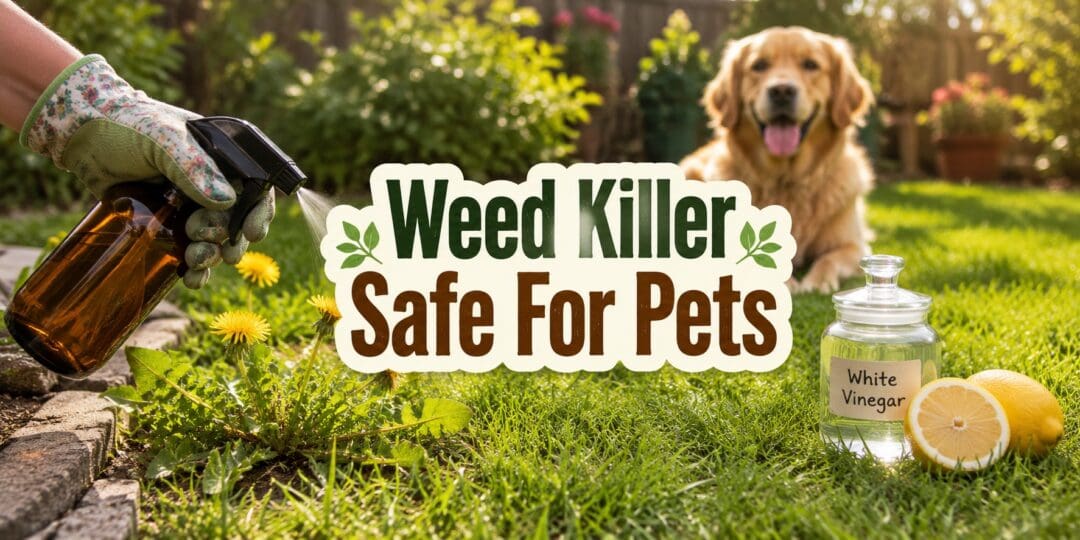
If you have dogs or cats that spend time in the yard, choosing a weed killer is not just a gardening decision. It is a safety decision. Most conventional herbicides contain chemical compounds that can harm pets through skin contact, paw licking, or ingesting treated vegetation, and the effects range from mild digestive upset to serious organ damage depending on the product and the exposure.
The good news is that effective weed control does not require toxic chemistry. There are genuinely pet-safe options, both commercial and homemade, that kill weeds reliably without putting your animals at risk. This guide covers everything you need to know: which chemicals to avoid and why, which natural alternatives actually work, how to apply them safely, and how to build a long-term weed management strategy that keeps your yard clean and your pets safe.
Why Conventional Weed Killers Are a Problem for Pets
Understanding the specific risks helps you make better decisions than simply buying anything labeled natural or organic on the front of the bottle.
Glyphosate
Glyphosate is the active ingredient in Roundup and hundreds of similar products. It is the most widely used herbicide in the world. The International Agency for Research on Cancer (IARC), a division of the World Health Organization, classified glyphosate as probably carcinogenic to humans in 2015. For pets, the risks include gastrointestinal irritation, vomiting, and diarrhea from ingestion of treated plants, and dermal absorption through paws walking on sprayed surfaces. Dogs in particular are at higher risk because they lick their paws and mouths repeatedly after contact with treated ground.
2,4-D
2,4-D is a broadleaf herbicide found in many lawn weed and feed products. Studies have linked 2,4-D exposure in dogs to an increased risk of canine malignant lymphoma. Dogs that live on lawns treated with 2,4-D show measurable levels of the compound in their urine for days after treatment, indicating significant dermal absorption through paw contact.
Triclopyr and Dicamba
These broadleaf herbicides are common in combination lawn products. Both cause gastrointestinal distress in pets at low exposures and carry more serious risks at higher doses. Triclopyr in particular has been associated with liver enzyme elevation in dogs with repeated exposure.
The Re-Entry Window Problem
Most conventional herbicide labels specify a re-entry interval, the time you should keep people and pets off treated areas. These intervals are often 24 to 72 hours, but research suggests that herbicide residues persist on grass and soil surfaces well beyond those label recommendations. A study published in Science of the Total Environment found that lawn herbicide residues were detectable on grass and in the urine of dogs living on treated lawns for weeks after application, far beyond the re-entry windows stated on product labels.
The practical implication for pet owners is that the label’s safety window may be significantly shorter than the actual risk window, particularly for pets that roll in grass, lick their paws, or spend extended time on treated surfaces.
What Makes a Weed Killer Truly Pet-Safe
A genuinely pet-safe weed killer meets several criteria beyond simply being labeled natural or chemical-free:
- The active ingredients break down rapidly in soil and do not accumulate in plant tissue that pets might ingest
- They do not cause systemic toxicity through dermal absorption at normal application rates
- They have a short or zero re-entry interval after application
- They have a documented safety profile with pets, not just with humans
With those criteria in mind, here are the options that genuinely qualify.
Pet-Safe Weed Killer Options That Actually Work
1. Acetic Acid (Horticultural Vinegar)
Horticultural vinegar is acetic acid at 20 to 30 percent concentration, significantly stronger than the 5 percent white vinegar in your pantry. It kills weeds on contact by desiccating the plant tissue. It works fastest on young, actively growing weeds in full sun and is less effective on established perennial weeds with deep root systems.
From a pet safety standpoint, acetic acid breaks down rapidly in soil, does not accumulate, and poses no systemic toxicity risk to pets once dry. The main caution is during application: full-strength horticultural vinegar is corrosive and can cause skin and eye irritation in both humans and animals. Keep pets indoors during application and for 30 to 60 minutes until the treated area is fully dry. Once dry, the area is safe.
Effectiveness: High for annual weeds and young growth. Moderate for perennials. Multiple applications needed for established plants.
Pet safety rating: Safe once dry. Keep pets away during application.
2. Iron-Based Herbicides (Selective Broadleaf Control)
Iron-based herbicides use chelated iron (ferrous sulfate or iron HEDTA) as the active ingredient. They work by overwhelming broadleaf weeds with iron, which accumulates to toxic levels in the plant while grass tolerates it naturally. This selectivity makes them ideal for lawn use: they kill dandelions, clover, and other broadleaf weeds without harming turf grass.
Iron is a naturally occurring mineral and breaks down safely in soil. At the concentrations used in these products, it poses no meaningful toxicity risk to pets. Some products in this category, such as Fiesta and Ortho Weed B Gon for Lawns, are specifically marketed as pet-safe and carry independent safety certifications.
Effectiveness: Excellent for broadleaf lawn weeds. No effect on grassy weeds or sedges.
Pet safety rating: Among the safest commercial options available. Re-entry after drying is generally considered safe for pets.
3. Citric Acid and Clove Oil Based Products
Several commercial pet-safe herbicides use combinations of citric acid, clove oil (eugenol), and sometimes acetic acid as their active ingredients. These contact killers work similarly to horticultural vinegar: they disrupt the plant’s cell membranes on contact, causing rapid desiccation. They break down quickly in soil and carry no systemic risk to pets.
Products like Natria and Green Gobbler fall into this category. They are effective on annual weeds and young growth, less so on perennial weeds with established root systems.
Effectiveness: Good for annual weeds and young growth in non-selective applications (paths, driveways, garden beds).
Pet safety rating: Safe once dry. Clove oil can cause mild irritation if pets contact the wet product, so a brief dry time is still recommended.
4. Corn Gluten Meal (Pre-Emergent)
Corn gluten meal is a byproduct of corn processing that works as a natural pre-emergent herbicide. It does not kill existing weeds but inhibits seed germination by interfering with root formation in germinating seedlings. Applied in early spring before weed seeds germinate, it significantly reduces annual weed populations over one to two seasons of consistent use.
It is completely non-toxic to pets and wildlife. Dogs will sometimes try to eat it because it smells like food, which is not harmful but worth knowing. It also adds nitrogen to soil as it breaks down, making it a dual-purpose lawn treatment.
Effectiveness: Works as prevention, not cure. Requires consistent annual application to build effectiveness. Does not affect existing weeds.
Pet safety rating: Completely safe. No re-entry interval needed.
5. Boiling Water
The simplest, cheapest, and most thoroughly pet-safe weed killer available is boiling water poured directly onto weeds. It kills the plant on contact by destroying cell structure throughout the plant including into the root zone, which gives it better knockdown on perennials than contact spray herbicides.
It has zero chemical residue, zero re-entry interval, and zero cost beyond the energy to boil the water. The practical limitations are obvious: it requires carrying boiling water outdoors, it is only feasible for spot treatment of individual weeds rather than large areas, and it kills any plant it contacts including desirable ones nearby.
Effectiveness: Excellent for individual weed spot treatment, particularly on driveways, paths, and gravel areas. Impractical for large areas.
Pet safety rating: Completely safe once the area cools. The only hazard is the hot water itself during application.
6. Flame Weeding
Flame weeding uses a propane torch to pass intense heat over weeds, destroying cell structure without chemicals. It does not require the plant to burn; brief contact with the flame is enough to cause fatal cellular damage. Weeds typically wilt and die within 24 hours.
It leaves no chemical residue whatsoever and is safe for pets immediately after use once the area has cooled. It works well on paths, driveways, gravel areas, and between paving stones. It is not suitable for use near dry vegetation, wooden structures, or in drought conditions due to fire risk.
Effectiveness: Good for annual weeds and young perennials. Multiple passes needed for established perennials. Excellent for hardscape areas.
Pet safety rating: No chemical risk. Standard fire safety precautions apply during use.
DIY Pet-Safe Weed Killer Recipes
Several effective weed killers can be made at home from ingredients that are genuinely safe for pets. These work best on annual weeds and young growth in full sun.
Basic Vinegar Spray
Mix one gallon of white vinegar (5 percent) with one cup of table salt and one tablespoon of dish soap. The vinegar and salt desiccate plant tissue and the dish soap helps the mixture adhere to leaf surfaces. This is effective on young annual weeds but will not reliably kill established perennials with deep roots. Note that the salt component can affect soil chemistry if used repeatedly in garden beds, so reserve this mix for paths, driveways, and hardscape areas.
Stronger Contact Spray
For a stronger version that approaches horticultural vinegar performance, use horticultural-grade 20 percent acetic acid (available from garden suppliers) straight or diluted to 15 percent with water. Add a tablespoon of dish soap per gallon as a surfactant. This is the closest home-mixed equivalent to commercial contact herbicides and works well on most annual and young perennial weeds. Handle with gloves and eye protection during mixing and application.
Salt and Boiling Water Spot Treatment
For persistent weeds in cracks and pavers, dissolve half a cup of salt in a kettle of boiling water and pour directly onto the weed. The combination of heat and salt is highly effective on even established weeds in hardscape settings. Do not use near garden beds or lawn edges as repeated salt application sterilizes soil.
Weed Control Without Any Herbicide: The Prevention-First Approach
The most self-sufficient and genuinely pet-safe approach to weed management is one that reduces the need for any herbicide, even a natural one, by making your yard inhospitable to weeds in the first place.
Dense Ground Cover and Thick Turf
Weeds are opportunists. They establish in bare soil, thin turf, and open gaps. A dense, healthy lawn crowds out most weed species naturally. Overseed thin areas in autumn, keep grass at the higher end of its recommended mowing height (taller grass shades the soil surface and prevents weed seed germination), and address soil compaction with aeration to improve turf density.
Mulching Garden Beds
A three to four inch layer of wood chip mulch in garden beds suppresses weed germination by blocking light from reaching the soil surface. Research from Washington State University Extension on mulching practices confirms that a minimum depth of three inches of organic mulch reduces weed emergence by 70 to 90 percent compared to unmulched beds. Refresh the mulch layer annually as it breaks down and enriches the soil beneath.
Landscape Fabric with Caution
Landscape fabric under mulch provides an additional barrier to weed emergence but has a significant long-term drawback: it degrades over time, becomes interwoven with roots, and eventually creates a maintenance nightmare. If you use it, choose a breathable woven fabric rather than plastic sheeting, and accept that it will need replacing every five to seven years.
Hand Pulling and Hoeing
For a small yard or garden, regular hand pulling of weeds before they set seed is the most sustainable long-term strategy. A sharp hoe used weekly in dry weather on young weed seedlings is remarkably effective and adds no chemistry to the environment whatsoever. The key is timing: pull or hoe before weeds flower and set seed, and you interrupt the reproduction cycle that keeps weed populations high year after year.
How to Apply Any Weed Killer Safely When You Have Pets
Even with a genuinely pet-safe product, application practices matter. These guidelines apply regardless of which option you choose:
- Apply on calm days with no wind to prevent drift onto areas where pets rest or play
- Keep pets indoors during application and until the treated area is fully dry, even with natural products
- Apply in the morning so the product dries completely before pets are let out in the afternoon
- Avoid applying before rain, which can spread herbicide residue across larger areas
- Treat weeds individually rather than blanket-spraying entire lawn areas where possible
- Rinse your pet’s paws after outdoor time if they have been in recently treated areas, as a precaution regardless of product used
- Store all products, including natural ones, out of reach of pets; concentrated acetic acid is corrosive
What to Do If Your Pet Is Exposed to Weed Killer
Even with the best precautions, accidental exposure happens. Knowing what to do in advance is part of responsible pet ownership.
For skin or paw contact with any herbicide, wash the affected area immediately with mild soap and warm water. For eye contact, flush with clean water for several minutes. If your pet has ingested treated vegetation or the product itself, contact your veterinarian or the ASPCA Animal Poison Control Center immediately.
The ASPCA Animal Poison Control Center maintains a 24-hour hotline at (888) 426-4435 and can advise on specific products and exposure levels. Have the product name and active ingredients ready when you call. If you used a homemade or natural product, knowing the concentration of acetic acid or other active ingredients helps them assess the risk accurately.
Building a Long-Term Pet-Safe Yard Management System
The most effective approach is not finding a single product and using it exclusively but building a layered system that reduces weed pressure year over year while keeping your yard safe for animals at every stage.
In spring, apply corn gluten meal as a pre-emergent before weed seeds germinate. Keep lawn areas thick and well-fed so grass out-competes weeds naturally. Use iron-based selective herbicide for any broadleaf weeds that establish in lawn areas. In garden beds, maintain a thick mulch layer and hand-pull anything that breaks through. For paths, driveways, and hardscape, use horticultural vinegar or flame weeding for spot treatment as needed.
Over two to three seasons of this approach, weed pressure drops significantly. The work shifts from reactive treatment to light maintenance, and the chemical load on your yard approaches zero. Your pets benefit from that reduction in every walk, every roll in the grass, every afternoon nap in the sun.
Create a Safer Homestead the Old-Fashioned Way
Keeping weeds under control without exposing your pets to harsh chemicals is just one example of the practical wisdom our grandparents relied on every day. The Amish Ways Book is filled with time-tested methods for natural home care, gardening, food preservation, cleaning, and self-sufficient living that help you reduce your dependence on modern chemicals while creating a healthier home for your entire family—including your four-legged companions.
👉 Discover The Amish Ways Book and learn the traditional skills that still work today!
Final Thoughts
Finding a weed killer safe for pets is not about finding a magic product that does everything conventional herbicides do without the risk. It is about understanding which tools work for which jobs, applying them thoughtfully, and building a yard environment where weeds have less opportunity to establish in the first place.
Iron-based herbicides and horticultural vinegar handle the majority of weed problems effectively and safely. Corn gluten meal reduces the problem before it starts. Boiling water and flame weeding handle hardscape spots without any chemistry at all. Combined with a thick lawn, well-mulched beds, and a weekly walk-through to pull anything that establishes, these tools give you a clean, productive yard that your dogs and cats can enjoy without you worrying about what they are walking through.
That is the self-sufficient approach to yard care: fewer inputs, more knowledge, better outcomes.
You may also like:
Join Our Facebook Group For Weekly Homesteading Advice
The 4 Valuable Antibiotics BIG PHARMA Doesn’t Want You To Stockpile (Video)
The Vinegar Weed Killer Recipe Every Homesteader Should Know
RM43 Weed Killer – What It Does And Why Many Homesteads Are Choosing Another Path
The Weeds in Your Backyard You Should Start Eating Today